


Narnia is my second home.
I grew up on C.S. Lewis’ classic children’s books, The Chronicles of Narnia. Sometimes, on lazy summer days, I’d reread one in an afternoon. The Last Battle was the first book that made me cry. The Silver Chair was the first book that made me think about faith and doubt. The Magician’s Nephew was, perhaps, the first book that made me want to be a writer.
I thought that Disney’s three films based on The Chronicles of Narnia were fine. But for me, they didn’t quite capture the power, humor and resonance of the books. So when I heard that Greta Gerwig would be bringing Narnia to Netflix, I was thrilled to journey through the wardrobe once again. Gerwig is a talented director who knows something about Christianity. Her Oscar-nominated film, Lady Bird, has some difficult, R-rated content—but it was also a surprisingly sweet and sympathetic depiction of faith, too. (You can read my interview with Gerwig about Lady Bird here.) And she, like me, is a bit of a Narnia geek.
“I’m slightly in the place of terror because I really do have such reverence for Narnia,” she told BBC Radio 4. “I loved Narnia so much as a child, [and] as an adult, C.S. Lewis as a thinker and a writer. I’m intimidated by doing this.”
I sympathize. But now—with Gerwig’s version of The Magician’s Nephew now set for release on Feb. 12, 2027, I’m not so sure what to think. Here’s why.
Puzzle-d
In the movie Project Hail Mary, scientist Ryland Grace tries to communicate with an unusual helpmate, endowing it with a variety of voices. He even tries out Meryl Streep’s voice at one point. “She can do anything,” Grace sighs.
And that’s almost true. Almost.
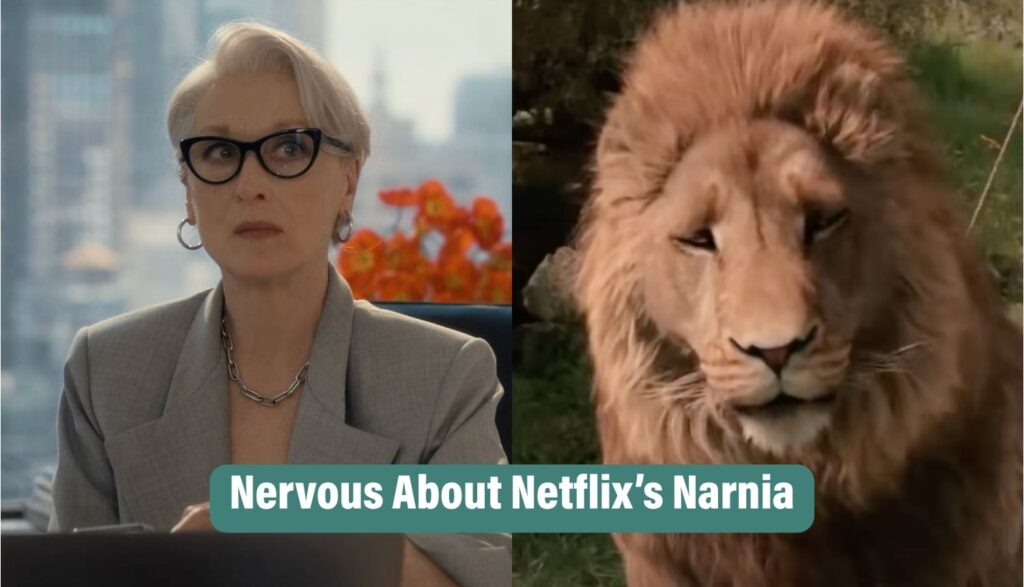
Last April, rumors started swirling that the Oscar-winning actress would be voicing Aslan, Narnia’s great lion, in Gerwig’s adaptations. While those rumors have never been confirmed, a partial cast list for The Magician’s Nephew was revealed earlier this month, and Streep is indeed on the list (along with other A-listers such as Daniel Craig and Carey Mulligan).
Is Streep going to be voicing Aslan? We just don’t know. But if she is, that’s a problem.
As you likely know, C.S. Lewis wasn’t just a children’s author. He’s perhaps best known as one of the 20th century’s greatest Christian apologists, helping many folks reconcile faith with reason. And for Christians, his Narnia books come with an unmistakable Christian heartbeat. You don’t need to be a Christian to enjoy Lewis’ adventure yarns—but it adds additional layers of meaning and resonance.
Aslan, son of the Emperor-Beyond-the-Sea, is Narnia’s avatar of Christ. The great lion says so (in so many words) in The Voyage of the Dawn Treader. “In your world, I have another name,” he tells one of Narnia’s visiting humans. “You should know me by it. This was the very reason why you were brought to Narnia, that by knowing me here for a little, you may know me better there.”
Obviously, switching the gender of Aslan from male to female—even if that female has won three Academy Awards—will be sure to infuriate a great many Christians and limit the movie’s appeal.
But even if you set aside those faith-based concerns, a Streep-as-Aslan casting decision just doesn’t make narrative sense.
Not Safe, But Good
Narnia is, obviously, another world—very different from the one we inhabit. Animals can talk. Horses can fly. Lamp posts grow right out of the ground. (Or, at least, one did.) As such, God’s interactions with such a world would look different from God’s interactions with ours. Thus, Narnia’s savior takes the form of a lion, not a man.
Certainly, many would say this is not theologically correct, at least if we interpret Genesis 1:27 literally. That verse tells us that we people (“male and female,” according to the Bible) were created in God’s own image, and we don’t look a thing like lions. Those big cats are products of the sixth day of creation, not the seventh. But no matter: Most Christians don’t have a problem with Lewis’ characterization of Aslan. Imaginary worlds get a lot of theological leeway.
But when you’re working in someone else’s imaginary world, you should adhere to its own rules. Narnia was created by C.S. Lewis. And Lewis wrote Aslan in as, not just a lion, but a male lion.
I think that Lewis wrote Aslan as such because of his mane. That mane serves as both a crown and halo for Lewis, a symbol of authority, a golden reflection of the sun. Characters lucky enough to sink their faces into that mane feel comfort, power and peace. And if they’re lucky enough to ride on Aslan’s back, they hold onto that mane for dear life.
And that mane takes on special significance when we hit the most famous Narnia book of all: The Lion, The Witch and the Wardrobe. It becomes not just a symbolic crown, but—like Christ’s own crown of thorns—a symbol of sacrifice.
When Aslan chooses to lay down his life for a traitor (Edmund Pevensie), the lion’s mortal enemy, the White Witch, shaves off Aslan’s mane. It’s an act intended to mock and humiliate the lion, a vindictive exclamation point for the Witch’s supposed victory. And it’s telling that when Aslan rises from the dead (as he does), the mane has grown back. The lion’s majesty and power have been restored.
That mane is a key element in Aslan’s character, both literary and theological. Turn Aslan into a female lion, and the mane is stripped away. And with it goes so much of the story’s power and pop. What the White Witch failed to do, Netflix might try to do again—without any real vindictiveness, but without real purpose or reason.
Again, setting aside the theology for a moment, Aslan without a mane ceases to be the Aslan that Narnia fans know and love. And a Narnia without Aslan—without that Aslan—ceases to be Narnia at all.
Greta Gerwig is, as I said, a very talented director. She appreciates the chronicles, she understands the stakes, and I’m sure these thoughts are not alien to her. But I hope, for the success of her project, that the Streep-as-Aslan rumors are untrue. Narnia deserves its ultimate savior and symbol, golden mane and all.
For more on Narnia, check out Plugged In’s Rewind on The Chronicles of Narnia: The Lion, the Witch and the Wardrobe.

6 Responses
“Obviously, switching the gender of Aslan from male to female—even if that female has won three Academy Awards—will be sure to infuriate a great many Christians and limit the movie’s appeal.”
I don’t remember a big upset when the devil was portrayed as androgynous in “The Passion of the Christ” (at least not from the Christian right—I do remember the film being characterized as some variant of homophobic because of that, cf. criticisms of “300”) and was played by a woman, Rosalinda Celentano.
Also, if I may make a minor correction:
“Her Oscar-winning film, Lady Bird”
I love love loved Lady Bird, but it didn’t win any of the Oscars it got nominated for.
Erik, you’re right–thought Laurie Metcalf snagged one, but we’ll get that corrected.
The Percy Jackson series: “Hey let’s stir up some controversy by casting Athena as black.”
The Narnia series: “Hold my beer.”
Asking a woman to play the part of a man (or vice versa) is a bad idea regardless of what script you’re using.
Having a woman play Aslan is a hate crime against Christianity
I always thought the best books were the ones that did not get made into films. The Horse and His Boy, The Magician’s Nephew, and The Last Battle were all incredible. Even with all of their greatness, I would much rather they just had no films forever than have them made into bad films. Aslan should not be female. Period.
Also, why is Gerwig making The Magician’s Nephew first? I don’t care as much as some people do as to what order the books are read in, but you absolutely cannot read The Magician’s Nephew before The Lion, the Witch, and the Wardrobe!