Newman Center Chapels Embrace Traditional Architecture
Young people on these campuses say they desire to encounter the faith and to evangelize through beauty and in accordance with the tradition of the Catholic Church.

Overflowing chapels and packed student centers present a happy problem for thriving Catholic communities on college campuses.
As these growing Catholic communities demand more space for worship, Newman Centers have turned toward traditional architecture when expanding to accommodate the numbers. Chapels constructed over the course of the past decade feature Gothic and Romanesque architecture — bell towers, arches and spires — as well as sacred art, mosaics and iconography inspired by both Western and Eastern traditions.
Young people on these campuses say they desire to encounter the faith and to evangelize through beauty and in accordance with the tradition of the Catholic Church.
St. Mary’s Catholic Center | Texas A&M University | College Station, Texas | Studio Io Liturgical Design and Brown Reynolds Watford Architects | Dedicated July 2023
Home to one of the largest Catholic student ministries in the country, the new church for St. Mary’s Catholic Center seats more than 1,500 people and is intended to serve as a catechetical and evangelization tool. Three words guided the building project: beauty, encounter and tradition.
“We can argue about truth, we can argue about what is good, but usually beauty is something that is outside of us,” campus minister Keven Pesek said. “It arrests us, captivates us. The desire was for someone to come into the church and to be struck dumb, to be made to be still.”
Consistent with Byzantine Romanesque and Spanish Colonial vernacular brick style, St. Mary’s unites Eastern and Western architectural styles to reflect the universality of the Church. The brick structure also resonates with the Academic Eclecticism movement in Texas in the early 20th century and corresponds to important buildings on the university campus and in the Northgate historic district, where the church is located. The distinctive bell tower calls back to the old Spanish missions in the region.
The baptistry provides one of the most notable features on the interior of the chapel, according to liturgical designer Michael Raia. Designs painted on the ceiling coffers above the baptismal font and adjacent seating depict the six days of creation, the Incarnation, the Paschal mystery, and the Trinity, and the gates around the lower font feature scenes from the Order of Baptism. Artistic links between the baptismal font and the altar help tell the story of salvation history from Genesis to Revelation.
“In material, alignment, and in design — peacocks symbolizing eternity flank the font and likewise the altar and tabernacle in the reredos — the font and the altar are linked together,” Raia said. “A similarly sized octagon to the font is inscribed in the floor at the termination of the center aisle where heaven kisses earth in the liturgy, especially in the reception of Holy Communion that is our foretaste of the heavenly banquet.”
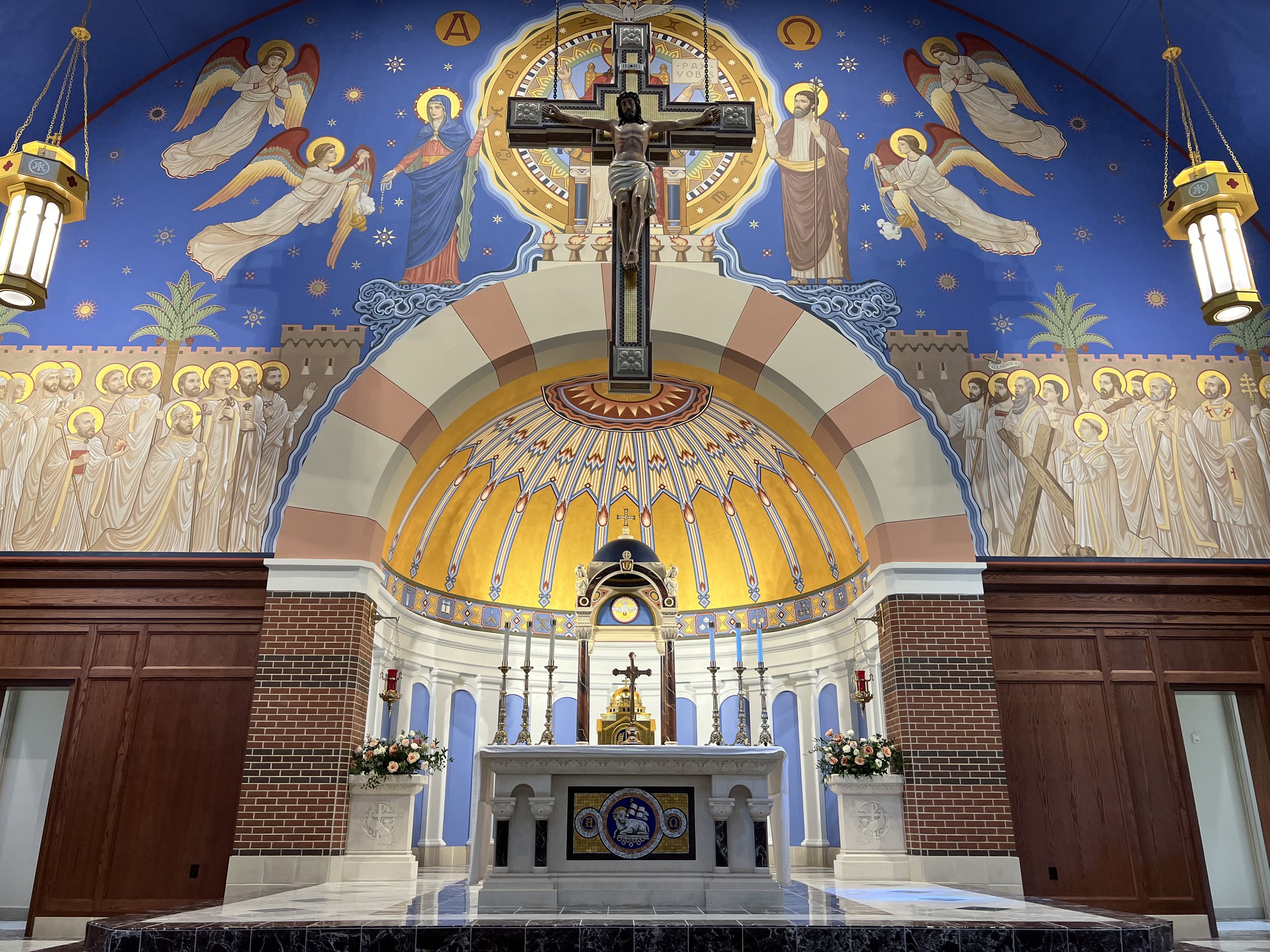
St. Thomas Aquinas Church and Newman Center | University of Nebraska-Lincoln | Lincoln, Nebraska | Clark Architects Collaborative 3 and James McCrery | Dedicated April 2015
The new chapel at St. Thomas Aquinas Church and Newman Center approximately doubled the square footage of the previous 1960s structure, increasing seating from 325 to 640 to better accommodate the thriving Catholic community at the University of Nebraska-Lincoln. Those behind the project wanted the church to be functional but also beautiful to draw people in, according to St. Thomas Aquinas pastor Father Ryan Kaup.
“Classical architecture stands the test of time and I think by 2015 we had recognized that modern architecture didn’t mix well with churches, evidenced by many buildings built in the later part of the last century,” Father Kaup said.
Designed in the English Collegiate Gothic tradition but incorporating Romanesque elements, the red-tone brick chapel appears both distinctly Catholic and American. With a cruciform plan and a crossing drum, the chapel also includes a bell tower visible from a distance in the Lincoln skyline.
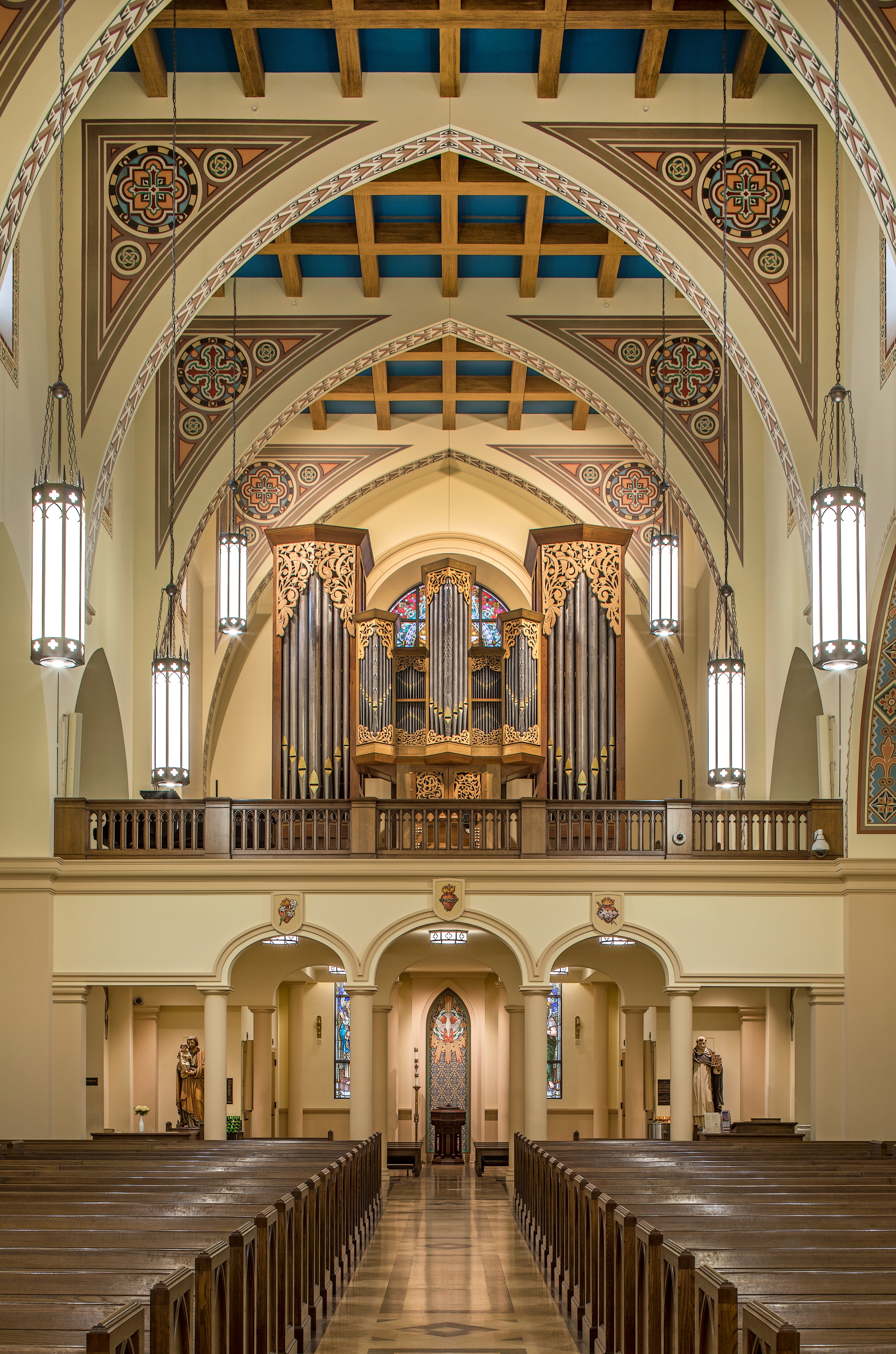
Inside, an arcade of Doric columns line the nave of the chapel, and the sanctuary houses antique altars, ambo, reading stand and presidential chairs acquired from Ohio and England, according to Clark Architects.
“One of my favorite parts of St. Thomas Aquinas Newman Center is the saints lining the sides of the church and filling the stained-glass window behind the altar,” rising senior Dylan Kluthe said. “It reminds me that they are actively present in our lives, praying for us, teaching us how to pray, and showing us how to live the abundant life.”
The stained-glass windows, designed and crafted by Franz Mayer of Munich in Germany, follow a classic style but incorporate modern saints. The large stained-glass window behind the high altar depicts Christ the King reigning in glory.
“Having a space like this creates a community centered on prayer, drawn so closely to the heart of the Father, where everything begins with a relationship with him,” Kluthe said. “And honestly, the beauty of the church speaks for itself. People walk in, even if they’re not Catholic, and they’re struck by it. That beauty helps them feel the gravity of what’s happening here, and something in them longs for it.”
St. Isidore’s Catholic Student Center | Kansas State University | Manhattan, Kansas | Clark Architects Collaborative 3 and Bruce McMillian Architects | Dedicated January 2023
Constructed in native Kansas limestone and designed in a Gothic style, St. Isidore’s Catholic Student Center embraces the agricultural roots of the college and region while lifting students’ hearts to God. The project began when the Catholic student body outgrew the old chapel.
“When I was a freshman, it was a roll of the dice whether you would actually be able to get to sit in the church, or if you would have to sit in one of the four overflow spaces,” said Ridge Pinkston, assistant pastoral minister for St. Isidore’s. “It was simply too small.”
The community needed more space. But when the staff at the Newman Center asked students what they wanted in a new church, they consistently asked for a traditional Catholic church.
Graduating senior Kate Weisner said she and other students on the building committee wanted to have a beautiful space that displayed the tradition of the Catholic Church and drew attention to Christ on the altar.
“It’s so wonderful as a student who wants to evangelize — K State is my mission field — to say, ‘Hey, come to a beautiful church,’ not ‘Come to a cafeteria,’” Weisner said.
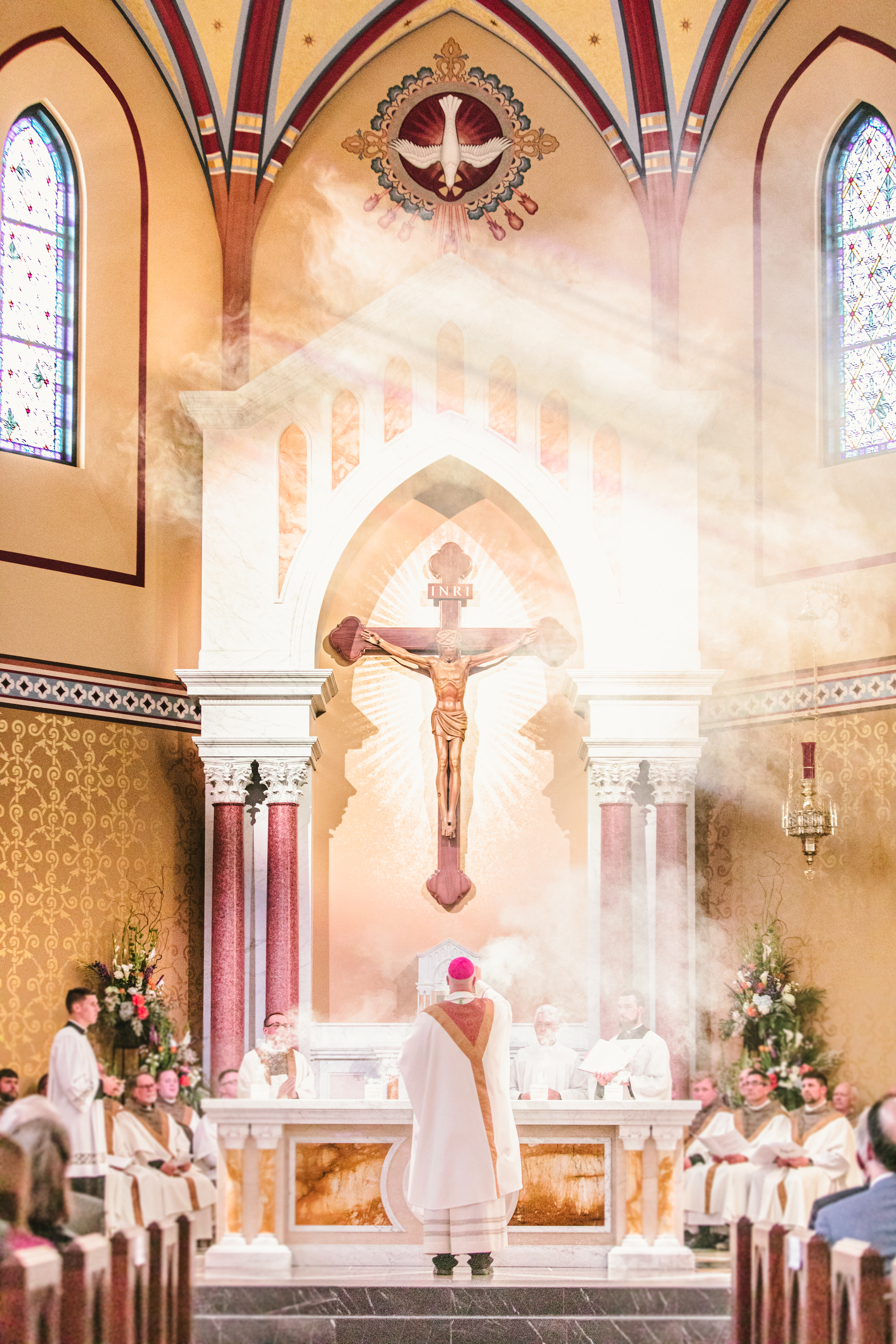
On the interior of the church, vibrant colors represent the earthly meeting the transcendent. At eye-level, browns, greens and yellows evoke the Earth, and motifs of garden imagery signify life and abundance. Upwards, whites, blues and golds evoke the celestial. The pillars lining the nave have a brown, soil-colored hue, a nod to the importance of agriculture to the region.
Each college of the university is represented by a patron saint in the stained-glass windows lining the church, according to Weisner. The gold-coated sanctuary immediately draws the eye. Around the sanctuary, the wallpaper shows gold vines on a gold background.
“We’re essentially coating the altar, the holy of holies, in this beautiful precious material, but also in a way that evokes the idea of life-givingness,” Pinkston said. “Through the sacrament of the Eucharist, life is received and given. And we wanted to invoke that in the art on the altar.”
St. Paul’s Catholic Student Center | University of Wisconsin-Madison | Madison, WI | RDG Planning & Design | December 2017
The first Catholic chapel at a secular university in the United States and the original center of the Newman movement, St. Paul’s University Catholic Center stands at the heart of the campus of the University of Wisconsin-Madison and dates back to 1883.
The third Catholic chapel on the site, the new Italo-Byzantine-style chapel and student center replaced a 1960s Brutalist structure. On the exterior, the church features a giant, colorful mosaic of the Crowning of Mary, inspired by the apse mosaic of the Basilica of Saint Mary Major, the resting place of Pope Francis’ earthly remains as well as other pontiffs, in Rome.
“St. Paul’s is here for one reason: to reach out and to attract students, welcome them in and offer the eternal truth that is Jesus Christ,” Director of Advancement Samuel Larson said. “With that, beauty attracts. We wanted to right away have that big mosaic to catch the attention and to draw people in.”
The new building borrows from the Romanesque revival of the first quarter of the 20th century and takes inspiration from the three major basilicas in Rome, combining ancient and modern in a “new traditionalism,” according to a description by architect Randall Milbrath and liturgical designer Matthew Alderman.
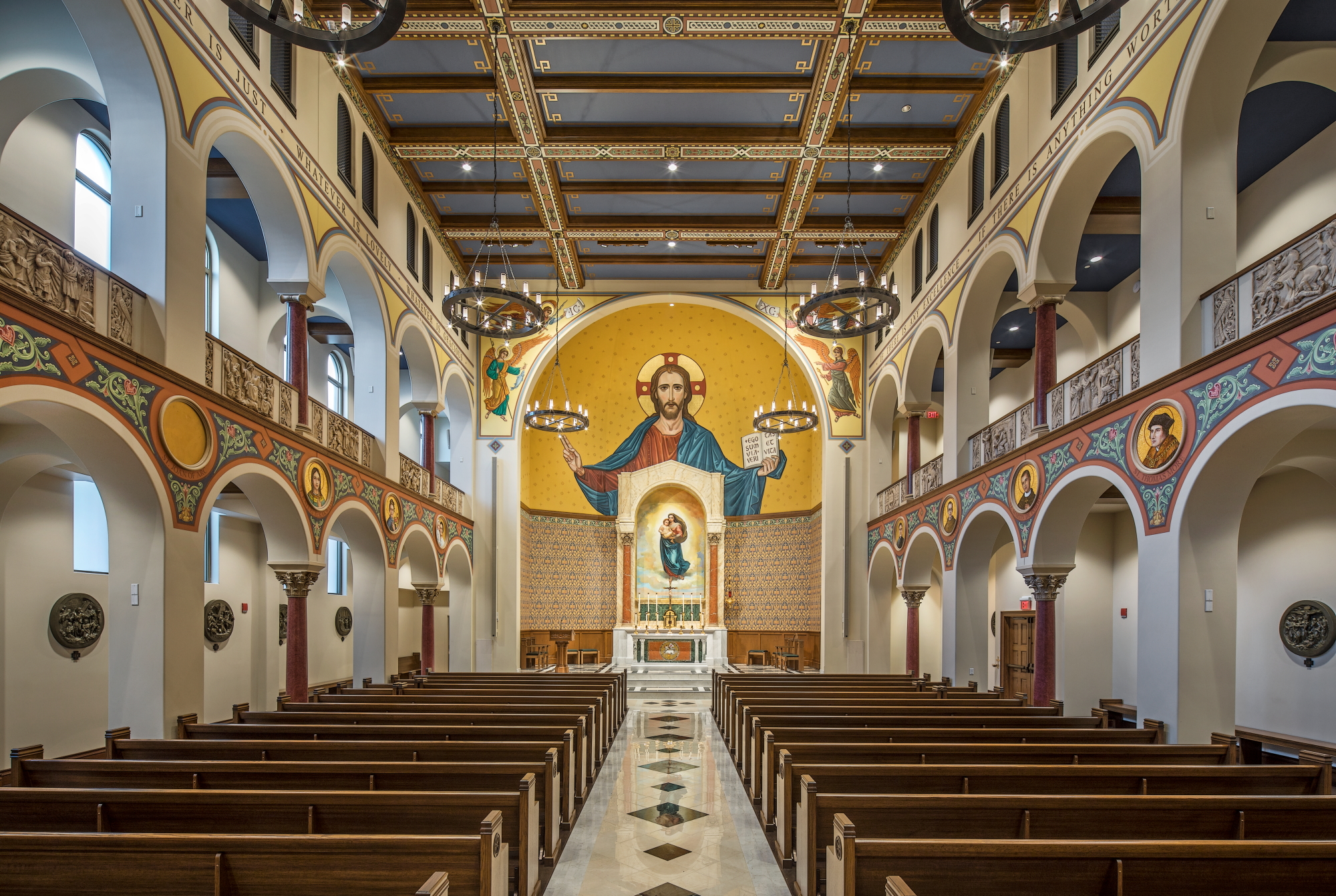
Mosaic portraits lining the arcade on the inside of the church depict saints chosen by students and closely interwoven with their lives, including Sts. Gianna Molla, Thomas More and Josemaría Escrivá. Two images of Jesus set against each other look down from above the altar. An image of Mary holding Baby Jesus sits just below a massive image of Christ Pantocrator, King of the Universe. Four angels depicted on the arch leading into the sanctuary point toward the altar.
Larson said, “Every single little detail throughout the chapel is meant to lift the heart and the soul and the mind of the students to God because it’s at the chapel that you encounter the transcendent truths of everything,” Larson said.
Our Lady of Wisdom Church & Catholic Student Center | University of Louisiana-Lafayette | McCrery Architects | In Progress
The new chapel and Newman Center for the Ragin’ Cajuns is designed to feel like home.
Architect James McCrery designed the Gothic church in a style inspired by the Vendée region of France, where early immigrants to Louisiana originated. For the student center, McCrery mirrored the Acadian style of south Louisiana, developed by local architect A. Hays Town during the 20th century.
With support from the university community and beyond, the Catholic center has raised $28 million toward its $35-million goal for the project. After a ceremonial groundbreaking in November 2024, builders began moving dirt for the new chapel in March.
Based on feedback from students in the university’s Catholic community, the building committee wanted to design a Newman Center that would feel like the 10,000 Catholic students’ second home, according to Mary Hernandez, executive director of advancement for Our Lady of Wisdom.
The new church will return to a traditional orientation, said chaplain Father Patrick Broussard. The acoustics of the structure are designed to accommodate both singing and the spoken word, and the two side altars of the cruciform structure will be dedicated to Christ the King and St. Thérèse of Lisieux. Most importantly, the tabernacle will be placed in the center of the sanctuary behind the altar of sacrifice.
Father Broussard said he wants those who enter the church to be drawn in by its beauty.
“I just hope that when people go in there that they immediately have this experience of the transcendent God that draws them in and draws them up.”
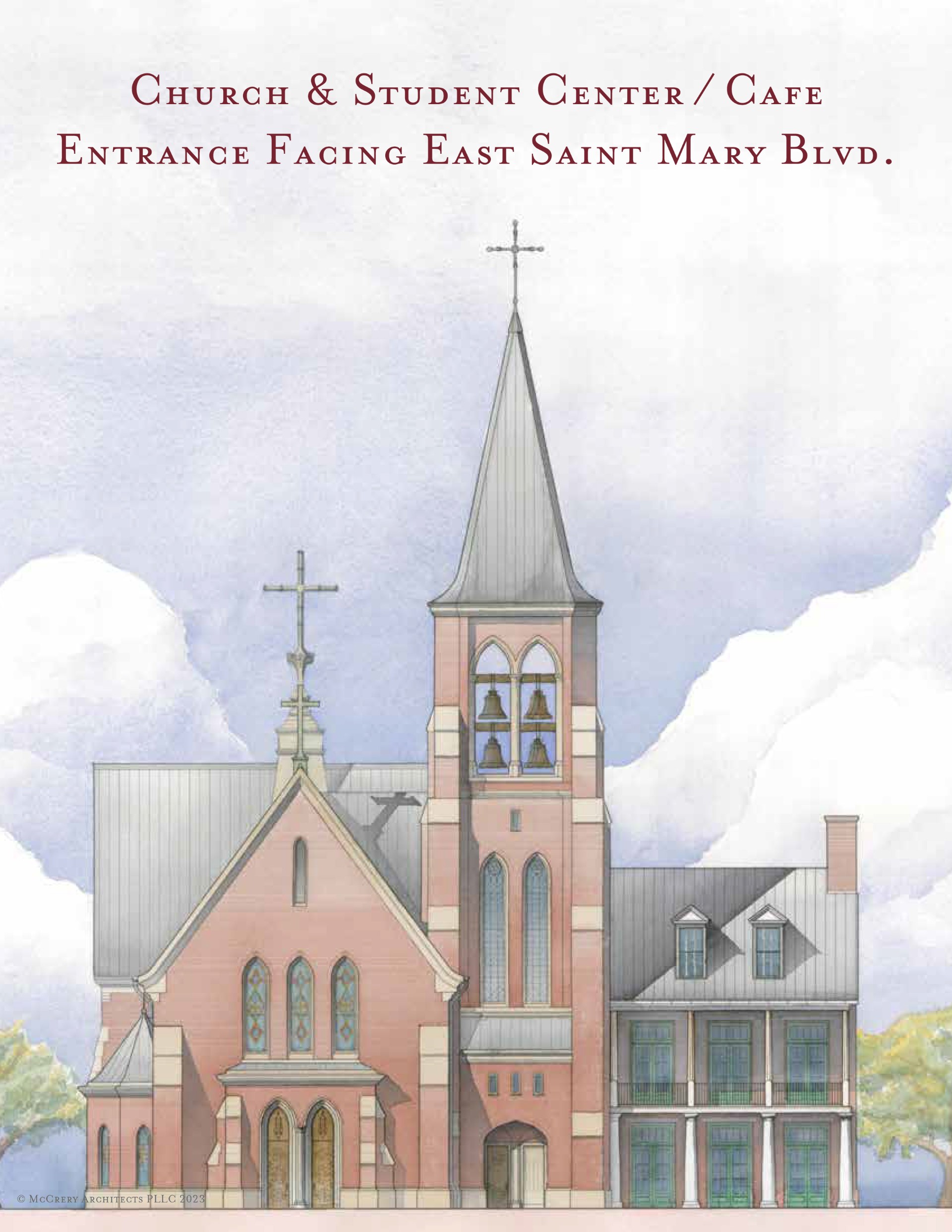
St. Thomas More Catholic Church | University of South Carolina | McCrery Architects | Fundraising
A converted three-car garage currently serves as the chapel for the St. Thomas More Newman Center at the University of South Carolina. If fundraising is successful, campus ministry will soon build a traditional cruciform church near campus to provide a better and more beautiful space for the growing number of Catholic students at the university. Flanking the church on both sides, the new Newman Center will include lecture and gathering spaces, study rooms, staff offices, and a rectory.
“Space is the greatest need — it really is,” Thomas More Director of Development Katie Washington said.
The expansion plan was originally the vision of Father Marcin Zahuta, the former pastor at St. Thomas More who passed away unexpectedly in 2020. The current pastor, Father Rhett Williams, continued in his predecessor’s footsteps when he took over the chaplaincy in 2020. He began recording Mass attendance numbers to track the Catholic community’s growth. In spring of 2021, 500 students attended Ash Wednesday services. This year, 2,013 students attended across five Masses, three of them held in the university’s student union for lack of space in the chapel.
While some aesthetic decisions for the interior have yet to be made, the proposed church will seat 500 students in the main nave and include a large side chapel and an adoration chapel in the transepts. The design ensures every seat in the church has an unobstructed view of the altar, according to Father Williams.
“Sometimes the columns get in the way of certain seats,” Father Williams said. “We kept the basilica form of the nave and the two side aisles, but we moved all the seats inside the columns.”
It was important to the community that the church follow a cruciform plan, according to Father Williams.
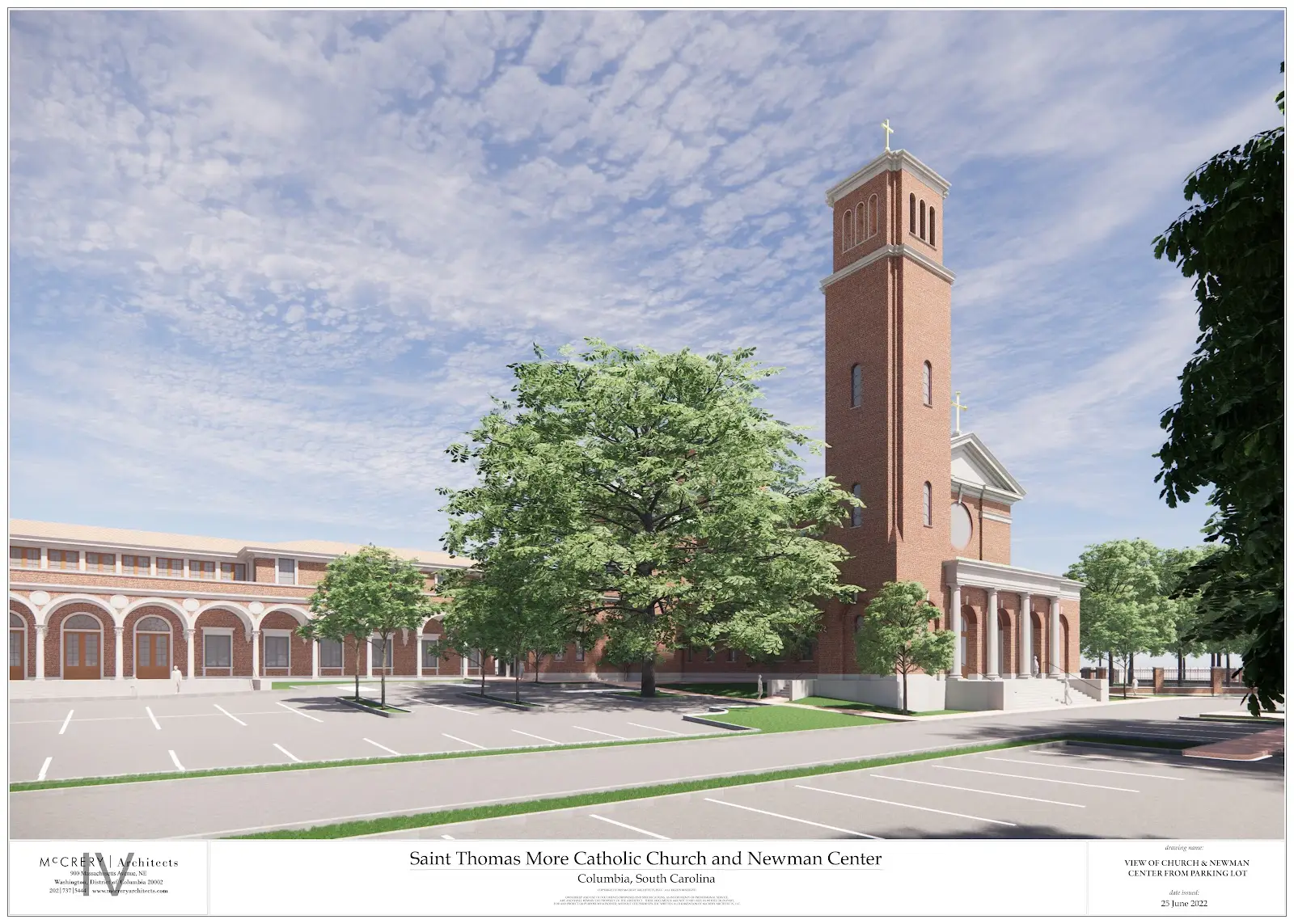
“The church is representative of the body of Christ … and so the church being cruciform gives it that sense,” Father Williams said. “The apse being the head, the transepts as the arms, the body as the nave. We wanted to keep that so that it’s a very visible symbol when it’s seen from the air or from the distance — they can see that cross form.”
A circular drum with windows will provide height and light to the space. Statues of the saints and stained glass will fill the church, and a few smaller side chapels will give students quiet places to pray alone in silence.
“[Hopefully] they can get lost in a little chapel and pray,” Father Williams said, adding that “it gives them a space to go and be with the Church universal and pray.”
Moira Gleason is a journalism student from Hillsdale College.
- Keywords:
- newman centers
- sacred architecture