CHINA
IN EARLY July a report in the Southern China Morning Post featured the headline “China is working on a new fighter jet for aircraft carriers to replace its J-15s”. The report at first sight was not unusual and a number of predominantly Western news agencies eagerly picked it up. However, what was surprising was the reason given for the ongoing work. No mention was made that the People’s Liberation Army Navy and especially its carrier force has a longstanding requirement for a new fifth type of carrier-borne fighter, but rather an allegation that, “China’s People’s Liberation Army Navy has been frustrated with the performance of its J-15 Flying Shark carrier-based air superiority fighter, and has sought to retire the type in the near future in favour of a more reliable and lighter aircraft.”
Chinese press claims The Southern China Morning Post quoted a military expert who claimed: “The task has become more pressing after a series of mechanical failures and crashes, as Beijing tries to build up a blue-water navy that can operate globally.”
At least four J-15 crashes have killed one top People’s Liberation Army Navy Aviation pilot and injured another. Only two accidents have been reported by the media.
One source told the Post: “The J-15 is a problematic aircraft - its unstable flight control system was the key factor behind the two fatal accidents two years ago,” and concluded that with a maximum take-off weight of 33 tonnes (72,750lb), the J-15 is the heaviest active operational carrier-borne fighter in the world.
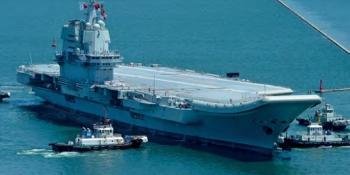
That fact alone however, is not the problem. In contrast to US supercarriers, China’s Liaoning (CV-16) is much too small for such a heavy fighter.
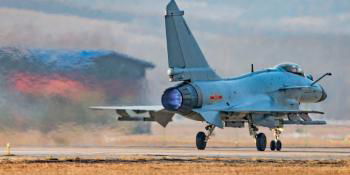
J-15: the Flying Shark Shenyang’s J-15 is China’s only carrier-borne multi-role fighter. The type is based on the Russian Sukhoi Su-33 airframe with the same Chinese avionics, flight control system, radar and weapon systems used in the J-11B fighter, but J-15 comprises more composite materials to reduce weight.
China acquired Su-33 prototype T-10K-7 (and not T-10K-3 as usually reported) via Ukraine in the 2001 timeframe. The aircraft was used for extensive study and reverse engineering for developing an indigenous version designated the J-15.
Following the J-15’s maiden flight in 2009, and conclusion of its subsequent flight-test phase, in 2013 the first batch of J-15s were handed over to the Naval Aviation’s Carrier Fighter Group; in total, 24 were delivered. Since late 2014, J-15s have been regularly deployed aboard the Liaoning; at least two have been lost and two more damaged, which have both been rebuilt.
Besides the standard J-15 there is a CATOBAR-capable version under development, often called J-15A. This features a typical catapult nose landing gear, and a prototype – known as the J-15T – was flown for the first time in July 2016. Since November 2016, the aircraft has undertaken testing of both an electromagnetic and steam catapult at the Huangdicun catapult-test site.
A third naval variant, the two-seat J-15S has been under development since 2011, with at least two – maybe three – prototypes built. However, the most recent reports suggest the J-15S programme was merged with the J-15D electronic warfare variant into a single type allegedly designated the J-17. Why a two- seat version? To serve not only as a trainer but also as a dedicated multi-role electronic attack aircraft comparable to US Navy EA-18G Growlers.


Given the number of J-15 accidents over the years, could these accidents be related to systemic and unfixable flaws which have only recently manifested themselves? Probably not given the vast experience Shenyang has in reverse engineering and manufacturing indigenous variants of the Flanker fighter. Though this reasoning has repeatedly been reported in Chinese media, it seems a lame argument that such flaws were inherited because Chinese engineers have overlooked design deficiencies or left them unrectified when reverse engineering a prototype Su-33. If there were flaws with the airframe or the flight control system, it’s certain that the entire fleet would have been permanently grounded, and new variants would not have been developed or produced.
More likely reasons…
The reported J-15 accident rate in recent years should not be considered as a programme failure; many F-14 Tomcats were lost in accidents during the type’s extensive service career, yet the F-14 remains one of the most capable carrier-borne fighters to date.


A dramatic increase in the frequency and complexity of flight J-15 operations inevitably increase the likelihood of and the cause of more accidents, coupled with the People’s Liberation Army Navy Aviation’s limited six-years of experience of carrier operations. Nor does the People’s Liberation Army Navy Aviation have a dedicated trainer for deck landings or catapult launches meaning the step up for trainee pilots from the JL-9 trainer to the J-15 is a tremendous one.
Given the weight and size of the J-15, the Chinese Liaoning- class carrier is small bearing in mind that the original Su-33 was intended to be operated by the Soviet Navy from larger Ulyanovsk class supercarriers using the once foreseen catapult launch systems to exploit the fighter’s full potential. The J-15’s full potential will only be realised in the future when operated from the larger Type 003 carrier, currently under construction at Shanghai.


Consequently, the J-15 and the J-17 electronic warfare variant, unveiled earlier this year, are clear testimony of the People’s Liberation Army Navy Aviation’s faith in its J-15 Flying Shark. Catapult capable and active electronically scanned array radarequipped J-15As armed with the latest PL-15 and PL-10 air-to-air missiles will give Chinese carrier strike groups a capability perhaps comparable to the US Navy’s F/A- 18 Super Hornets and EA-18G Growlers and possibly greater performance.
It’s unlikely the J-15 will be retired from People’s Liberation Army Navy Aviation service anytime soon, but even more likely that the type will eventually make full use of its long-range and payloads, and play a crucial role alongside any potential future type for many years to come; all the J-15 lacks is stealth.

Future fighter
No decisions appear to have been taken about the People’s Liberation Army Navy Aviation’s next carrier capable fighter although Chinese media reports suggest the service is pressing for a decision. Contending designs under consideration are from Shenyang and the 601 Institute (allegedly the FC-31 V3) and another from Catic and 611 Institute (either a J-20- based design or a new type).
Recent reports suggest the FC-31-based design has the edge because it is slightly smaller and lighter than the J-15. The Post’s report did, however, fail to mention that the requirement for a next generation carrier-borne fighter had been in the oing for several years before the fatal J-15 crash occurred. The headline quoted at the start of this feature would have been more surprising if China was not already developing a new carrier-borne fighter. The headline could be seen as a prime example of how semi-oicial Chinese media reports should be interpreted. Whether it’s objective was to deliberately misinform the public is another question.