
 Sign in with Facebook
Josh's Reviews > The Score: How to Stop Playing Somebody Else's Game
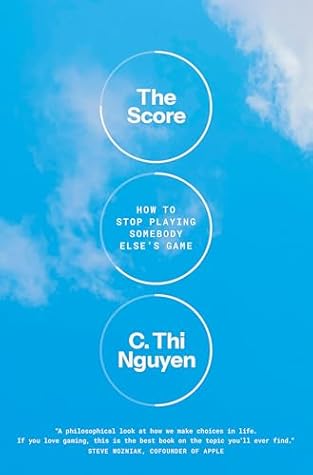
The Score: How to Stop Playing Somebody Else's Game
by

by
C. Thi Nguyen sets out with a genuinely compelling question: Why do scoring systems in games bring us joy while metrics at work leave us hollow? Unfortunately, The Score never really answers it. Instead, the book meanders through philosophical abstractions that romanticize ambiguity as if vagueness itself were a virtue. At times it reads less like philosophy and more like an extended shrug—celebrating the beauty of not knowing what we truly value while offering little guidance for those of us actually trying to navigate a world saturated with KPIs and performance reviews.
The structure feels scattered. One chapter dives into rock climbing aesthetics, the next into bureaucratic value capture, then suddenly we're analyzing cookbook instructions. These vignettes might have worked with grounding interviews—real people wrestling with metrics in their actual lives—but Nguyen largely stays in the theoretical ether. I kept waiting for the concrete examples that would bridge his ideas to lived experience. They never arrived.
Most frustrating is the bait-and-switch at the book's core. The premise promises insight into why game scores energize us while workplace metrics drain us. But Nguyen sidesteps the real answer: games offer voluntary constraints with immediate feedback and intrinsic rewards, while workplace metrics are imposed with delayed, extrinsic rewards tied to survival. Instead of excavating this distinction, he retreats into poetic musings about "choosing your game"—advice that rings hollow when your mortgage depends on playing the game your employer designed.
There are glimmers of insight here, particularly around how metrics flatten complex values into countable proxies. But these moments get buried under layers of academic preening and an almost willful refusal to land a point. A book about scoring systems shouldn't itself feel unmoored from any clear metric of success. The Score fails its own test.
The structure feels scattered. One chapter dives into rock climbing aesthetics, the next into bureaucratic value capture, then suddenly we're analyzing cookbook instructions. These vignettes might have worked with grounding interviews—real people wrestling with metrics in their actual lives—but Nguyen largely stays in the theoretical ether. I kept waiting for the concrete examples that would bridge his ideas to lived experience. They never arrived.
Most frustrating is the bait-and-switch at the book's core. The premise promises insight into why game scores energize us while workplace metrics drain us. But Nguyen sidesteps the real answer: games offer voluntary constraints with immediate feedback and intrinsic rewards, while workplace metrics are imposed with delayed, extrinsic rewards tied to survival. Instead of excavating this distinction, he retreats into poetic musings about "choosing your game"—advice that rings hollow when your mortgage depends on playing the game your employer designed.
There are glimmers of insight here, particularly around how metrics flatten complex values into countable proxies. But these moments get buried under layers of academic preening and an almost willful refusal to land a point. A book about scoring systems shouldn't itself feel unmoored from any clear metric of success. The Score fails its own test.
Sign into Goodreads to see if any of your friends have read
The Score.
Sign In »
Reading Progress
January 18, 2026
– Shelved as:
to-read
January 18, 2026
– Shelved
January 20, 2026
–
Started Reading
February 2, 2026
–
Finished Reading
