
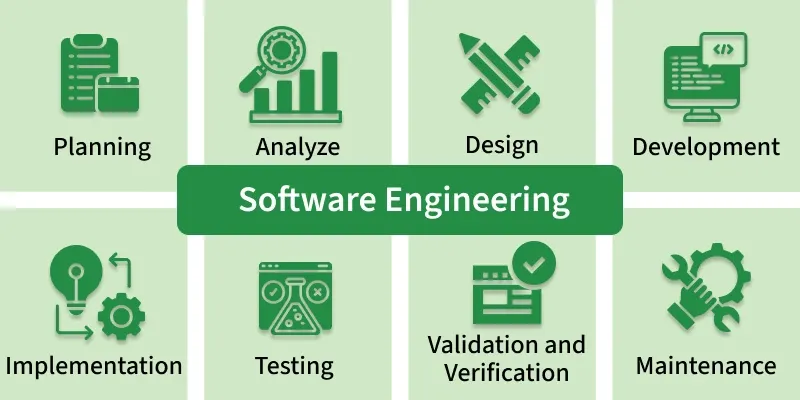
Software Engineering is the process of designing, developing, testing, and maintaining software.
- It is a systematic and disciplined approach to software development that aims to create high-quality, reliable, and maintainable software.
- It includes a variety of techniques, tools, and methodologies, including requirements analysis, design, testing, and maintenance.
Basics
Learn what software is and why Software Engineering is needed.
Software Development Models
Need to manage complexity, reduce risks, and ensure software is built systematically, on time, and within budget.
- Classical Waterfall Model
- Iterative Waterfall Model
- Spiral Model
- Incremental process model
- Rapid application development model(RAD)
- RAD Model vs Traditional SDLC
- Agile Development Models
- Agile Software Development
- Extreme Programming (XP)
- SDLC V-Model
- Comparison of different life cycle models
Software Architecture
Defines the high-level structure of a system, showing how components are organized and interact with each other.
- User Interface Design
- Coupling and Cohesion
- Information System Life Cycle
- Database application system life cycle
- Pham-Nordmann-Zhang Model (PNZ model)
- Schick-Wolverton software reliability model
Software Project Management(SPM)
Focuses on planning, organizing, and controlling software projects to deliver quality software on time and within budget.
- Project Management Process
- Project size estimation techniques
- System configuration management
- COCOMO Model
- Capability maturity model (CMM)
- Integrating Risk Management in SDLC | Set 1
- Integrating Risk Management in SDLC | Set 2
- Integrating Risk Management in SDLC | Set 3
- Role and Responsibilities of a software Project Manager
- Software Project Management Complexities
- Quasi renewal processes
- Reliability Growth Models
- Jelinski Moranda software reliability model
- Schick-Wolverton software reliability model
- Goel-Okumoto Model
- Mills’ Error Seeding Model
- Basic fault tolerant software techniques
- Software Maintenance
Software Metrices
Measurable values used to evaluate the quality, performance, and efficiency of software and its development process.
- Software Measurement and Metrics
- People Metrics and Process Metrics in Software Engineering
- Halstead’s Software Metrics
- Cyclomatic Complexity
- Functional Point (FP) Analysis – Software Engineering
- Lines of Code (LOC) in Software Engineering
Software Requirements
Define what a system must do and serve as the foundation for its design, development, and testing.
- Requirements Engineering Process
- Classification of Software Requirements
- How to write a good SRS for your Project
- Quality Characteristics of a good SRS
- Requirements Elicitation
- Challenges in eliciting requirements
Software Configuration
Focuses on managing and controlling changes to software components and artifacts throughout the development lifecycle.
- Software Configuration Management
- Objectives of Software Configuration Management
- Software Quality Assurance
- Project Monitoring & Control
Software Quality
Measures how well a software product meets requirements and delivers reliable, efficient, and user-friendly performance.
Software Design
Creates a structured blueprint that defines how a software system will meet its requirements efficiently.
- Software Design Process
- Software Design process – Set 2
- Software Design Principles
- Coupling and Cohesion
- Function Oriented Design
- Object Oriented Design
- User Interface Design
Software Reliability
Measures how consistently a system performs its intended functions without failure over time.
Software Testing and Debugging
It ensure that software works correctly by identifying and fixing defects throughout development.
- Software Testing Tutorial
- Seven Principles of software testing
- Testing Guidelines
- Black box testing
- White box Testing
- Debugging
- Selenium: An Automation tool
- Integration Testing
Software Maintenance
Involves updating and improving software to keep it effective, efficient, and relevant over time.
Difference Between
Understanding the differences between software engineering concepts helps choose the right approach for building effective and efficient software.
- Waterfall model vs Incremental model
- v-model vs waterfall model
- Manual testing vs Automation testing
- Sanity Testing vs Smoke Testing
- Cohesion vs Coupling
- Alpha Testing vs Beta Testing
- Testing and Debugging
- Functional vs Non-functional Testing
- Waterfall Model vs Spiral Model
- RAD vs Waterfall
- Unit Testing vs System Testing
- Load Testing vs Stress Testing
- Frontend Testing vs Backend Testing
- Agile Model vs V-Model
Software Engineering Interview Questions
- Software Engineering Interview Questions
- Software Engineering Quiz
- SDLC MCQ Questions
- Risk Management MCQ Questions
- Software Development Models MCQ Questions and Answers
- Software Quality Assurance Quiz