Home Run Derby
Major League Baseball's Home Run Derby is a special competition held annually the day before the All-Star Game in which players compete to see who can hit the most home runs. The format of the event has changed multiple times since its debut in 1985. Currently, 10 players compete in a four-round event, with each player getting seven "outs" per round.
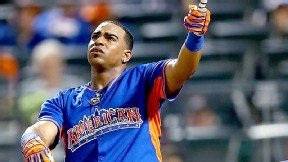
The 2013 Home Run Derby was won by Yoenis Cespedes of the Oakland A's. Cespedes hit 32 total home runs, including nine in the final round.
A new format is being introduced for the 20th annual Gillette Home Run Derby at Target Field in Minneapolis. Ten players will compete in the event on July 14 at Target Field, five from the American League and five from the National League.
Round 1
- Ten participants total; five participants representing each league.
- The batting order will be determined prior to the event. Hitter No. 1 for the NL will hit first followed by Hitter No. 1 for the AL. This order will continue for hitters Nos. 2-5 for each league, with the NL going first, followed by the AL.
- Each participant will receive seven outs.
- The player from each league who hits the most home runs (AL 1, NL 1) will automatically advance to Round 3 (semifinals).
- The next two participants with the most home runs from each league (AL 2, AL 3/NL 2, NL 3) advance to Round 2.
Round 2
- The two participants advancing from Round 1 for each league will compete against each other (AL 2 vs. AL 3/NL 2 vs. NL 3).
- The NL matchup will occur first, followed by the AL matchup, with NL 2 and AL 2 choosing if they want to hit first or second.
- Each participant will receive seven outs.
- The winners from the Round 2 matchups (one from each league) will advance to Round 3 (semifinals).
Round 3 (Semifinals)
- The top seed from each league (AL 1, NL 1) will face the winner from his league's Round 2 matchup.
- The NL matchup will occur first, followed by the AL matchup, with NL 1 and AL 1 choosing if they want to hit first or second.
- Each participant will receive seven outs.
- The participant from each league with the most home runs will advance to the finals.
Round 4 (Finals)
- The semifinal winners (one player from each league) will compete for the crown of Home Run Derby champion.
- The batting order will be determined by a coin flip, which will be held at a meeting at home plate between the two finalists and their league captains (note that a finalist and team captain could be the same person).
- Each finalist will receive seven outs.
Tiebreaker(s)
- If two or more players are tied for advancement into the next round or for the championship, each player will receive three swings to hit as many home runs as possible. If they are still tied after three swings, they will each take one swing. This process is repeated if necessary until one player wins the swing-off.
Major League Baseball added Home Run Derby to the schedule of All-Star events in 1985 at the Metrodome. The event was set up as a competition between the two leagues, with players getting five outs per inning in a two-inning event. The format of the event allowed for ties among individual players for the championship. In 1988, the Home Run Derby was rained out, the only time since the event was created that it did not take place. The field size fluctuated in the early days of the event, starting with five players per league, dropping to three in 1986 and two in 1987 before increasing to four in 1989. The field was 10 total players from 1996 to 1999, and has been set at eight ever since 2000.
In 1991, the number of outs was expanded to 10, but the team competition format remained. However, a tiebreaker was put in place to determine an individual champion, and it was first used in 1993 when Juan Gonzalez defeated Ken Griffey Jr. in a playoff. Griffey Jr. won the title the following season, the first of his three Home Run Derby championships (the most for any individual player). The American League won the final team championship that year, finishing with five titles to the NL's four.
The multiround format that is currently in place was instituted in 1995, when the event shifted from a team-based to an individual competition. The field remained split evenly between AL and NL players, though there have been exceptions to that -- most notably in 2005, when the field was set with eight players representing eight different countries.
In 1998, Griffey won his second championship when he tied Jim Thome, 3-3 in the final round. Prior to the 2000s, ties were broken by the number of home runs a player had hit in the regular season to that point. The next year, Home Run Derby headed to Boston for the first time, and Mark McGwire put on a show, peppering 13 home runs in the first round, with most sailing over Fenway Park's famed Green Monster. However, McGwire ran out of steam in the second round, and the rules then did not aggregate home runs from the first two rounds, so he failed to advance to the finals, where Griffey won his second consecutive title.
Griffey went for a three-peat in Atlanta's Turner Field in 2000, but was out-hit by Chicago's Sammy Sosa, who established a record by hitting nine home runs in the final round. That same year, MLB again tweaked the format, setting up head-to-head matchups in the second round. The player with the most home runs in the first round matched up against the player with the fourth most. And two and three matched up against each other. The format meant that a player could have the second-most home runs total, as well as in the second round, and fail to reach the final.
That exact scenario happened in 2003, when Jason Giambi hit a round-best 12 home runs in the first round, then 11 more in the second round, but was eliminated by Albert Pujols, who hit 14 home runs in the second round, matching Giambi's single-round record (set in the first round in 2001). Garrett Anderson went on to win the title that year, then hit a home run in the All-Star game, becoming the third player to pull off that feat, joining Cal Ripken Jr. (1991) and Frank Thomas (1995).
In 2004, Miguel Tejada set a single-round record when he hit 15 home runs in the second round, en route to his eventual title. That record didn't last long, as the following season, Bobby Abreu hit 24 first-round home runs at Comerica Park in Detroit. Abreu finished the event with 41 total home runs, an event record that still stands.
In 2008, Josh Hamilton made Home Run Derby history at Yankee Stadium, hitting a record 28 home runs, including 13 consecutive at one point. Hamilton's show captured the crowd, but not the title. With totals reset for the final, Hamilton lost out to Minnesota's Justin Morneau. Hamilton's 35 total home runs hit during the event are still the second-most in Home Run Derby history.
Year-by-Year Home Run Derby Champions
| Year | Winner | Team | Host | Total HR |
|---|---|---|---|---|
| 2013 | Yoenis Cespedes | Athletics | New York (NL) | 32 |
| 2012 | Prince Fielder | Tigers | Kansas City | 28 |
| 2011 | Robinson Cano | Yankees | Arizona | 32 |
| 2010 | David Ortiz | Red Sox | Los Angeles (AL) | 32 |
| 2009 | Prince Fielder | Brewers | St. Louis | 23 |
| 2008 | Justin Morneau | Twins | New York (AL) | 22 |
| 2007 | Vladimir Guerrero | Angels | San Francisco | 17 |
| 2006 | Ryan Howard | Phillies | Pittsburgh | 23 |
| 2005 | Bobby Abreu | Phillies | Detroit | 41 |
| 2004 | Miguel Tejada | Orioles | Houston | 27 |
| 2003 | Garrett Anderson | Angels | Chicago (AL) | 22 |
| 2002 | Jason Giambi | Yankees | Milwaukee | 24 |
| 2001 | Luis Gonzalez | Diamondbacks | Seattle | 16 |
| 2000 | Sammy Sosa | Cubs | Atlanta | 26 |
| 1999 | Ken Griffey Jr. | Mariners | Boston | 16 |
| 1998 | Ken Griffey Jr. | Mariners | Colorado | 19 |
| 1997 | Tino Martinez | Yankees | Cleveland | 16 |
| 1996 | Barry Bonds | Giants | Philadelphia | 17 |
| 1995 | Frank Thomas | White Sox | Texas | 15 |
| 1994 | Ken Griffey Jr. | Mariners | Pittsburgh | 7 |
| 1993 | Juan Gonzalez | Rangers | Baltimore | 7 |
| 1992 | Mark McGwire | Athletics | San Diego | 12 |
| 1991 | Cal Ripken Jr. | Orioles | Toronto | 12 |
| 1990 | Ryne Sandberg | Cubs | Chicago (NL) | 3 |
| 1989 | Eric Davis | Reds | Anaheim | 3 |
| 1988 | Canceled due to rain | |||
| 1987 | Andre Dawson | Cubs | Oakland | 3 |
| 1986 | Wally Joyner Darryl Strawberry |
Angels Mets |
Houston | 4 |
| 1985 | Dave Parker | Reds | Minnesota | 6 |
TOP STORY

Cespedes wins 2013 Home Run Derby
Yoenis Cespedes crushed 32 home runs overall, including nine in the final round, to win his first Home Run Derby crown. Story »
2013 HOME RUN DERBY RESULTS
| Player | Round 1 | Round 2 | Finals | Total |
|---|---|---|---|---|
| Yoenis Cespedes | 17 | 6 | 9 | 32 |
| Bryce Harper | 8 | 8 | 8 | 24 |
| Michael Cuddyer | 7 | 8 | -- | 15 |
| Chris Davis | 8 | 4 | -- | 12 |
| Pedro Alvarez | 6 | -- | -- | 6 |
| Prince Fielder | 5 | -- | -- | 5 |
| David Wright | 5 | -- | -- | 5 |
| Robinson Cano | 4 | -- | -- | 4 |
2014 HOME RUN DERBY PARTICIPANTS
![]() Jose Bautista (captain) |
![]() Yoenis Cespedes |
![]() Josh Donaldson |
![]() Brian Dozier |
![]() Adam Jones |
![]() Todd Frazier |
![]() Justin Morneau |
![]() Yasiel Puig |
![]() Giancarlo Stanton |
![]() Troy Tulowitzki (captain) |
Stats through July 10, 2014
ULTIMATE HOME RUN DERBY

You picked the field of 32, our experts seeded them and your votes determined the Ultimate Home Run Derby champion. See which slugger won, and how he earned the title. Vote »