None
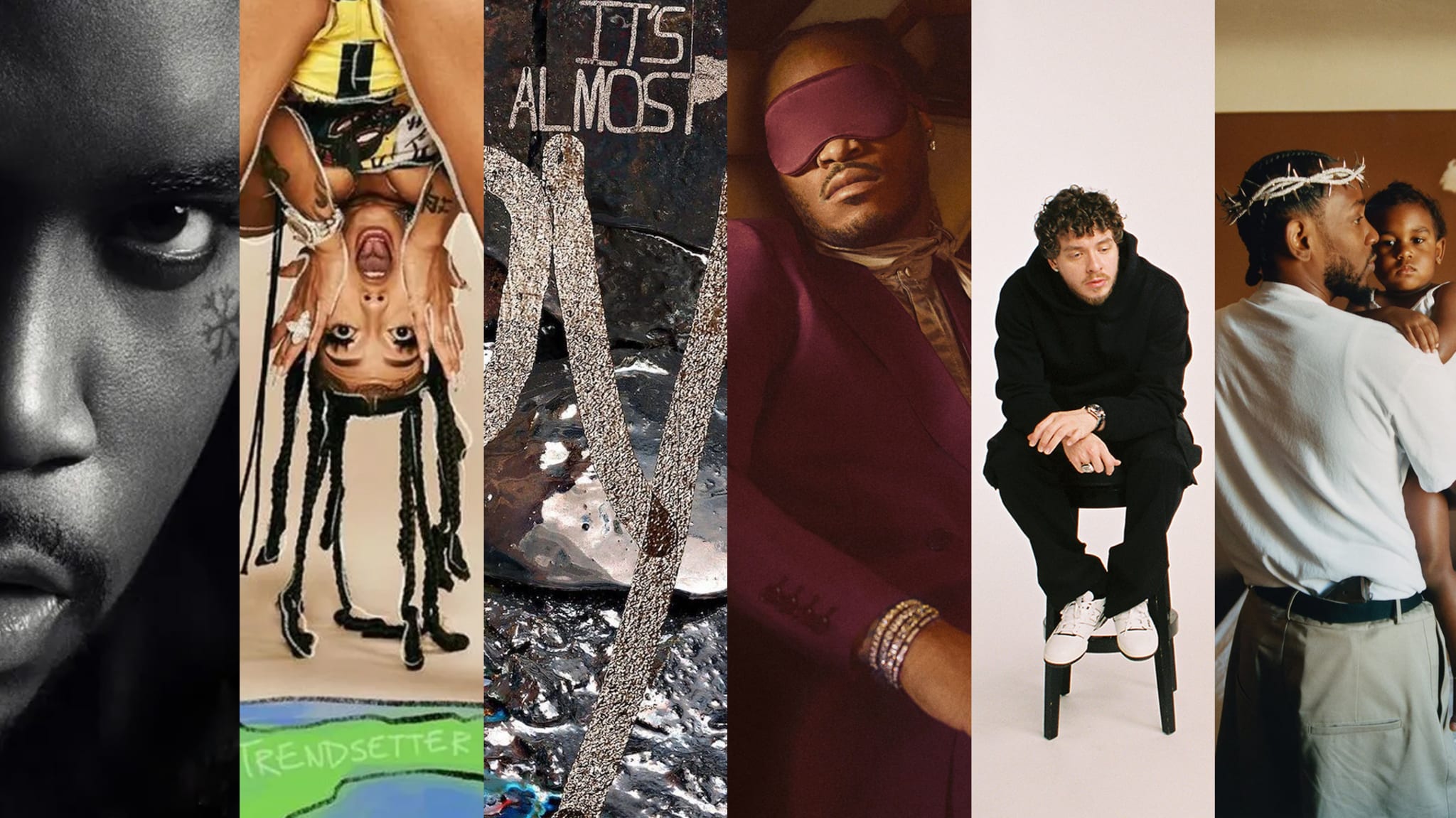
Music is being delivered in a lot of different ways these days. From Kendrick Lamar disappearing for five years and returning to announce his new album with a Michael Jordan-esque press release, to Future using an image from a magazine photoshoot as his album artwork, the formula for rap album rollouts is wide-ranging in 2022.
A good rollout builds hype for the music, feeds fans in creative ways, and teases just enough of the project to maximize its success. The approaches to accomplish this have changed over the past few decades, but the end goal has stayed the same. Some rising artists, like Fivio Foreign, strategically place themselves adjacent to established stars, like Kanye West, to help bolster the number of eyes on their project. Others, like Pusha-T and Coi Leray, go the more traditional route and drop massive singles months before their final release date in order to build hype, and then go on a long press run. Then there are artists like Jack Harlow, who can use their star power and social media savvy to make the most of viral moments.
If 2022 has proven anything, it’s that there’s no one-size-fits-all approach to album rollouts. What works for Kendrick Lamar or Future might not work for Jack Harlow or Coi Leray. That being said, the recent string of massive rap releases over the past two months, which started with Fivio Foriegn’s B.I.B.L.E. in April and now ends with Kendrick’s Mr. Morale & The Big Steppers in mid-May have delivered a wide array of album rollouts that have all had varied results.
We sat down and scored how well each of these major rollouts from the past two months were executed, and if they impacted the success of the project. We scored the rollouts based on their creativity, pre-album single quality (where applicable), fan reception, music video quality, and how effective the rollout was overall. Each category was given a numerical score on a scale from 1 to 10. Creativity refers to how the rollout was unique to the artist and played into themes in their music. Pre-album singles were scored based on quality and how well they drew attention to the project, music videos were scored by uniqueness, quality, and impact, and fan reception was scored based on how the artist’s audience responded to all aspects of their rollout. Effectiveness is how well the rollout brought attention to the album and bolstered the album’s sales. The overall scores were calculated as the average of all the other categories.
It’s important to note: We only graded the major rap album rollouts from the past 8 weeks, and we are only appraising the rollouts and the thought and execution behind them, not rating the overall quality of the music itself (for evaluations of the albums themselves, check out our Best Albums of 2022 So Far list).
Fivio Foreign, 'B.I.B.L.E.'
Release Date: April 8
Creativity: 5
Pre-Album Singles: 7
Music Videos: 7
Fan reception: 7
Effectiveness: 5
Overall score: 6
Fivio Foreign used his proximity to Kanye West to his advantage throughout his rollout. After his contributions to Donda and Donda 2, he had hype on his side going into the release of B.I.B.L.E. Fivio strategically included Ye as “executive producer” of the album when he initially announced it, and the first single “City of Gods” featuring Ye and Alicia Keys had attention-grabbing visuals, A-list collaborators, and brought a lot of mainstream attention to Fivio. The second single “Magic City” featuring Quavo, however, was lackluster and not even the best Quavo-assisted song on the album. The music video didn’t add much to the hype, either. Fivio’s choice to collaborate with the City Girls and Nicki Minaj in the weeks leading up to B.I.B.L.E. was a smart move, though, and the collabs brought more attention from new audiences. There wasn’t anything especially creative about the rollout, but Fivio did keep people focused on him for weeks, even if that meant a slight altercation with 6ix9ine over more provocative “King of New York” talk.
As far as how effective these tactics were on the album’s overall success, it sold 29,000 units in its first week, debuting at No. 9 on the Billboard 200 albums chart. That was likely disappointing for Fivio’s team, especially considering the expensive inclusions of things like a Destiny’s Child sample. Many of Fivio’s fans rode with him through it all and weren’t disappointed with B.I.B.L.E., but I would have liked to see him tap into the New York drill scene more in his rollout to really get the city behind him. Overall, B.I.B.L.E.’s rollout ended up feeling as average as the album itself.
Coi Leray, 'Trendsetter'
Release Date: April 8
Creativity: 5
Pre-Album Singles: 6
Music Videos: 6
Fan Reception: 4
Effectiveness: 2
Overall score: 4.5
The lack of success for Coi Leray’s latest album is a curious case. Trendsetter wasn’t a bad album, and Coi had several commercially successful singles and music videos (one of which with Nicki Minaj), and a solid roster of A-list features. The music videos were fun and made sense given Coi Leray’s persona, but none of them made a lasting impact in a major way. She went the traditional rollout route and did interviews with most of the major radio shows and blogs, and had a heavy presence on Tiktok. On paper, all of this should have amounted to more than her staggeringly low 9,000 first-week sales. It almost feels like she was played by the very industrial machine that she was advised to utilize.
The patented industry rollout formula didn’t work for Coi. Some of the drama involving her and her father Benzino might have affected the rollout, but it was a surprise to see her fans not show up for her debut studio album. She utilized TikTok to amplify her singles, and a few of them sparked viral trends on the app. The TikTok approach works extremely well to make individual songs and moments go viral, but we’re now seeing that it’s difficult to translate that attention to a full-length LP. Because platforms like TikTok reward bite-sized content, it ended up feeling like Coi wasn’t able to hold her fans’ attention. Her unsuccessful rollout is not necessarily a reflection of Trendsetter’s quality. Her singles were OK, and they had the star power and TikTok attention on their side. Coi played into the colorful aesthetics of her personality in creative ways with the album art and promotional material, but the results didn’t reflect these efforts. Trendsetter is a case study of how even the most commercial album rollouts can still be unsuccessful.
Pusha-T, 'It's Almost Dry'
Release Date: April 22
Creativity: 8
Pre-Album Singles: 8
Music Videos: 9
Fan Reception: 10
Effectiveness: 9
Overall score: 9
Everything about Pusha-T’s rollout was surgical, from the singles to the music videos and interviews. “Diet Coke” was a fitting prelude to It’s Almost Dry, and the music video featuring Kanye West built hype around the song and album. “Hear Me Clearly” was a solid offering from NIGO’s album and showed off Pharrell’s elite production, which made way for Push dropping the bomb that was “Neck & Wrist” featuring Hov as a single. The music video for “Call My Bluff” that dropped after the album was just for good measure, and despite the album’s first single coming nearly two months before its release, Push’s loyal fan base stuck with him throughout the rollout.
The It’s Almost Dry rollout reflects an artist who has mastered a patented formula, yet still knows how to be inventive and present it in a way that feels new and fresh. Declaring that he would have the “album of the motherfucking year” early on, Push continued the same campaign he started with DAYTONA, and delivered on his promise once again. While he went the traditional album rollout route and did interviews with nearly every major syndicated radio station and music publication, he had some fun with the jokes about his own career, even hosting an album listening event called “Cokechella” that came dressed with a mountain of fake white powder behind Chase B’s DJ booth, and styrofoam bricks decorating bar tables. The rollout had some missteps, though, like how drawn-out it was. Push spent over two months building hype for It’s Almost Dry, and while it met fans’ expectations, it also felt like his team were stalling at some points, and there might have been a bigger bang on release day if it came a few weeks earlier. But at the end of the day, it all resulted in It’s Almost Dry becoming Push’s first No.1 album. That’s a testament to not only the quality of the music, but also how well it was presented.
Future, 'I Never Liked You'
Release Date: April 29
Creativity: 2
Pre-Album Singles: N/A
Music Videos: 8
Fan Reception: 10
Effectiveness: 8
Overall score: 7
Future’s fans will always hold him down no matter what. The Atlanta rapper’s nonchalant personality was reflected in his album rollout, but it didn’t hurt his sales at all. I Never Liked You was carried by its provocative title and the GQ cover story that labeled him the best rapper alive. He lazily used one of the photos from that cover shoot as the album art, but it still fit with the album’s aesthetic. It’s not uncommon for Future to drop an album with little to no prior notice, and I Never Liked You is no different (he delivered his album announcement, title, cover art, and tracklist in rapid succession) and it worked again.
Future was completely uninventive during this album rollout, and it still resulted in his eighth No. 1 album and one of the highest-selling rap albums this year. The most creative thing about this rollout was the music video for “Wait For U,” which was pretty fly and played into Future’s “toxic king” trope in a hilariously literal way. That song also topped the charts, debuting at No. 1 on the Billboard chart. His fanbase appeared to be happy through the whole ride, especially since they’re accustomed to him dropping without warning. Future didn’t need a pre-album single, social media activity, or any real promotional assets for I Never Liked You to be successful. It’s hard to say if this was because his rollout was effective, or if he’s just such a massive star that he’ll have people’s attention regardless of what he does before dropping new music. This formula wouldn’t work for most other artists, but most artists also aren’t being called “the best rapper alive.”
Jack Harlow, 'Come Home The Kids Miss You'
Release Date: May 6
Creativity: 9
Pre-Album Singles: 8
Music Videos: 9
Fan Reception: 9
Effectiveness: 4
Overall score: 8
Throughout his rollout, Jack Harlow played up his charismatic personality and internet-savvy nature. “Nail Tech” was a nice primer for Come Home The Kids Miss You, which had a fun music video and a well-placed Yung Miami cameo, which helped it debut at No. 5 on the Billboard chart. Then it caught the attention of Kanye West, and all of a sudden, Jack was featured on the unofficially(?) released Donda 2 and performed next to his idol in Miami. His verse on “Louie Bags” wasn’t particularly memorable, but the spontaneous Kanye co-sign was a big moment. After that, he dropped a simple snippet of himself in the studio rapping to a song that sampled Fergie’s “Glamorous.” The clip went viral on TikTok and Twitter, and a week later, Jack dropped “First Class.” It debuted at No. 1 on the charts, went platinum, and is easily one of the biggest rap songs of 2022 so far. The music video, featuring a cameo appearance from Anitta, also made perfect sense. (Note: The only reason I didn’t score his singles higher is because his flow on “Nail Tech” is too similar to the one he used on “Industry Baby,” and “First Class” relies too heavily on the “Glamorous” sample, but they were very effective)
Everything about the Come Home The Kids Miss You rollout was strategically planned. The album arrived on the same weekend as the Kentucky Derby, which Jack also participated in as an announcer. The Derby yielded several viral moments with Jack, Drake, and Druski interacting with each other and the massive crowd, and they filmed the music video for “Churchill Downs” there as well. The formula is honestly pretty simple: Jack Harlow and his team are really good at using the internet and creating viral moments. He’s managed to stay in the news cycles consistently for all the right reasons, and maintaining that focus is a testament to a good rollout. Ironically, I think this internet-savvy approach also created a persona that Jack’s rhymes couldn’t authentically reflect.
Unfortunately for Jack, it turned out that the rollout for his album was better executed than the body of work it was promoting. The Topanga cameo in the final teaser for the album was cool, but it didn’t amount to anything. Even the album’s title still doesn’t make much sense. But despite the music lacking, the commercial machine still did its job, and Come Home The Kids Miss You became Jack Harlow’s best-selling album so far, in part because of his focused and well-timed rollout.
Kendrick Lamar, 'Mr. Morale & The Big Steppers'
Release Date: May 13
Creativity: 8
Pre-Album Singles: 10
Music Videos: 10
Fan Reception: 9
Effectiveness: 9
Overall score: 9
Kendrick Lamar doesn’t need to follow any of the conventional rules of an album rollout. He could have shock-dropped Mr. Morale & The Big Steppers on May 13, and it still would have made waves across the industry. Despite being in a lane of his own, though, K Dot was still creative during his rollout, which started eight months ago in August when he shared a cryptic note on his oklama website that had fans piecing together the bread crumbs he left behind. After going dark for a few more months, he dropped more hints on oklama.com in the weeks leading up to the album’s release, including a Michael Jordan-styled press release to signal his return, and a major clue about Mr. Morale being a double album. Kendrick knows how inquisitive his fans are, so leaving codes to be cracked on his website (and adopting his “oklama” alias) were all perfect elements to keep his audience engaged. Kendrick was aware that the website would become a hub that fans would incessantly check for updates about his next moves, so he played into their reputation for combing the internet for clues.
Following tradition, Kendrick also added a new entry to his “The Heart” series before its release. The song alone was thought-provoking, but the music video (and deepfake technology) brought it to another level. Kendrick morphing into O.J. Simpson, Kanye West, Jussie Smollett, Will Smith, Kobe Bryant, and Nipsey Hussle captivated fans and had them ready for whatever Mr. Morale would be. Kendrick capped off the rollout with a music video for “N95” after the album dropped, which included another set of stunning visuals directed by pgLang co-founder Dave Free, and news of a world tour. Despite the album ultimately drawing polarizing responses from critics and fans alike, Kendrick dominated the rap conversation for weeks and landed his fourth No. 1 album, even though it never felt like that was Kendrick’s goal with this album or rollout in the first place.