In this tutorial, I will show you how to implement Angular Template Driven Forms Validation example (and Submit) with Angular 14 and Bootstrap 4.
More Practice:
– Angular Form Validation example (Reactive Forms)
– Angular File upload example with progress bar
– Angular CRUD Application example with Web API
– Angular JWT Authentication example with Web Api
Serverless with Firebase:
– Angular 14 Firebase CRUD with Realtime Database
– Angular 14 Firestore CRUD example
– Angular 14 File Upload with Firebase Storage
Contents
- Overview of Angular 14 Template Driven Forms Validation example
- Technology
- Setup Project
- Import Bootstrap
- Template Driven Forms Validation with Angular 14
- Angular 14 component with Template Driven Form
- Angular Template Driven Form Validation template
- Confirm Password validation in Template Driven Form
- Run Template Driven Form Validation with Angular 14 example
- Conclusion
- Further Reading
Overview of Angular 14 Template Driven Forms Validation example
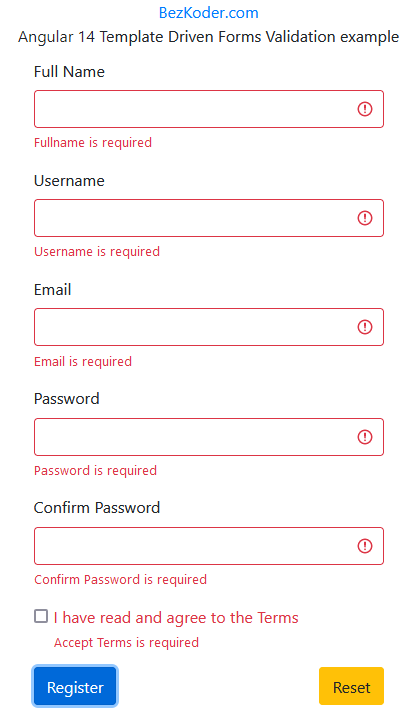
We will implement validation for a Angular Form using Template Driven Forms and Bootstrap 4. The form has:
- Full Name: required
- Username: required, from 6 to 20 characters
- Email: required, email format
- Password: required, from 6 to 40 characters
- Confirm Password: required, same as Password
- Accept Terms Checkbox: required
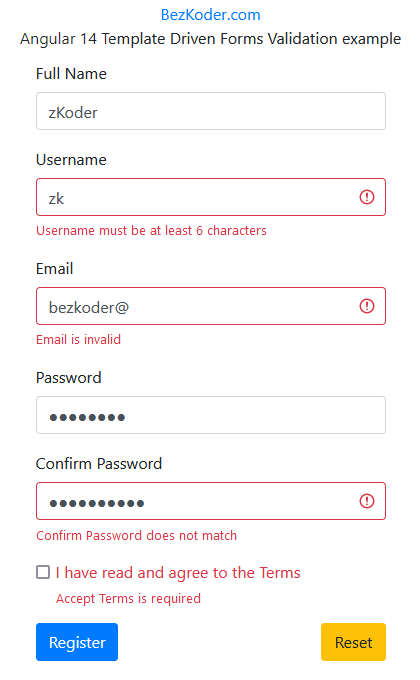
Some fields could be wrong:
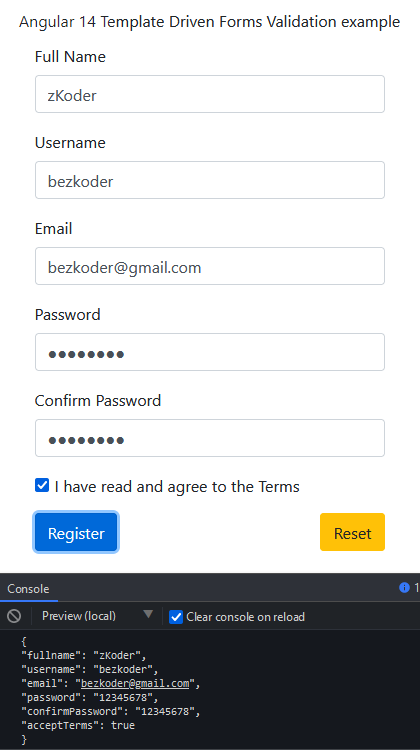
Successful Submission will look like this:
Technology
We’re gonna use following modules:
- Angular 14
- Bootstrap 4
- @angular/forms 14
Setup Project
First we need to add the FormsModule into our App Module.
Open src/app/app.module.ts and import FormsModule from @angular/forms:
import { NgModule } from '@angular/core';
import { BrowserModule } from '@angular/platform-browser';
import { FormsModule } from  '@angular/forms';

import { AppComponent } from './app.component';

@NgModule({
  declarations: [
    AppComponent
  ],
  imports: [
    BrowserModule,
    FormsModule
  ],
  providers: [],
  bootstrap: [AppComponent]
})
export class AppModule { }
Import Bootstrap
Open src/index.html and add following line to <head> tag:
<!doctype html>
<html lang="en">
<head>
  ...
  <link rel="stylesheet" href="https://unpkg.com/[email protected]/dist/css/bootstrap.min.css" />
</head>
<body>
  <app-root></app-root>
</body>
</html>
Another way to import Bootstrap into Angular project:
– Run the command: npm install [email protected].
– Next, open src/style.css and add following code:
@import "~bootstrap/dist/css/bootstrap.css";
Template Driven Forms Validation with Angular 14
Template Driven Forms rely on directives defined in the FormsModule. In this example, we will use:
NgModelNgForm: creates a top-levelFormGroupinstance, binds it to a<form>element to track form value and validation status.
We also need to use attributes of following FormsModule directives:
RequiredValidator: requiredMinLengthValidator: minlengthMaxLengthValidator: maxlengthEmailValidator: email
To get access to the NgForm and the overall form status, we declare a template reference variable #f="ngForm".
<form
  name="form"
  #f="ngForm"
  (ngSubmit)="f.form.valid && onSubmit()"
>
The f template variable is now a reference to the NgForm directive instance. So we can use f.form.valid or f.submitted for example.
Similarly, to inspect the properties of the associated FormControl, we export the directive into a local template variable using ngModel as the key (#username="ngModel").
<input
  type="text"
  class="form-control"
  name="username"
  [(ngModel)]="form.username"
  required
  minlength="6"
  maxlength="20"
  #username="ngModel"
/>
Now we can access the control using the directive’s control property: username.errors.
<div *ngIf="f.submitted && username.errors" class="invalid-feedback">
  <div *ngIf="username.errors['required']">Username is required</div>
  <div *ngIf="username.errors['minlength']">
    Username must be at least 6 characters
  </div>
  <div *ngIf="username.errors['maxlength']">
    Username must be at most 20 characters
  </div>
</div>
Angular 14 component with Template Driven Form
In the component that working with Template Driven Form, let’s create an object (form) that stores all form value. We will bind the form fields with the property of this object.
Then create two functions for Form submission and Form reset: onSubmit() and onReset().
app/app.component.ts
import { Component } from '@angular/core';
import { NgForm } from '@angular/forms';

@Component({
  selector: 'app-root',
  templateUrl: './app.component.html',
  styleUrls: ['./app.component.css'],
})
export class AppComponent {
  form = {
    fullname: '',
    username: '',
    email: '',
    password: '',
    confirmPassword: '',
    acceptTerms: false,
  };

  onSubmit(): void {
    console.log(JSON.stringify(this.form, null, 2));
  }

  onReset(form: NgForm): void {
    form.reset();
  }
}
Angular Template Driven Form Validation template
Now we create the form with input fields and validation messages.
We bind to the FormGroup object (form) in the app component and use f as template variable. Form submit event will call onSubmit() handler above using event binding (ngSubmit).
Validation messages will display after form submission for the first time by f.submitted value.
app/app.component.html
<div class="register-form">
  <form
    name="form"
    #f="ngForm"
    (ngSubmit)="f.form.valid && onSubmit()"
    novalidate
    [appMatchPassword]="['password', 'confirmPassword']"
  >
    <div class="form-group">
      <label>Full Name</label>
      <input
        type="text"
        class="form-control"
        name="fullname"
        [(ngModel)]="form.fullname"
        required
        #fullname="ngModel"
        [ngClass]="{ 'is-invalid': f.submitted && fullname.errors }"
      />
      <div *ngIf="f.submitted && fullname.errors" class="invalid-feedback">
        <div *ngIf="fullname.errors['required']">Fullname is required</div>
      </div>
    </div>

    <div class="form-group">
      <label>Username</label>
      <input
        type="text"
        class="form-control"
        name="username"
        [(ngModel)]="form.username"
        required
        minlength="6"
        maxlength="20"
        #username="ngModel"
        [ngClass]="{ 'is-invalid': f.submitted && username.errors }"
      />
      <div *ngIf="f.submitted && username.errors" class="invalid-feedback">
        <div *ngIf="username.errors['required']">Username is required</div>
        <div *ngIf="username.errors['minlength']">
          Username must be at least 6 characters
        </div>
        <div *ngIf="username.errors['maxlength']">
          Username must be at most 20 characters
        </div>
      </div>
    </div>

    <div class="form-group">
      <label>Email</label>
      <input
        type="email"
        class="form-control"
        name="email"
        [(ngModel)]="form.email"
        required
        email
        #email="ngModel"
        [ngClass]="{ 'is-invalid': f.submitted && email.errors }"
      />
      <div *ngIf="f.submitted && email.errors" class="invalid-feedback">
        <div *ngIf="email.errors['required']">Email is required</div>
        <div *ngIf="email.errors['email']">Email is invalid</div>
      </div>
    </div>

    <div class="form-group">
      <label>Password</label>
      <input
        type="password"
        class="form-control"
        name="password"
        [(ngModel)]="form.password"
        required
        minlength="6"
        maxlength="40"
        #password="ngModel"
        [ngClass]="{ 'is-invalid': f.submitted && password.errors }"
      />
      <div *ngIf="f.submitted && password.errors" class="invalid-feedback">
        <div *ngIf="password.errors['required']">Password is required</div>
        <div *ngIf="password.errors['minlength']">
          Password must be at least 6 characters
        </div>
        <div *ngIf="password.errors['maxlength']">
          Username must not exceed 40 characters
        </div>
      </div>
    </div>

    <div class="form-group">
      <label>Confirm Password</label>
      <input
        type="password"
        class="form-control"
        name="confirmPassword"
        [(ngModel)]="form.confirmPassword"
        required
        #confirmPassword="ngModel"
        [ngClass]="{ 'is-invalid': f.submitted && confirmPassword.errors }"
      />
      <div
        *ngIf="f.submitted && confirmPassword.errors"
        class="invalid-feedback"
      >
        <div *ngIf="confirmPassword.errors['required']">
          Confirm Password is required
        </div>
        <div *ngIf="confirmPassword.errors['matching']">
          Confirm Password does not match
        </div>
      </div>
    </div>

    <div class="form-group form-check">
      <input
        type="checkbox"
        lass="form-control"
        name="acceptTerms"
        [(ngModel)]="form.acceptTerms"
        class="form-check-input"
        required
        #acceptTerms="ngModel"
        [ngClass]="{ 'is-invalid': f.submitted && acceptTerms.errors }"
      />
      <label for="acceptTerms" class="form-check-label">
        I have read and agree to the Terms
      </label>
      <div *ngIf="f.submitted && acceptTerms.errors" class="invalid-feedback">
        Accept Terms is required
      </div>
    </div>

    <div class="form-group">
      <button type="submit" class="btn btn-primary">Register</button>
      <button
        type="button"
        (click)="onReset(f)"
        class="btn btn-warning float-right"
      >
        Reset
      </button>
    </div>
  </form>
</div>
You can see that we has appMatchPassword directive in the form: [appMatchPassword]="['password', 'confirmPassword']". Let’s continue to the next section for more details.
Confirm Password validation in Template Driven Form
Now we will create Validation class to implement password and confirm password validation.
– First, the validator returns null (meaning validation has passed) if there is any error on the control that we want to check (confirm password).
– Next, the validator checks that two fields match or not and set error (matching property value to true) on checking control if validation fails.
utils/validation.ts
import { FormGroup } from '@angular/forms';

export default class Validation {
  static match(controlName: string, checkControlName: string) {
    return (formGroup: FormGroup) => {
      const control = formGroup.controls[controlName];
      const checkControl = formGroup.controls[checkControlName];

      if (checkControl?.errors && !checkControl.errors['matching']) {
        return null;
      }

      if (control?.value !== checkControl?.value) {
        checkControl?.setErrors({ matching: true });
        return { matching: true };
      } else {
        checkControl?.setErrors(null);
        return null;
      }
    };
  }
}
Then we create a custom Directive to implement custom validator for the Template Driven Form.
Run the command: ng g d directives/passwordPattern
You will see a folder named directives is created with two files inside it: match-password.directive.ts and match-password.directive.spec.ts.
We will implement the Validator interface on MatchPasswordDirective class and override the validate() method. This directive is used to validate if the password and confirmPassword are matching or not.
Open directives/match-password.directive.ts and write following code:
import { Directive, Input } from '@angular/core';
import { FormGroup, NG_VALIDATORS, ValidationErrors, Validator } from '@angular/forms';

import Validation from '../utils/validation';

@Directive({
  selector: '[appMatchPassword]',
  providers: [{ provide: NG_VALIDATORS, useExisting: MatchPasswordDirective, multi: true }]
})
export class MatchPasswordDirective implements Validator {
  @Input('appMatchPassword') matchPassword: string[] = [];

  validate(formGroup: FormGroup): ValidationErrors | null {
    return Validation.match(this.matchPassword[0], this.matchPassword[1])(formGroup);
  }
}
The input is an array of Strings, which contains 2 fields to match. In the validate() method, we call Validation.match() static method.
Run Template Driven Form Validation with Angular 14 example
You can run our App with command: ng serve.
If the process is successful, open Browser with Url: http://localhost:4200/ and check it.
Or run on Stackblitz:
Conclusion
Today we’ve built Angular 14 Template Driven Forms Validation example successfully with Angular Forms module & Bootstrap 4.
You can also use the Form Validation in following posts:
– Angular File upload example with progress bar
– Angular CRUD Application example with Web API
– Angular JWT Authentication example with Web Api
Or using Angular Reactive Forms Module:
Angular Form Validation example (Reactive Forms)
Happy learning! See you again.
Further Reading
Serverless with Firebase:
– Angular 14 Firebase CRUD with Realtime Database
– Angular 14 Firestore CRUD example
– Angular 14 File Upload with Firebase Storage
Fullstack CRUD Application:
– Angular + Node Express + MySQL example
– Angular + Node Express + PostgreSQL example
– Angular + Node Express + MongoDB example
– Angular + Spring Boot + H2 example
– Angular + Spring Boot + MySQL example
– Angular + Spring Boot + PostgreSQL example
– Angular + Spring Boot + MongoDB example
– Angular + Django example
– Angular + Django + MySQL example
– Angular + Django + PostgreSQL example
– Angular + Django + MongoDB example