'Britain backs war on Iran' and 'Trump vows to press on'

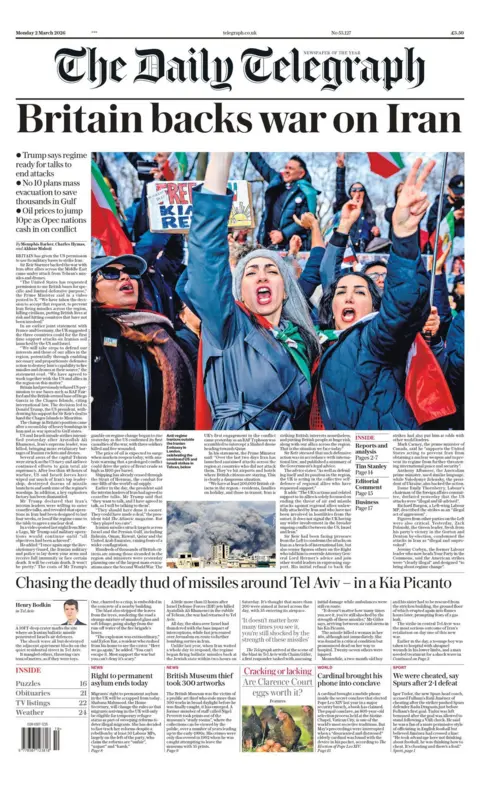
The headline on the front page of the Daily Telegraph reads: “Britain backs war on Iran”.
The papers are all leading on conflict in the Middle East for a second consecutive day, with the front page of the Telegraph reading: "Britain backs war on Iran". It says that Sir Keir Starmer has given the US permission to use its military bases for "specific and limited defensive purpose". The UK had previously refused such permissions, but the Telegraph notes that the change in position has come after a second day of "heavy bombings" in the region.
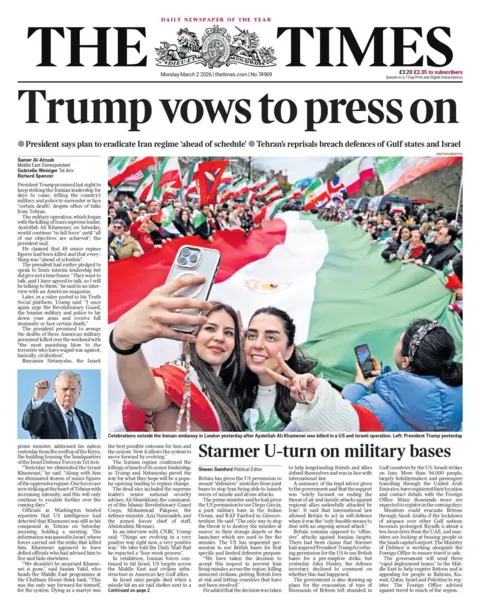
The headline on the front page of the Times reads: “Trump vows to press on”.
The Times carries a photograph of people celebrating outside the Iranian embassy in London on Sunday, and says that US President Donald Trump has vowed to "press on" with strikes in Iran. On Sunday night, Trump said that the military operation would continue in "full force" until "all our objectives are achieved".
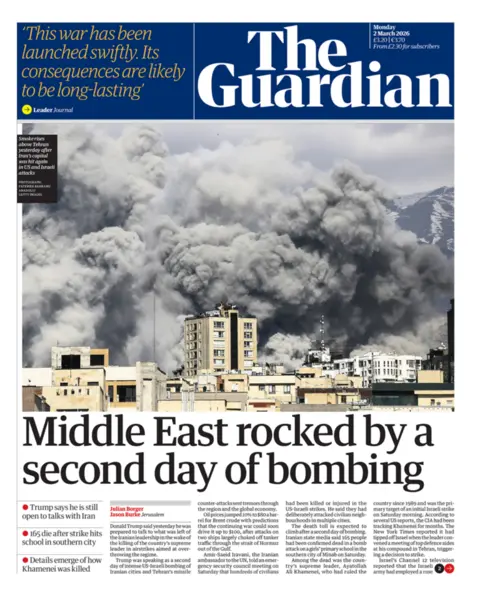
The headline on the front page of the the Guardian reads: “Middle East rocked by a second day of bombing”.
"Middle East rocked by second day of bombing" writes the Guardian, with an image of explosions in Tehran, the Iranian capital, taking up the majority of the front page. Iranian state media is reporting that 165 people have been confirmed dead after a strike on a girls' primary school in Minab on Saturday, with the paper adding that the death toll from bombings across the country is expected to climb.
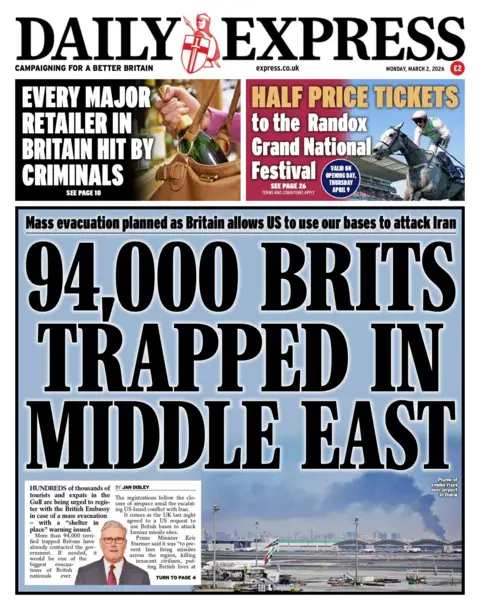
The headline on the front page of the Express reads: “94,000 Brits trapped in the Middle East”.
The UK government is drawing up plans to evacuate "hundreds of thousands of tourists and expats" from the Middle East, according to the Express. It reports that 94,000 Britons have already registered with the British Embassy, and that a "shelter in place" warning is currently in effect.
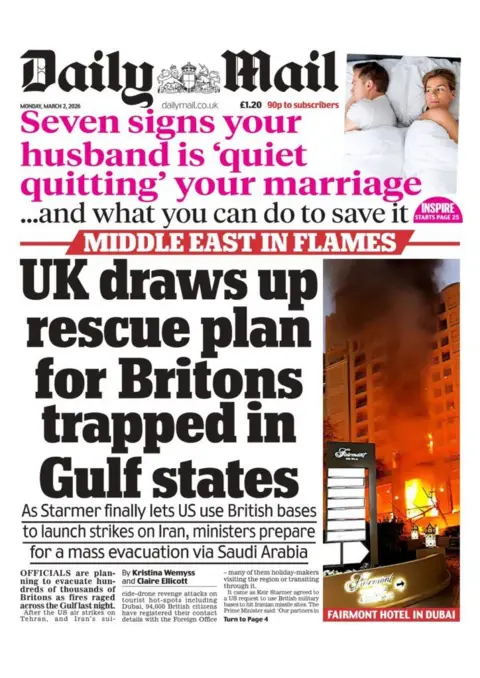
The headline on the front page of the Daily Mail reads: “UK draws up rescue plan for Britons trapped in Gulf states”.
The Daily Mail leads with a similar headline, and suggests that a mass evacuation would occur via Saudi Arabia. The paper features a photo of a blaze at the Fairmont Hotel in Dubai, and notes that the tourist hotspot is already experiencing "Iran's suicide-drone revenge attacks".
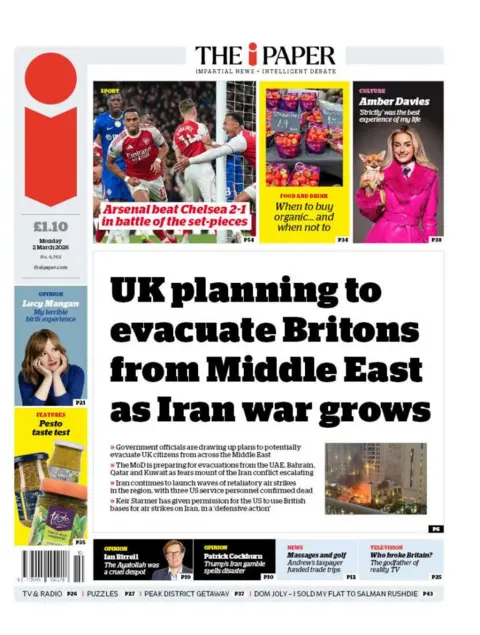
The headline on the front page of the i Paper reads: “UK planning to evacuate Britons from Middle East as Iran war grows”.
The i Paper reports that the Ministry of Defence has pegged the United Arab Emirates, Bahrain, Qatar and Kuwait as key sites from which it will need to evacuate British citizens.
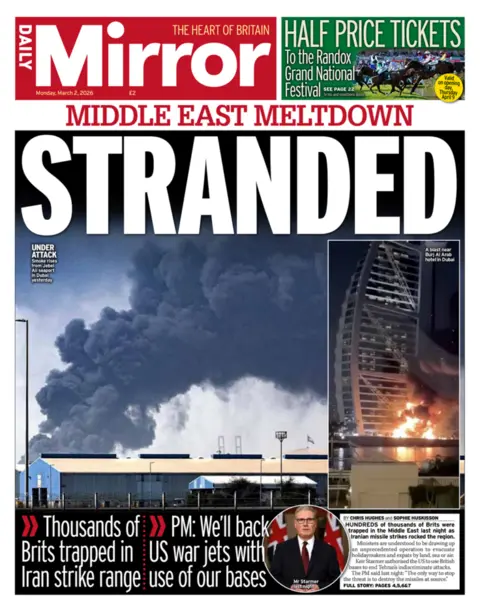
The headline on the front page of the Mirror reads: “Stranded”.
Images of attacks on Dubai's Jebel Ali seaport and the Burj Al Arab hotel lead the the Mirror, under the headline "Stranded".
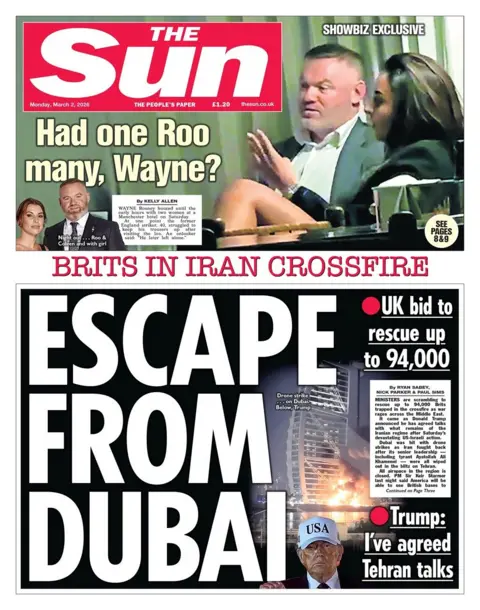
The headline on the front page of the Sun reads: “Escape from Dubai”.
"Escape from Dubai" warns the Sun, featuring the same image of a drone strike alongside the Burj Al Arab hotel.
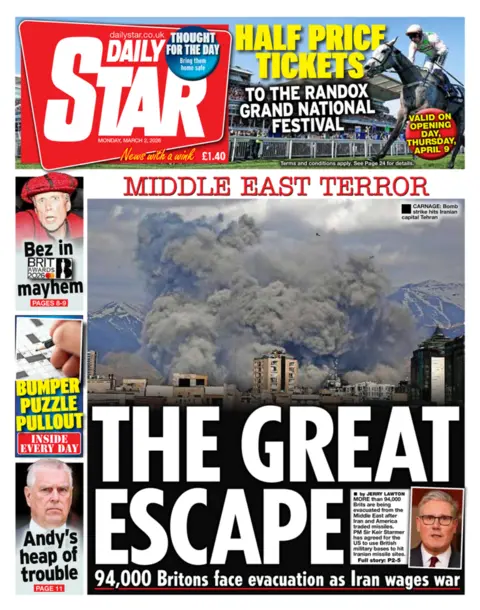
The headline on the front page of the Daily Star reads: “The great escape”.
In a shift from its usual tongue-in-cheek approach, the Star declares British evacuation plans "The Great Escape" amid what it describes as "terror" in the Middle East.
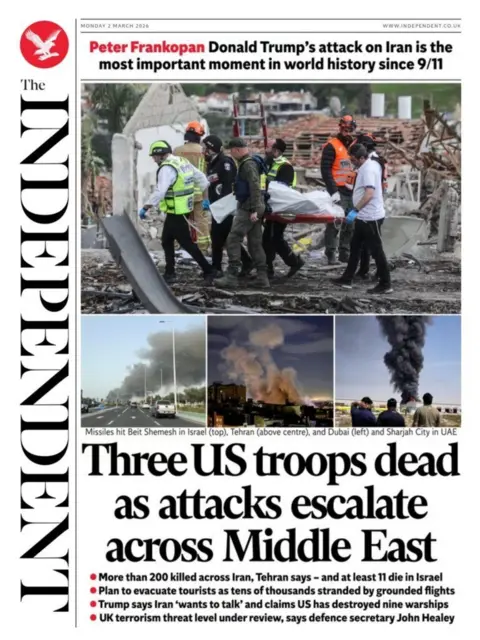
The headline on the front page of the Independent reads: “Three US troops dead as attacks escalate across Middle East”.
The Independent gives an update on death tolls following the offensive, and reports that three US troops have been confirmed dead. It adds that Iran officials say more than 200 people have been killed across the country, while at least 11 people have died in Israel.
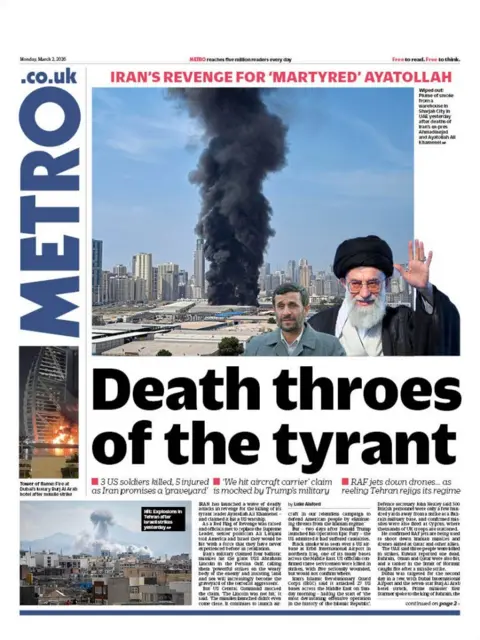
The headline on the front page of the Metro reads: “Death throes of the tyrant”.
The Metro calls the retaliatory attacks the "death throes of the tyrant", writing that "the Red flag of Revenge" has been raised by Iranian officials.
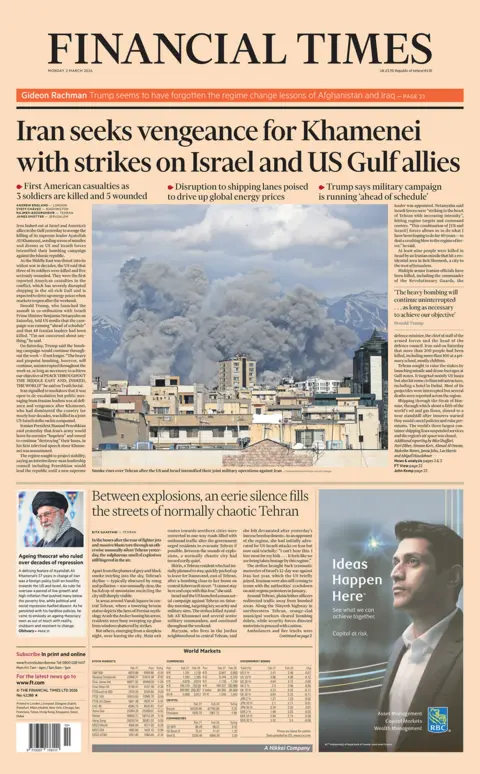
The headline on the front page of the Financial Times reads: “Iran seeks vengeance for Khamenei with strikes on Israel and US Gulf allies”.
"Iran seeks vengeance for Khamenei" says the Financial Times. It reports that although Iran has signalled to mediators that it is open to de-escalation, the public message is one of "defiance and vengeance" following the killing of Iran's supreme leader. The paper also notes that shipping through the Strait of Hormuz has slowed to a near standstill, which is likely to drive up global energy prices.

"Britain backs war on Iran" is the headline in the Daily Telegraph, which leads with the decision to allow the US to use UK military bases to attack Tehran's missile sites. The paper says Sir Keir Starmer's previous refusal to grant such permission caused him to face pressure from some within his own party, and put him at odds with other world leaders. It adds that the initial denial led to President Trump withdrawing his support for the deal to hand the Chagos Islands to Mauritius. Similarly, the Times highlights claims the move "angered" Trump. It characterises Sir Keir's latest decision as a U-turn.

A photograph of a burning Dubai hotel - hit by a shot-down Iranian drone - appears on the front page of the Sun, as it reports on the British nationals "caught in the crossfire".

"Stranded" is the headline in the Daily Mirror, which reports that the government is planning "an unprecedented operation to evacuate holidaymakers and expats by land, sea or air".

According to the Daily Mail - because of closed airspace - the plans could see people driven along desert roads to Saudi Arabia, from where they could fly home. It says officials are in talks with a number of airlines, while the i Paper reports that RAF planes could be used for the operation. The Daily Star terms it "the great escape".

The Financial Times describes the second day of attacks as Iran "lashing out" at Israel and America's Gulf allies "to avenge the killing of its leader". But, the paper says, despite public messages of defiance and vengeance, the Iranians have signalled they are "open to de-escalation".

The Guardian points out that President Trump is "prepared to talk to what is left" of the country's leadership. However, US intelligence officials cited in the international edition of the New York Times say the White House's ability to influence what comes next is "limited".

One official report on what might happen after the Ayatollah's death suggests that "a complete change in government is unlikely" - with the paper saying that Trump has "set in motion events that could be hard to control and that could leave Iran in chaos for some time".

News Daily banner

Sign up for our morning newsletter and get BBC News in your inbox.

News Daily banner