Ethiopia PM hits out at Eritrea over atrocities in Tigray

 Reuters
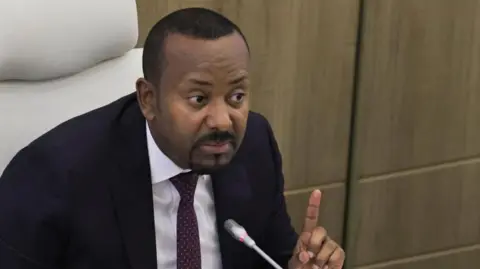
Ethiopia's Prime Minister Abiy Ahmed has hit out at Eritrea's army for committing atrocities during the two-year war in the northern Tigray region, which ended in 2022.
Eritrean forces fought alongside the Ethiopian army against local Tigrayan fighters for control of Tigray, which borders Eritrea.
In an address to parliament, Abiy admitted for the first time that Eritrean troops had massacred people in Aksum - allegations Eritrea had previously denied following reports of mass killings that took place in the historic city over two days in November 2020.
It is the latest twist in a volatile relationship between the two Horn of Africa neighbours, who flip flop from being friends to enemies.
Abiy won the Nobel Peace Prize in 2019 for ending a 20-year military stalemate with Eritrea over a border dispute.
Friendly relations were forged further during the Tigray war, but have of late given way to a war of words over the Red Sea - something landlocked Ethiopia wants access to through Eritrea.
Ethiopia's foreign ministry has also recently accused Eritrea of changing allegiances in Tigray - leading to fears of a renewed conflict in the region.
The African Union (AU) brokered a deal between the government and the Tigray People's Liberation Front (TPLF) to end the brutal Tigray war in November 2022, but Eritrea was not a signatory to the Pretoria Agreement.
At the time Asmara opposed the truce, arguing it should not have been concluded before the TPLF was fully defeated.
All sides were accused of committing atrocities during the Tigray war - with some of the worst abuses blamed on Eritrean troops.
Most communications to the region were cut off during the war - and journalists were not granted access, but the BBC and rights groups like Amnesty International were able to piece together what happened in Aksum.
Witnesses recounted how hundreds of unarmed civilians were killed by Eritrean soldiers - many of them boys and men - during house-to-house raids on 28 and 29 November 2020.
Abiy had told parliament on 30 November 2020 that "not a single civilian was killed" during the operation.
But during his parliamentary address on Tuesday the prime minister admitted that there had been mass killings of young people by Eritrean soldiers.
He added that during the war when allied forces began taking control of Tigray's cities, Eritrean troops had demolished homes, looted properties, destroyed industries and seized machinery in places such as Adwa, Aksum, Adigrat and Shire.
Abiy said he had dispatched envoys to Eritrea during the conflict, urging its government to halt the destruction and killings.
His comments came as passenger flights between Ethiopia's capital, Addis Ababa, and cities in Tigray resumed on Tuesday morning after a five-day suspension.
They had been cancelled because of clashes between the federal army and Tigray fighters in a disputed area of western Tigray - sparking fears of a return to conflict.
An AU envoy estimated that 600,000 people were killed during the two-year Tigray war.
 Getty Images/BBC
Go to BBCAfrica.com for more news from the African continent.
Follow us on Twitter @BBCAfrica, on Facebook at BBC Africa or on Instagram at bbcafrica