3. SURVEY RESULT AND ANALYSIS
subdirectory_arrow_right Figure source:
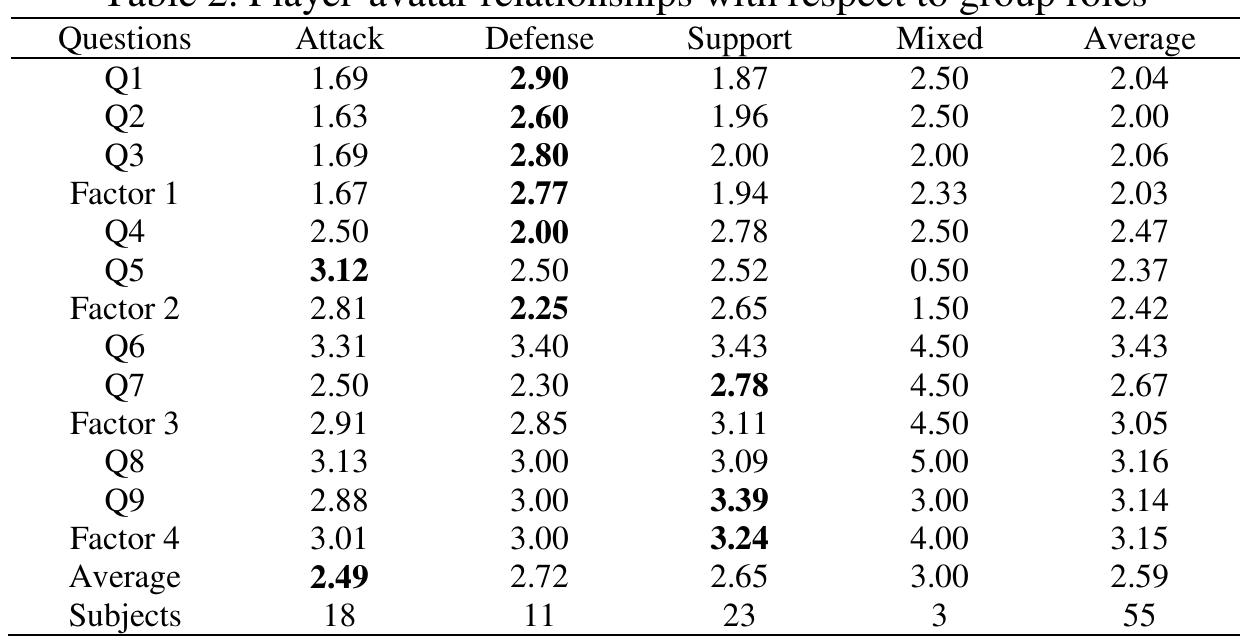
Abstract: Character attachment have been studied thoroughly from the view of psychology and media researches. In game playing, the player-avatar relationship is a form of character attachment and affects a good game design as well as management systems such as character customizing and in game purchasing policy. In this paper, we investigate such player-avatar relationship on the theme of team-based FPS where in general the attachment is not expected to be high. However, from the online survey for Tom Clancy"s Rainbow 6 Siege mania groups, we find that there are different character attachment patterns with respect to the role of players in the teamattacker, defender, and supporter. It shows that attackers think avatar as an "object, but the defenders show more "avatar as others" than the attackers. The supporters show high responsibility for the avatar and their play style is most like "avatar as symbiote" manner.
... Read more Related topics:
First Person Shooter Character Attachment Related Papers Abstract: This paper proposes a new and reliable metric for measuring character attachment (CA), the connection felt by a video game player toward a video game character. Results of construct
validity analyses indicate that the proposed CA scale has a significant relationship with self-esteem, addiction, game enjoyment, and time spent playing games; all of these relationships are predicted by theory. Additionally, CA levels for role-playing games differ significantly from CA levels of other character-driven games.
... Read more
Abstract: This paper proposes a new and reliable metric for measuring character attachment (CA), the connection felt by a video game player toward a video game character. Results of construct validity analyses indicate that the proposed CA scale has a significant relationship with self-esteem, addiction, game enjoyment, and time spent playing games; all of these relationships are predicted by theory. Additionally, CA levels for role-playing games differ significantly from CA levels of other character-driven games.
... Read more
Abstract: The increasing variety and complexity of video games allows players to choose how to behave and represent themselves within these virtual environments. The focus of this dissertation was to examine the connections between the personality traits (specifically, HEXACO traits and psychopathic traits) of video game players and player-created and controlled game-characters (i.e., avatars), and the link between traits and behavior in video games. In Study 1 (n = 198), the connections between player personality traits and behavior in a Massively Multiplayer Online Roleplaying Game (World of Warcraft) were examined. Six behavior components were found (i.e., Player-versus-Player, Social
... Read more
Abstract: One's feelings of intimacy and connectedness with distal, fictional media characters are referred to as parasocial interactions. Video games have challenged this concept, as the distance between game players and characters is greatly reduced, if not completely removed, in virtual environments. Games encourage the internalization and psychological merging of a player's and a character's mind, a multidimensional concept known as character attachment (CA). Data from our study suggest that dimensions of CA are useful in understanding both pro- and anti-social gaming motivations. Pro-social gamers feel a greater sense of control over their characters, while anti-social gamers are more likely to suspend their disbelief of the game environment and not take responsibility for their virtual actions. Pro-social gaming was more prevalent in older gamers, and younger male game characters were motivated by anti-social reasons.
... Read more
Abstract: One's feelings of intimacy and connectedness with distal, fictional media characters are referred to as parasocial interactions. Video games have challenged this concept, as the distance between game players and characters is greatly reduced, if not completely removed, in virtual environments. Games encourage the internalization and psychological merging of a player's and a character's mind, a multidimensional concept known as character attachment (CA). Data from our study suggest that dimensions of CA are useful in understanding both pro- and anti-social gaming motivations. Pro-social gamers feel a greater sense of control over their characters, while anti-social gamers are more likely to suspend their disbelief of the game environment and not take responsibility for their virtual actions. Pro-social gaming was more prevalent in older gamers, and younger male game characters were motivated by anti-social reasons.
... Read more