Academia.eduAcademia.edu

The Pardoner's Tale

description15 papers
group107 followers
lightbulbAbout this topic
The Pardoner's Tale is a narrative from Geoffrey Chaucer's "The Canterbury Tales," exploring themes of greed, morality, and the consequences of vice. It features a Pardoner who preaches against sin while embodying hypocrisy, illustrating the conflict between appearance and reality in medieval society.
lightbulbAbout this topic
The Pardoner's Tale is a narrative from Geoffrey Chaucer's "The Canterbury Tales," exploring themes of greed, morality, and the consequences of vice. It features a Pardoner who preaches against sin while embodying hypocrisy, illustrating the conflict between appearance and reality in medieval society.
In the literary context of the late fourteenth-century London, a group of pilgrims sets off to the shrine of St Thomas à Beckett, in Canterbury. The journey gives each of them the possibility to interact with their fellow travellers and... more
This article explores various kinds of maternal rhetoric featured by a series of female speakers in Fragment VI of the Canterbury Tales: from the Physician's Tale, the Goddess Nature fostering new birth and the maiden Virginia imitating... more
The Pardoner has long been known as one of the most marginal characters of the Canterbury Tales, an "abandoned wretch" and "the one lost soul among the Canterbury pilgrims," as George Lyman Kittridge has called him, the very last of the... more
This article introduces a strategic decision-game theoretic approach, the Pardoner's Dilemma, and juxtaposes it with the Prisoner's Dilemma. Game theory has emerged as a significant approach in the twentieth century for explaining... more
In Geoffrey Chaucer's The Canterbury Tales (1387-1400), the arboreal is imbued with symbolic and allegorical meaning. Used by Chaucer as rhetorical devices, the trees in "The Merchant's Tale" symbolize fertility, while the tree in "The... more
The editorial staff of New Chaucer Studies: Pedagogy and Profession works hard to ensure that contributions are accurate and follow professional ethical guidelines. However, the views and opinions expressed in each contribution belong... more
The Parson's penitential "meditaci01D1," which Harry Bailly describes as having "som vertuous sentence," points to the hereafter, appropriately concluding Chaucer's earthly tales of mirth and solas, joy and woe, comedy and tragedy. For... more
As members of the Dissertation Committee, we certify that we have read the dissertation prepared by Jason Herman entitled Intention, Utility and Chaucer’s Retraction and recommend that it be accepted as fulfilling the dissertation... more
The Parson's penitential "meditaci01D1," which Harry Bailly describes as having "som vertuous sentence," points to the hereafter, appropriately concluding Chaucer's earthly tales of mirth and solas, joy and woe, comedy and tragedy. For... more
The paper sets out to argue that the Pardoner's atypical sexuality is subversive of the medieval gender matrix and that his challenge to heteronormativity is ultimately encompassed and disarmed. Chaucer presents the Pardoner as a genderly... more
Despite few overt references to the Second Plague Pandemic (1348-1840), The Canterbury Tales (c.1387-1400) offer a compelling psychogram of a diverse community processing massive demographic shifts in the wake of recurrent epidemic waves.... more
The editorial staff of New Chaucer Studies: Pedagogy and Profession works hard to ensure that contributions are accurate and follow professional ethical guidelines. However, the views and opinions expressed in each contribution belong... more
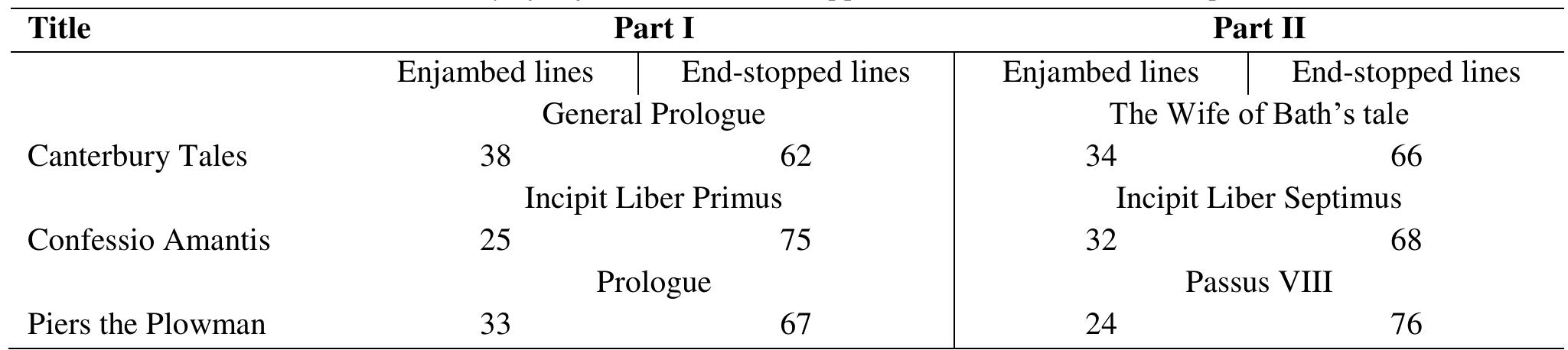
Poetry, being one of the two main categories of literature in general, has recently been subject to subordinate attention in literatures in terms of form, especially the poetic part of medieval epoch. Alongside the structural and semantic... more
This article looks again at the figure of the Pardoner in the Canterbury Tales and reconsiders the possibility that 'he' is a woman passing as a man. The importance of such a reading is revealed by exploring the anxieties this raises over... more
This essay pursues imperfect analogies between Chaucerian poetics and border theory/pedagogy, drawing on the author’s experience teaching Chaucer in the US-Mexico Borderlands. It calls for reading Chaucer from the classroom and from the... more
Teaching secondary students amid the COVID-19 pandemic and intensified national concern over  racial injustice offered an opportunity for reflection about how we frame the past and approaches to  curriculum moving forward.
Death has long been a topic in concern for all humans. Regardless of gender, nationality or time period, we all reach the same destination: death. However, the interpretation of death itself does not always stay the same, but radically... more
The contrast between Dorigen's faithfulness to her husband in the Franklin's Tale and Alison's deceit towards Absolon and John in the Miller's Tale illustrates how women are held to a religious double standard in which they must sacrifice... more
Compare and contrast between Geoffrey Chaucer"s contemporary  society and 21st century century.
A survey of how sexuality is written about in Chaucer using close readings of specific passages: the Pardoner's GP Portrait, Pandarus' "joking" (attempted?) rape of Crisyede in "Troilus and Crisyede" Book 3, the Wife of Bath's praise of... more
-it was a code of behavior for knights (fighting men) requiring bravery, honor, courtesy, protection of the weak, respect and courtly love for women, generosity, fairness to enemies (i.e. the use of "might for right"-NOT "might makes... more
Chaucer's Pardoner in the context of 14th c. religious developments--Wyclif, etc.
Johns Hopkins University Press is collaborating with JSTOR to digitize, preserve and extend access to New Literary History. JSTOR is a not-for-profit service that helps scholars, researchers, and students discover, use, and build upon a... more
Generations of scholars have analyzed the culminating tale of Geoffrey Chaucer’s The Canterbury Tales—The Pardoner’s Prologue and Tale, asserting the confessional theme, sermon structure, sacramental hermeneutics or reconciliation results... more
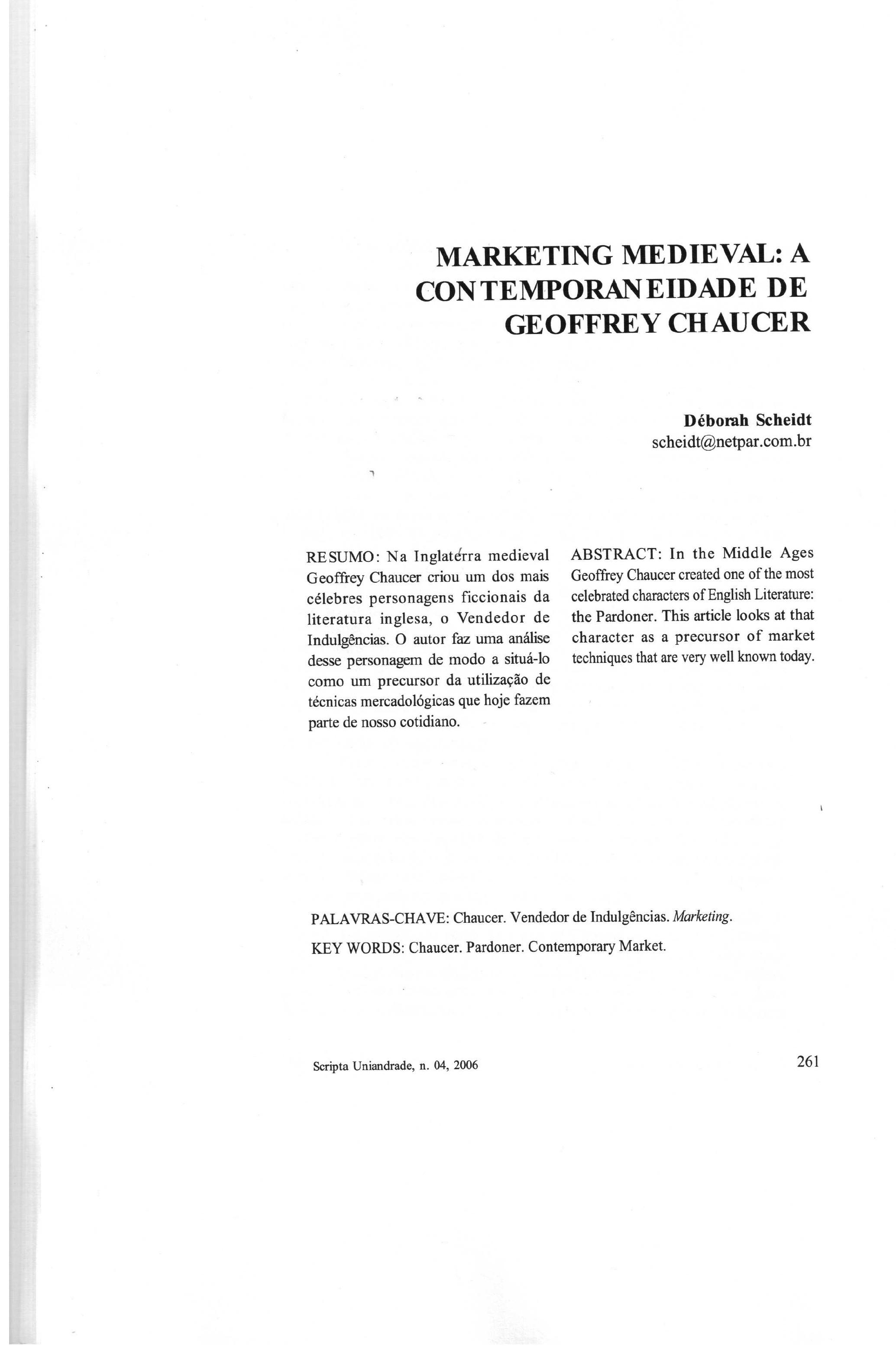
In the Middle Ages Geoffrey Chaucer created one of the most
celebrated characters of English Literature: the Pardoner. This article looks at the character as a precursor of market techniques
that are very well known today.
In the literary context of the late fourteenth-century London, a group of pilgrims sets off to the shrine of St Thomas à Beckett, in Canterbury. The journey gives each of them the possibility to interact with their fellow travellers and... more
By means of some veiled hints related to the figure of the Pardoner, Chaucer introduces his readers to a peculiar character whose ambiguous moral and sexual identity might be discovered in a far-flung Germanic past once prevailing in... more
Download research papers for free!