Academia.eduAcademia.edu

Subexponential distributions

description17 papers
group0 followers
lightbulbAbout this topic
Subexponential distributions are a class of probability distributions characterized by their tail behavior, where the tail of the distribution decays slower than an exponential distribution. They are often used in reliability theory and risk management to model heavy-tailed phenomena, where large values have a significant probability of occurrence.
lightbulbAbout this topic
Subexponential distributions are a class of probability distributions characterized by their tail behavior, where the tail of the distribution decays slower than an exponential distribution. They are often used in reliability theory and risk management to model heavy-tailed phenomena, where large values have a significant probability of occurrence.
The Johnson system of distributions provides a flexible framework for modeling continuous random variables through monotonic transformations of the standard normal distribution. Despite its widespread use, the system is typically... more
We investigate the asymptotic behaviour of (1-G(x))-(I np,)(l-F(x)) as x +OO if 1-F is regularly varying with index p, 0~ p < 1. Applications to random walk theory and infinite divisibility are given. regular variation * subordination *... more
In this paper, according to a certain criterion, we divide the exponential distribution class into some subclasses. One of them is closely related to the regular-variation-tailed distribution class, so it is called the... more
Considering slowly varying functions (SVF), Seneta in 2019 conjectured the following implication, for α ≥ 1, x 0 y α−1 (1 − F (y))dy is SVF =⇒ [0,x] y α dF (y) is SVF, as x → ∞, where F (x) is a cumulative distribution function on [0, ∞).... more
We define a new class of positive and measurable functions that are bounded by regularly varying functions (which were introduced by Karamata). We study integrals and Laplace transforms of these functions. We use the obtained results to... more
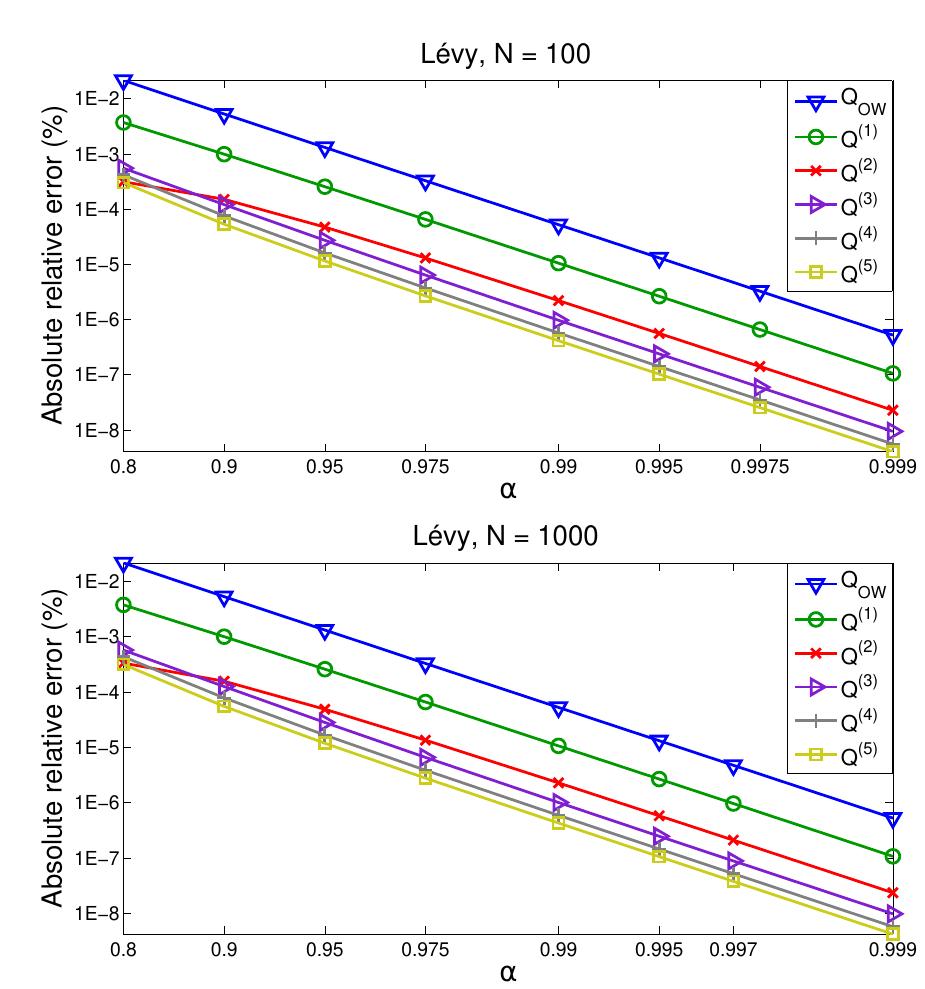
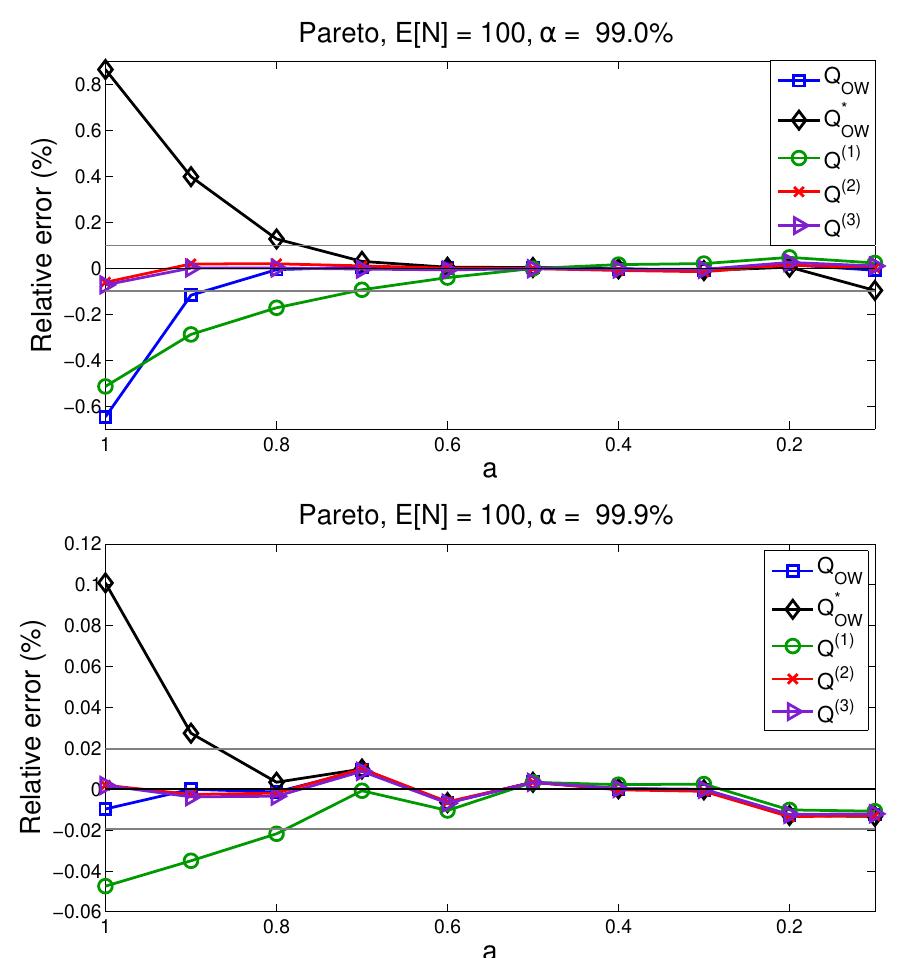
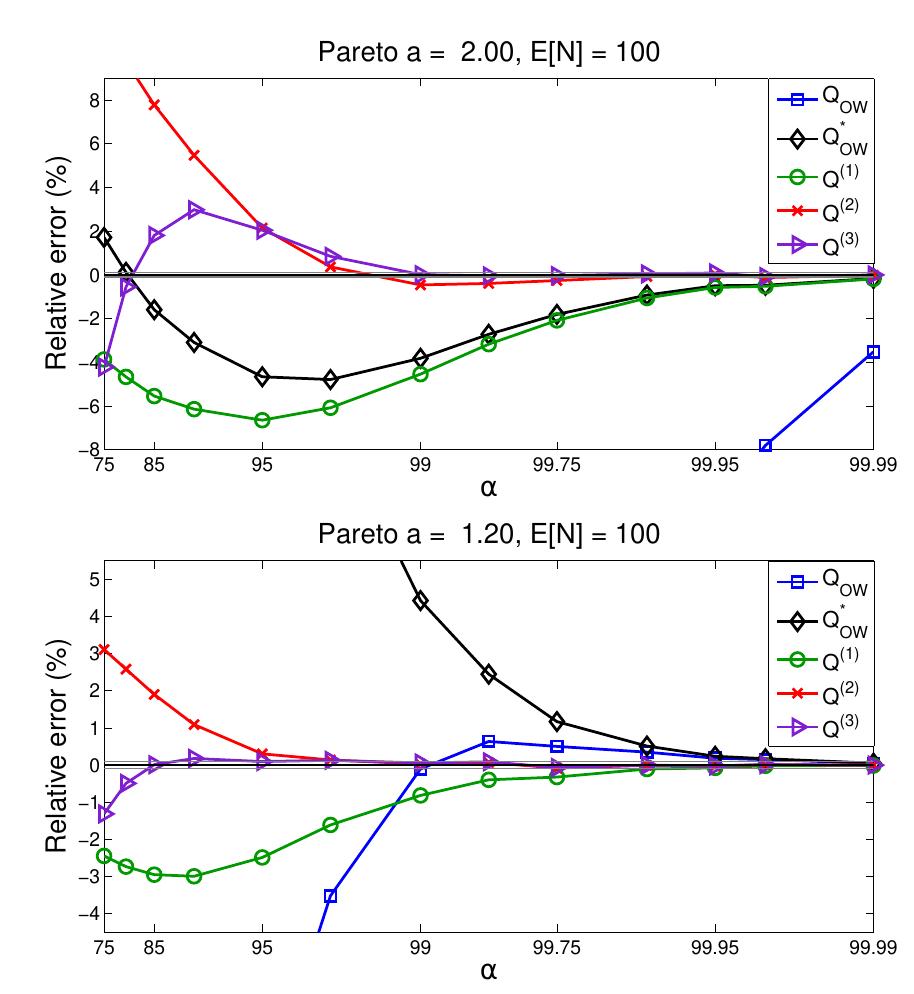
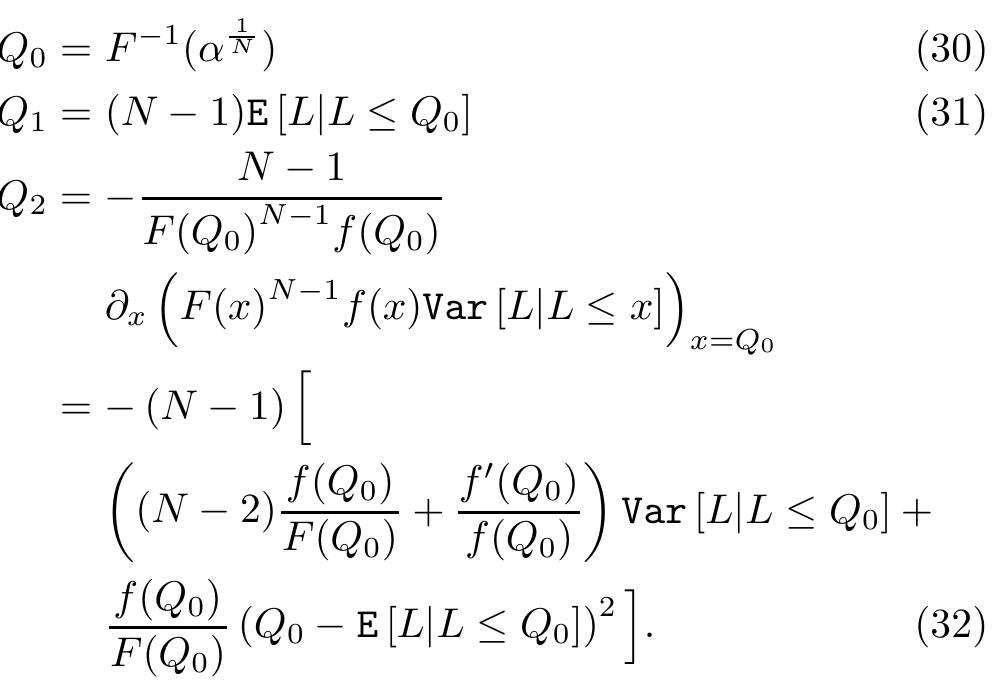
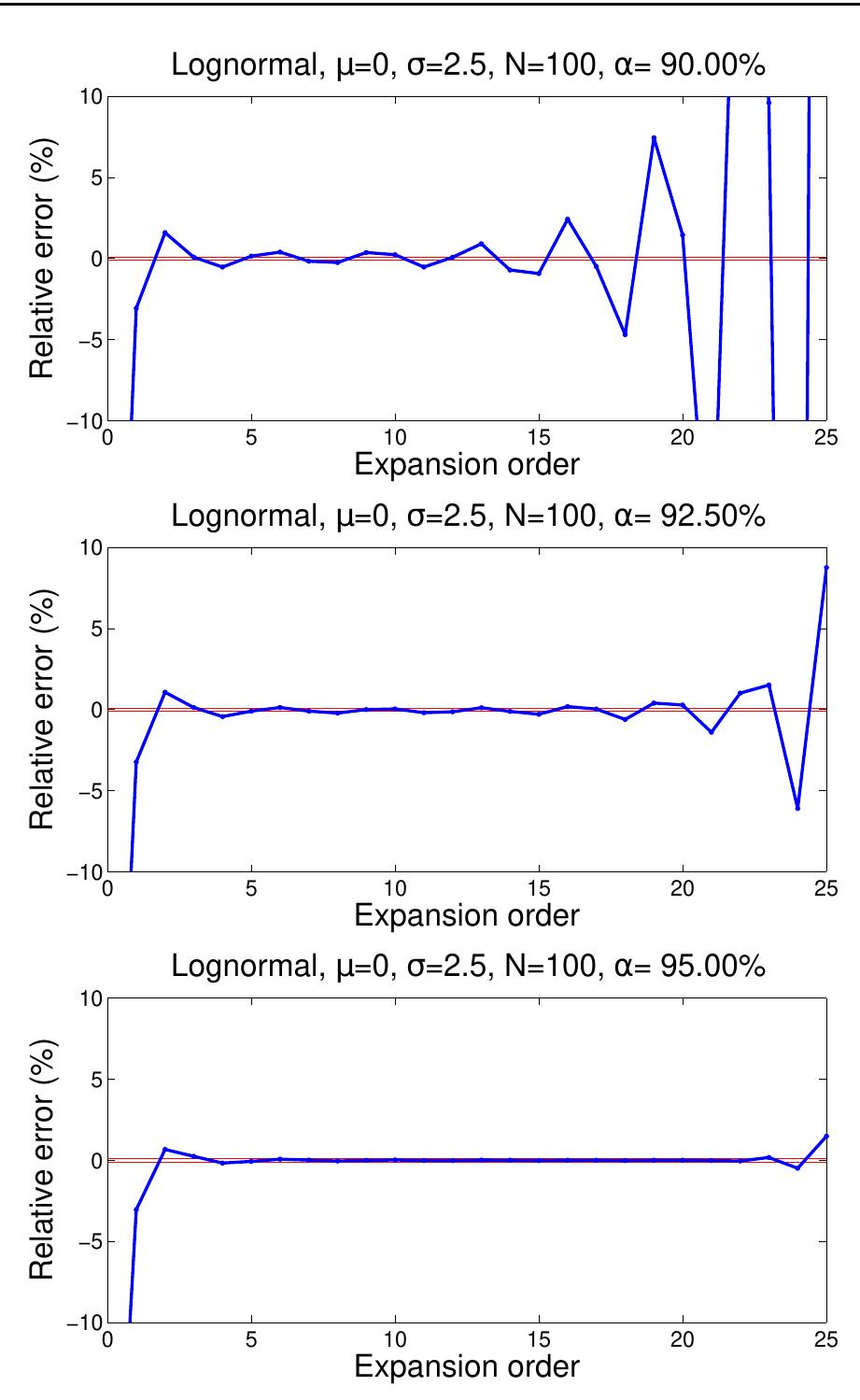
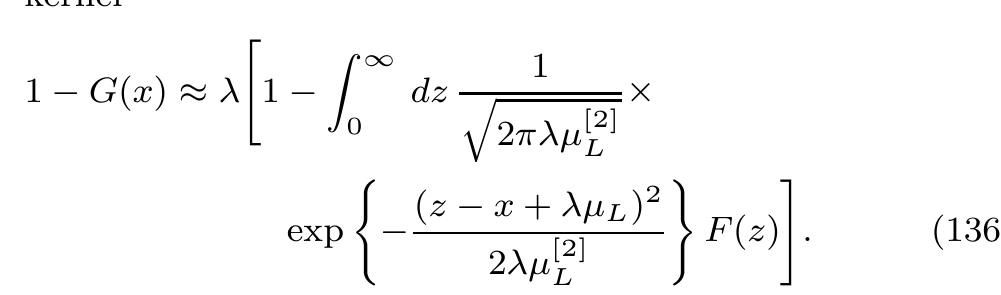
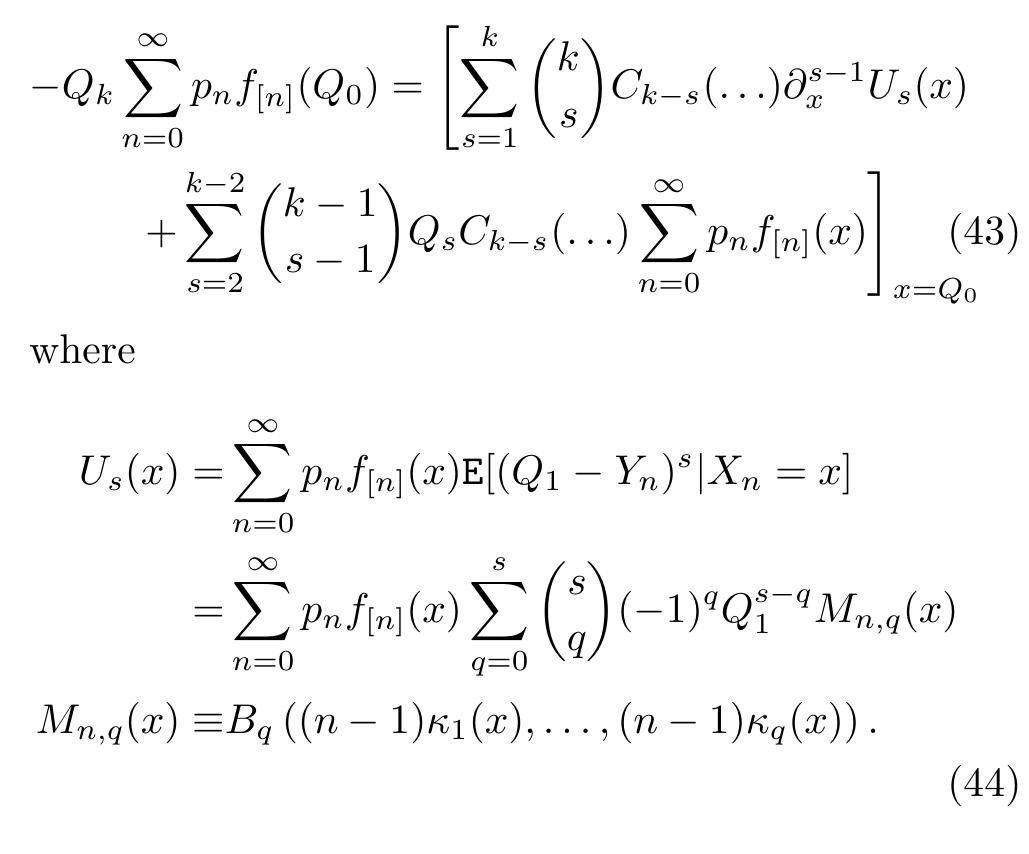
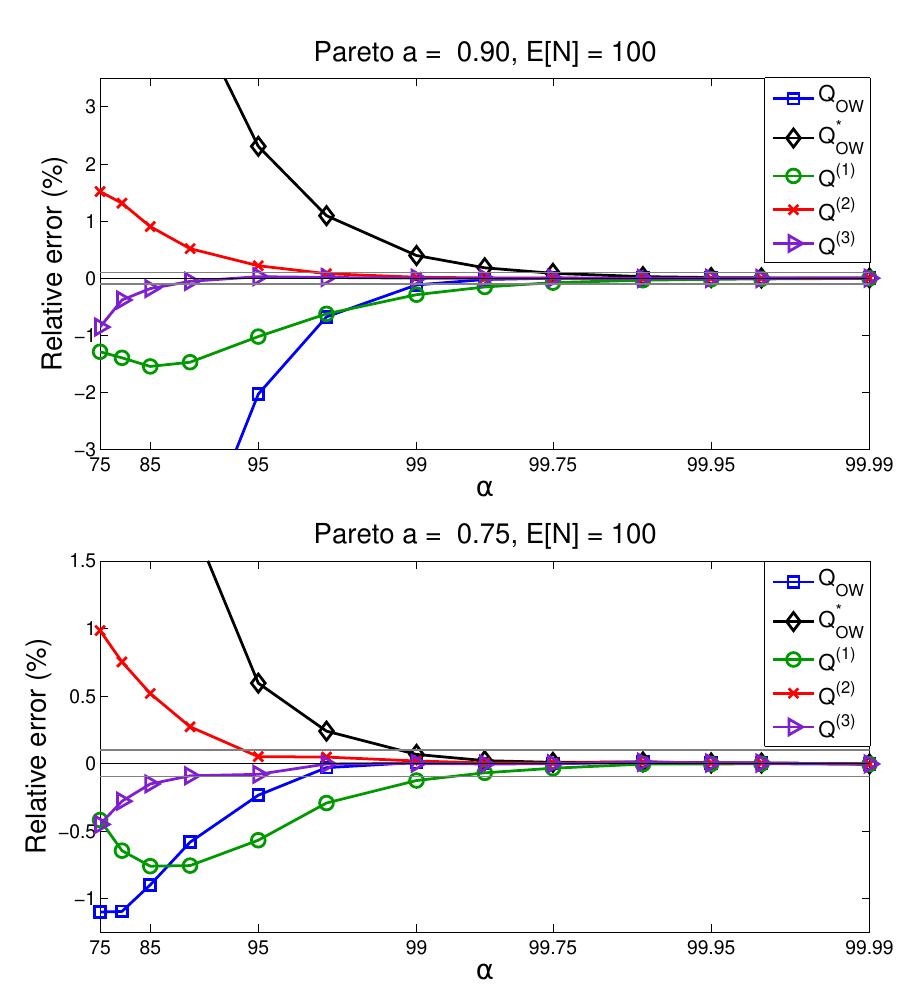
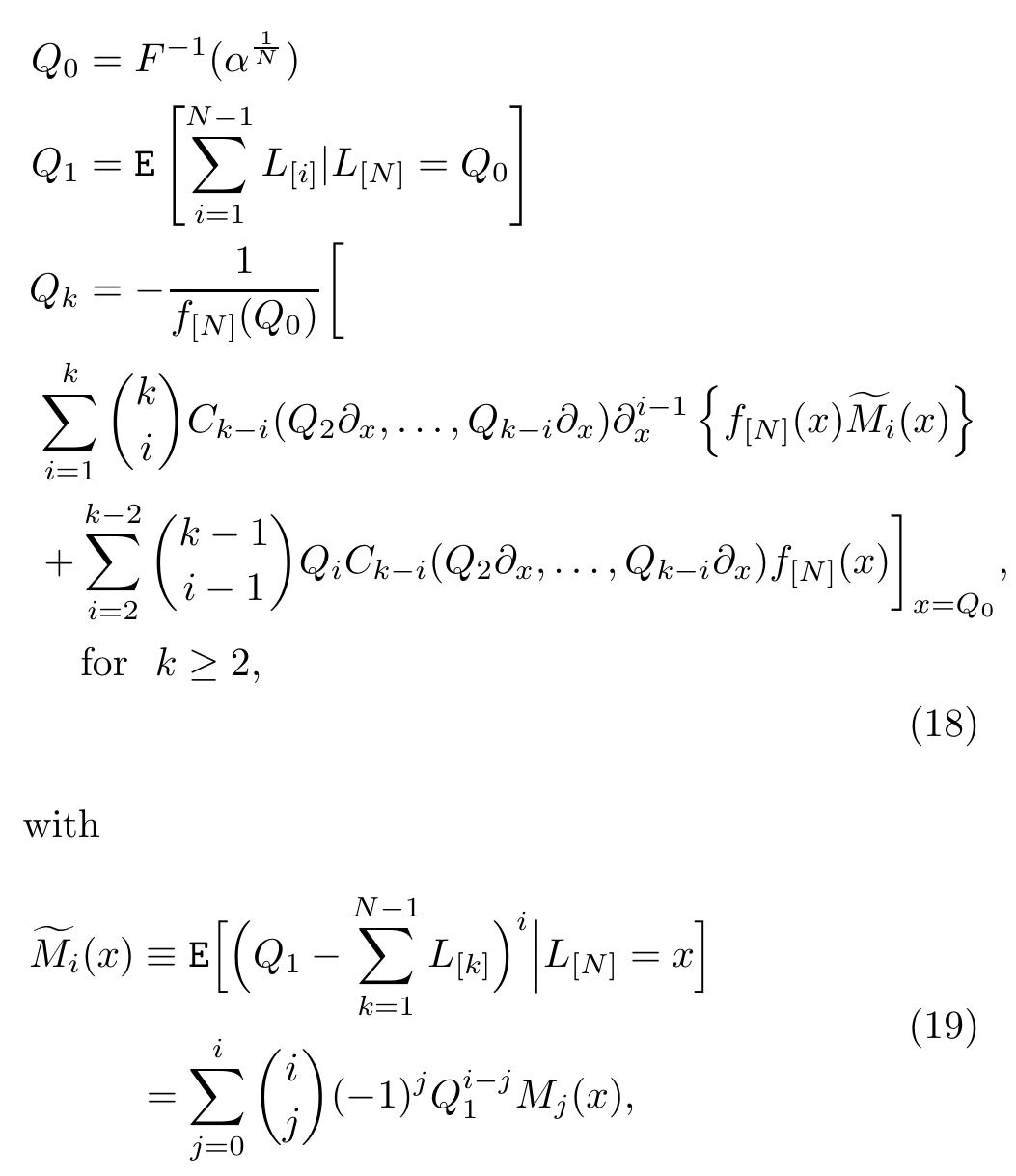
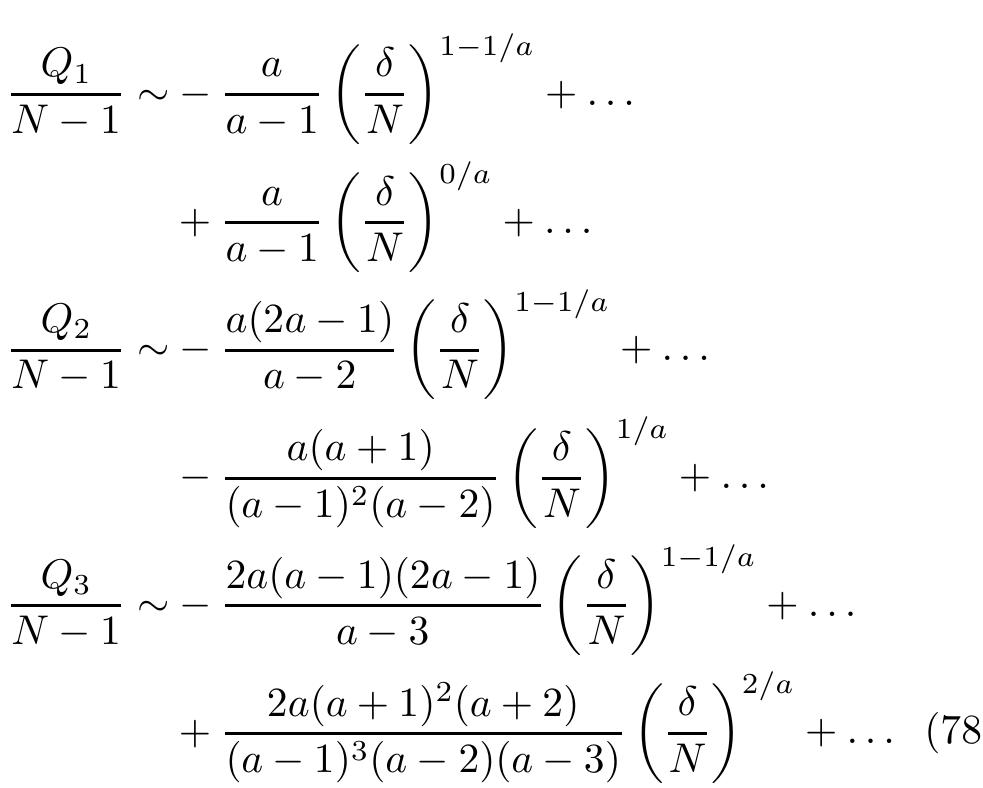
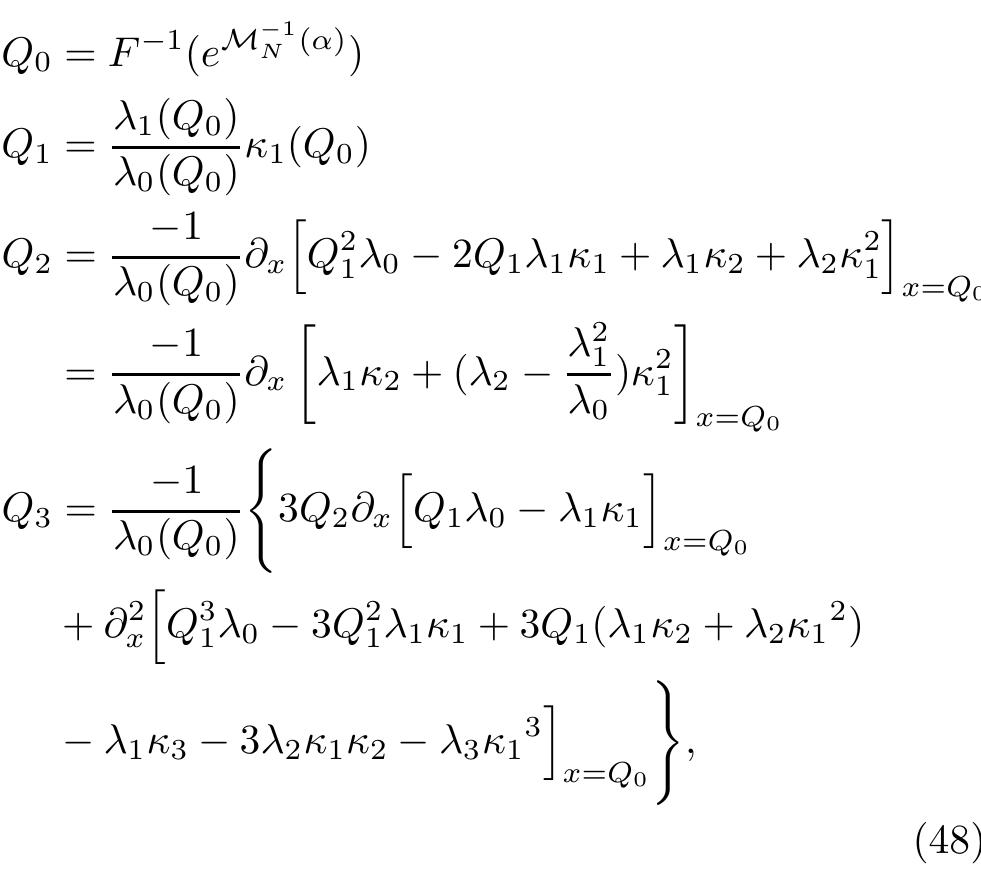
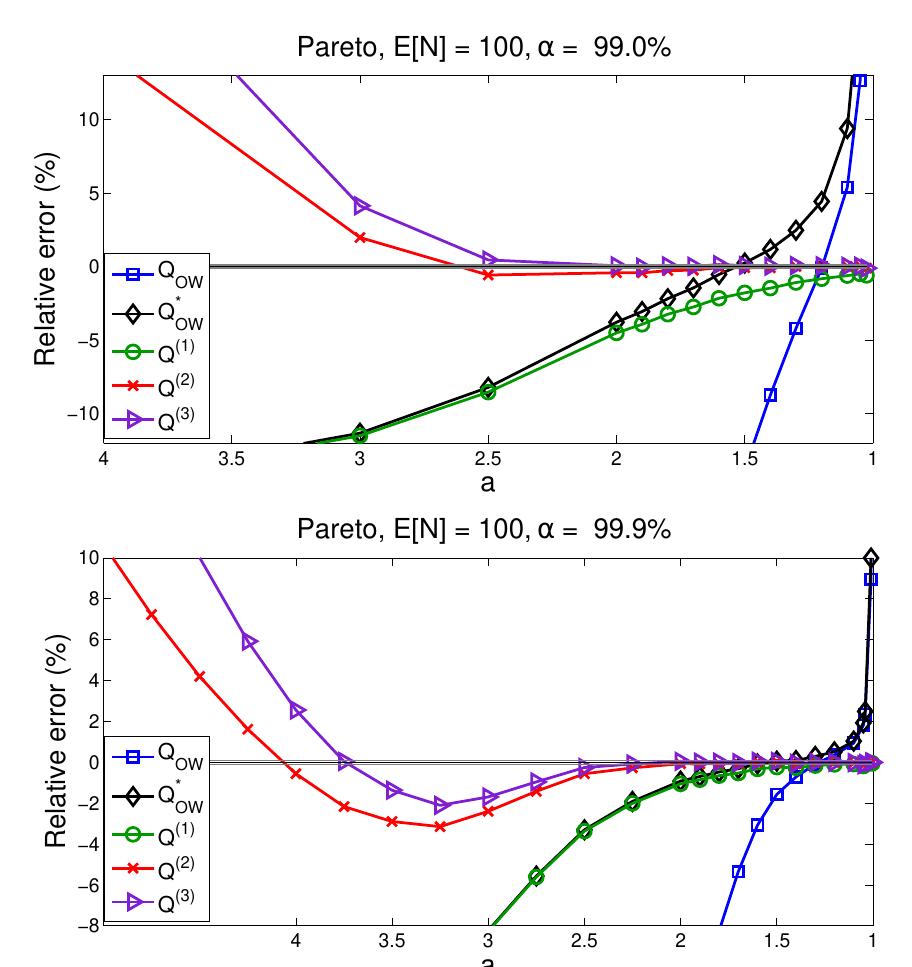
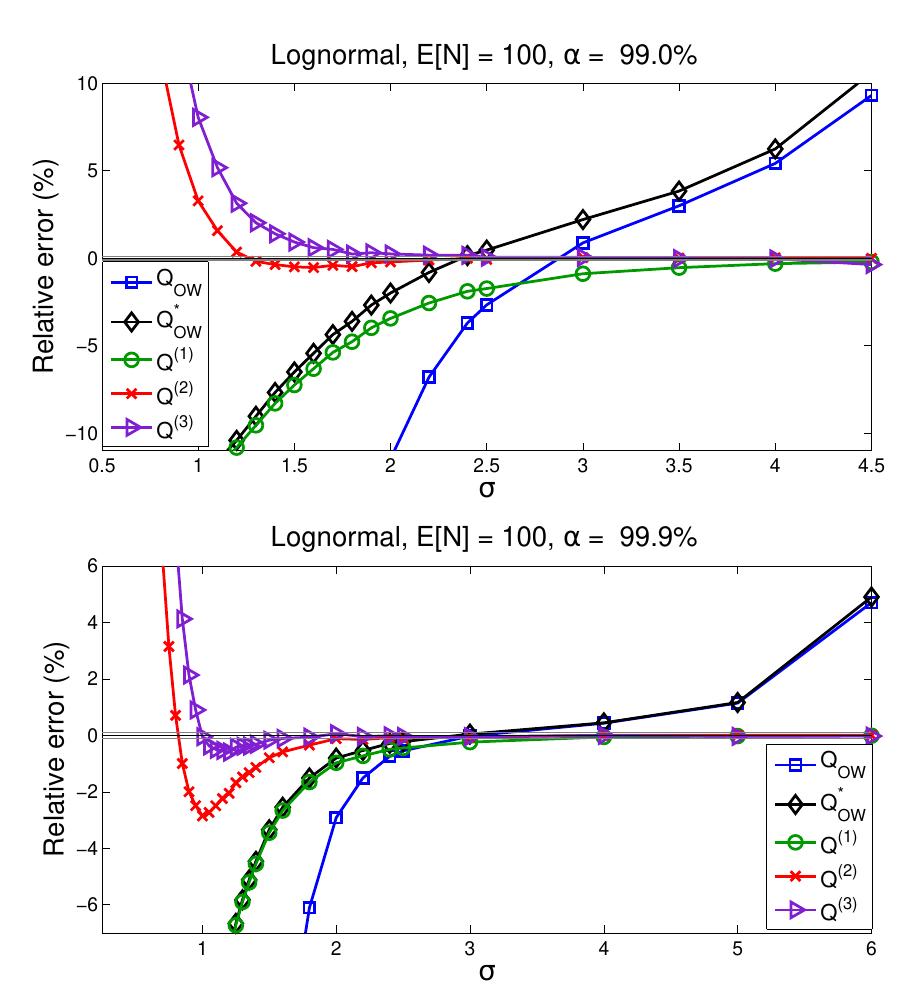
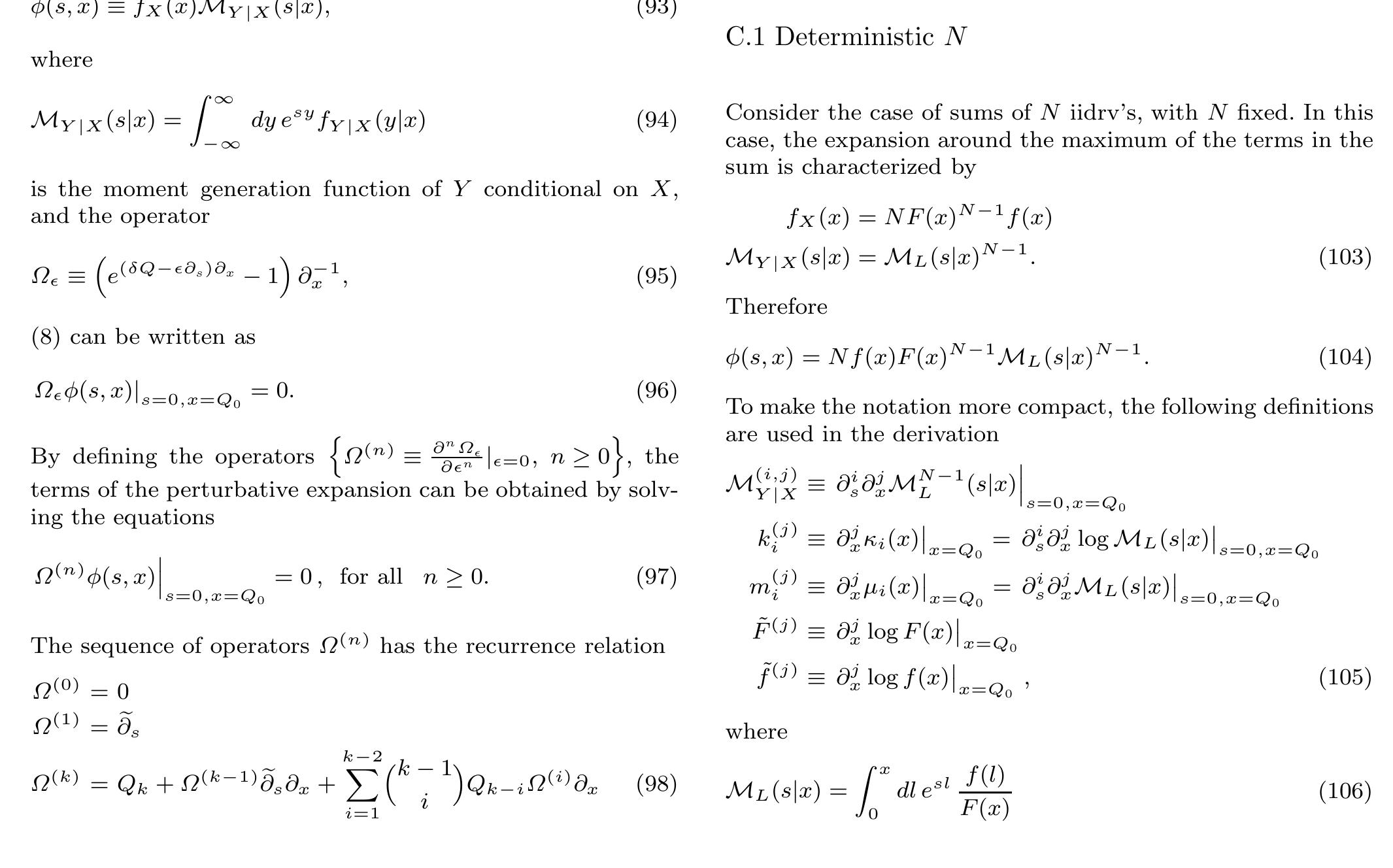
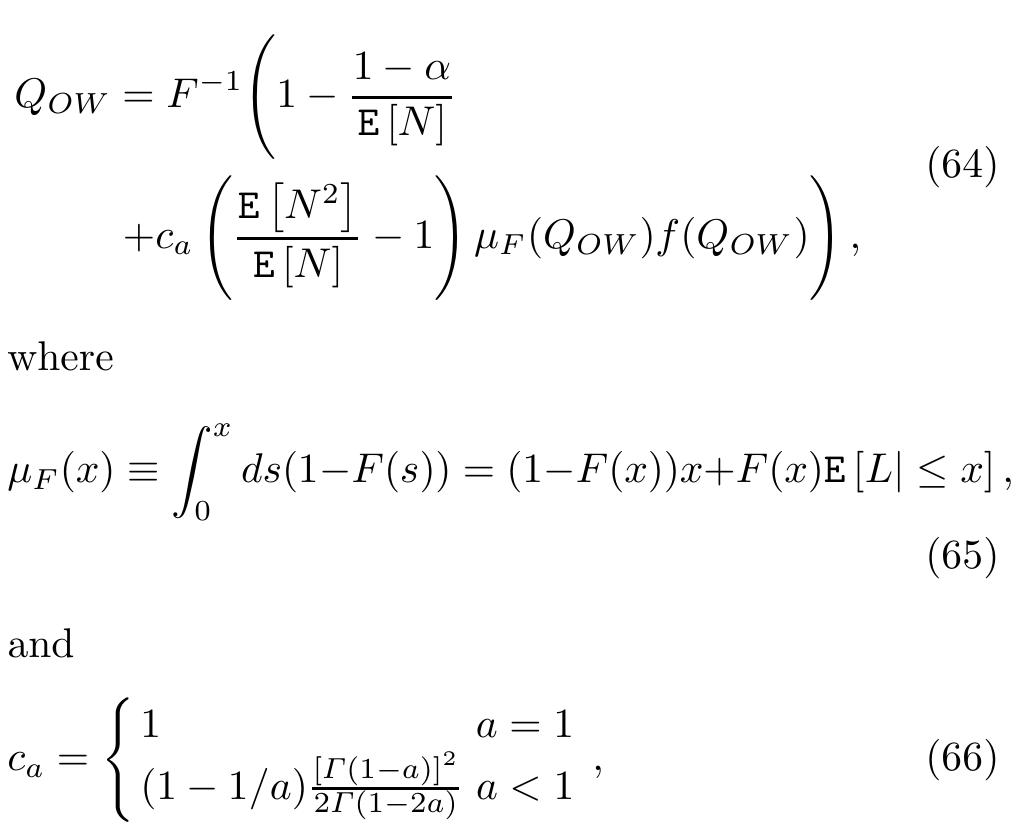
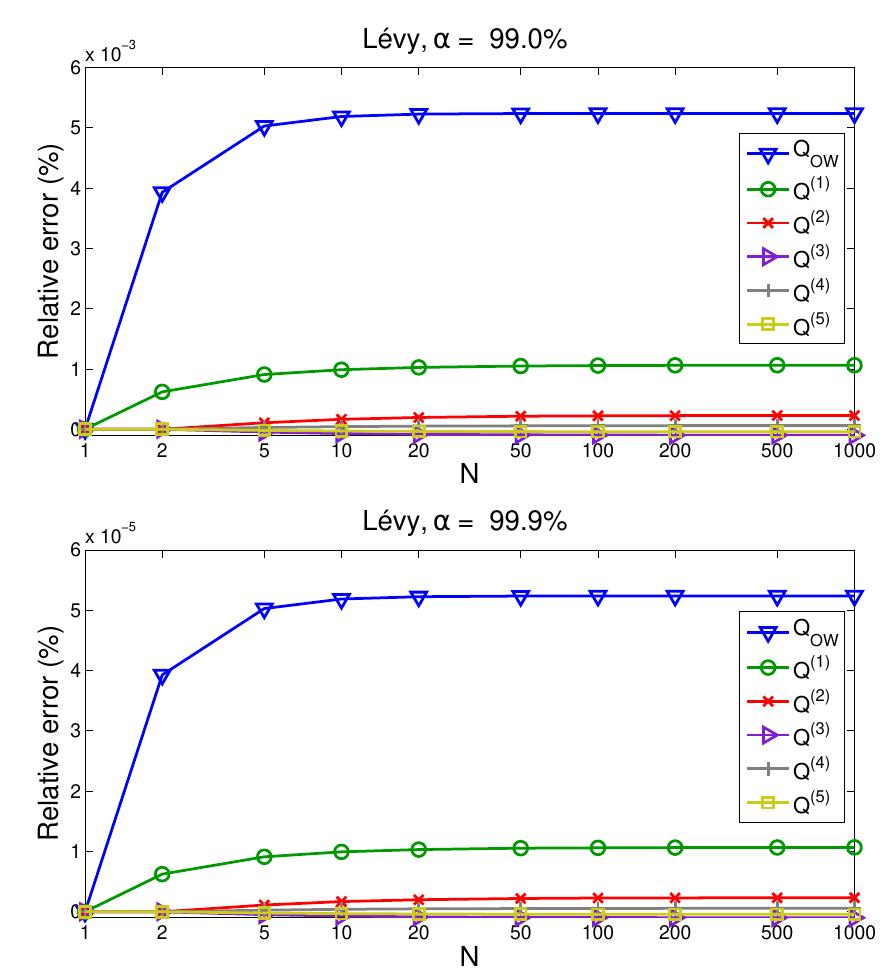
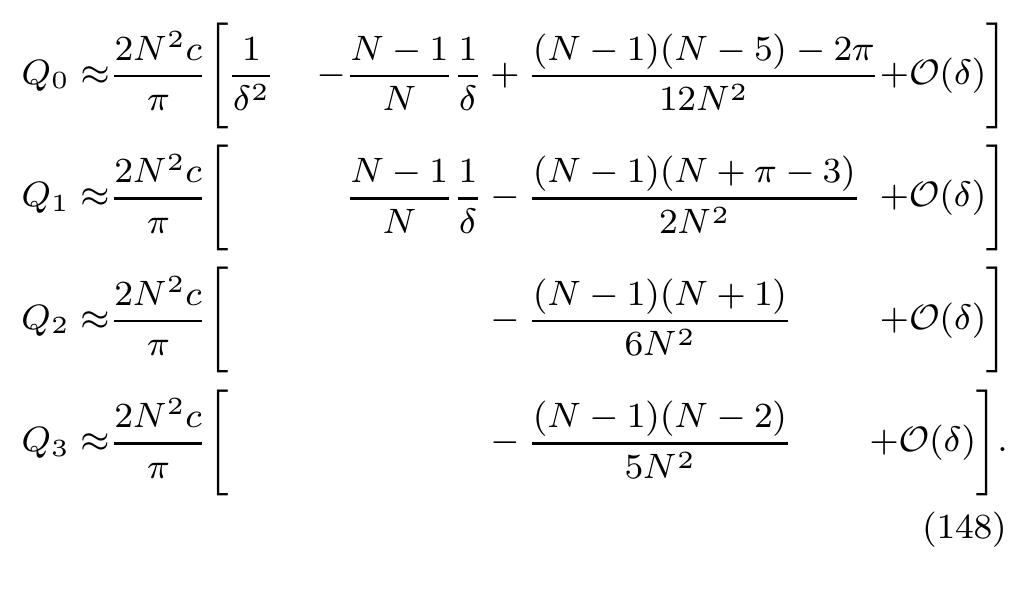
A perturbative approach is used to derive approximations of arbitrary order to estimate high percentiles of sums of positive independent random variables that exhibit heavy tails. Closed-form expressions for the successive approximations... more
We construct approximations to the renewal function for a bivariate renewal process. Suppose (X, Y), (X 1 , Y 1), (X 2 , Y 2),. .. denote i.i.d.
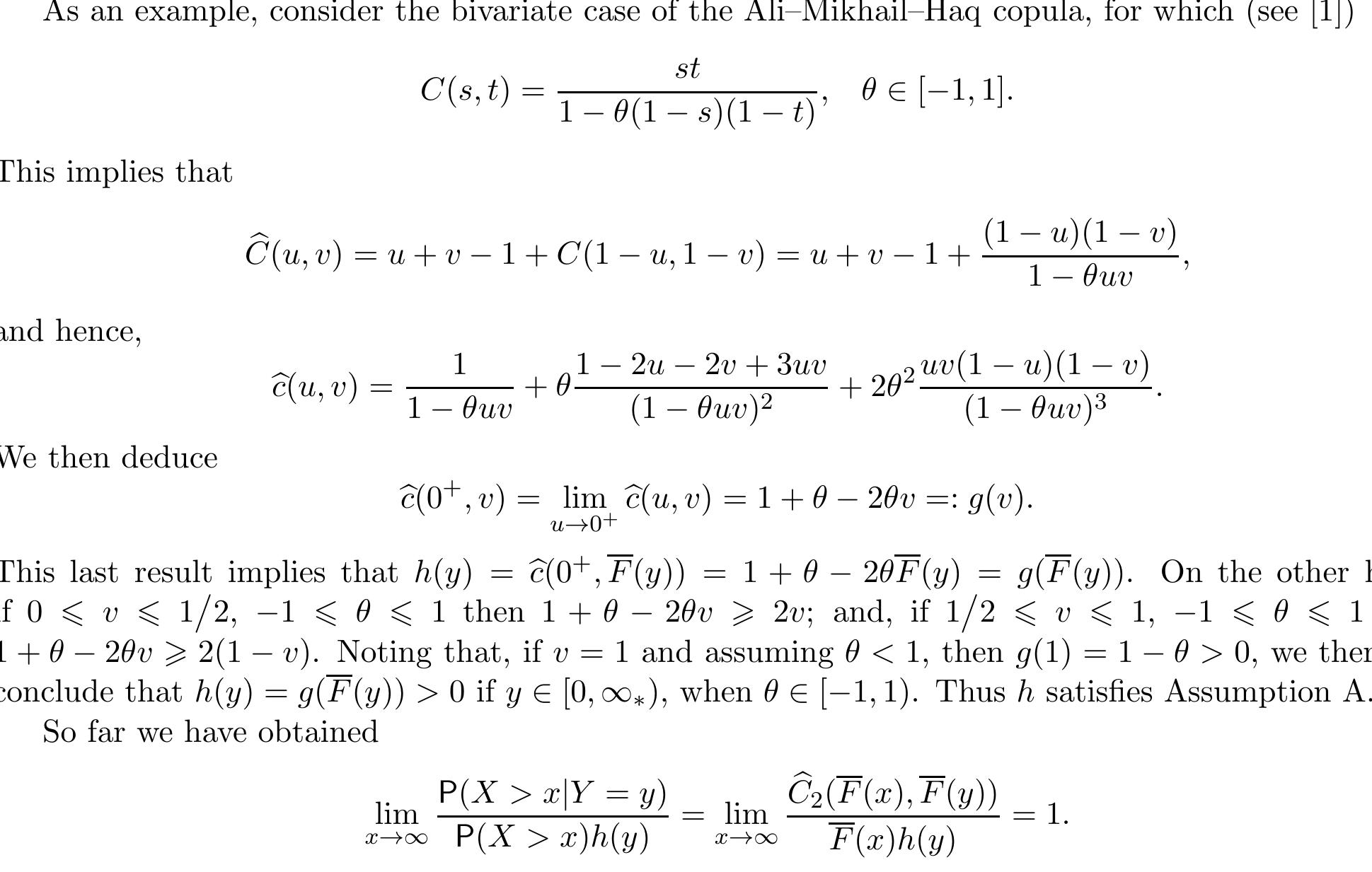
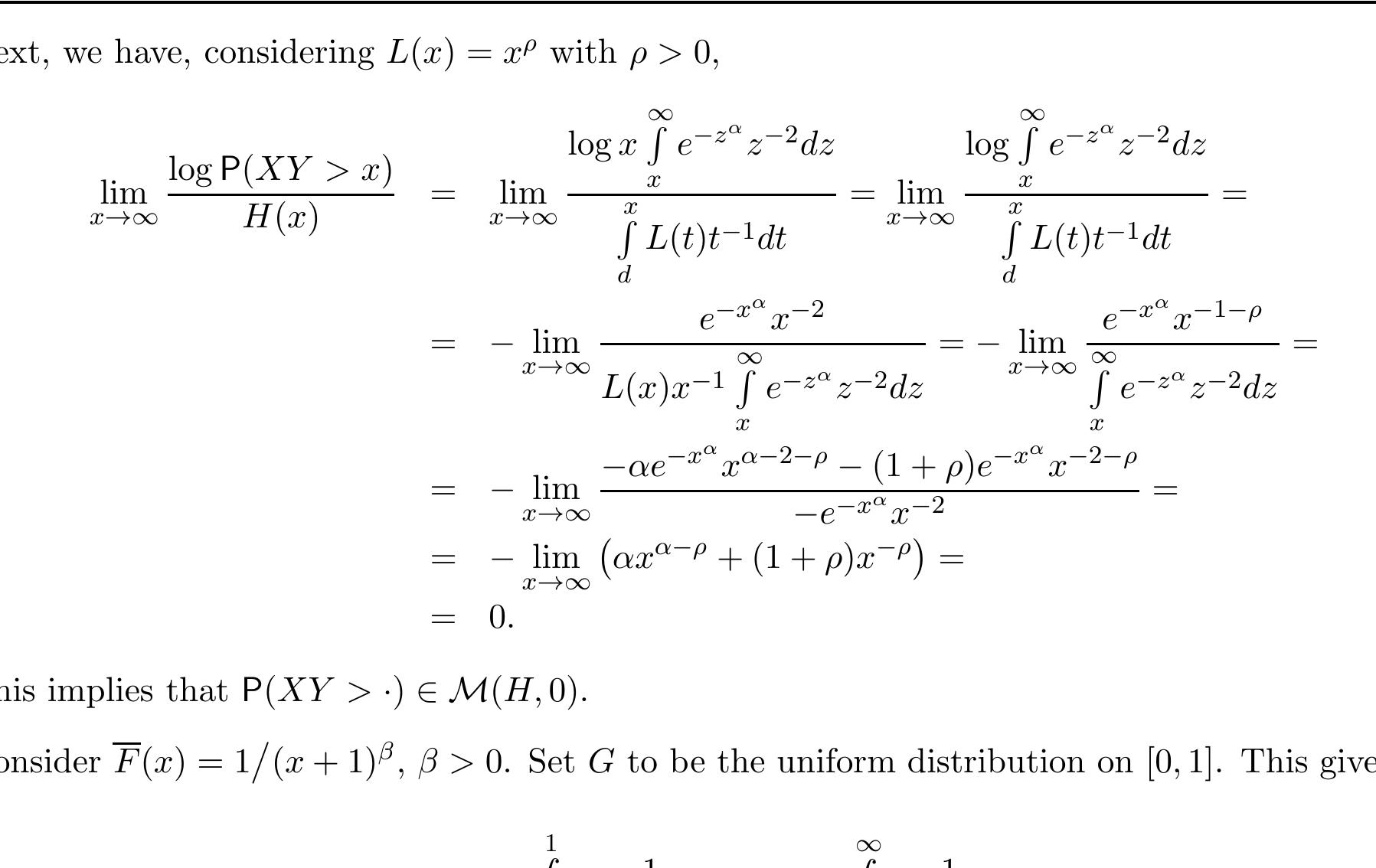
For a large class of distribution functions we study properties of the product of random variables X and Y. We take into account the dependency structure between X and Y by making assumptions about the asymptotic equality P(X > x|Y = y) ∼... more
We study some properties of the distribution function of a random variable of the form X = C D , where C and D are independent random variables. We assume that C is absolutely continuous and limited to a finite interval, such that its... more
We propose a general framework for obtaining asymptotic distributional bounds on the stationary backlog W A1+A2;c in a bu er fed by a combined uid process A 1 +A 2 and drained at a constant r a t e c. The uid process A 1 is an independent... more
A perturbative approach is used to derive approximations of arbitrary order to estimate high percentiles of sums of positive independent random variables that exhibit heavy tails. Closed-form expressions for the successive approximations... more
We construct approximations to the renewal function for a bivariate renewal process. Suppose (X, Y), (X 1 , Y 1), (X 2 , Y 2),. .. denote i.i.d.
In this paper, according to a certain criterion, we divide the exponential distribution class into some subclasses. One of them is closely related to the regular-variation-tailed distribution class, so it is called the... more
For a large class of distribution functions we study properties of the product of random variables X and Y. We take into account the dependency structure between X and Y by making assumptions about the asymptotic equality P(X > x|Y = y) ∼... more
This paper studies the subexponential properties of the stationary workload, actual waiting time and sojourn time distributions in work-conserving single-server queues when the equilibrium residual service time distribution is... more
We study distributions F on [0,8) such that for some T = 8, F*2(x, x+T] ~ 2F(x, x+T]. The case T = 8 corresponds to F being subexponential, and our analysis shows that the properties for T &lt; 8 are, in fact, very similar to this... more
We study the asymptotic probability that a random walk with heavytailed increments crosses a high boundary on a random time interval. We use new techniques to extend results of Asmussen [Ann. Appl. Probab. 8 (1998) 354-374] to completely... more
Suppose X, i = 1,2,. are i.i.d. positive random variables with d.f. F. We assume the tail d.f. F = 1-F to be regularly varying (F(tx)/F(t) + x-" ,x > 0,t + 30) with 0 < /3 < 1. The asymptotic behaviour of P(~,v > x) as x + cc where S, =... more
We propose a general framework for obtaining asymptotic distributional bounds on the stationary backlog W A1+A2;c in a bu er fed by a combined uid process A 1 +A 2 and drained at a constant r a t e c. The uid process A 1 is an independent... more
Lowering of service indicator at Bedridden Room, which one of them is caused by the low of nurse performance. This research aim to know the relation of individual characteristic and work load with nurse performance in Bedridden Room of... more
A perturbative approach is used to derive approximations of arbitrary order to estimate high percentiles of sums of positive independent random variables that exhibit heavy tails. Closed-form expressions for the successive approximations... more
We consider the tail behavior of the product of two independent nonnegative random variables X and Y. Breiman (1965) has considered this problem, assuming that X is regularly varying with index α and that E{Yα+ε} &lt; ∞ for some ε &gt; 0.... more
Let (X, Y), (X 1 , Y 1), (X 2 , Y 2),. .. denote independent positive random vectors with common distribution function F (x, y) = P (X x, Y y) with F (x, y) < 1 for all x, y. Based on the X i and the Y j we construct the sum sequences S 1... more
Let F (x) denote a distribution function in R d and let F * n (x) denote the nth convolution power of F (x). In this paper we discuss the asymptotic behaviour of 1 − F * n (x) as x tends to ∞ in a certain prescribed way. It turns out that... more
Let X 1 , X 2 , . . . X n be independent and identically distributed (i.i.d.) non-negative random variables with common distribution function (d.f.) F with unbounded support and EX 2 1 < ∞. We show that for a large class of heavy tailed... more
Abstract. The convolution of regularly varying probability densities is proved asymptotic to their sum, and hence is also regularly varying. Ex-tensions to rapid variation, O-regular variation, and other types of asymptotic decay are also... more
Convolutions of long-tailed and subexponential distributions play a major role in the analysis of many stochastic systems. We study these convolutions, proving some important new results through a simple and coherent approach, and showing... more
Convolutions of long-tailed and subexponential distributions play a major role in the analysis of many stochastic systems. We study these convolutions, proving some important new results through a simple and coherent approach, and also... more
The paper provides a new test of convergence and divergence of positive series. In particular, it extends the known test by Margaret Martin [Bull. Amer. Math. Soc. 47, 452–457 (1941)].
We improve on some results of Sundt (1982) on the asymptotic behaviour of compound negative binomial distributions.
The class of subexponential distributions S is characterized by F(0) = 0, 1 − F(2)(x) ~ 2(1 − F(x)) as x → ∞. In this paper we consider a subclass of S for which the relation 1 − F(2)(x) − 2(1 − F(x)) + (1 − F(x))2 = o(a(x)) as x → ∞... more
In this chapter we are interested in (right-) tail properties of distributions, i.e. in properties of a distribution which, for any x, depend only on the restriction of the distribution to (x, ∞). More generally it is helpful to consider... more
Suppose that {f (n), n ∈ N 0 } is a sequence of positive real numbers and suppose that the sequence {a(n), n ∈ N 0 } is given by a(0) = 0, and, for n 1, by the convolution equation nf (n) = a * f (n). The resulting sequence is denoted by... more
by Kai Ng
Consider a sequence {X k , k ≥ 1} of random variables on (−∞, ∞). Results on the asymptotic tail probabilities of the quantities , and S (n) = max0 ≤ k ≤ n S k , with X 0 = 0 and n ≥ 1, are well known in the case where the random... more
In this paper we study the local behaviour of a characteristic of two types of shock models. In many physical systems, a failure occurs when the stress or the fatigue, represented by "(n), reaches a critical level x. We are interested in... more
Suppose that {f (n), n ∈ N 0 } is a sequence of positive real numbers and suppose that the sequence {a(n), n ∈ N 0 } is given by a(0) = 0, and, for n 1, by the convolution equation nf (n) = a * f (n). The resulting sequence is denoted by... more
Let fX;Xi; i = 1; 2; :::g denote independent positive random variables having a common distribution function F(x) and, independent of X, let N denote an integer valued random variable. Using S(0) = 0 and S(n) = S(n ?? 1) + Xn, the random... more
A distribution function F on the nonnegative real line is called subexponential if xlimoo (1-e*"(x))/(1-F(x)) = n, for all n /> 2, where F *n denotes the n-fold Stieltjes convolution of F with itself. In this paper, we consider the rate... more
Let (X, Y), (X 1 , Y 1), (X 2 , Y 2),. .. denote independent positive random vectors with common distribution function F (x, y) = P (X x, Y y) with F (x, y) < 1 for all x, y. Based on the X i and the Y j we construct the sum sequences S 1... more
The convolution of regularly varying probability densities is proved asymptotic to their sum, and hence is also regularly varying. Extensions to rapid variation, O-regular variation, and other types of asymptotic decay are also given.... more
This paper is dedicated to the memory of Tatjana Ostrogorski and also to our co-author Aleksandras Baltrunas who died during the preparation of this paper. Both were infinite dimensional mathematicians and both unfortunately died too young.
Assume that X and Y are independent, nonnegative d-dimensional random vectors with distribution function (d.f.) F (x) and G(x), respectively. We are interested in estimates for the difference between the product and the convolution... more
Download research papers for free!