After thanking Allah, who granted me the ability to finish this work, I would like to express my sincere gratitude to my thesis supervisors: Prof. Hikmat Hilal for all his guidance, understanding, support and sound advice in all aspects...
moreAfter thanking Allah, who granted me the ability to finish this work, I would like to express my sincere gratitude to my thesis supervisors: Prof. Hikmat Hilal for all his guidance, understanding, support and sound advice in all aspects of my research work and Prof. Amer El-Hamouz for his scientific support, encouragement, guidance and constructive advice. I would like to acknowledge the Palestinian Central Public Health Laboratory for their cooperation. In particular, I thank my friend Lama Awartani for offering help and making arrangements. I also thank Nour Halayqa and Ahed Halayqa for their assistance in nitrate concentration measurement. I would like to thank Dr. Dae Hoon Park (Dansuk Co., Seoul, S. Korea) and Dr. Guy Campet (ICMCB, University of Bordeaux, France) for performing SEM measurements. I thank Dr. Ahed Zyoud for his help in nitrite concentration measuring. Special thanks to Dr. Taha Kenjo who provided me with many published scientific papers about my work. I appreciate help and support from all members of the Chemistry Department at An-Najah National University especially laboratory technicians, in particular Mr. Nafiz Dweikat. My warm thanks to my dear friends, especially Fedaa Talal and Manar Ata Allah for all their support, motivation, and help. Parents, my sisters and brothers thank you for being a great source of support, love and encouragement which have always carried me through the way. Finally, my greatest gratitude to my husband Rami Nassar for his care and unreserved support which gave me the courage and confidence that I need in my life. Hiba v ار اإلقر


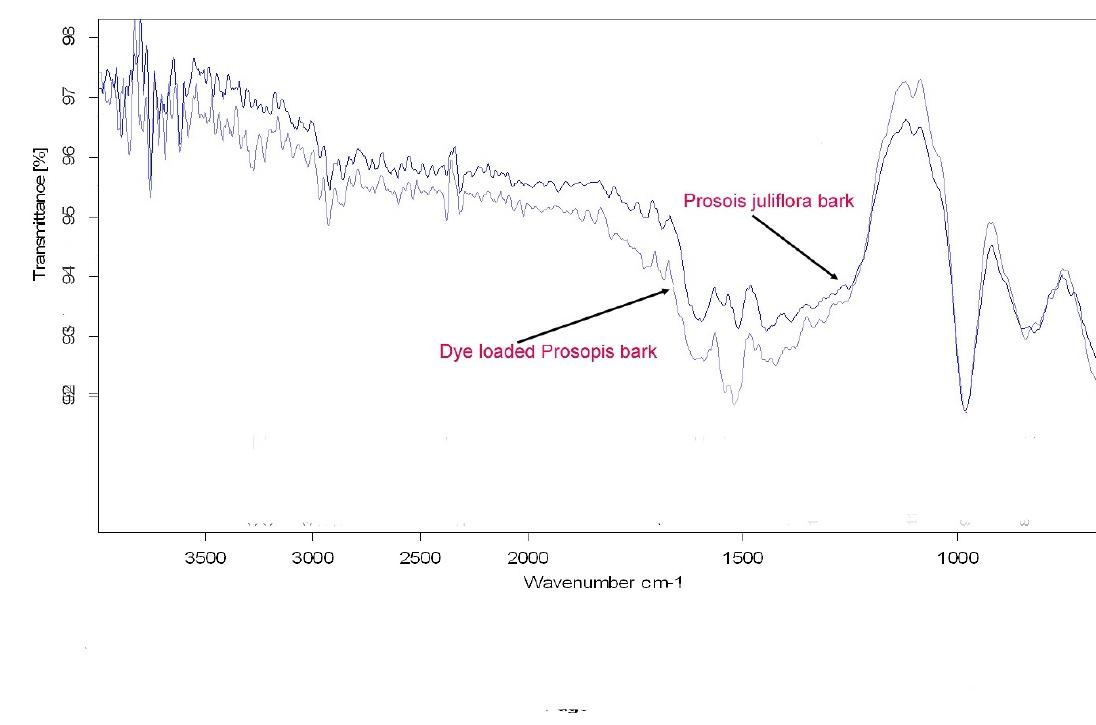
![The Adsorbents were characterized by determining Moisture content, Ash content, Volatiles Content, fixed carbon Using Proximate Analysis. Bulk Density was de- termined using Archimedes‘s principle. The pH at the point of zero charge (p the pH drift method. Hzpc) was measured by using The surface functional groups of the adsorbent studied by Fourier transform infrared (FTIR) spectroscopy in the frequency range from 4000 cm7! to 400 cm7!. spectrophotometrically at 540 nm using a UV-V] Dye concentration was estimated by monitoring the absorbance S spectrophotometer. Calibra- tion curve for BV 14 is given in Fig. 3.](https://figures.academia-assets.com/60822892/figure_002.jpg)