IHCTHTYT APXEOJlOnT HAUJOHAJlbHOT AKAflEMU HAYK YKPAfHM
INSTITUTE OF ARCHAEOLOGY
OF THE NATIONAL ACADEMY OF SCIENCES OF UKRAINE
GBPOriEMCbKMM
CEPEflHIM nAJlEOJlIT
THE EUROPEAN
MIDDLE PALAEOLITHIC
mCTHTYT APXEOJIOrn HAHJOHAJILHOI AKAflEMII HAYK YKPAIHH
INSTITUTE OF ARCHAEOLOGY OF THE NATIONAL ACADEMY OF SCIENCES OF
UKRAINE
GBPOnEHCbKHH
CEPE^HIH IIAJIEOJlIT
THE EUROPEAN
MIDDLE PALAEOLITHIC
PeziaKTOp JI.B.KyjiaKOBCtKa
Editor L. V.Kulakovska
Khi'b
IUji»x-2006
Z. MESTER
MOUSTERIAN INDUSTRIES IN HUNGARY - 15 YEARS LATER
Abstract
I he monograph on the Mousierian cultures nf the Carpathian Basin, by Ixirissa Koulakovskaya. came out
in I'JMV In this work, she reviewed the most important Hungarian sites (Ky:iaKoecKan. t989, <HI 'J 11 Thanks
ii' ffflg Hungarian and foreign researchers, many new records became known from the beginning qfI9$0i
I his new knowledge, which is based on the revision of the old sites and their assemblages and of course Uit
new exploration*, changed our general view of the Hungarian Middle Palaeolithic Here I am going 10
summarize these new records and review the research conditions of the Mousierian in Hungary.
15 years ago
In Miklbs Gabon's monograph on the Middle
Palaeolithic in Central and Eastern Europe, there
have been no sites of Transcarpathian territory
mentioned in the Ukraine yet [Gabori. !976. Fig.
16]. A new era opened in the exploration of this area
when a systematic investigation started in the scope
of the Transcarpathian Palaeolithic Expedition of the
Ukrainian Academy of Sciences, lead by V. N.
Ciladilin. The discovery of a multilayer site at
Korolevo in 1974 has a special role regarding the
change of eras [Kv.iaKOBCKaa. 1989. 3]. The layers
of lliis open-air site entombed the finds of different
Middle Palaeolithic industries. In connection with
the study of the. assemblage of Korolevo. Larissa
Koulakovskaya reviewed the Mousterian cultures of
the Carpathian Basin [KynaKOBCKaa, 1989]. Her
monograph, which was published in Russian, is
Standard work for Eastern European researchers
interested in the Mousterian.
She marked eight sites on a map of Hungary
[Phc 67). and six of the eight sites - Tata (TaTaj.
Szelim Cave (Ccihm), Kiskevely Cave (KHUJKeBcni.
Frd (3pj.). Suba-Iyuk Cave (LLlyoaiOK). Soiyomkut
Rock-shelter iIUohomkvt) - were represented in
detail. Besides these, she mentioned some other sites
as well. She studied the industries building upon the
Bordes' method. In addition, she took up the
questions of chronology and classification.
15 years later
Our view of the Hungarian Middle Palaeolithic
has undergone radical changes. This is due to the
Stall of a new era in Hungarian Palaeolithic research,
which began in the 1980s. What were the causes of
these changes'.' First, the evolution of international
research (new approaches to problems and notable
results) necessitated the rethinking of several
questions. Second, a younger generation of
researchers, filled with new ambitions and energy.
began their careers. Third, the interest of Western
European prehistorians shifted towards the
assemblages of Central and Eastern European sites.
The following things assisted in altering our
knowledge of the Hungarian Middle Palaeolithic:
- the review of the archaeological and
paleontological finds of older excavations;
- the review of the stratigraphical and
chronological interpretations concerning well-known
sites;
analyses of industries within new
approaches;
- new excavations at "classical" sites.
- discovery of new sites.
In this article. I am going to review the latest
results and the conditions of Middle Palaeolithic
research in Hungary. Meanwhile. 1 will present the
sites and cultures from west to east. Due to the
limitations on the size of the text. I will be unable to
cover all the issues, but interested readers can find
further details in the books and studies mentioned in
the bibliography.
Tata, open-air site
Hitherto, this is the first excavated and
westernmost Middle Palaeolithic site in Hungary.
Tivadar Kormos did the initial excavation in 1909-
1910 [Kormos, 1912]. Later, in 1958-1959. Ldszlo
Ve'rtes undertook a great project [Ve'rtes. 196-1]. The
site provided a rather great assemblage: 2318 stone
tools and 150 kg blank flakes. Among the tools the
sidescrapers are dominant (527c). Most of them were
made on pebbles (58.6%). The proportion ol the
pieces, with a 20 and 40 mm length is very high
(82.7%). 39% of the tools are bifacial. Based on the
above. Vertes determined this industry as a
specialized and standardized Mousterian |Ve'rtes.
1964. 210]. Mikl6s Gdbori emphasized that tin-
industry of Tata was a local fades, or in other
words, it was a Mousterian which used pebbles and
the Pontinian technique. In his opinion, this industry
170
did not develop further from this point [Gdbori.
1976. 73]. Recently, due to the microliths. it has
been reclassified as a Taubachian industry [Dobosi.
2000a. 54]. a determination that meets the new
absolute chronological data of the site. The samples,
which came, from die travertines situated above and
below the cultural layer, were tested with the
-?0Th/"2Th method. From the new data, the age of
the Palaeolithic settlement of Tata is placed between
116*5 kyr and 78±5 kyr [Schwarz and Skoflek.
19821. id est the site is part of OIS 5.
Recently. Marie-Helene Moncel studied the lithic
artefacts of Tata in the scope of analysing Central
European microlithic industries [Moncel. 2003a;
2003b; 2003c|. She demonstrated with an explicit
technological analysis that die knappers followed
only one mental scheme during the knapping work.
However, this scheme permitted them to produce
different (thin, thick, short or elongated) flakes. The
varied products belong to different stages of
debitage. The assemblages of Tata and odier Central
European sites show that this technological method
lived on in a large geographical region for a long
time.
In die history of research, the latest excavations
were carried out between 1995 and 2001 by the
Kuny Domokos Museum of Tata. During these six
years. Julianna Kisne Cseh and Viola T. Dobosi
discovered the layers which remained after V£rtes's
excavation, and they collected numerous lithic
artefacts and animal bones. Their first results were
reported at an international conference held at Tata
in 2003 [Kisne Cseh. in press).
Szelim and Kiskevely caves
The industries of these caves are comparable to
Tata, but the assemblages, which have already been
published, are rather small. Both of the caves were
excavated before World War II. The chronological
and archaeological interpretations of the finds were
reviewed in die 1980s and 1990s.
The revision of Szelim Cave (Fig. 1. 2i was
earned out within the framework of defining the
Jankovichian isee below) by Veronika Gabori-Csank
[Gabori-Csank. 1983; 1993]. The Mousterian finds
were found in the bottom layer (E) of the 12.5 m
sequence. This layer, which had been further divided
into five levels (Ei-Es). originates from the end of
the last interglacial in Gdbori-CsSnk's opinion. The
stone tools lay in the E, and Ej levels. A part of
them corresponds to the industry of Tata, and
another part of them is similar to the finds
discovered at Erd. She agreed with Luszlo Vertes.
who said that two industries were present in both of
the levels [Gabori-Csank, 1993, 41-46],
In the scope of die same work. Gabori-Csank
studied the problem of Kiskevely Cave (Fig. I. 51.
Building upon Jeno Hillebrand's opinion, she
emphasized that the Mousterian-type tools belonged
to the hearth of a brown layer (4). She determined
die age of this layer to the Early Wiirm. based upon
faunal evidence [Gabori-Csank. 1983. 281: 1993.
31-36].
The chronological and archaeological review of
Kiskevely Cave was done by Viola T. Dobosi and
Istvan Vbrds [Dobosi and Voros. 1994]. They
synthesized the stratigraphical observations, which
were known from publications and excavating
reports [Dobosi and Voros. 1994. Fig. 7|. They
explored five Pleistocene layers in the cave, and
separated die bones of the fauna [Dobosi and Voros.
1994. Fig. I]. The fauna substages. which correlate
with the chronostratigraphical units, are parts of the
Utrechtian stage:
Layer s Alpine system Faunal substages OIS
2 WUrm 3 Pilisszantdian 2
3 Wiirm 2/3 (Stillfried B) Istalldskoian 3
4/3 Late WUrm 1 Late Subalyukian 4
4 Early Wtlrm 1 Early Subalyukian 5b-a
5 End of Riss/Wiirm-Pre-WUnn Varboian 5c
The Jankovichian
The stone tools which were found in the B2 layer
of Szelim Cave and in the level above the hearth of
the brown layer ;4) of Kiskevely Cave were dated to
the Upper Palaeolithic, as the Transdanubian group
of the Szeletian, by Hungarian researchers. Veronika
Gabori-Csdnk excavated a similar lithic assemblage
from Remete-Felsd Cave (Fie, 1. 8) in 1969-1970
[Gabori-Csank, 1983]. However, in the latter site,
the chronostratigraphical context placed the artefacts
before the cold maximum of WUrm 1. Since teeth o1'
Neanderthal Man have turned up from the same
layer. Veronika Gabori-Csank decided to review die
odier sites of the Transdanubian Szeletian
(Jankovich Cave, Kiskevely Cave, Szelim Cave.
Dzerava skala and Bivak Cave. Pilisszanto II and
CsSkvar rock-shelters and Lovas - Fig. I (, She
171
demonstrated that the industry at issue was in such a
chronological situation everywhere, which proved
I hut the assemblages could not have originated after
Wiirm 1. This meant that they belonged to the
Middle Palaeolithic. For this very reason. Veronika
Gabori-Csank nominated this industry as the
Junkovichian after Jankovich Cave (Fig. 1, 3).
because this site provided the most artefacts. This
culture shows connections with the Micoquian of
South Germany and Moravia, and sporadic finds
were discovered in Northeast Hungary (Haromkut
Cave) |Gabori-Csank. 1993].
In the past decade, the presence of Jankovichian-
type tools have been detected in several
assemblages. A part of the finds of former
excavations had been connected to this culture in the
case of Szeleta [Ringer and Mester. 2000, 267-268]
and Kecskesgalya Cave [Mester, 2000a], (Both of
the sites are in the Biikk Mountains, Northeast
Hungary.) Such finds turned up from die Cserhat
Mountains, which are situated between
Transdanubia and the BUkk Mountains. The leaf-
scraper from Galgahevi'z was secondary positioned
IMarko and Pentek. 2003]. A fragment of a bifacial
tool in the assemblage of Galgagyork-Majoka 3 also
relates to the Jankovichian [Mark6 et a],, 2002, 256}.
The results of the latest researches show that the
problem of the Jankovichian cannot be considered as
closed, and we can expect further interesting
questions to arise in the near future. The paint mine
of Lovas (Fig. 1. 11) can be placed in the Late
Glacial instead of the Middle Palaeolithic by new
|JC data (11,740 B.P.) [Dobosi. 2000b." 156].
However, it must be mentioned that the taphonomic
and archaeozoologic analyses of bone tools has
raised the possibility of the mine being in use in
different stages of the Prehistory [Patou-Mathis,
20021. The palaeoanthropological analysis of human
remains (right lower incisors and a canine) from
Remete-Felso Cave showed that no specific metric
or morphological features differentiate them from
cither Neanderthal or Upper Palaeolithic modern
teeth [Tillicrct al.. in press].
6rd, open-air site
'Hie site (Fig. 1, 10), which is situated near
Budapest, was excavated in 1963-1964 by Veronika
Gabori-Csank. Thanks to the complex and detailed
monograph on Erd [Gabori-Csank, 1968], it became
our most famous Middle Palaeolithic site. Six
settlement levels were discovered from the well-
structured deposition. Building upon the geological,
palacobotanical and palaeontological examinations,
all of them were dated before the first cold
maximum of the Wurm. The 1JC data, in comparison
with the above, seem to be too young: 44.300+1400
and 35,300+900 B.P. The rich assemblage has two
special features: 1 ) the dominating presence of
quartzite (787c among the raw materials, and 2) the
high percentage of cave bear bones (between 69.2$
and 96.5% depending on levels) among the faunal
remains. The former was ascribed to the technical
tradition, and the latter was thought to be the result
of specialized limiting. Tin's was the first collection
in Hungary by which palaeontological analysis
could have been carried out from the point of view
of hunting |V. Gabori-Csank and M. Kretzoi in
Gabori-Csank. 1968. 223-244; Gabori and Gabori-
Csank, 1978],
Since the publication of the Erd monograph, our
knowledge of technology, archaeozoology and
methodology has greatly increased. Thus, the review
of artefacts coming from Erd is timely indeed,
Although the analyses which were taken up in the
last years by French and Hungarian researchers have
not finished yet. many new discoveries have been
made.
The theme of Eva Daschek's dissertation is the
archaeozooloaical examination of the animal bones
(IPH. Paris). She analysed the remains of the
mammoths, the woolly rhinoceroses, the horses and
(lie Bovidae which were excavated from the upper
levels of the larger hollow. Building upon the results
of the taxonomical. taphonomical and
palaeontological researches, she got an entirely new
picture of the site [Daschek. 2003]. The horse bones
belonged to species (E. cf. steinheimensis or E, cf.
chosaricus) living before the Wtirm. This implied
that the age of the site could be identical with the
end of the Puss (OIS 6). The condition of the
surfaces of the bones and the traces on their surfaces
indicated that the hollow functioned as a natural
trap, and both hyenas and man visited this trap
alternately and intermittently. Man utilized the
perished animals as meat. Of course, this hypothesis
might have to be revised if the remains of the other
species — especially regarding the cave bear - will be
analysed.
Veronika Gabori-Csank determined the lithic
industry as South-Eastern European Charentian. The
use of the 6-8 cm length pebbles, which were
collected at a distance of 500 m from the settlement,
characterises mis culture. The raw materials were
chopped with a special technique [Gabori-Csank,
1968. 115. 182], The technological analysis of the
lithic artefacts is in progress, but we already have
some new results [Mester, in press a; Mester and
Moncel. 2004] We found such raw materials among
the others, which originated from a 10-40 km
distance. These ones got into the settlement as
debitage products. Among the finds, some were non-
172
oval and larger than 6-8 cm. When these tools were
made, the knappers often applied the discoid and
Quina debitage. The products are very standardized.
The morphology of the Hakes aligned with the
function. From this fact it ensues that the retouch
modified the angles of the rough cutting edges
marginally.
Regarding the results of the archaeozoologicai
analyses, we can say that the interpretation of this
production method can be sought after in the
function of the site.
Budapest-Farkasret, flint mine
Veronika Gabori-Csank discovered a Palaeolithic
flint mine near Farkasret cemetery in Budapest
between 1084 and 1987. Hitherto, just a short essay
was published from this site [Gabori-Csank. 1988] -
the detailed study remained unpublished because the
authors passed away [Gabori-Csank and Gabon.
1996|.
Today the mine is a small hollow. Prehistoric
men dug the homstone cobs from its walls. The
artefacts -big quartzite hammer-stones, vast number
of homstone flakes and 176 cutter tools made bf
antler- were situated in three levels. All the antlers
were cast by hiuds. There were a few processed
pieces among the lithic finds. One of them, a big
sidescraper is the most important. It was determined
as a Mousterian tool by the excavators. They dated
the mine to the Middle Palaeolithic, although the
obtained two l-C data are very different from each
other: 3.470±80 B.P. (antler) and 40.350±950
(charcoal).
Istvan Voros studied the antlers. Based on
palaeontological arguments, he claims that the mine
was in use in the Late Copper Age or the Early
Bronze Age [Voros. 1998-1999]. Hornstones have
already been found in other Copper Age and Bronze
Age sites [Bird, 2002] and in the Middle Palaeolithic
site of Erd [Mester. in press a]. It is imaginable that
flint was quarried in different periods here -
similarly to the paint mine in Lovas. The site
demands further analyses.
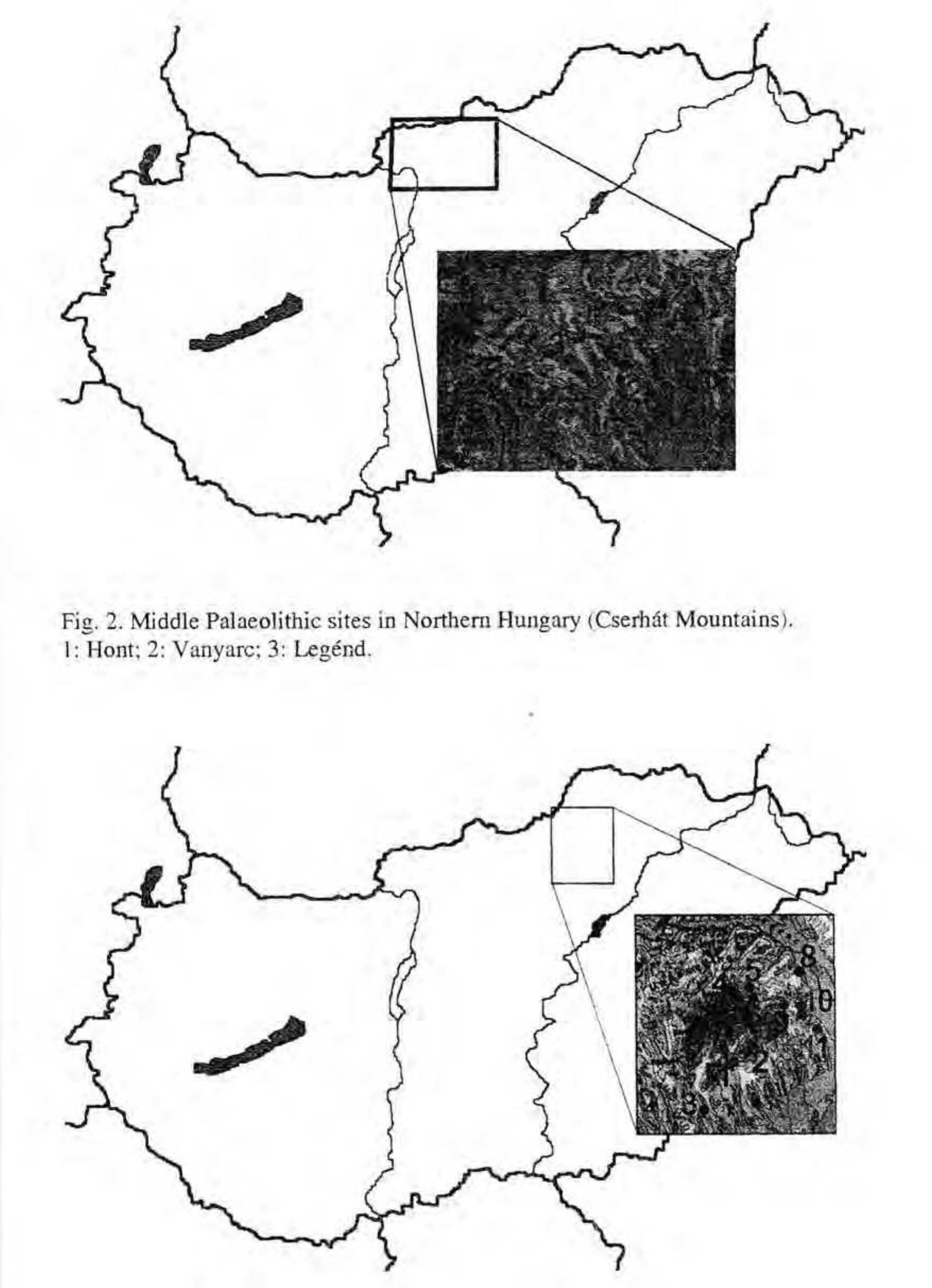
New open-air sites in the Cserhdt Mountains
In the eastern part of Hungary, the Biikk
Mountains are the richest in Middle Palaeolithic
sites. The geographical region between the above,
mentioned Transdanubian sites and the Biikk
seemed to be unoccupied during the Palaeolithic for
a long time. Miklos Gabon and Veronika Gabori-
Csank excavated near Hont (Fig. 2. 1). in the valley
of the I poly river in the 1960s. Here they found the
bifacial finds of an unidentified Middle Palaeolithic
industry [Gabon. 1976. 80-81). Unfortunately, the
archaeologists did not publish the assemblage of the
site in detail.
Attila Pentek and Andras Marko have made
systematic field surveys in the Cscrhat Mountains
for years. So far, they have discovered hundreds of
Palaeolithic sites. They also collected Middle
Palaeolithic artefacts and identified the same site of
Hont. They have started to publish their new
discoveries with the site at Legend (Fig. 2. 3'
[Markd and Pentek. in press]. The industry of the
site of Vanyarc. where Marko and Pentek have
already excavated, is connected with the region of
the Biikk Mountains. The high proportion of the
felsitic porphyry, which is a characteristic raw
material in the Szeletian (in the Btlkk Mountains), is
also an indication. Their preliminary publication will
be published in the Communicationes
Archacologicae Hungariae i Budapest i [Andras
Marko. personal communication!.
Suba-Iyuk Cave
The cave, which was discovered in 1932. is the
most significant Middle Palaeolithic site in the Biikk
Mountains (Fig. 3. 1). The deposition was made up
of 18 layers, from which a very rich assemblage was
discovered. The most illustrious specialists of the era
published the results of their geological,
palaeontological, anthracotomical. anthropological
and archaeological researches in a monograph
[Bartucz et al., 1940|. The human remains were
determined to belong to a Neanderthal woman (40-
45 years old) and a Neanderthal child (7 years old).
The lithic industry, of which finds were found in
layers 1-14, was divided into a lower (Developed
Mousterian) and an upper (Late Mousterian) culture
Vertes thought that the Szeletian in the Biikk
Mountains developed from the latter one |Vertes
1956, 327,3381.
The human bones were reanalysed in the 1990s
Based on the new results, the woman was 25-35
years old and the child was about 3 when they died
They can be classified into the Central European
group of the Homo sapiens neandenludensh
(Krapina. Vindija) [Pap et at, 1996]. The
archaeological context shows that the child was
buried, but the body of the woman decomposed on
the former surface [Mester. in press b].
During the review of the assemblage, we were
able to establish two long-tenn settlements in layers
3 and 11. Their finds were well separable.
Considering everything, there were two Mousterian
facies in the cave: one of them was a Typical
Mousterian rich in sidescrapers, and the other one
was a Quina-type Mousterian. which did not link up
173
with die Szeletian genetically [Mester, 1989, 1990}.
The technological behaviour of the two fades was
different, too [Mester. 2004].
The sediment of the cave represents Lhe Upper
Pleistocene. The revision of the deposition is the
work of Arpad Ringer. He gave a new chronological
interpretation correlating the layers with the oxygen
isotopic stadiums [Ringer. 1993, 107-114; 2002a;
Mester. 2004, Fig. 2]. Accordingly, die Typical
Mousterian belonged to the OlS 5e. while the Quina-
type Mousterian settled in the cave during the OIS 4.
Revised sites in the Biikk Mountains
Due to the new interpretation of the Palaeolithic
industries of Suba-lyuk Cave, a review had to be
carried out of those of the Bukk Moulnains which
were considered as Mousterian previously. Vertes
thought that the assemblage of Biidbs-pest Cave
(Fig. 3. 5) provided the evidence for the
transformation from a regional Mousterian into
Szeletian |Vertes, 1965, 131-134]. On the contrary,
the revision showed thai both of the above
mentioned Mousterian fades are present in the cave
and the bifacial tools belong to the Babonyian
[Mester. 1990; 1995]. We separated three groups of
the industry at Kecskesgalya Cave ( Fig. 3. 2) during
the review. One of them can be classified as
Aurignadan. while another one belongs probably to
the Jankovichian and the third one represent a
Mousterian sensu law [Mester. 2000a], The
straugraphical situation of the four tools, which were
found in the Solyomkut rock-shelter (Fig. 3, 4) is
doubtful because of the absence of documentation.
Thus, the problem of cultural determination of two
artefacts made of polish 3wieciech6w flint is also
unsolved. Building upon the archaeological context
of this raw material, the site may be classified as
Babonyian or Aurignacian |Mester. 2000b].
lhe identification of the Babonyian (see below i
called for the revision of the assemblages referring
to the Eger culture, or in other words to the
"Mesolidiic with rough tools". The eponymous site
of this culture is Eger-Koporos (Fig. 3, 3). In the
industry of the open-air site there are Middle
Palaeolithic-type tools with Upper Palaeolithic-
types Accordingly. Viola T. Dobosi considered it as
a transitional industry [Dobosi. 1995]. I rather think
that the collection represents several different
settlements because of the vast extent of the site
I about 1500 By) and uncertainty concerning the
position of the finds [Mester. 2000b. 89].
Arpad Ringer lead a new excavation in Diosgyor-
Tapolca Cave (Fig. 3, 9) in 1988. In the light of the
results, he reinterpreted the chronostratigraphy of the
artefacts and dated them to the OIS 5c period
[Ringer. 1993]. Marie-Helene Moncel studied the
Hfhtc artefacts in the view of technology a few years
ago. The production of small flakes is dominant in
this industry, which has more features in common
with the Taubachian [Ringer and Moncel. 2002].
An emblematic site of Hungarian Palaeolithic
research is Szeleta Cave (Fig. 3. 6;. The fust
evidence of the presence of prehistoric man was
found here in 1907. Szeleta Cave has been the
eponymous site of the Szeletian, a culture of the
Central European Upper Palaeolithic with bifacial
leaf-points, since 1953. Although a great part of
deposition was removed during the excavations of
about one hundred years of research, based on the
documentations, the original position of the litliic
artefacts can be reconstructed more or less [Ringer
and Mester, 2000; Mester. 2002]. Arpad Ringer
established the presence of several cultures beside
the Szeletian, while he was revising the finds
originating from the former excavations. These
Middle Palaeolithic cultures are the following: the
Babonyian, the Mousterian I (which preferred the
red porphyrite) and the Mousterian II (which can be
characterized with the use of hydroquartzite from
Avas Hill in Miskolc, Hungary). Babonyian-type
tools occurred only in the lower layers, but
Mousterian 1 and II and Jankovichian-type finds
were present ir all of the cultural layers. This means
that die latter three industries survived up to the
Tursac interstadial [Ringer and Mester. 2000. 267;
Ringer. 2002b. Fig. 2]. A new project of researching
the Szeleta Cave has begun in 1999. Within its
scope, Arpad Ringer lead several new excavations in
die cave, which resulted in numerous novel results.
The Babonyian
Arpad Ringer discovered some open-air sites by
field surveys near Miskolc in the 1970s and 1980s.
The assemblages of diese sites belong to a culture,
which was formerly unknown. The new Middle
Palaeolithic industry, which had been characterized
with special bifacial tools, was nominated as the
Babonyian [Ringer, 1983]. Larissa Koulakovskaya
also mentioned it as a new discovery [DDDDOODDDOQ.
1989. 90-91], The eponymous site is Sajobabony-
Mehesz-teto (Fig. 3. 8), where the first excavation
was in 1974. At the time, the excavator Viola T.
Dobosi, identified the finds as those of the
Mesolithic Eger culture. In the 1980-1990s, Ringer
made some excavations on the site. Among the
artefacts of tliis Micoquian-featured culture, there
are many leaf-shaped tools. Keilmessers with
asymmetrical cross-sections are representative tools.
The favourite raw material of the Babonyian was the
felsitic porphyry, which can be found in the eastern
174
part Of the Bukk Mountains and is prevalent in the
Szeletian as the raw materia] of the leaf-points.
Arpad Ringer proved with typological, technological
and chronological arguments that the Szeletian in the
Bilkk Mountains derived from the Babonyian
[Ringer. 1989). The two cultures make up a techno-
typological complex, which was frequent in the
highland region of Northern Hungary. The sites can
be found mainly on the hill-tops, but their remains
turned up from several caves (Balla. Diosgyor-
Tapolca and Szeleta caves - Fig. 3. 7. 9, 6). The
duration of the techno-typological complex began
with the appearance of the Babonyian and finished
with the Evolved Szeletian. The former is about 160
Ky based on the TL-dating of die Malyi open-air site
I Fig. 3. II). and the latter is about 20 Ky. which was
measured with l-1C method from the Szeleta Cave
|Ringer. 2001; 2002b].
When the excavated sites and their assemblages
are published in detail, we will probably have more
exact data from this transition period. Thus, we will
be able to analyse the correlation between the
Babonyian and other Central European cultures
which can be characterised with leaf-shaped tools.
Miskolc-Avas, flint mines
On Avas Hill, within of the city of Miskolc, there
are hydroquartzite rocks which solidified due to
tertiary volcanic activity. Prehistoric men of the
region used the rocks as raw material for knapped
tools. Between 1928 and 1935. mine holes were
excavated in Pergola, which is a part of the Avas.
Probably, these were in use in the Neolithic. The
traces of a flint quarry were discovered on another
part of the hill (Tuzkoves.) in 1988. Arpad Ringer,
who excavated there several times, established the
presence of the Levalloiso-Mousterian and the
Denticulated Mousterian by the stone tools. The
prehistoric miners adopted a new procedure to
obtain the silex: heat treatment [Ringer. 2003J. The
preferred raw material of the Mousterian II of
Szeleta Cave also originated from Avas Hill [Ringer
and Mester. 2000, 267]
In 2004. new excavations have started between
Tuzkoves and Pergola. Since these works are being
carried out before road construction begins, there is
an opportunity to discover the tlint quarries and the
processing workshops on a ca. 150 x 14 nr area
|Arpad Ringer, personal communication!.
Conclusion
Thanks to its unique geographical position, the
Carpathian Basin has always been the meeting-point
of natural and cultural influences and movement
coming from every direction of the compass.
Probably, that is the reason why the Hungarian
Middle Palaeolithic is so varied. Our sites provide
many important and interesting additions about the
European prehistoric processes. Intensive research in
the last twenty years reshaped Prehistory studies.
These explorations functionally connect with the
actual problems and trends of international research.
This paper aimed to introduce Hungarian results to
the wider audience of European archaeology. In
addition, we would like to continue a tradition that is
represented by illustrious predecessors, such as
Laszl6 Vertes. Mikl6s Gabori and Veroiuka Gabon-
Csank.
A cknowkdgements
Above all, I am grateful to my Hungarian
colleagues who have permitted me to use their
unpublished results in this paper. I thank Larissa
Koulakovskaya for inviting me to the conference,
where 1 was able to present these novel results.
Finally, I express my thanks to my young colleague.
Peter Szolyak, for the English translation of this text.
This study was supported by the Janos Bolyai
Research Fellowship of the Hungarian Academy of
Sciences.
7>
B1BLIOGRAPHIE
Bartucz, Lajos, Dancza, Janos. Hollendonner,
Ferenc. Kadic. OttokaY. Mottl, Mdria, Pataki. Vidor.
Palosi. Ervin, Szabo. Jozsef and Vendl. Aladar.
1940. Die Mussolini-Hbhle (Subalyuk) bei
Cserepfalu. Geologica Hungarica Series
Palaeontologica 14. Budapest. 351 p.
Biro. Katalin T.. 2002. New data on the
utilisation of Buda hornstone in the Early Bronze
Age. Budapest Regisegei 36. p. 131-143.
Daschek. Eva. 2003. Etude archeozoologique des
grands mammiferes de la couche supdrieure du
grand vallon d'Erd (Hongrie). Memoire de D.E.A..
Museum National d'Histoire Naturelle, Paris. 93 p.
Dobosi. Viola T.. 1995. Eger-Koporosteto.
Re'vision d'une industrie a outils foliaces. In: Les
industries a pointes foliacdes d'Europe ccntrale -
Actes du Colloque de Miskolc. 10-15 septembre
1991. Paleo. supplement n" 1, p. 45-55.
Dobosi. Viola T.. 2000 a. Middle Palaeolithic
phenomena in Hungary. In: Ronen. Avraham and
Weinstein-Evron, Mlna *eds.). Toward Modem
Humans - The Yabrudian and Micoquian 400-50 k-
years ago. BAR International Series 850. 51-59.
Dobosi, Viola T. 2000 b. Upper Palaeolithic
research in Hungary - a situation report from 2000.
Praehistoria 1. p. 149-159.
Dobosi. Viola T. and Vbros, Istvan. 1994.
Material and chronological revision of the Kiskevely
Cave. Folia Archaeologica 43. p. 9-50.
Gabori, Miklos, 1976. Les civilisations du
Paldolithique moyen entre les AJpes et l'Oural.
Akademiai Kiado, Budapest, 278 p.
Gabori. Miklos and Gabori-Csdnk, Veronika.
1978. The ecology of the Hungarian Middle
Palaeolithic. Foldrajzi Kdzlemenyek 1978:1-3. p.
175-182.
Gabori-Csank. Veronika. 1968. La station du
Paleolithique moyen d'Erd - Hongrie. Akademiai
Kiado. Budapest. 1968. 277 p.
Gabori-Csdnk, Veronika. 1983. La grotte Remete
Felso " (Superieure) et le " Szeletien de
Transdanubie ". Acta Archaeologica Academiae
Scientiarum Hungaricae 35. p. 249-285.
Gabori-Csank, Veronika, 1988. Une mine de
silex paleolithique a Budapest. Hongrie. In: Dibble.
Harold L. and Montct-White, Anta (eds.). Upper
Pleistocene Prehistory of Western Eurasia.
University Museum Monograph 54. The University
Museum University of Pennsylvania, p. 141-143.
Gdbori-Csank. Veronika. 1993. Le Jankovichien
- Une civilisation paldolithique en Hongrie.
E.R.A.U.L. 53. Liege. 198 p.
Gdbori-Csank. Veronika and Gabori. Miklos.
1996. Oskori kovafcjto Budapest-Farkasreten
Manuscript. Budapest. 42 p.
Kisne Cseh, Julianna (ed ). in press Topical
issues of the research of Middle Palaeolithic period
in Central Europe. Tudomanyos Fiizetck 12. Tata
Kormos. Tivadar. 1912. Die Palaolithischc
Ansiedlung bei Tata. Mitteilimgcn aus dem Jalirbuch
der kgl. Ungarischen Geologischen Anstalt 20,
Budapest, p. 1-66.
Marko. Ardras and Pentek. Attila. 2003
Masodlagos helyzetu levelkaparo Galgahevizroi.
Osregeszeti Levelek 5, p. 5-7
Marko, A. and Pentek. A., in press Rav. material
procurement strategy on the Palaeolithic site
Lcgcnd-Kaldy-farm (Cscrhat Mountains. Northern
Hungary) Praehistoria 4-5.
Marko. Andras, Pentek. Attila and Bercs. Sandor.
2002 Chipped stone assemblages from the environs
of Galgagyork (Northern Hungary) Praehistoria 3.
p.245-257.
Mester, Zsolt, 1989 A Subalyuk-barlang kbzepso
paleolitikus iparainak ujraertekelcsc - La
revaluation des industries du Paleolithique moyen
de la grotte Subalyuk Folia Archaeologica 40. p.
11-35.
Mester, Zsolt, 1990. La transition vers Ic
Paleolithique supencur des industries moustcriennes
de la montagne de Biikk (Hongrie). In Fanzy.
Catherine (dir.), Paleolithique moyen recent et
Paleolithique superieur ancien cn Europe - Actes du
Colloque international dc Nemours, 9-11 Mai 1988
Mcmoires du Musee dc Prehistoire d'lle-de-Francc
3, Nemours, p. 111-113.
Mester. Zsolt, 1995. Le materiel lithique dc la
grotte Budospcst : facies d'atelier ou industne
intermcdiaire ? In: Les industries a pointes fohacccs
d'Europe ccntrale - Actes du Colloque dc Miskolc.
10-15 septembre 1991. Paleo, supplement n° 1, p
31-35
Mester, Zsolt. 2000 a. Apparition du
Jankovichien au sud dc la montagne de Bukk
(Hongrie) In: Mester. Zsolt and Ringer. Arpad
(dir.), A la recherche de l'Homme prehistonque -
Volume commemoratif de Miklos Gabori et de
Veronika Gabori-Csank E.R.A.U.L. 95. Liege, p.
247-255.
Mester. Zsolt, 2000 b. Sur la presence du silex de
Swieciechow dans I'Abn de Solyomkut (montagne
de Bukk. Hongrie). Praehistoria 1, p. X3-93
Mester, Zsolt, 2002. Excavations at Szcleta Cave
before 1999: methodology and overview
Praehistoria 3, p. 57-78.
176
Mcster. Zsolt, 2004. Technologic dcs industries
moustericnnes de la groae Suba-lyuk (Hongrie). In.
Le Secretariat du Congres (ed.). Actes du XlVe
Congres UISPP. Universite de Liege. Belgique. 2-8
scptcmbre 2001 - Section 5: Le Paleolithique
moyen Sessions generates el posters BAR
International Series 1239. p. 127-133.
Mester. Zsolt. in press a. La production lithique a
la station d'Erd (Hongrie). In. Kisne Cscli, Julianna
(ed ). in press. Topical issues of the research of
Middle Palaeolithic period in Central Europe
Tudomanyos Fiizetek 12, Tata
Mester, Zsolt, in press b. Ujabb megfontolasok a
suba-lyuki neandervolgyi temetkezes kerdesehez -
Nouvelles considerations sur les sepultures
neandertalienncs de la grotte Suba-lyuk. In: Hon G
(szerk.), Momos III - Oskoros Kutatok III. Orszagos
Osszejovetelenek konferenciakotetc. Szombathely-
Bozsok. 2002 okt 7-9. Szombathely.
Mester, Zsolt and Moncel, Mane-Helene. 2004
Le site paleolithique moyen de Erd (Hongrie)
chaines operatoircs et rcsultats morpho-fonctionnels
de la production European Association of
Archaeologists Xlh Annual Meeting. Lyon 8-11
September 2004. Abstracts Book, p. 268.
Moncel, Mane-Helene, 2003 a Tata (Hongne).
Un assemblage microlithique du debut du
Pleistocene superieur en Europe Centrale
L"Anthropologie 107, p. 117-151.
Moncel. Mane- Helene, 2003 b. Some
Observation on Microlidtic Assemblages in Centra!
Europe during Lower and Middle Palaeolithic -
Kiilna and Pfedmosti II (Czech Republic).
Vcrtcsszolos and Tata (Hungary). In: Burdukiewicz,
Jan Michal and Ronen, Avraham (eds), Lower
Palaeolithic Small Tools in Europe and the Levant.
BAR International Series 1115, p. 169-187.
Moncel, Marie- Helene, 2003 c L'expioitation
des petits galets dans des assemblages
microlithiques du Paleolithique moyen d'Europe
Centrale - Kiilna et Predmosti II en Republique
Tcheque, Tata en Hongne. In: Peresani. Marco (ed.).
Discoid Lithic Technology - Advances and
implications. BAR International Scries 1120, p.
225-239.
Pap. Udiko, Tillier. Anne-marie. Arensburg,
Baruch and Chech, Mario. 1996. The Subalyuk
Neanderthal remains (Hungary), a re-examination.
Annales Histonco-Naturales Musei Nationals
Hunganci 88, p. 233-270.
Patou-Mathis, Marylene. 2002 Nouvelle analyse
du materiel osseux du site de Lovas (Hongrie)
Praehistoria 3, p. 161-175.
Ringer, Arpad. 1983. Babonyien - Einc
mitteluaJaolitische Blattwerkzcugindustrie in
Nordostungarn. Dissertationcs Arcliaeologicae Ser
II No 11. Budapest. 158 p
Ringer. Arpad, 1989 L'originc du Szeletien ds
Biikk en Hongrie et son evolution vers I.
Paleolithique superieur Anthropolgie (Brno) 27. p
223-22').
Ringer, Arpad, 1993. Eszakkelet-magvarorszagi
geomorfologiai szintek es regcszcti adataik helso-
pleisztocen folyoteraszok. Idszok cs barlangi
iiledekek kronosztratigrafiai rendszere. C.Sc thesis.
Miskolc.
Ringer, Arpad. 2001. Le compicxe techno-
typologique du Babonyien-Szeletien en Hongrie du
Nord. In: Cliquet, Dominique (dir.), Les industries a
outils bifaciaux du Paleolithique moyen d'Europe
occidentale - Actes de la table-ronde Internationale
organisee a Caen (Basse-Normandie - France) 14 et
15""octobre 1999. E.R.A.U.L. 98. Liege, p 213-220.
Ringer. Arpad, 2002 a. The chronostratigraph;.
and palaeo-human-ecology of the Middle and Upper
Palaeolithic in Northeast Hungary, between 130.000
and 10,000 BP. Praehistoria 3. p. 39-46.
Ringer. Arpad, 2002 b The new image of Szeleta
and Istallos-ko Caves in the Biikk Mountains, a
revision project between 1999-2002. Praehistoria 3.
p. 47-52.
Ringer, Arpad. 2003. Oskokon kovabanyaszat es
kovako-feldolgozas a miskolci Avason. (Des mines
et des ateliers de silex prehistoriques sur le mom
Avas a Miskolc.) Herman Otto Mtizeum Evkonyve
42. p. 5-15.
Ringer, Arpad and Mester. Zsolt. 2000 Resultaii
de la revision de la grotte Szeleta entreprise en 1999
et 2000. Anthropologic (Brno) 38, p. 261-270.
Ringer, Arpad and Moncel, Maric-Hclcne. 2002.
Le Taubachien dans la grotte Diosgyor-Tapolca
(montagne de Biikk. Hongrie du Nord-est)
Praehistoria 3, p. 177-201
Schwarcz, H. P. and Skoflek. t„ 1982. New dates
for the Tata, Hungary archaeological site. Nature
295. p. 590-591,
Tillier. Anne-marie. Mester. Zsolt. Henry-
Garnbier. Dominique. Pap, Ildiko. Ringer, Arpad
and Gyenis, Gyula, in press. The Middle-Upper
Palaeolithic transition in Hungary: an
anthropological perspective. In: Cabrera Valdes,
Victoria (ed.). International Colloquium "En cl
Centenario de la Cucva de el Castillo: El ocaso de
los Neandenates". Santoiia 8-10 sept 2003
Vertes, Laszlo, 195b. Problematika szeletienu -
Problemkreis des Szeletien. Slovenska Archcologia
SAV 4, p. 318-340.
Vertes, Laszlo (Hrsg.), 1964 Tata. Line
mittelpalaolithische Travertm-Sicdlung in Ungam.
Akademiai Kiado. Budapest. 284 p.
Vcrtes. Laszlo. 1965 Az oskokor cs az atmeneti
kokor emlekei Magyarorszagon. Akademiai Kiado.
Budapest. 385 p.
Voros, lstvan. 1998-1999. Antlers from the
Prehistoric flint mine at Denever street (Budapest -
Farkasret). Folia Archaeologica 47. p. 69-102.
KynaKOBCKaa. JIapHCa BirraieBHa. 1989
MycTbcpcKHe Kyj&typii KapnaTCKoro oaccciiHa.
HayKOBa jVMKa, Khcb. 1989. 126 p.
Fig. I, Middle Palaeolithic sites in Western Hungary (Transdanubia).
1: Tata: 2: Szelim Cave; 3: Jankovich Cave; 4: Pilisszanto II Rock-shelter; 5: Kiskevely Cave: 6: Bivak
Cave; 7: Csakvar Rock-shelter: 8: Remete-Felso Cave; 9: Budapest-Farkasret; 10: Erd: 11: Lovas; 12:
Dzerava skdla in Western Slovakia.
178
Fig. 3. Middle Palaeolithic sites in Northeast Hungary (BilkJc Mountains).
lj Suba-lyuk Cave; 2: Kecske'sgalya Cave: 3: Eger-K6poros; 4: Solyomkut Rock-shelter; 5: Budos-pest
Cave; 6: Szeleta Cave; 7: Balla Cave; 8: Sajobabony-Mehesz-teto; 9: DiosgySr-Tapolca Cave; 10: Miskolc-
Avas hill; 11: Malyi.
179


 Zsolt Mester