Academia.eduAcademia.edu

Outline

The Culture-Fair Common Region Test (CRT)

2021, Academia Letters

https://doi.org/10.20935/AL103

Abstract

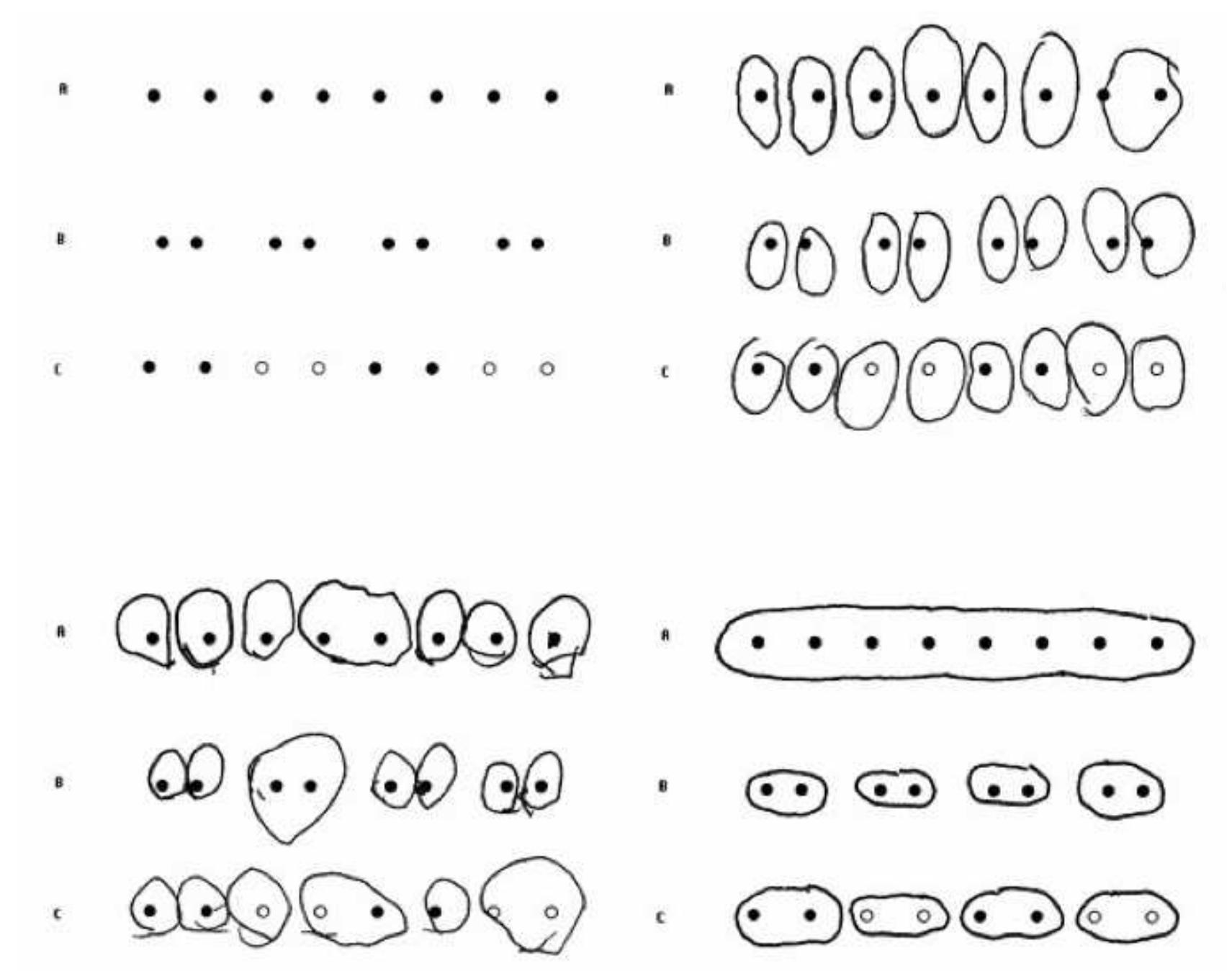
The Common Region Test (CRT) is a useful spatial categorization test that assesses spatial binding of individual objects to places, or pairs of matching objects to a region. Our aim was to test whether ethnic differences exist in the CRT of typically developing children and those with special needs (N = 117). Typically developing children were more likely to show objects-region binding, independently of ethnicity. Likewise, children with ASD and ADHD showed mainly unsystematic coding, independently of ethnicity. Thus, it is demonstrated that the CRT is a useful culture-fair assessment of spatial categorization. In culture-fair test developments, it is important that the same constructs are measured across different cultures. Professionals in mental health weigh socioeconomic factors as more important than race (Cuccaro et al., 1996). Moreover, epidemiological studies suggest that children with special needs have more underlying medical conditions than typically developing children even after controlling for factors such as race/ethnicity/national minority status (Dizitzer et al., 2020; Schieve et al., 2012; Turygin et al., 2013). The Common Region Test (CRT) uses a Wertheimer array with three rows of dots (Wertheimer, 1923), see Figure 1, upper left figure. In the first row, dots were equal insofar as they were of the same appearance and distance, in the second row, pairs of dots were closer together which tests the Gestalt principle of proximity, and in the third row, pairs of dots were of different colour which resembled the Gestalt principle of similarity. When asked to draw a circle around those dots which they think belong together, young children allocate small individual places to each dot in this array (object-place binding), but

Key takeaways
sparkles

AI

  1. The CRT effectively measures spatial categorization in children, independent of ethnicity.
  2. N = 117 participants showed similar response patterns across ethnicities in CRT results.
  3. Children with ASD and ADHD displayed unsystematic coding, regardless of their ethnic backgrounds.
  4. Fine motor skills correlate with spatial categorization performance in children with special needs.
  5. The study confirms the CRT as a culture-fair assessment tool for spatial categorization.
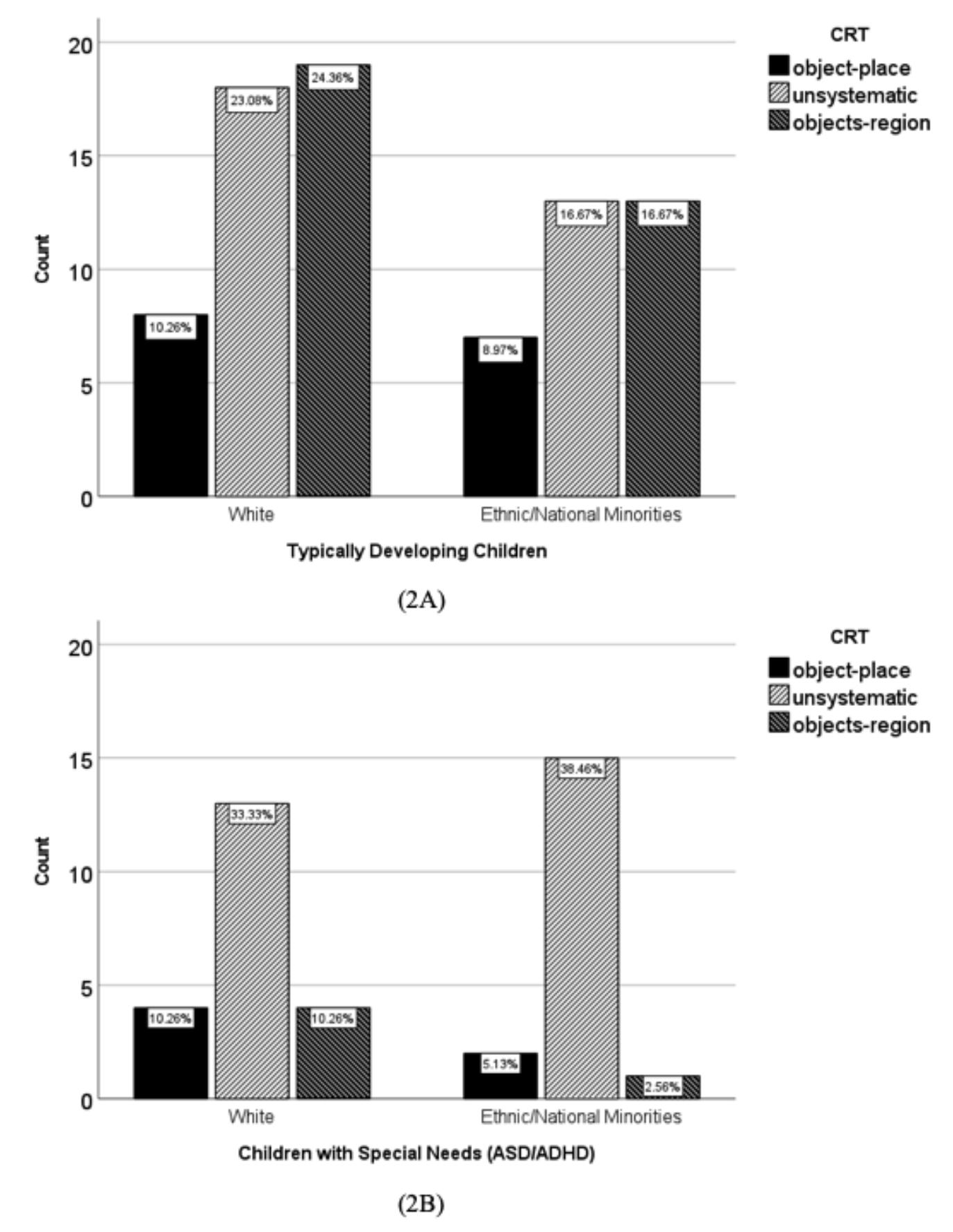
ACADEMIA Letters The Culture-Fair Common Region Test (CRT) Christiane Lange-Kuettner Ridhi Kochhar The Common Region Test (CRT) is a useful spatial categorization test that assesses spatial binding of individual objects to places, or pairs of matching objects to a region. Our aim was to test whether ethnic differences exist in the CRT of typically developing children and those with special needs (N = 117). Typically developing children were more likely to show objects-region binding, independently of ethnicity. Likewise, children with ASD and ADHD showed mainly unsystematic coding, independently of ethnicity. Thus, it is demonstrated that the CRT is a useful culture-fair assessment of spatial categorization. In culture-fair test developments, it is important that the same constructs are measured across different cultures. Professionals in mental health weigh socio-economic factors as more important than race (Cuccaro et al., 1996). Moreover, epidemiological studies sug- gest that children with special needs have more underlying medical conditions than typically developing children even after controlling for factors such as race/ethnicity/national minority status (Dizitzer et al., 2020; Schieve et al., 2012; Turygin et al., 2013). The Common Region Test (CRT) uses a Wertheimer array with three rows of dots (Wertheimer, 1923), see Figure 1, upper left figure. In the first row, dots were equal in- sofar as they were of the same appearance and distance, in the second row, pairs of dots were closer together which tests the Gestalt principle of proximity, and in the third row, pairs of dots were of different colour which resembled the Gestalt principle of similarity. When asked to draw a circle around those dots which they think belong together, young children allocate small individual places to each dot in this array (object-place binding), but Academia Letters, January 2021 ©2021 by Academia Inc. — Open Access — Distributed under CC BY 4.0 Corresponding Author: Christiane Lange-Kuettner, [email protected] Citation: Lange-Kuettner, C., Kochhar, R. (2021). The Culture-Fair Common Region Test (CRT). Academia Letters, Article 103. https://doi.org/10.20935/AL103. 1 Figure 1 Common Region Test, CRT. Wertheimer array (upper left). 4- to 6-year-old children show object-place binding (upper right). With increasing age, object-region binding of matching objects dominates (lower right). Unsystematic coders (lower left) show both types of spatial binding (Lange-Küttner, 2006, with permission of the British Psychological Society). older children draw common regions around matching dots (objects-region binding) (Lange- Küttner, 2006, 2010, 2013). Moreover, there are children who show unsystematic coding as they follow neither a clear system of object-place binding nor of objects-region binding. Such unsystematic binding is most often a temporary transitional pattern in the development from object-place to objects-region binding. We have recently published an article on spatial categorization in children with special needs using the CRT and revealed that children with autistic spectrum disorder (ASD) show unsystematic and under-inclusive allocation of objects to places independently of their age, Academia Letters, January 2021 ©2021 by Academia Inc. — Open Access — Distributed under CC BY 4.0 Corresponding Author: Christiane Lange-Kuettner, [email protected] Citation: Lange-Kuettner, C., Kochhar, R. (2021). The Culture-Fair Common Region Test (CRT). Academia Letters, Article 103. https://doi.org/10.20935/AL103. 2 while those with attention-deficit hyperactivity disorder (ADHD) show unsystematic and over- inclusive allocation of non-matching objects to regions. The spatial categorization was de- pendent on the level of fine motor skills, with children with ASD having poorer fine motor skills than those with ADHD who in turn showed less well-developed fine motor skills than typically developing children. While fine motor skills development appears to be a quasi-biological variable, social sci- ence commentators were asking, though, whether there would be ethnic differences in this cross-cultural urban London-based UK sample. We are thus testing whether there could be a racial factor involved in the CRT because spatial categorization in geographical terms could also imply ethnic segregation (Mask, 2020; McDoom & Gisselquist, 2016). People who have something in common can choose or be obliged to settle in the same area. But because we were aware of the motor component, we were expecting children with ASD and ADHD to show unsystematic response patterns in the CRT independently of ethnicity. The alternative hypothesis is that because ethnically diverse children may be more likely to experience isola- tion or segregation, they would be constructing fewer common spatial regions. Methods Participants A sample of N = 117 school children from various schools in South-West London, UK, took part in the study. About half the sample were White children (n = 66, 56.4%). The other half of the sample consisted of Asian (n = 44, 37.6%), Black (n = 5, 4.3%), Arab (n = 1, .90%) and Albanian (n = 1, .90%) children. More details on the sample and the diagnostic assessments can be found in the recently published paper on spatial categorization and fine motor skills (Lange-Küttner & Kochhar, 2020). Apparatus and Procedure Common Region Test (CRT). This test was given on one sheet of paper, with three rows of dots: row A, B and C, see Figure 1. Row A consisted of equidistant dots, row B where pairs of dots were closer together (proximity) and row C where dots were equidistant but pairwise colored (black/white) (similarity) (Lange-Küttner, 2006). Children were given the following instruction: “Please draw a circle around those dots which you think belong together”. They were tested individually by the second author. Scoring of the CRT was based on whether children had drawn a circle around individual dots (object-place binding) (score 1), matching dots (objects-region binding) (score 3) or whether there was a combination of approaches Academia Letters, January 2021 ©2021 by Academia Inc. — Open Access — Distributed under CC BY 4.0 Corresponding Author: Christiane Lange-Kuettner, [email protected] Citation: Lange-Kuettner, C., Kochhar, R. (2021). The Culture-Fair Common Region Test (CRT). Academia Letters, Article 103. https://doi.org/10.20935/AL103. 3 (unsystematic binding) (score 2). The final interrater reliability for the 117 drawings was 99.1%. One disagreement was settled in a discussion. Results Typically Developing Children. Object-place binding was the least common approach, with unsystematic and objects-region binding at about the same level in either group of white and ethnic minority children. Chi-square analysis showed that there were no significantly different distributions between the two groups, χ2 (2, 78) = .16, p = .925, eta = .04, see Figure 2A, which was confirmed with a Bayes test for independent samples, Rouder t(76) = −.362, p = .718, BF 5.39. The quoted eta is ethnicity-dependent in this and all chi-square tests that follow. Children with Special Needs. The same analysis for just children with a clinical diag- nosis showed that unsystematic coding was the most common approach. Chi-square analysis showed that there were no significantly different distributions between white and ethnic mi- nority children, χ2 (2, 39) = 2.39, p = .302, eta = .25, see Figure 2B. This was confirmed with a Bayes test for independent samples, Rouder t(37) = −.318, p = .752, BF4.06. ASD/ADHD. Children with special needs were further split into two sub-samples of chil- dren with ASD vs. ADHD. In children with ASD, there was no significant difference be- tween white and ethnic minority children with regards to the CRT, χ2 (2, 19) = 4.54, p = .103, eta = .49, and this was confirmed with a Bayes test for independent samples, Rouder t(17) = −.36, p = .720, BF2.98. In children with ADHD, there was absolutely no difference between white and ethnic minority children, χ2 (2, 20) = .10, p = .995, eta = .02, see also the Bayes test for independent samples, Rouder t(18) = .000, p = 1.0, BF3.12. Conclusion We could find the same response pattern of children coming from different ethnicities in the CRT, both in typically developing children and in those with special needs. Typically devel- oping children showed allocation of regions to matching dots, while this was rare in children with special needs, whether ASD or ADHD, who mainly used unsystematic strategies, but both groups did so independently of their ethnic/national minority status. Thus, this clearly demonstrated that the Common Region Test (CRT) is a culture-fair test that allows to assess children’s systematic attention and spatial categorization according to Gestalt features of sim- ilarity and proximity. Academia Letters, January 2021 ©2021 by Academia Inc. — Open Access — Distributed under CC BY 4.0 Corresponding Author: Christiane Lange-Kuettner, [email protected] Citation: Lange-Kuettner, C., Kochhar, R. (2021). The Culture-Fair Common Region Test (CRT). Academia Letters, Article 103. https://doi.org/10.20935/AL103. 4 Figure 2 Response patterns in the Common-Region-Test (CRT). The number of children (count) is plotted on the y-axes with percentages available in each column. References Cuccaro, M. L., Wright, H. H., Rownd, C. V., Abramson, R. K., Waller, J., & Fender, D. (1996). Brief report: Professional perceptions of children with developmental difficulties: Academia Letters, January 2021 ©2021 by Academia Inc. — Open Access — Distributed under CC BY 4.0 Corresponding Author: Christiane Lange-Kuettner, [email protected] Citation: Lange-Kuettner, C., Kochhar, R. (2021). The Culture-Fair Common Region Test (CRT). Academia Letters, Article 103. https://doi.org/10.20935/AL103. 5 The influence of race and socioeconomic status. Journal of Autism and Developmental Disorders, 26(4), 461-469. https://doi.org/10.1007/BF02172830 Dizitzer, Y., Meiri, G., Flusser, H., Michaelovski, A., Dinstein, I., & Menashe, I. (2020). Comorbidity and health services’ usage in children with autism spectrum disorder: A nested case–control study. Epidemiology and Psychiatric Sciences, ArtID e95. https://doi.org/10.1017/S2045796020000050 Lange-Küttner, C. (2006). Drawing boundaries: From individual to common region - the development of spatial region attribution in children. British Journal of Developmental Psychology, 24, 419-427. https://doi.org/10.1348/026151005X50753 Lange-Küttner, C. (2010). Ready-made and self-made facilitation effects of arrays: Priming and conceptualization in children’s visual memory. Swiss Journal of Psychology, 69(4), 189-200. https://doi.org/10.1024/1421-0185/a000023 Lange-Küttner, C. (2013). Array effects, spatial concepts, or information processing speed: What is the crucial variable for place learning? Swiss Journal of Psychology, 72(4), 197- 217. https://doi.org/10.1024/1421-0185/a000113 Lange-Küttner, C., & Kochhar, R. (2020). Fine motor skills and unsystematic spatial binding in the Common Region Test: Under-Inclusivity in Autism Spectrum Disorder and over- inclusivity in Attention-Deficit Hyperactivity Disorder. Journal of Motor Learning and Development, 8(3), 544-568. https://doi.org/10.1123/jmld.2019-0033 Mask, D. (2020). The address book. Profile Books. McDoom, O. S., & Gisselquist, R. M. (2016). The measurement of ethnic and religious di- visions: Spatial, temporal, and categorical dimensions with evidence from Mindanao, the Philippines. Social Indicators Research, 129(2), 863-891. https://doi.org/10.1007/s11205- 015-1145-9 Schieve, L. A., Gonzalez, V., Boulet, S. L., Visser, S. N., Rice, C. E., Van Naarden Braun, K., & Boyle, C. A. (2012). Concurrent medical conditions and health care use and needs among children with learning and behavioral developmental disabilities, National Health Interview Survey, 2006–2010. Research in Developmental Disabilities, 33(2), 467-476. https://doi.org/10.1016/j.ridd.2011.10.008 Turygin, N., Matson, J. L., & Tureck, K. (2013). ADHD symptom prevalence and risk factors in a sample of toddlers with ASD or who are at risk for developmental delay. Research in Academia Letters, January 2021 ©2021 by Academia Inc. — Open Access — Distributed under CC BY 4.0 Corresponding Author: Christiane Lange-Kuettner, [email protected] Citation: Lange-Kuettner, C., Kochhar, R. (2021). The Culture-Fair Common Region Test (CRT). Academia Letters, Article 103. https://doi.org/10.20935/AL103. 6 Developmental Disabilities, 34(11), 4203-4209. https://doi.org/10.1016/j.ridd.2013.07.020 Academia Letters, January 2021 ©2021 by Academia Inc. — Open Access — Distributed under CC BY 4.0 Corresponding Author: Christiane Lange-Kuettner, [email protected] Citation: Lange-Kuettner, C., Kochhar, R. (2021). The Culture-Fair Common Region Test (CRT). Academia Letters, Article 103. https://doi.org/10.20935/AL103. 7

References (12)

  1. Cuccaro, M. L., Wright, H. H., Rownd, C. V., Abramson, R. K., Waller, J., & Fender, D. (1996). Brief report: Professional perceptions of children with developmental difficulties: Academia Letters, January 2021
  2. Corresponding Author: Christiane Lange-Kuettner, [email protected] Citation: Lange-Kuettner, C., Kochhar, R. (2021). The Culture-Fair Common Region Test (CRT). Academia Letters, Article 103. https://doi.org/10.20935/AL103. The influence of race and socioeconomic status. Journal of Autism and Developmental Disorders, 26(4), 461-469. https://doi.org/10.1007/BF02172830
  3. Dizitzer, Y., Meiri, G., Flusser, H., Michaelovski, A., Dinstein, I., & Menashe, I. (2020). Comorbidity and health services' usage in children with autism spectrum disorder: A nested case-control study. Epidemiology and Psychiatric Sciences, ArtID e95. https://doi.org/10.1017/S2045796020000050
  4. Lange-Küttner, C. (2006). Drawing boundaries: From individual to common region -the development of spatial region attribution in children. British Journal of Developmental Psychology, 24, 419-427. https://doi.org/10.1348/026151005X50753
  5. Lange-Küttner, C. (2010). Ready-made and self-made facilitation effects of arrays: Priming and conceptualization in children's visual memory. Swiss Journal of Psychology, 69(4), 189-200. https://doi.org/10.1024/1421-0185/a000023
  6. Lange-Küttner, C. (2013). Array effects, spatial concepts, or information processing speed: What is the crucial variable for place learning? Swiss Journal of Psychology, 72(4), 197- 217. https://doi.org/10.1024/1421-0185/a000113
  7. Lange-Küttner, C., & Kochhar, R. (2020). Fine motor skills and unsystematic spatial binding in the Common Region Test: Under-Inclusivity in Autism Spectrum Disorder and over- inclusivity in Attention-Deficit Hyperactivity Disorder. Journal of Motor Learning and Development, 8(3), 544-568. https://doi.org/10.1123/jmld.2019-0033
  8. Mask, D. (2020). The address book. Profile Books.
  9. McDoom, O. S., & Gisselquist, R. M. (2016). The measurement of ethnic and religious di- visions: Spatial, temporal, and categorical dimensions with evidence from Mindanao, the Philippines. Social Indicators Research, 129(2), 863-891. https://doi.org/10.1007/s11205- 015-1145-9
  10. Schieve, L. A., Gonzalez, V., Boulet, S. L., Visser, S. N., Rice, C. E., Van Naarden Braun, K., & Boyle, C. A. (2012). Concurrent medical conditions and health care use and needs among children with learning and behavioral developmental disabilities, National Health Interview Survey, 2006-2010. Research in Developmental Disabilities, 33(2), 467-476. https://doi.org/10.1016/j.ridd.2011.10.008
  11. Turygin, N., Matson, J. L., & Tureck, K. (2013). ADHD symptom prevalence and risk factors in a sample of toddlers with ASD or who are at risk for developmental delay. Research in Academia Letters, January 2021
  12. Corresponding Author: Christiane Lange-Kuettner, [email protected] Citation: Lange-Kuettner, C., Kochhar, R. (2021). The Culture-Fair Common Region Test (CRT). Academia Letters, Article 103. https://doi.org/10.20935/AL103.

FAQs

sparkles

AI

What differing allocation patterns were observed between children with ASD and ADHD?add

The study indicates that children with ASD showed unsystematic and under-inclusive object allocation, while those with ADHD demonstrated unsystematic and overinclusive allocation of non-matching objects to regions.

How did fine motor skills influence spatial categorization in this study?add

The findings revealed that spatial categorization was significantly linked to fine motor skills, with children with ASD exhibiting poorer skills than those with ADHD, who in turn scored lower than typically developing children.

What was the effect of ethnicity on CRT performance among participants?add

The analysis revealed no significant differences in CRT performance based on ethnicity, with both typically developing and children with special needs showing similar unsystematic coding patterns across diverse ethnic backgrounds.

Which scoring approaches were utilized in the Common Region Test (CRT)?add

Scoring in the CRT categorized responses into three types: object-place binding (score 1), objects-region binding (score 3), and unsystematic binding (score 2) based on children's drawn circles around dots.

What demographic was included in the study's sample population?add

The sample consisted of 117 school children in South-West London, with approximately 56.4% identified as White, 37.6% Asian, and smaller percentages from Black, Arab, and Albanian ethnic backgrounds.

Last updated
About the author
University of Bremen, Department Member

Venia Legendi, University of Bremen Honorary Associate Professor, University of Nicosia, Cyprus Editor-in-Chief 'Cognitive Development' Associate Editor 'Frontiers in Developmental Psychology'

Papers
101
Followers
521
View all papers from Christiane Lange-Kuettnerarrow_forward