Ultimate Guide to Winning with the Italian Game

The Italian Game is one of the first chess openings we play when we discover the wonderful world of chess.
At first glance it’s pretty straightforward and doesn’t seem to require much thought.
1.e4 e5 2.Nf3 Nc6 3.Bc4 and boom, you have your Italian Game setup right there.
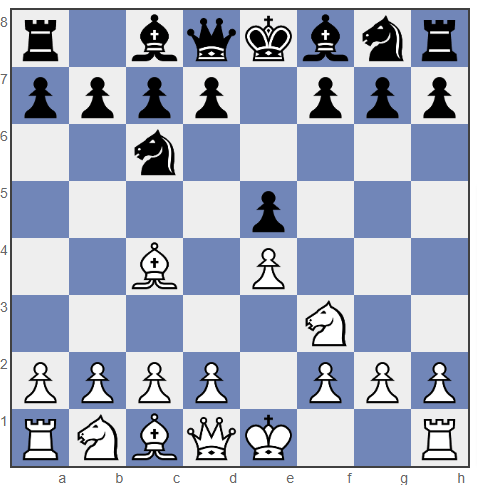
However, there’s much more to it than simply a beginner-friendly chess opening.
In fact, the Italian Game —or Italian Opening— can turn into a highly tactical opening if you or your opponent make even the slightest mistake.
Learn below all the main lines and sidelines of the Italian Game, as well as useful tricks and tips.
Main Line in the Italian Game: Giuoco Piano
1.e4 e5 2.Nf3 Nc6 3.Bc4 Bc5
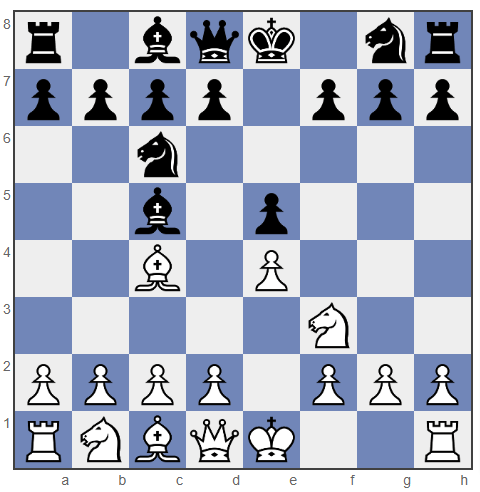
This is by far the most common start to an Italian Game.
Both White and Black have developed their pieces naturally and are eyeing the f7 and f2 squares while fighting for the center.
The most common continuation is 4.c3.
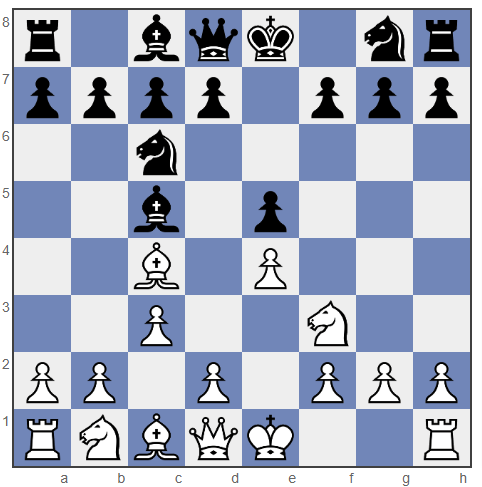
White can also:
- Castle.
- Play d3.
- Play b4.
- Play Nc3.
Let’s explore all these options in full.
4.c3: Classical Variation in the Italian Game
With the move 4.c3, White is attempting to quickly consolidate the center by playing d4 soon if Black allows it.
It’s a super solid choice that guarantees strong play for White.
A typical Italian Game with 4.c3 usually continues with 4…Nf6 5.d3 d6.
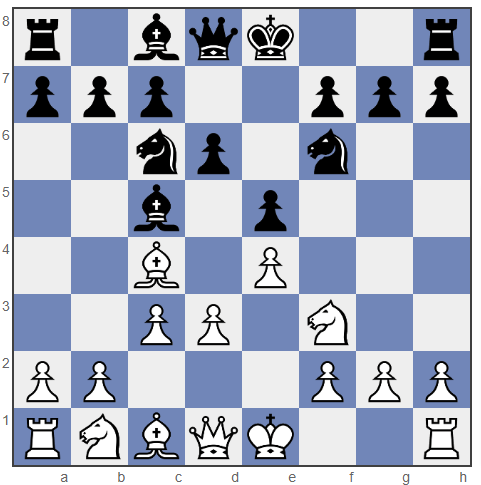
This is called Giuoco Pianissimo – There’s a whole section dedicated to the Giuoco Pianissimo later in the article.
White is taking things slow and doesn’t want to play d4 just yet.
The natural moves keep coming.
Both sides are ready to castle and almost all of their minor pieces are either developed or about to be developed.
6.O-O a6 7.a4 Ba7:
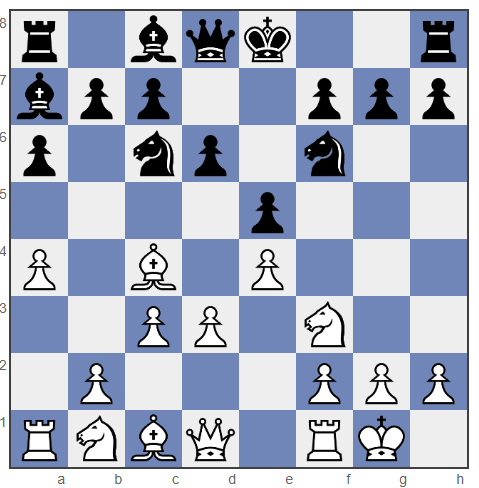
Both a6 and a4 allow the bishops to retreat while still putting pressure on the center.
In particular, the move Ba7 by Black is an extremely flexible move that:
- Prepares the b5 expansion.
- Discourages White to play d4.
- Maintains a decent pressure on the a7–g1 diagonal.
After this, the most played moves are 8.Re1 O-O 9.h3 Ne7 10.d4 Ng6 11.Nbd2 c6:
4.O-O
In this variation, White decides to castle immediately, delaying the development on the queenside but securing its king right away and preparing Re1.
The game usually follows like this:
4…Nf6 5.d3 d6 6.c3 a6 7.a4 Ba7 8.Re1
4.d3: Giuoco Pianissimo
A very popular choice by White on the Italian Game.
Giuoco Pianissimo comes from the Italian language and it literally means “very quiet game”.
In this variation, White takes things real slow and doesn’t risk anything.
The main continuation for Black after the Giuoco Pianissimo has started is 4…Nf6:
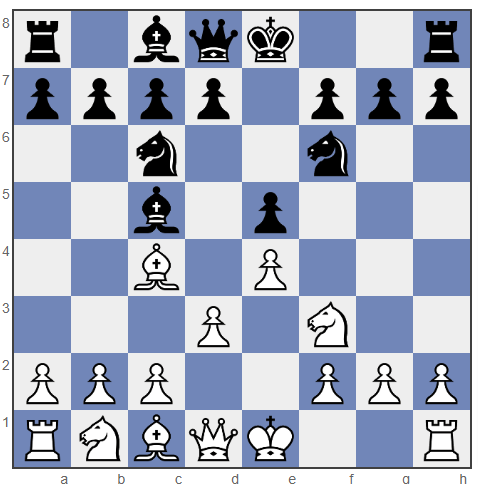
Now White can basically play 4 moves:
- 5.O-O
- 5.c3
- 5.Nc3
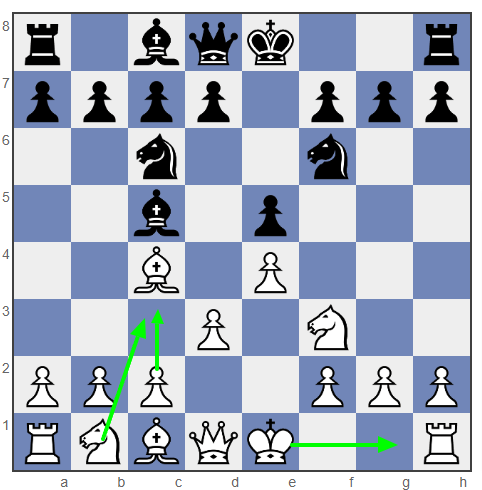
The first two have better win rates than the third one, which is more drawish, so you could pick 5.Nc3 if you are playing against a stronger opponent and you don’t mind to split the point.
White can also play some lesser explored moves such as:
- 5.Bg5
- 5.a4
- 5.Nbd2
- 5.Bb3
- 5.h3
4.b4: Evans Gambit
We will analyze the Evans Gambit more deeply later in the article, but for now let’s say that it’s one of the most exciting —and dangerous!— ways to play the Italian Game.
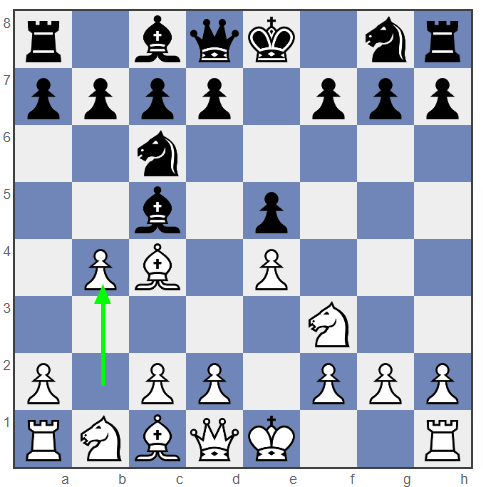
Its main line goes like this:
4…Bxb4 5.c3 Ba5 6.d4 d6 7.Qb3 Qd7
White decides to sacrifice a pawn in exchange for more control on the center and open lines to attack the Black king.
Black has also the choice of declining the Evans Gambit by playing:
4…Bb6 5.a4 a6 6.Nc3 Nf6
Greco’s Attack
In the Greco’s Attack, White chooses a more aggressive approach:
1.e4 e5 2.Nf3 Nc6 3.Bc4 Bc5 4.c3 Nf6 5.d4 exd4 6.cxd4 Bb4+
After 6…Bb4+, White has three main options:
- 7.Bd2
- 7.Nbd2
- 7.Nc3
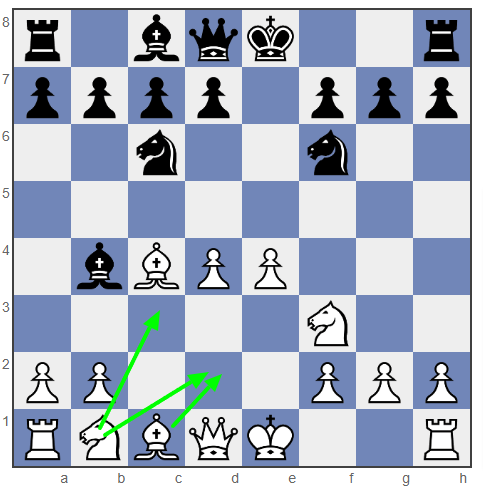
7.Nc3 is probably the most sharp choice:
7.Nc3 Nxe4 8.O-O Bxc3 9.d5 Bf6 10.Re1 Ne7 11.Rxe4
Bird’s Attack
This is an extremely interesting way to play the Italian Game for White.
Instead of sticking to the slow pace of the Giuoco Piano, White plays 5.b4 and surprises Black:
1.e4 e5 2.Nf3 Nc6 3.Bc4 Bc5 4.c3 Nf6 5.b4 Bb6 6.d3 d6 7.a4 a5 8.b5 Ne7
The main idea of the Bird’s Attack on the Italian Game is to gain space on the queenside while disrupting Black’s normal piece development, as well as claiming control of the center.
5.b4 — This is the key move of Bird’s Attack. White aggressively pushes on the queenside, aiming to gain space and potentially trap Black’s bishop.
5…Bb6 — Black retreats the bishop to a safe square.
6.d3 — White continues developing, supporting the e4 pawn.
6…d6 — Black mirrors this move, supporting their e5 pawn.
7.a4 — White continues the queenside expansion.
7…a5 — Black counters by fixing the pawn structure on the queenside.
8.b5 — White pushes forward, gaining more space.
8…Ne7 — Black retreats the knight, preparing for potential kingside play.
Key points about Bird’s Attack:
It’s named after Henry Edward Bird, a 19th-century English chess master.
The main idea is to gain space on the queenside and potentially trap Black’s light-squared bishop.
It leads to an asymmetrical pawn structure, which can create interesting imbalances.
White’s play is primarily on the queenside, while Black often looks for counterplay on the kingside.
The position remains closed in the center, leading to a strategic battle.
This variation is less common than some other Italian Game lines, but it can be an interesting surprise weapon. It requires good positional understanding.
Rosentreter Gambit
In the Rosentreter Gambit, White plays d4 directly, instead of preparing the move with 4.c3 first:
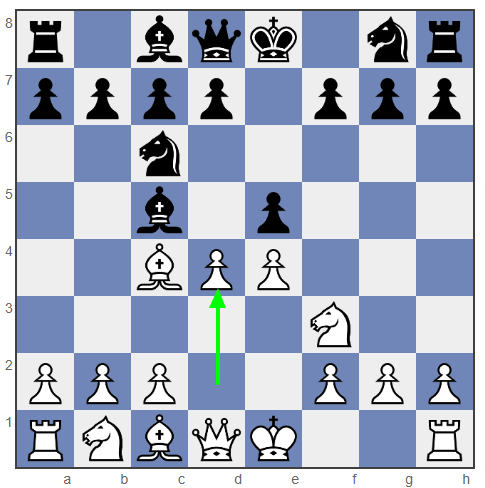
The main line in this gambit is:
1.e4 e5 2.Nf3 Nc6 3.Bc4 Bc5 4.d4 exd4 5.c3 Nf6 6.e5 d5 7.Bb5 Ne4 8.cxd4 Bb6 9.Nc3 O-O 10.Be3
Black usually avoids taking the extra pawn on c3 in move 5 because that would give White too much of an advantage in development.
Key points about the Rosentreter Gambit:
- Named after Arthur Rosentreter, a German chess player.
- Aims for rapid piece development and open lines for attack.
- Leads to sharp, tactical play with opportunities for both sides.
- White sacrifices a pawn for initiative and attacking chances.
- Often results in asymmetrical pawn structures and dynamic imbalances.
Deutz Gambit
The Deutz Gambit arises after the following moves:
1.e4 e5 2.Nf3 Nc6 3.Bc4 Bc5 4.O-O Nf6 5.d4
The Deutz is similar to the Rosentreter but with the difference that in the Deutz White first castles and only then plays d4.
Key points about the Deutz Gambit:
– Named after Johann Deutz, a 19th-century German player.
– The main idea is to sacrifice a pawn for rapid development and open lines.
– After 5.d4, Black has several options: 5…exd4 (accepting), 5…Bxd4 (also accepting), or 5…ed5 (declining).
– If Black accepts with 5…exd4, White often follows with 6.e5, gaining space and tempo.
– Leads to sharp, tactical play where activity compensates the pawn.
Jerome Gambit
The Jerome Gambit is just wild.
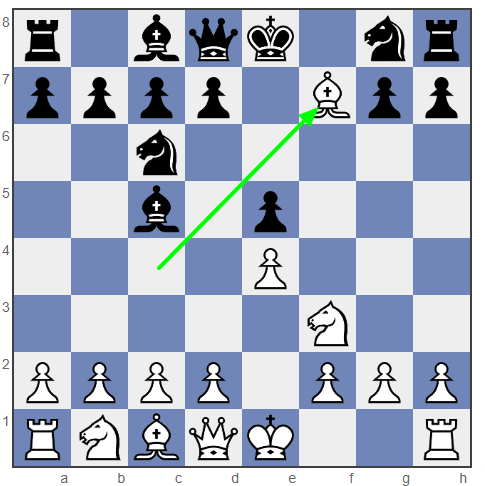
Only mad people or romantics can play this chess opening. It is especially effective in bullet or blitz time controls.
However, it’s not that good in classical because if Black plays correctly, then it can maintain a steady advantage throughout the game.
But… it’s not that simple to play against the Jerome Gambit. Let’s see the correct way to do it and the incorrect way of playing it.
Correct way:
1.e4 e5 2.Nf3 Nc6 3.Bc4 Bc5 4.Bxf7+ Kxf7 5.Nxe5+ Nxe5 6.d4 Qh4 7.O-O Qxe4 8.dxc5 Nf6
Even though the Black king is unsafe, Black has kept the extra piece and will soon coordinate.
If Black panics:
1.e4 e5 2.Nf3 Nc6 3.Bc4 Bc5 4.Bxf7+ Kxf7 5.Nxe5+ Ke6 6.Qg4+ Kxe5 7.d4+ Bxd4 8.Bf4+ Kf6 9.Bg5+ Kf7 10.Bxd8 Nxd8
White captures the queen and gets the upper hand.
Evans Gambit
We have already seen that the Evans Gambit takes place in the Italian Game after: 1.e4 e5 2.Nf3 Nc6 3.Bc4 Bc5 4.b4
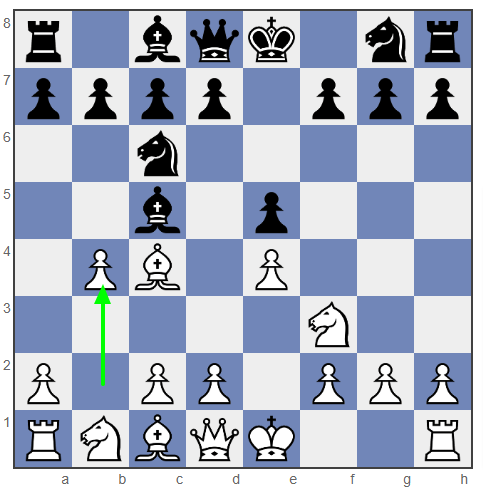
Now Black has two options: accept the pawn (Evans Gambit Accepted) or move the bishop (Evans Gambit Declined).
Evans Gambit Accepted
1.e4 e5 2.Nf3 Nc6 3.Bc4 Bc5 4.b4 Bxb4 5.c3 Ba5 6.d4 d6 7.Qb3 Qd7 8.dxe5 Bb6
Black accepted the gambit and returns a pawn to catch up in development.
Evans Gambit Declined
1.e4 e5 2.Nf3 Nc6 3.Bc4 Bc5 4.b4 Bb6 5.a4 a6 6.Nc3 Nf6
The evaluation is equal, though White often feels a bit more comfortable.
In the following video, FM Viktor Neustroev provides an introduction to the Evans Gambit:
Get Neustroev’s full course on the Evans Gambit with 50% OFF.
Mayet Defense
Black accepts the Evans Gambit but retreats the bishop to f8:
1.e4 e5 2.Nf3 Nc6 3.Bc4 Bc5 4.b4 Bxb4 5.c3 Bf8
Black resets the position and ignores the queenside fight.
Morphy Attack
A sharp line of the Evans Gambit:
1.e4 e5 2.Nf3 Nc6 3.Bc4 Bc5 4.b4 Bxb4 5.c3 Ba5 6.d4 exd4
Black is a pawn up but White has a strong center and open lines.
Symmetrical Italian Game
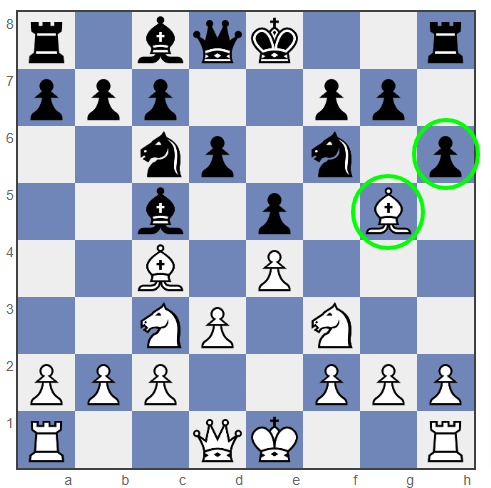
1.e4 e5 2.Nf3 Nc6 3.Bc4 Bc5 4.Nc3 Nf6 5.d3 d6
The symmetry is usually broken in move 6, when White plays Bg5 and Black responds with h6:
Italian With 3…Nf6: Two Knights Defense
1.e4 e5 2.Nf3 Nc6 3.Bc4 Nf6
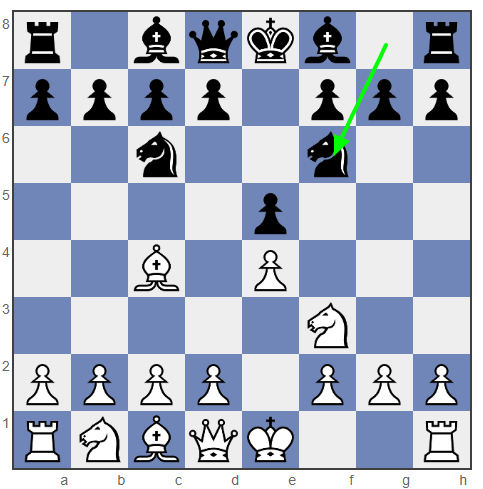
The Two Knights Defense is considered a pretty aggressive choice by Black.
There are 3 main responses for White:
- 4.d3
- 4.Ng5
- 4.d4
The most active is without a doubt 4.Ng5, threatening Nxf7.
If both sides play correctly:
1.e4 e5 2.Nf3 Nc6 3.Bc4 Nf6 4.Ng5 d5 5.exd5 Na5 6.Bb5 c6 7.dxc6 bxc6 8.Bd3 Nd5 9.Nf3 Bd6
Crazy line:
1.e4 e5 2.Nf3 Nc6 3.Bc4 Nf6 4.Ng5 Bc5 5.Nxf7 Bxf2+ 6.Kf1 Qe7 7.Nxh8 d5
Fried Liver Attack
Probably the most exciting line in the Italian Game.
1.e4 e5 2.Nf3 Nc6 3.Bc4 Nf6 4.Ng5 d5 5.exd5 Nxd5 6.Nxf7 Kxf7 7.Qf3+ Ke6 8.Nc3
White sacrifices on f7 and Black’s king safety is compromised.
Italian Game With 4.Nc3: Four Knights Game
1.e4 e5 2.Nf3 Nc6 3.Bc4 Nf6 4.Nc3
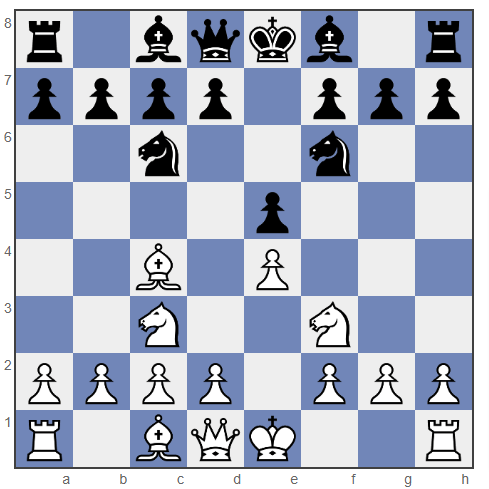
This is a very drawish line, which might be helpful against higher-rated players.
Main continuation: 4…Nxe4 5.Nxe4 d5 6.Bd3 dxe4 7.Bxe4 Bd6 8.O-O
Scotch Gambit
1.e4 e5 2.Nf3 Nc6 3.Bc4 Nf6 4.d4 exd4 5.O-O
If you like the Scotch, this variation is for you. Main line: … Nxe4 6.Re1 d5 7.Bxd5 Qxd5 8.Nc3 Qa5 9.Nxe4
Italian With 3…Be7: Hungarian Defense
1.e4 e5 2.Nf3 Nc6 3.Bc4 Be7
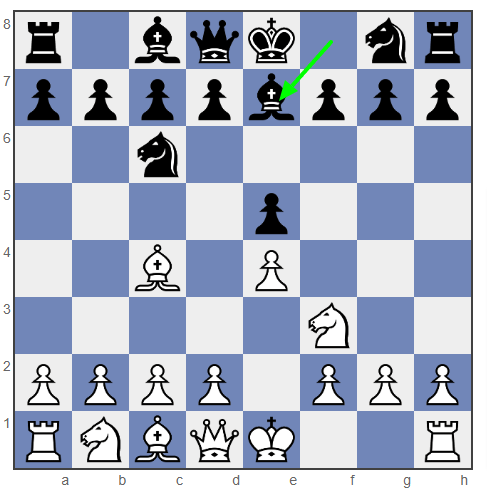
A conservative way of playing the Italian; quieter positions but fully playable.
Italian With 3…d6: Paris Defense
1.e4 e5 2.Nf3 Nc6 3.Bc4 d6
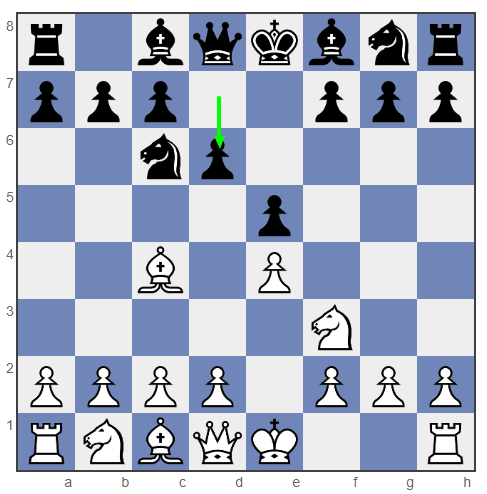
Another passive approach that has been played many times at master level.
This is a game played earlier this year:
Italian With 3…g6
1.e4 e5 2.Nf3 Nc6 3.Bc4 g6
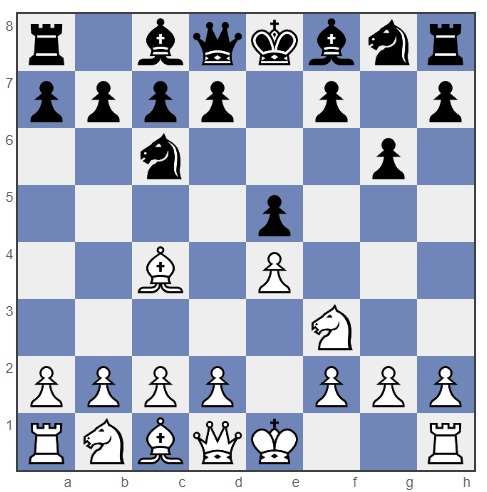
Weird and not common at master level, but you may still face it.
Italian With 3…f5: Rousseau Gambit
1.e4 e5 2.Nf3 Nc6 3.Bc4 f5
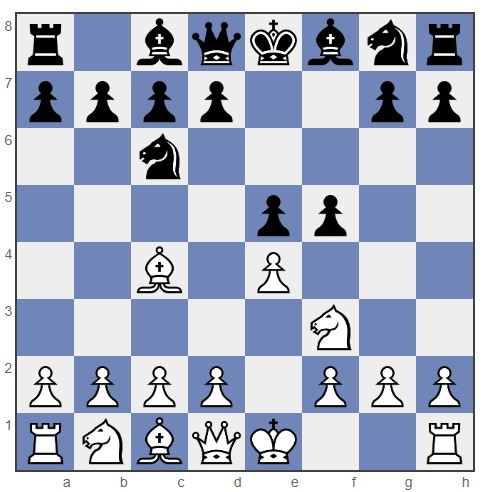
Not the most solid, but the Rousseau Gambit will surprise many opponents.
Tricks and Traps in the Italian Game
Trick in the Four Knights Variation
1.e4 e5 2.Nf3 Nc6 3.Bc4 Bc5 4.Nc3 Nf6 5.d3 d6 6.Bg5 h6 7.Bxf6 Qxf6 8.Nd5 Qd8 9.c3 Be6 10.d4 exd4 11.cxd4 Bb6 12.Nxb6 axb6 13.d5
Smothered Mate
1.e4 e5 2.Nf3 Nc6 3.Bc4 Nd4 4.Nxe5 Qg5 5.Nxf7 Qxg2 6.Rf1 Qxe4+ 7.Be2 Nf3#
Belloni Trap
1.e4 e5 2.Nf3 Nc6 3.Bc4 Bc5 4.c3 d6 5.d4 exd4 6.cxd4 Bb4+ 7.Kf1 Nf6 8.d5 Ne5 9.Qa4+ c6 10.Qxb4
Model Games in the Italian Game
Useful Resources
If you are determined to master the Italian Game, here are some useful resources for you:
Chess course: Win with Evans Gambit with FM Viktor Neustroev
Opening Explorer: See all the lines in the Italian Game
Openings Trainer: Practice the Italian vs the computer
Magnus Carlsen Italian games: Replay all of Magnus Carlsen chess games with the Italian Game
Author: Federico Vinas
C50 Sub-variants:
- Italian Game
1. e4 e5 2. Nf3 Nc6 3. Bc4 - Blackburne shilling gambit
1. e4 e5 2. Nf3 Nc6 3. Bc4 Nd4 4. Nxe5 Qg5 5. Nxf7 Qxg2 6. Rf1 Qxe4+ 7. Be2 Nf3+ - Rousseau gambit
1. e4 e5 2. Nf3 Nc6 3. Bc4 f5 - Hungarian defence
1. e4 e5 2. Nf3 Nc6 3. Bc4 Be7 - Hungarian defence, Tartakower variation
1. e4 e5 2. Nf3 Nc6 3. Bc4 Be7 4. d4 exd4 5. c3 Nf6 6. e5 Ne4 - Giuoco Piano
1. e4 e5 2. Nf3 Nc6 3. Bc4 Bc5 - Giuoco Piano, four knights variation
1. e4 e5 2. Nf3 Nc6 3. Bc4 Bc5 4. Nc3 Nf6 - Giuoco Piano, Jerome gambit
1. e4 e5 2. Nf3 Nc6 3. Bc4 Bc5 4. Bxf7+ - Giuoco Pianissimo
1. e4 e5 2. Nf3 Nc6 3. Bc4 Bc5 4. d3 - Giuoco Pianissimo, Dubois variation
1. e4 e5 2. Nf3 Nc6 3. Bc4 Bc5 4. d3 f5 5. Ng5 f4 - Giuoco Pianissimo
1. e4 e5 2. Nf3 Nc6 3. Bc4 Bc5 4. d3 Nf6 - Giuoco Pianissimo, Italian four knights variation
1. e4 e5 2. Nf3 Nc6 3. Bc4 Bc5 4. d3 Nf6 5. Nc3 - Giuoco Pianissimo, Canal variation
1. e4 e5 2. Nf3 Nc6 3. Bc4 Bc5 4. d3 Nf6 5. Nc3 d6 6. Bg5