The Most Luminous Supernovae
Abstract
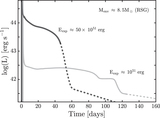
Recent observations have revealed a stunning diversity of extremely luminous supernovae, seemingly increasing in radiant energy without bound. We consider simple approximate limits for what existing models can provide for the peak luminosity and total radiated energy for non-relativistic, isotropic stellar explosions. The brightest possible supernova is a Type I explosion powered by a sub-millisecond magnetar with field strength B ∼ few × {10}13 G. In extreme cases, such models might reach a peak luminosity of 2× {10}46 {erg} {{{s}}}-1 and radiate a total energy of up to 4× {10}52 {erg}. Other less luminous models are also explored, including prompt hyper-energetic explosions in red supergiants, pulsational-pair instability supernovae, pair-instability supernovae, and colliding shells. Approximate analytic expressions and limits are given for each case. Excluding magnetars, the peak luminosity is near 3× {10}44 {erg} {{{s}}}-1 for the brightest models and the corresponding limit on total radiated energy is 3× {10}51 {erg}. Barring new physics, supernovae with a light output over 3× {10}51 erg must be rotationally powered, either during the explosion itself or after, the most obvious candidate being a rapidly rotating magnetar. A magnetar-based model for the recent transient event, ASASSN-15lh is presented that strains, but does not exceed the limits of what the model can provide.
- Publication:
-
The Astrophysical Journal
- Pub Date:
- April 2016
- DOI:
- arXiv:
- arXiv:1602.04865
- Bibcode:
- 2016ApJ...820L..38S
- Keywords:
-
- supernovae: general;
- Astrophysics - High Energy Astrophysical Phenomena
- E-Print:
- 5 pages, 2 figures and 1 table. Submitted to The Astrophysical Journal Letters