, December 4, 2025
Democratic Minimalism
Shadi Hamid’s America without alternatives
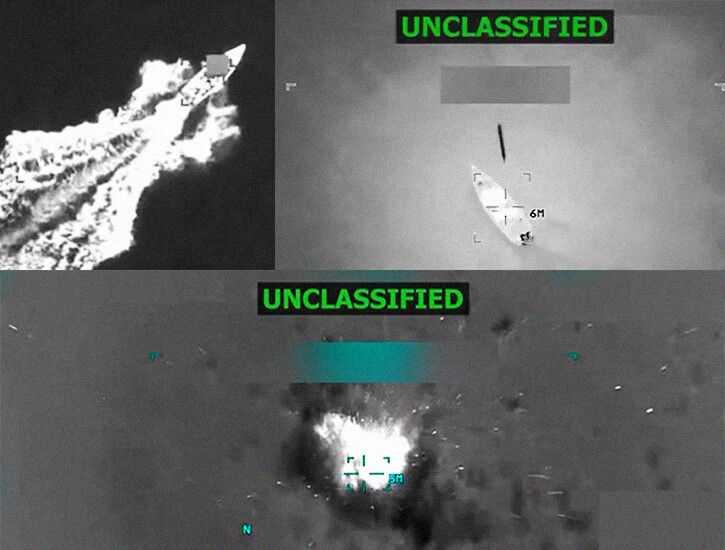
Stills from a video posted by Defense Secretary Pete Hegseth showing boats in the Caribbean. | X
The Case for American Power by Shadi Hamid. Simon & Schuster, 256 pages. 2025.
Who should you consult during a crisis of faith? If the counsel of a priest or imam doesn’t help, you might instead turn to a convert: someone whose zeal is fresh, and who can remind you of the virtues of belief by evoking the darker days before they gained it. Hearing about their path to deliverance may dispel your doubt and fortify you against any future lapse. In The Case for American Power, Washington Post columnist Shadi Hamid offers precisely this remedy—not for traditional penitents but for right-minded secular liberals in the United States whose confidence in their nation is shaken. A redemption story, mixing personal memoir with pulp political science, the book traces Hamid’s arc from espousing juvenile “anti-imperialism” to defending what he calls the “American civic religion,” which recognizes the United States as an essential force for moral progress: “better than any previous empire and certainly better than any conceivable alternative.” To those struggling to reconcile this image of the country with its recent activities abroad—spreading reaction and supporting genocide—not to mention its much longer history of aggressive war, the author urges patience. Criticizing such policies is legitimate, he writes, but forsaking the homeland is not. Once you’ve learned how Hamid became a believer maybe you can do the same.
A research professor of Islamic studies at the Fuller Theological Seminary as well as a talking head on broadcast news shows, Hamid is attuned to the religious valences of political life. Born to an Egyptian family in Pennsylvania in 1983, he was a student at Georgetown in the new millennium, when the Bush administration launched its crusade across the Middle East while clamping down on Muslim communities at home. Outraged by both developments, he fell in with a “motley crew of socialists, anarchists, and ordinary students who found themselves stupefied by a war that seemed self-evidently absurd,” organizing protests and vigils on campus while preaching the gospel of Chomsky. “There was a lot of blame to go around,” he recalls. “We blamed America first, and for good reason.”
Hamid’s early postgraduate years were spent in Amman researching what eventually became his doctoral dissertation on the Muslim Brotherhood. Yet the intensely anti-American climate there had a paradoxical effect on the young scholar, who recalls how, sick of “being asked to justify or explain decisions that I had nothing to do with,” he studiously avoided any conversation that might expose him as an American. This feeling of guilt, however, was also an ineluctable reminder that “I was American,” which revealed something “deeper and more profound” beneath his opposition to the war on terror: a genuine affinity with his native country, and a desire for it to live up to its professed values.
He returned to the United States to take a job at the Brookings Institution and published his first book, Temptations of Power (2014), which described the fortunes of Islamist groups before and after the Arab Spring, arguing that while state repression had forced them to moderate, democratic openings had caused them to radicalize. This position was elaborated in Islamic Exceptionalism (2016), a more popular and polemical tract, in which Hamid claimed—via several case studies spanning Egypt, Turkey, Tunisia, and Syria—that Islam is inherently resistant to the kind of secular democracy that has swept Christian countries.
What’s perceived as a deterioration in its global position is, for Shadi Hamid, merely an acknowledgement of this perennial gap between what America should be and what it is.
These works represented a midpoint in Hamid’s transition from opponent to upholder of American hegemony. On the one hand they stressed the particularity of Muslim societies and the difficulty of imposing Western paradigms on them at gunpoint. On the other, their account of the Islamic “exception” fit neatly with an emerging establishment consensus on the Middle East: that for all our attempts to democratize the region, it remained too backward to recognize the advantages of the American model. At the time Hamid was coy about the Huntingtonian implications of his argument: “Talk of a ‘clash of civilizations’ is as unwise as it is imprecise,” he wrote, “but there does appear to be a clash of values.” Yet in subsequent years he refined this intellectual maneuver as a contributor to The Atlantic and then the Post, denouncing Washington’s most myopic foreign policy decisions while affirming that these instances of poor judgement were merely that. However terrible the fallout of armed interventions or U.S.-backed coups, they could not compromise the sanctity or superiority of the American project.
The Case for American Power is an attempt to maintain this view in the increasingly inhospitable conditions of this decade, sketching the doctrines that support American ascendancy and the precepts that believers can invoke when it is challenged, either by external forces or internal failures. No longer disavowed, civilizational clashes are now viewed as the defining feature of our era, with righteousness lying squarely on one side. Hamid starts from the premise that the United States was “founded as a nation with a distinctly moral purpose” and a “set of sometimes radical ideas about what was right and good.” It was “infused with idealism,” driven by a “mission beyond itself,” in a way that distinguished it from other states.
The precise details of that mission are never quite nailed down, but Hamid knows that it has something to do with “democracy”: cherishing it, preserving it, occasionally exporting it. Marking his distance from his youthful cynicism, he insists that the Iraq War was motivated not by an ambition to control the global oil supply or set up a reliable proxy state but by “admirable views about democracy’s universality”—“a beautiful sentiment,” for which George W. Bush “deserves some credit,” whatever his other faults. Democracy, after all, is the “only system of government aligned with our nature,” in contrast to dictatorship which erodes the humanity of its subjects. Hamid urges us to respect this sacred principle, while conceding that its application in the domain of foreign policy has at times been uneven.
Another upside of democracy is that it forces countries to adapt to the oscillations of popular opinion, making them fundamentally immune to fixity. For Hamid this implies that the tangible effects of American power, past and present, cannot be used to evaluate American power per se. For that would be to reify our existing situation as the only possible one, rather than recognizing the open horizon afforded by free elections. Surveying the nation’s extensive record of espionage and jingoism—Vietnam, Chile, Brazil, Iran, the Congo, Palestine—Hamid concludes that none of this is relevant to its moral standing, which is less a matter of America’s extant character than its potential role. “Nations (like people) can change . . . If we have indeed been a force for bad rather than good, are we doomed to always be that way?”
This introduces a strange dualism to Hamid’s thought, sundering the platonic form of America from its degraded reality. He is willing to permit most criticisms of empire, conceding, for example, that American interference in the Arab world has been a story of self-sabotage and overreach—so long as they do not undermine it as an ideal. On this basis, Hamid mounts a counterintuitive defense of hypocrisy, observing that in such instances when politicians proclaim their ethical commitments but fail to put them into practice, this signals nothing less than the endurance of America as an abstract value toward which they are striving. “Or, to put it differently, insofar as hypocrisy points to an aspiration not met, the aspiration remains. This is better than the alternative.” From this perspective, the problem with autocracy is precisely its hypocrisy deficit. Despots are less likely to pretend that they are guided by certain moral codes, and without that pretense, morality itself is at risk of vanishing. To abolish hypocrisy is to foreclose possibility and submit to actuality: in a word, to Fall.
For similar reasons, Hamid is opposed to any assertion of imperial decline or emerging multipolarity: the notion that we are entering an era in which authority is dispersed across different states and no longer rests with any single sovereign. This is dismissed as a fantasy that fails to reckon with the true scale of America’s supremacy, capable of controlling critical sea lanes and international financial flows alike. What’s perceived as a deterioration in its global position is, for Hamid, merely an acknowledgement of this perennial gap between what America should be and what it is. Fretting over that breach is now a “national pastime, with each generation of Americans rediscovering what it means to lose faith,” and the consternation over Trump’s return to the White House conforms to this pattern that has played out with many presidents past. It is simply another pendulum swing in a system which often creates the impression of chaos, but which, beneath the ephemera of D.C. politics, remains robust enough to rule the world.
Strengthening that rule must now be our priority, Hamid concludes, since the only other contenders for shaping the global order are the authoritarian regimes of China and Russia. As the new Cold War heats up, there is no room for the kind of Americanophobia that the author previously entertained. We are locked in an “existential struggle between opposing systems” initiated by Russia’s invasion of Ukraine, which is presented as a turning point without parallel in recent history. “In a better world, coexistence might have been possible. But that world is no longer the one we live in.” While Hamid writes about America in the subjunctive mood, then—more concerned with its potential than with its current state—his view of the wider global situation is more rigidly present tense: the way it is now is the way it has to be.
Theologically, the benefits of Hamid’s dualism are twofold. First, it allows him to incorporate doubt into the structure of belief. The book is full of equivocation, handwringing, and second-guessing, usually coupled with reflexive meditations on the writing process that soon start to grate. “As I write this,” he reflects after making his case for American moral superiority, “the doubts still linger.” “As I write these words, I won’t pretend that I’m not still conflicted. Because I am.” “I feel uncool just writing this.” “I am writing this as much to myself as to you, the reader . . . to remind myself of something I believe to be true.” In the end, though, these reservations serve to reaffirm Hamid’s loyalty to America—because only such a humane and tolerant society would allow him to hold such objections, let alone express them at the ballot box. “Democracy itself encourages self-doubt.”
Hamid’s faith is not the type that can be tested against empirical reality or subjected to rational scrutiny.
Second, this viewpoint means that no crime the United States commits can possibly weaken one’s attachment to it. When the country blows up news stations in Kabul or small boats in the Caribbean, we are encouraged to see this as a betrayal rather than a revelation of its national essence. At which point we can relive Hamid’s moment of conversion in Amman, taking our anger as a sign of our investment in the motherland, and an impetus to improve it as much as we can.
Still, in a spirit of sober pragmatism, Hamid is clear that such improvement has its limits. He insists that the chasm between aspiration and reality can never be fully closed. “There is no way to be entirely consistent, and it is unclear what such consistency would even look like in practice.” Anti-imperialists can only maintain their purism by refusing to reckon with the realities of government, whereas those who understand the latter know that “in the chaotic realm of international relations, there are fewer rules and norms. Interests conflict. There are enemies who want to destroy you. Survival is paramount.” In these circumstances, you sometimes have to get your hands dirty.
This bleak worldview, manifest in Hamid’s eulogy to hypocrisy, reveals what many would argue is the true function of the American civic religion: a standard of civilization that can be used to justify all manner of barbarism. “At their core,” writes Hamid, “liberal democracies run on a certain kind of faith . . . In the real world, however, politics is marked by trade-offs.” Lofty idealism coincides with brutal realism. The first is an ideological supplement that allows us to pursue the second with a clean conscience. It is precisely the opiate that many American liberals, trying to salvage their patriotism in the maelstrom of Trump 2.0, have been craving.
Moreover, because Hamid maintains a strict separation between the ideal and the real, he needn’t be concerned that American-style democracy tends to leave voters perennially unfulfilled, never able to shape the polity in their image. Since its inception the country has never been particularly fond of government by the people. The Founding Fathers believed in “the rule of the best: the well heeled, the wise, and the virtuous,” while their inheritors have long sought to insulate sensible statecraft from the “unseriousness of the mob.” Rather than lamenting this lack of democracy, Hamid simply proposes that we reconceive the term. His sympathies lie with what he calls “democratic minimalism”: a more modest approach to popular sovereignty, based on the maxim “less is more.” All we should hope for is “the peaceful alternation of power”—not a perfect form of self-rule, but an effective “set of mechanisms for conflict regulation” that will prevent it from becoming “existential.”
At this point, however, Hamid runs into trouble because he has also staked his thesis on the idea of an “existential struggle between opposing systems.” The incompatibility of these positions is plain to see. He exhorts us to join a crusade against the Sino-Russian menace in the name of democracy, while at the same time conceding that our own democratic outlets are minimal. He praises the American system as an extension of our species-being, as if the Creator Himself had fine-tuned the Electoral College, while also warning us to not to expect too much from it. Just as the ideal and real Americas can never come together in Hamid’s schema, nor can we bridge the gap between the principle of democracy and its restricted practice: a lacuna that feels painfully apparent in 2025, with MAGA authoritarianism on the march.
Hamid’s willingness to bet the house on a democracy that only dubiously exists forces him to defend a series of eccentric positions. To make the case that the assault on Ukraine is a singular turning point in twenty-first-century history, for instance, he places it in an entirely different ethical category to the invasion of Iraq. One was carried out by a democracy and the other by a dictatorship; therefore one was a well-intentioned bid to spread the natural system of government and the other a sinister effort to destroy it. Even if we take this claim at face value, we might wonder how it would go down with the victims of America’s white phosphorus attacks on Fallujah in 2004, or the family of the fourteen-year-old girl from Yusufiyah who was gang-raped and executed by U.S. soldiers in 2006, or the countless people who endured unspeakable horrors in the empire’s sprawling network of torture bases. They would no doubt be reassured to hear that these acts were carried out under the authority of an elected president rather than an appointed one (though even this would be hard to sustain given the circumstances of the Bush–Gore contest).
The assumption that only American power has “mission beyond itself” signals a similar variety of parochialism. For when it comes to representing universal values, it is the rival superpower, China, that may well have a stronger case—as a peasant society that under the banner of communism redistributed land, modernized industry, provided basic services, spread literacy, and dramatically increased life expectancy, eventually lifting eight hundred million people out of poverty while at the same time leaping to the forefront of the global green transition and the technological revolution. Hamid would scoff at this idealized account of the People’s Republic of China, stressing the various factors—mass famine, widespread repression, attacks on minorities, digital surveillance—that undermine its egalitarian rhetoric. But why then would he not apply this skepticism to his own country, with its equally vitiated set of values?
The answer is simple. As the book goes on, it becomes clear that Hamid’s faith is not the type that can be tested against empirical reality or subjected to rational scrutiny. He admits in the epilogue that it more or less boils down to a three-word statement: “I love America.” This feeling, which he discovered in the heat of the war on terror, has since hardened into a dogma. Now that the world is militating against it, with American credibility smoldering in the hellfire of Gaza, its rote invocation has become all the more necessary for believers. The Case for American Power may not equip them with many robust arguments to fall back on, but at least it gives them a kind of catechism to recite.
And yet, if the book is in this sense a direct response to contemporary conditions, it is also an attempt to evade them, by retreating back into the warm certainties of the 1990s and 2000s—from the perpetuity of U.S. dominance to the division of the world into democracies and dictatorships, the “coalition of the willing” and the “axis of evil,” with the former group vowing to topple the latter. While Hamid tries to locate America’s greatness in its “potential for change,” his writing more accurately reflects the persistence of this tired Manichean outlook, which liberals have imported from the turn of the millennium to cope with an unruly present. It wrought havoc then and it will do the same now. But this is of scant interest to the zealot, who can always turn his mind to higher things.