
How much does it cost and how do I pay?
See our our fares and passes page.
Where does TCAT go?
TCAT has 25 routes that serve the Greater Ithaca Area and rural areas throughout Tompkins County. See page with popular destinations and their associated routes.
Transfers - What happens if more than one route is needed to complete a trip?
Upon request, bus operators will provide you with a maximum of two transfer slips at no additional cost if more than one bus route is needed to get to your destination. Transfers are good for a continuous one-way trip on the day of issue and will only be honored on the next available bus. They will not be accepted on any trip that will return the passenger to the area in which the transfer was originally issued, nor to re-board the same route. Day or semester pass holders do not need a transfer slip, simply swipe your card again.
How can I find out if my bus will be delayed?
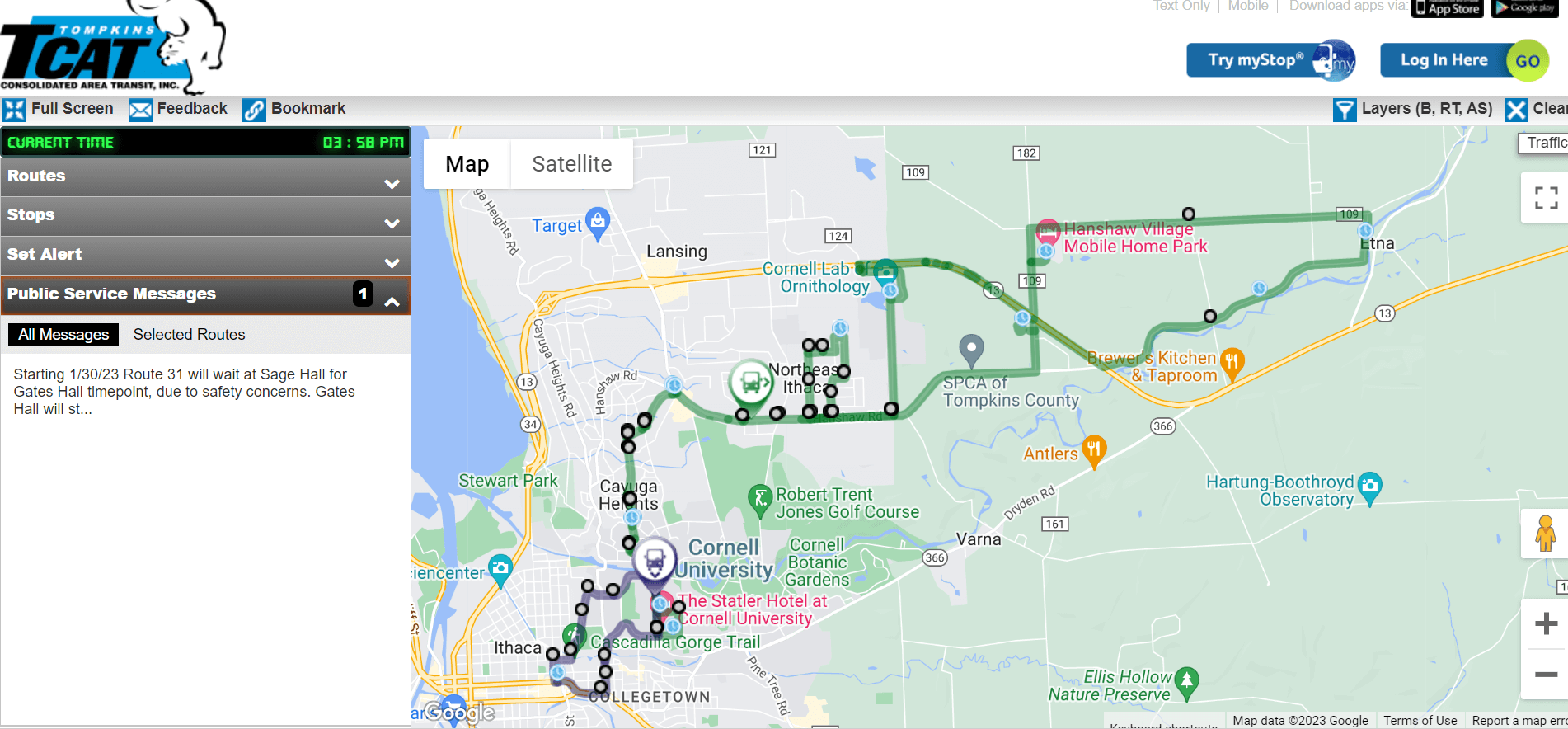
As soon as information becomes available. TCAT’s customer service representatives or dispatchers make every effort to alert the public. TCAT advises riders to consult TCAT’s Bus Tracker to check the status of their routes. The Bus Tracker also includes passenger alerts, which are also streamed on the red banner across TCAT’s home page. Riders are also encouraged to download the MyStop or other real-time apps. See TCAT’s app page for a list of apps available.
Occasionally, TCAT buses need to go on detour due to construction or road closures, often leading to confusion about bus delays. Detour or service notifications can be found under “Public Service Messages” on the Bus Tracker and on the MyStop app..
TCAT also conveys information via Twitter (TCATRides). Furthermore, as soon as information becomes available, phone messages are recorded at (607) 277-7433.
As a general note, given that TCAT operates 25-plus routes, it is often difficult to convey specific route delays in a timely manner. As a rule of thumb, TCAT asks passengers to dress for the weather and to be at their bus stops on time.
Log into the Bus Tracker at: http://realtimetcatbus.availtec.com/ and sign up for text and email alerts.

I tried to catch the bus as it was pulling away from the curb, but the operator wouldn’t stop for me. Why?
As soon as the bus is in motion, TCAT bus operators are prohibited from stopping for safety reasons. The bus operator’s attention is focused on merging into traffic and any distraction could pose a safety hazard.
When does TCAT make service changes?
 TCAT generally makes service changes and publishes new schedules three times per year. Spring service runs from mid-January until late May, summer service operates from late-May until late-August, and fall service is in effect from late-August until mid-January. Check our schedules page for up-to-date announcements and information.
Planners, shown left, spend several hours adjusting routes based on available resources, to include the number of bus operators who will be available to fulfill service.
Why do I have to stow my belongings away from aisles/fold my baby stroller and/or grocery cart?
If a bus operator has to stop quickly, your item can turn into a projectile and injure someone. Furthermore, the aisles need to be kept clear so passengers can walk safely without the risk of tripping.
I lost something on the bus. How do I get it back?
We also need a thorough description of your lost property. All lost items are normally turned in to the front office when the bus returns to the depot which is usually on the following day. On occasion, items do get turned in on the same day they were lost.
All Lost & Found Items can be reclaimed at the TCAT main office.
TCAT Main Office
737 Willow Avenue
(opposite the city golf course)
Ithaca, NY 14850
Monday – Friday
8:00 am – 5:00 pm
Contact:
(607) 277-RIDE (7433)
tcat@tcatmail.com
Please bring photo I.D. with you (if it is not among your lost items)
PLEASE NOTE: We only keep lost property items for 30 days. After that time, items are donated.
TCAT is not responsible for lost or stolen items, but will make every effort to return them to their rightful owners.
Does TCAT operate on holidays?
TCAT operates 359 days a year. Service does not operate on January 1, Memorial Day (May), Juneteenth (June 19), Independence Day (July 4), Thanksgiving Day (November), and Christmas Day (Dec. 25).
I can't afford to ride the bus, but need transportation. Are there any programs out there that can help me?
2-1-1 of the Human Services Coalition of Tompkins County can assist by offering free bus passes to those who are financially struggling.
Phone: 2-1-1 or toll free 877-211-8667 (if outside Tompkins County)
Email: iandr@hactc.org
Hours of operation – locally staffed M-F 8:30am-8pm
Or see: GO ITHACA’s Easy Access program
Why shouldn’t I cross in front of a stopped bus after I get off?
For safety reasons. If you wait until the bus departs the stop before crossing you will be able to see traffic in both directions and motorists will be able to see you.
I don’t have bus service in my neighborhood. How does TCAT determine where to operate its routes?
TCAT creates its routes based on based on travel patterns and magnitude of demand. In January 2010, TCAT implemented a new route system based on two years of expert consultation, field work and public outreach that netted 600 suggestions. With limited resources, TCAT strives to offer service that provides the most coverage to the majority of the community. TCAT is always willing to consider requests for service.
Can I bring pets on the bus?
Animals are allowed on the bus in an enclosed pet carrier. Service animals are allowed and must be under complete control of the owner. Dogs that serve as comfort or therapy dogs would not be accepted on the bus unless in an enclosed animal carrier.
I went out on Sunday night and needed to catch a bus home at 1:00 AM on Monday morning. According to the trip planner, the route 90 should have been running but it never showed up. Was the trip planner incorrect?
Transit schedules often show a schedule for a “Service Day” rather than a calendar day. By “service day,” we mean that TCAT’s transit system starts up around 4:00 AM in the morning, continues throughout the day, and has its final trips around 2:30 AM the following day. This would mean that a Monday schedule actually encompasses the time period from 4:00 AM Monday morning until 2:30 AM Tuesday morning. Although trips that occur after midnight are technically on the next calendar day, they are still considered part of the previous day’s service schedule, especially since one individual bus trip might start at 11:30 PM Monday and finish at 12:30 AM Tuesday, having spanned the date change.
This may be where the confusion sets in. When you see on the schedule that there is a Route 90 leaving the Commons at 1:00 AM on “Mondays” (and every weekday), this means that the bus actually serves the stop at 1:00 AM, on the calendar days Tues-Sat. As there is no Route 90 service on the Sunday schedule, this means that there is also no service in the early morning hours of Monday.
It is difficult to display this information in a consistent fashion so that it is easily comprehendible to passengers. Eventually we hope to change over to Google transit which is equipped to handle and display this information.
Are there neighboring transit systems that can provide transportation in and out of Tompkins County?
Three out-of-county transit systems provide service into Tompkins County – C TRAN (Chemung County), Cortland Transit, and Schuyler County Transit.
C TRAN
C Tran’s route 30 connects downtown Ithaca, Cornell University, and East Hill Plaza to various Chemung County communities, including but not limited to Elmira, Horseheads, and Spencer. Connections can be made to most TCAT routes in downtown Ithaca and Cornell University. This commuter service is provided during weekday rush hours.
Contact information for C TRAN.
Cortland Transit
Cortland Transit operates two services into Tompkins County, the routes 6 and 7. The route 6 connects Cortland with TC3 and Dryden, while the route 7 continues past Dryden to Cornell University and East Hill Plaza. Connections can be made in Dryden with the TCAT 43 and with most TCAT routes in Cornell University. The route 6 operates throughout the day on weekdays, while the route 7 operates during weekday rush hours.
Contact information for Cortland Transit.
Schuyler County Transit
Schuyler County Transit’s route 6 travels directly to and from (and points in between) Schuyler Hospital and Cayuga Medical Center.
Route 6 riders connecting to and from TCAT routes 14 and 20 (ONLY) do not need to pay a second fare so long as they request and obtain a transfer slip from the bus operator on the originating trip.
- Connecting from the Schuyler Co. Route 6 at the Enfield Park and Ride onto a TCAT inbound route 20 serving Cornell and downtown Ithaca: The rider needs to request a transfer slip from the Schuyler Co. route 6 driver to present to the TCAT Route 20 bus driver.
- Connecting from the TCAT outbound Route 20 at the Enfield Park and Ride onto the Schuyler County-bound Route 6: Upon boarding the route 20 heading outbound to Enfield, the rider must pay the regular TCAT fare ($1.50 for single adult ride/ .75 for seniors 60 and older and persons with disabilities). The rider needs to request a transfer slip from the TCAT driver to present to the Schuyler County-bound route 6 driver.
- Connecting from the Schuyler Co. Route 6 at Cayuga Medical Center to the TCAT route 14 bus serving West Hill and downtown Ithaca. Again, riders do not need to pay a second fare on the route 14, but must request and obtain a transfer slip from the route 6 driver to show the TCAT route 14 driver at Cayuga Medical Center.
- Connecting from the TCAT outbound route 14 to travel to Cayuga Medical Center to pick up the Schuyler County-bound Route 6: riders must pay regular TCAT fare to travel to Cayuga Medical Center where they can pick up Schuyler County-bound route 6.To avoid paying a second fare, they need to ask the route 20 TCAT driver for a transfer slip to show the Schuyler County-bound route 6 driver.
What is a service animal?
Service animals are animals that have been trained to perform tasks that assist people with disabilities. Passengers with disabilities may ride with their trained service animal. The operator may ask if the animal is a service animal and what tasks the animal has been trained to perform.
The service animal must be under the control of the owner at all times. If the animal is not under the control of the owner or if the animal poses a direct threat to the health or safety of others, the operator may require the animal to leave the bus.
All TCAT buses are equipped with a wheelchair lift or ramp, which the driver will deploy upon request. If you are still unable to access the bus system, you may be eligible for ADA complementary paratransit.
Why doesn’t TCAT use smaller buses? Wouldn’t they be cheaper?
Smaller buses can only be used on certain routes that have lower ridership due to their smaller capacity. As such, they are not cheaper to operate as the cost of labor, maintenance remains the same, regardless of bus size. Although fuel efficiency is slightly better, but the difference is negligible. Furthermore, the Federal Transit Administration doesn’t allow TCAT to have two separate sized fleets, so we size ours to meet rush hour demand.
Other transit systems have gone fare free, why not TCAT?
The question of whether TCAT should go fare-free and how that might be accomplished has been raised frequently by the public over the past several months.
While TCAT aplauds community members for their passion in trying to make local transit more accessible, too many roadblocks exist for the agency to implement a zero-fare program.
In 2022, the TCAT Board of Directors tasked its Planning Committee with addressing this question. This document and the supplemental material represents the report of the Committee.
Firstly, the question of whether TCAT should go fare-free is beyond the scope of the work of the Planning Committee. That decision would need to be made by the TCAT board, in consultation with TCAT staff and the TCAT underwriters. What this report attempts to do is to gather relevant information in one place, so that if the decision is made to implement a fare-free structure in the future, some of the ground work has already been done.
The most cited benefits of going fare-free include:
- Increased ridership, which has the effect of taking some cars off the road and potentially saving energy and reducing greenhouse gas emissions
- Equity, by increasing accessibility of low-income residents to transit
- Operational efficiency, by eliminating the costs associated with handling money, eliminating transfers, eliminating farebox maintenance, quicker boarding, etc.
However, TCAT in 2023 continues to experience severe constraints to its service. Decreased ridership and staff shortages and, to some extent, parts shortages are combining to make management of the TCAT system as difficult as it has ever been.
TCAT continues to uphold the Planning Committee’s earlier conclusion.
Some background
At the onset of the committee’s work on going fare-free, TCAT General Manager Scot Vanderpool laid out a set of criteria that would need to be met before we could begin going fare-free:
- The number of bus operators increases to 90 – 95
- Preventive maintenance services are maintained at 100% for a quarter of a year
- Addition of 2 additional qualified and trained mechanics
- Parts ordering becomes predictable
It was the the committee’s recommendation that the fare-free proposal, be re-examined by TCAT board and staff at such a time as the above criteria have been achieved. As of the second quarter of 2023, those conditions have not been achieved.
One decision that would need to be made before a fare-free system could be implemented is how the increased cost to TCAT would be funded. A rough, working estimate at this time is that an additional $1.5 million would be needed annually. There are many assumptions that go into this calculation.
It is unlikely that money to pay for the fare-free annual funding gap would come from a private donor. Therefore, one or all of the local underwriters would most likely have to fund some or all of this initiative. There has also been discussion of cultivating additional community partners to help fund TCAT, perhaps with something like bulk-fare agreements. Some large entities who could be approached include Ithaca College, the hospital, other large employers, and all the municipalities in the County. Sewing together this patchwork of funding would be a large undertaking.
A key piece of the financial picture is whether or not Cornell University would continue to contribute the equivalent of its current bulk fare payments – approximately $3.3 million at this time – if TCAT were to go fare-free. Despite repeated, direct requests to Cornell to comment on this, they have declined to do so.
Another decision that would need to be made is whether to attempt to transition to fare-free in stages, or to attempt to change all at once. TCAT has already gone fare-free for people aged 17 and younger. Other specific populations who could potentially go fare-free include seniors, low-income people, or people from a specific geographic area. Also, discussions have taken place for several years about the idea of a downtown circulator, which is usually envisioned as being fare-free.
An assumption is made that going fare-free will increase the number of riders on TCAT’s buses. We are currently estimating an increase of 20% to 30%, but that is really just a guess. It will be important if TCAT ever does go fare-free to monitor the actual change in ridership and to adjust the related calculations accordingly.
One of those related factors is the size of the fleet. Increased ridership would likely result in an increase in the size of the fleet necessary to meet the new, higher demand. In addition to an increase in the number of bus operators and mechanic-hours that a larger fleet would require, and to the price of additional buses and insurance and fuel and parts, there is the question of the size of the TCAT bus facility. The facility is currently crowded and does not have significant capacity to store more buses. TCAT has spent considerable resources in the past 7 years studying how to expand capacity, including building a new facility. No practical on-site solutions were found, and the cost of building a new facility is daunting ($50 million estimate in 2018). The size and capacity of the TCAT facility may be a limiting factor in going fare-free, and would need to be addressed before such a system could be initiated.
STOA – State Aid Operating Assistance from NYS – requires that at least 30 cents per passenger is charged in order to get reimbursement. Therefore, TCAT would need to account for a certain revenue dollar figure to be designated as being the match for STOA. It does not appear that this is a limitation to going fare-free, merely something that needs to be accounted for in our finances.
If we assume that going fare-free means the eventual elimination of the fare boxes, we must account for the ongoing need to accurately count passengers. This is essential for the efficiency of the TCAT system and for reimbursement purposes. In order to maximize the operational efficiency of the system, TCAT needs to know as much information as we can about who is riding, and where and when. TCAT does have Automatic Passenger Counters. The status of these counters would need to be assessed at such a time as fare-free is to be initiated.
One assumption that should not be made about a fare-free system is that, for example, a 20% increase in ridership would equal 20% more people using the system, or would result in a significant decrease in the number of cars on the road. There is some evidence that in a fare-free system, a considerable number of people will board a bus for a short trip that they might otherwise have walked. This is not a reason to decide against going fare-free, but it is something to keep in mind in terms of managing expectations.
There is also reason to believe that safety issues can rise in a fare-free system. Without a barrier of having to pay to board a bus, some people may do so and cause trouble. It is something that should be monitored if TCAT were to go fare-free so that any increase in incidents could be dealt with appropriately.
Some thinking should be done about the opportunity cost of going fare-free. Is going fare-free the most important project TCAT should engage in, given limited resources? New routes and increasing the frequency of service on existing routes would also serve the community well. For example, in 2014, Tioga Transit bus service was discontinued to West Danby. This is a very large geographic area that TCAT does not cover. Would the use of $1.5 million a year be better put towards going fare-free or towards restoring bus service to a large corner of the county?
Why do I see empty buses? Looks like a waste of money to me.
That empty bus you saw was likely on its way to becoming filled with passengers as the route progressed. In some cases, that empty bus is returning to the garage after a full and busy day in service. Most passengers do not ride the entire route, so buses tend to be fuller in the middle of the route and emptier at each end.
On your new buses, windows are locked. Why and what should I do if the air conditioning system breaks down?
This feature is now an industry standard. This so called “fixed” design will not enable passengers to open windows. Fixed windows mitigate costly repairs to the streamlined heating ventilation air conditioning (HVAC) system in TCAT’s newer buses. If a window was opened on a warm day, it could overwhelm the HVAC system and pose discomfort for everyone on the bus. Any buses with HVAC issues are considered “out-of-service”, meaning the bus would be pulled off the road until the system is fixed so that riders would not be subjected to excessive heat or cold. In the event that a window needs to be opened due to an on-route breakdown, all of our buses are equipped with several emergency windows that will open, allowing for ventilation.
Can we rent or charter a TCAT bus for a wedding, school trip or any other event?
We would love to help, but TCAT is prohibited from offering Charter Bus Service under the FTA Regulation 49 CFR Part 604. For more information regarding the rules and regulations, refer to the FTA website.
I am interested in advertising on your buses. How much does it cost?
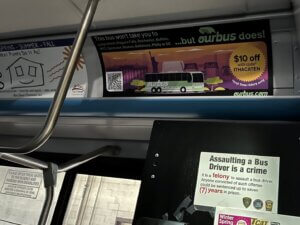
 Advertising on TCAT buses, both inside and out, offers great visibility for your organization. All of the advertising on our buses is now handled by Gateway Outdoor Advertising.
Gateway’s Regional Manager is Debbie Richards. She can be reached at 585-750-7392 (cell) or via email at: drichards@gatewayoutdoor.com.
How can I get more involved with TCAT?
TCAT’s Rider’s Advisory and Accessibility Committee is comprised of riders and members of the TCAT team and meets once a month to discuss current issues, future projects, and how TCAT can improve service for older riders and riders with disabilities. If you are interested in joining, please contact Patty Poist at 607-277-9388 x 560 or by email at pp1@tcatmail.com
I have no clue about how to ride the bus?
We know it can be intimidatiing If you have never used public transportation or are new to the TCAT system.
We can help. Email us at tcat@tcatmail.com or call Patty Poist at (607) 277-9388 ext. 1561.
It seems public transportation has its own vocabulary. Can you help me with that?
Check out our glossary of commonly used terms at TCAT and in the transit industry in general.