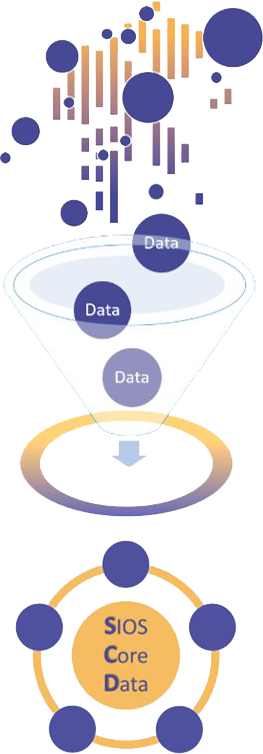
SIOS Core Data
SIOS Core Data consist of a list of essential Earth System Science (ESS) variables relevant to determine environmental change in the Arctic. SIOS Core Data are developed to improve the relevance and availability of scientific information addressing ESS topics for decision-making. SIOS Core Data providers have committed to maintain the observations for at least five years, to make the data publicly available, and to follow advanced principles of scientific data management and stewardship.

- What are SIOS Core Data?
-
SIOS Core Data comprise the critical data needed to scientifically assess the state of the environment in Svalbard.
The first set of SIOS Core Data variables was partly derived from the list of Essential Climate Variables (ECVs) defined by the Global Climate Observing System (GCOS). The most relevant variables for Svalbard were identified by the SIOS’ Scientific Optimisation Advisory Group (SOAG) in cooperation with the Research Infrastructure Coordination Committee (RICC) and scientific experts.
To qualify as SIOS Core Data, the data must meet the three criteria described below:
-
Scientific requirements
The variable must be critical in answering the key ESS research questions as defined in the SIOS infrastructure optimisation report, and further updates in SESS reports.
The requirement for temporal and spatial coverage varies between variables and potentially depending on the scientific question. This should be considered in the scientific requirement (optimisation). Connection with GCOS ECVs and other Essential variable schemes, as for example Essential Ocean Variables, and marine Essential Biodiversity Variables, can provide guidelines and criteria for selection and prioritisation.
-
Data availability
The data must be available through the SIOS Data Management System (SDMS) and accessible in the SIOS Data Access Portal.
Data must be described with rich discovery and use metadata. Where possible, existing measurement and calibration protocols (e.g. WMO, GAW, BSRN11, ACTRIS and ICOS12) should be used to collect SIOS Core Data to secure comparability.
-
Collecting commitment
There must be a commitment from the data-providing institute to maintain the measurement infrastructure setup and data production for at least 5 years, as well as making the data available through SDMS.
-
- SIOS Core Data Candidates
-
SIOS Core Data Candidates are data that fulfil the criteria outlined above but are not yet available online. SIOS provides support for its member institutions in transforming SIOS Core Data Candidates into SIOS Core Data.
SIOS Core Data Categories
SIOS Core Data are divided into 4 categories: