Free Keyword Generator

See how you can use our free keyword generator tool to uncover high-performing keywords and topics for SEO, PPC, and content marketing.
Keyword research starts with finding keywords that can drive traffic to your website. By identifying popular search terms that align with your target audience’s search intent, you can create relevant and valuable content that improves your search engine rankings. Tools that assist in finding keywords are essential for uncovering long-tail keywords, which are more targeted and can significantly enhance your organic content strategy.
Introduction to keyword ideas
A solid process for generating keyword ideas is the foundation of a successful search engine optimization (SEO) strategy. Your initial keyword research and competitive analysis work together to help you understand what your target audience is searching for and how you can create content that meets their needs.
From there, you need a repeatable method to continue generating relevant content for your audience that’s aligned with both their search queries and their search intent.
A free keyword generator tool can be invaluable in this process, providing you with a steady stream of relevant keywords and phrases to target in your content, backed by SERP data. You can generate keyword ideas and identify the most relevant keywords for your business.
These tools provide valuable insights into search volume, competition level, and cost-per-click (CPC) data, helping you optimize your SEO efforts and create a data-driven content strategy. Long-tail keywords, in particular, can be highly effective in targeting specific search queries and driving traffic to your website.
What is a keyword generator tool for?
A keyword generator tool pulls additional keyword ideas from a database, using algorithms based on semantic relationships and SERP data, to instantly produce a list of keywords related to your seed keyword. It provides insights for each keyword, such as ranking difficulty, average monthly search volume, and cost per click.
Digital marketers and SEOs benefit from a keyword generator because it eliminates the guesswork needed to identify the keywords your audience is searching for, helping you decide which keywords are worth creating content around. Identifying high-value keywords can significantly impact your SEO and digital marketing efforts by driving more traffic and reaching a broader audience.
It’s also a great way to explore critical terms that are adjacent to your core pillar topics. For example, instead of just typing in broad industry terms like “email marketing” or “CRM software,” try entering specific competitor names or product features as your starting point. You could use names like “ConvertKit” or “HubSpot,” or features like “visual automation builder” or “lead scoring.” You can even try phrases that describe common complaints, such as “too expensive CRM” or “hard to set up email platform.”
Why does this work? Because it helps uncover high-intent, long-tail keywords—things people are actually searching for when they’re close to making a decision. You might find phrases like “ConvertKit vs Mailchimp” or “best CRM for small teams” that reveal not just interest, but also comparison and frustration. These kinds of insights are especially useful for creating blog posts, landing pages, or product positioning that speaks directly to what your audience cares about.
Using keyword tools in this way helps you go beyond surface-level search terms and tap into what your potential customers are really thinking. It’s a smart, easy way to make your SEO research more strategic and customer-focused.
How this free keyword generator tool works
Ready to get tons of helpful keyword ideas with the click of a button? Let’s walk through how to use this keyword generator tool, powered by Semrush.
Type your target keyword into the search bar
Focus on a keyword related to your brand, industry, or niche.

A great way to avoid “wasting” any of your 10 free daily keyword generator searches is to create a dream list of keywords you’d love to rank for. These are usually broader, high-level terms that act as “umbrella” keywords. They encompass many long-tail variations that can inspire your content or SEO strategy.
The keyword generator will identify the long-tail variations, which means less work for you.
Evaluate keyword data and metrics
Review your keyword search results and consider how they can contribute to your SEO or marketing strategy.

From the image above, you can see that each keyword is accompanied by several metrics:
- Volume: The estimated number of times the keyword is searched each month
- KD %: Keyword difficulty, or how hard it will be to rank for the keyword (on a scale from 0-100, with 100 being the hardest)
- CPC: Cost per click, or how much a single click on a paid search ad for this keyword will cost
- # of Results: The total number of search results Google returns for the keyword
- Search Trend: How search volume for the keyword has fluctuated over a period of time
Use these metrics as a guide for your keyword research, not the final word on what to target.
Identifying keyword opportunities with lower difficulty scores—that is, low-competition keywords—can radically transform your SEO strategy. Doing this helps you rank faster and more easily in search results—especially if you’re working with a newer site or have limited domain authority.
Low-difficulty keywords are often long-tail keywords that don’t have massive search volume. Long-tail keywords are often highly targeted, meaning it’s easier to align your content with the user’s search intent and give them exactly what they’re looking for.
By focusing on these easier-to-rank terms, you can start generating consistent traffic, build topical authority, and create a strong foundation that makes it easier to compete for higher-volume keywords over time.
For instance, you might notice that “dog toy breeds” has a high keyword difficulty rating, leading you to consider skipping it. However, if it’s highly relevant to your brand or niche, don’t shy away from it.
Instead, double down by creating related content and focusing on longer, more in-depth, authoritative pieces to strengthen your authority on the topic and improve your chances of ranking.
Creating a keyword list
A keyword list is a collection of relevant keywords and phrases that a business wants to target in its content. Creating a keyword list helps you stay organized and aligned across teams.
Your keyword list should include a mix of short- and long-tail keywords to target different search queries. By analyzing search volume and keyword difficulty, you can prioritize and focus on the most important keywords.
Keyword lists are also useful for informing PPC campaigns and improving return on investment (ROI). A keyword research tool can help you create and manage your keyword list, as well as identify new keywords and phrases to target. By continuously monitoring and analyzing your keyword list, you can stay up to date with evolving search trends and drive more traffic to your website.
A keyword list can also help you identify gaps in your content and create new content to target specific search queries. By using a keyword generator tool, you can create a comprehensive keyword list and improve your SEO efforts, ensuring that your content is always relevant and optimized for search engines.
Filter and group keywords by pillar topics

Just because a keyword is on the list, it doesn’t necessarily mean it’s a good one for you to focus on.
For example, the keyword “dog in toy” is actually a shortened query for “dog in toy story.” If you’re trying to rank for dog toys, this keyword isn’t the best fit since searchers want to know about a dog in a children’s movie, not learn about dog toys.
On the other hand, the list shows you some of the top types of dog toys people are searching for. You could make pillar topics out of “indestructible dog toys,” “interactive dog toys,” and “rare beauty dog toys.” Then, take other keywords and see if they fit under these categories. For example, “robot dog toy” may fall under “interactive dog toys,” or “dog puzzle toys” may fall under “indestructible dog toys.”
Organizing your keywords by themed topics will ensure you don’t let any opportunities fall through the cracks.
Drill down on long-tail keywords
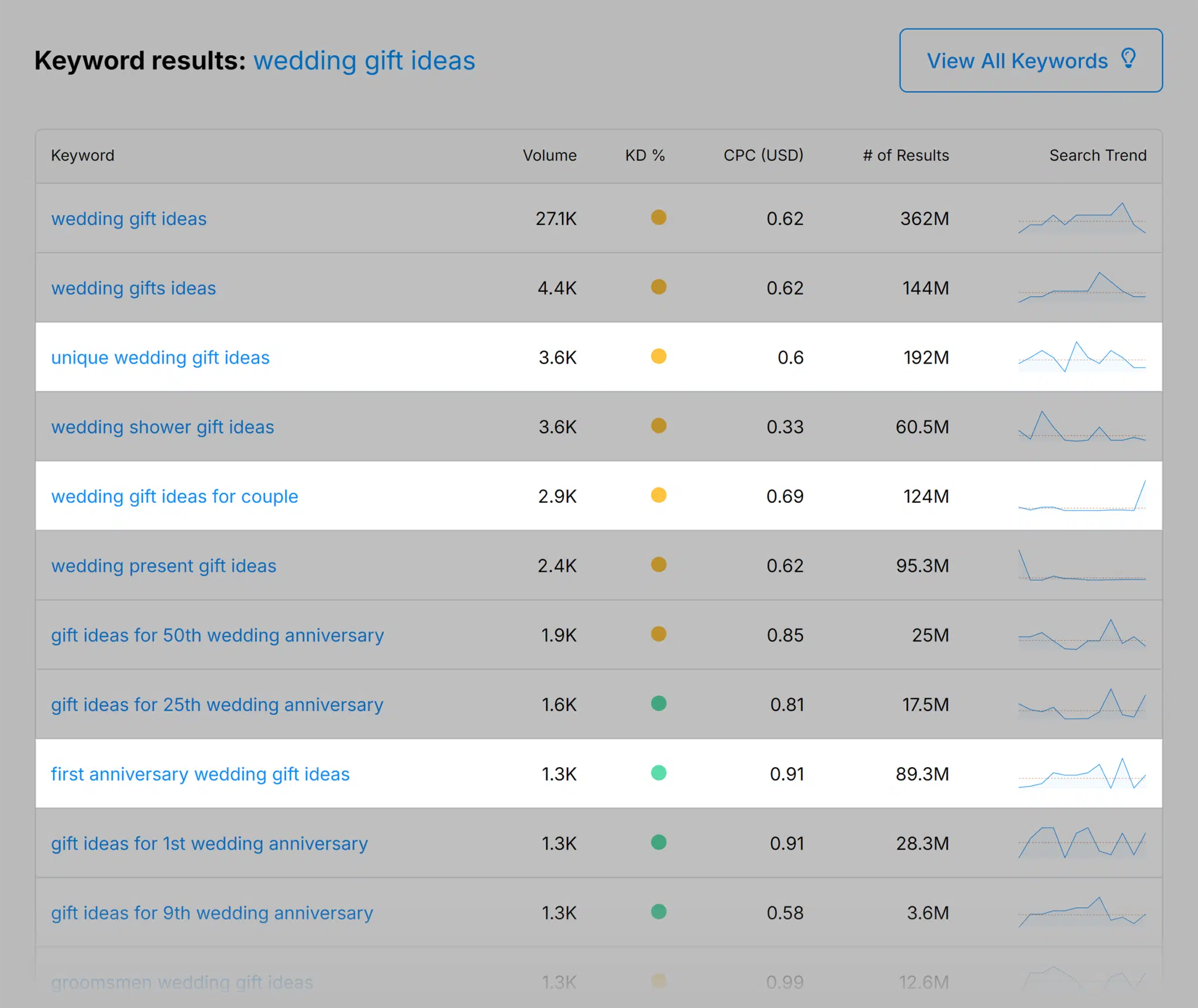
Once you’ve identified your main pillar topics and related branch topics, use the keyword tool to gather deeper insights. The goal is to expand each pillar topic with relevant branch topics that align with what your potential customers are searching for.
You can even manually test some of these ideas or expand upon the long-tail themes to provide further direction for your content. Remember, understanding how people search for information is crucial in identifying long-tail keywords. Tools that analyze search behavior, such as Google Autocomplete, can uncover relevant keywords that enhance your content marketing and SEO strategies.
This approach lays the foundation for a comprehensive content strategy that can be utilized across multiple marketing channels, like PPC, blog posts, and social media campaigns.
For instance, the keyword “indestructible dog toys” can lead to additional long-tail topics like “indestructible stuffed dog toys for aggressive chewers,” “plush dog toys that are indestructible,” and “indestructible squeaky dog toys.” Each of these could become its own blog post or the focus of a targeted PPC campaign.
Start generating keywords today
Ready to elevate your SEO and digital marketing strategy? It’s time to start generating winning keywords with Semrush’s free keyword generator tool.
Whether you’re targeting high-impact keywords for content, exploring long-tail phrases for niche audiences, or optimizing your PPC campaigns, this tool is designed to simplify your keyword research process and deliver results.
Maximize the tool’s potential
- Create a dream list: Before you start, jot down a list of broad keywords that are most relevant to your brand or industry. These will act as a foundation for discovering valuable long-tail variations.
- Leverage advanced filters: Take advantage of the tool’s filtering options to narrow your search with metrics like search volume, keyword difficulty, and cost per click. This ensures you focus on terms that align with your goals.
- Analyze and organize: Use the data provided—like search trends and keyword difficulty—to prioritize keywords and group them into themes or pillar topics. This will help you craft a well-structured content or advertising strategy.
We have only just scratched the surface of the range of data available with keyword research tools, as well as multiple applications for your content marketing plans and growth strategies. Check out the other inspirational keyword data tools available from Semrush.
SEO keyword research & ideation best practices
We’ve covered how you can leverage a keyword generator for keyword ideas, and how you need to analyze search volume and competition level. Of course, you always need to prioritize keywords based on search intent and potential ROI to ensure that you’re bringing in the right organic traffic for your website.
We’ve got some additional actionable tips to make your keyword ideation more productive:
- Look at the data, keeping close watch on your audience’s search trends and engagement patterns. Create a comprehensive keyword list that includes a mix of short- and long-tail keywords, and then continuously monitor and analyze keyword performance to stay up to date with changing search trends. You can then use keyword research to inform your PPC campaigns and improve ROI, and vice versa (tap into PPC findings to see what keywords might better serve your target demographic).
- Create high-quality, relevant content that targets specific search queries. Optimize your website content and meta tags to improve your SEO efforts and conversion. Always consider how relevant and helpful your content actually is.
- Start with problems, not products. Think about the real-life problems your audience faces. Instead of brainstorming around your solution (e.g., “project management software”), start with the pain point (e.g., “how to organize remote teams”).
- Use competitor content as inspiration. Plug competitor URLs into tools like Semrush, Ahrefs, or Ubersuggest to see which keywords they rank for. It’s a shortcut to discovering what’s already working in your niche.
- Explore forums and communities. Sites like Reddit, Quora, and niche Facebook or Slack groups are goldmines for keyword ideas. Look for repeated questions or phrases that signal what people are actively searching for.
- Play with keyword variations and modifiers. Add words and phrases like “best,” “cheap,” “vs,” “for beginners,” or “near me” to your base keywords. These modifiers often uncover long-tail searches with clearer intent and lower competition.
Stay up-to-date with the latest SEO best practices and algorithm updates to ensure that your keyword research and SEO efforts are always optimized. By following these best practices, you can create a data-driven content strategy that drives traffic to your website and improves your search engine rankings.
Explore our other SEO tools
| Keyword Difficulty Checker: Assess ranking difficulty & identify targetable keywords |
| Keyword Rank Checker: Monitor keyword rankings & your growth in the SERPs |
| SERP Checker: Gain insights into SERPs & what it takes to rank |
| Website Traffic Checker: Analyze website traffic patterns & performance metrics for any domain |
| Competitor Analysis Tool: Discover your competitors’ top keywords, backlinks, & traffic sources |
| Website Authority Tool: Check your site’s authority score & get key metrics on rankings and traffic |
| Backlink Checker: Get powerful insights into any site’s backlink profile and link-building opportunities |
About the Author