Bing tests Google-style “Sponsored results” grouping
Bing’s new grouped “Sponsored results” format could drive higher unintentional ad engagement by blending paid listings more seamlessly into search results.
Microsoft is now testing a Google-like redesign of search ads in Bing, grouping multiple sponsored links under a single “Sponsored results” label and adding a “Hide” button that collapses the entire ad block.
Driving the news. Sachin Patel spotted the Bing test in the wild and shared screenshots and video showing the new layout. In the test, only the first sponsored result carries an ad label, while subsequent ads appear unlabelled underneath it. Users can tap “Hide” to collapse the entire set of ads, then “Show” to reveal them again.

How it works. The structure groups ad units in a way that can blur the distinction between organic and paid content. By collapsing ad labeling into a single header, the design makes individual ads look more like regular results.
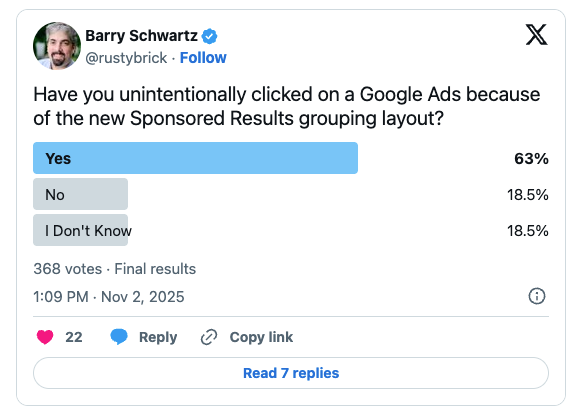
Catch up. Google rolled out a nearly identical treatment two months ago — and it’s already sparked complaints of accidental ad clicks. Barry Schwartz did a poll on X that showed 63% of responders saying they had unintentionally clicked on a Google Ads Results because of the new grouping.
Bing adopting the same pattern signals a potential industrywide shift in how search ads are labeled and displayed.
Why we care. Bing’s new grouped “Sponsored results” format could increase ad visibility — and potentially boost click-through rates — by making ads appear more blended with organic results. The addition of a “Hide” button introduces a new user-control dynamic, but the single-label grouping may also lead to more accidental clicks, similar to what advertisers have seen with Google’s recent redesign, meaning higher bounce rates.
If Microsoft rolls this out broadly, it could meaningfully affect campaign performance, attribution and spend efficiency across Bing search.
First seen. Sachin Patel shared his view of this grouping on X.
The takeaway: If rolled out widely, Bing’s new format could drive more engagement — intentional or not — and reignite concerns about the clarity of search ad disclosures. For now, the experiment appears limited, and not everyone can replicate it.
What Microsoft are saying. Microsoft Ads Liaison Navahreached out to say that this was a test that they have opted not to continue.
Search Engine Land is owned by Semrush. We remain committed to providing high-quality coverage of marketing topics. Unless otherwise noted, this page’s content was written by either an employee or a paid contractor of Semrush Inc.
About the Author