Showing posts with label missile. Show all posts

Monday, 22 September 2025

A Trident-II D5 SLBM launch in the Atlantic on 21 September 2025: analysis of footage from Puerto Rico (UPDATED)

frame stack of movie by SAC station Anasco, Puerto Rico


click map to enlarge

On 15 September 2025, Navigational Warnings appeared that pointed to an upcoming Trident-II D5 SLBM (Submarine Launched Ballistic Missile) unarmed test launch in the Atlantic between 17 and 22 September 2025, from a submarine of either the US Navy or UK Royal Navy positioned some 400 km out of the coast of Florida (update 24 Sept 2025: according to this US DoD bulletin it was an American test launch from an unnamed Ohio-class SSBN (Ballistic Missile submarine). The submarine test-launched four Trident missiles between Sept 17 and 21). I have posted about such tests and the typical pattern of Navigational Warnings associated to them earlier, in an analysis of a Trident launch that was inadvertently captured on camera in a time-lapse by an amateur astronomer on La Palma in September of 2013.

And now we have another case of inadvertant capture on camera of such a launch, and a second opportunity for analysis! 

In the evening of 21 September 2025 near 23:30 UTC, eyewitnesses in Puerto Rico saw a fuzzy object and what looked like expanding missile exhaust clouds move through the sky, consistent with a rocket or missile launch. The event was captured by amongst others a meteor camera of the Caribbean Astronomy Society (SAC) near Anasco, Puerto Rico. 

Eddie Irizarry of SAC was so kind to send me the video footage for identification and analysis. Immediately, it was clear to me that the video showed the Trident test launch we expected.

In top of this post is a frame-stack from the footage. Below it is a map I prepared showing the northern part of the sky as seen from the camera station in Puerto Rico, with the blue line representing the sky trajectory expected for this Trident launch for an assumed (but see below) apogee altitude of 2200 km. They compare well (note: the video stack shows a part of the trajectory only, up to about azimuth 30 degrees, while the sky map shows the full trajectory).

Here is the video footage itself (courtesy of  Eddie Irizarry, used with permission):


The trajectory for this Trident test launch is known, as it can be reconstructed from the Navigational Warnings that have been issued for it. Below is the Navigational Warning, and a map where I have plotted the exclusion zones A-D from it, and a fitted ballistic trajectory:

151958Z SEP 25
HYDROLANT 1538/25(GEN).
ATLANTIC OCEAN.
DNC 01, DNC 16.
1. HAZARDOUS OPERATIONS 171830Z TO 220136Z SEP
   IN AREAS BOUND BY:
   A. 28-34.00N 076-29.00W, 29-07.00N 076-28.00W,
      29-05.00N 075-33.00W, 28-30.00N 075-35.00W.
   B. 28-37.00N 075-51.00W, 28-55.00N 075-44.00W,
      27-44.00N 070-28.00W, 27-05.00N 070-28.00W.
   C. 16-28.00N 044-01.00W, 17-01.00N 043-43.00W,
      14-36.00N 038-46.00W, 13-37.00N 039-33.00W.
   D. 10-35.00S 001-40.00W, 10-05.00S 001-25.00W,
      12-01.00S 002-21.00E, 12-45.00S 002-55.00E,
      13-11.00S 002-20.00E, 13-01.00S 002-02.00E,
      13-04.00S 002-00.00E, 12-38.00S 001-15.00E.
   E. 26-58.00N 070-28.00W, 28-14.00N 070-28.00W,
      25-56.00N 063-20.00W, 24-34.00N 063-50.00W.
2. CANCEL THIS MSG 220236Z SEP 25.
click map to enlarge


On the map, I have undicated the part of the trajectory that was captured by the SAC camera on Puerto Rico as a yellow line

Area A is the launch area where the submarine is located. Areas B, E and C are respectively the splashdown zones of the first, second and third stages of the missile. Area D is the RV (Reentry Vehicle) target zone. The switched designations for the C and E area are probably a clerical error.

The launch area, 400 km out of the Florida coast is one of two well established launch locations for Trident tests in the Atlantic (see my earlier investigation here). Likewise, the target area in the southeastern part of the Atlantic, 900 km east of St Helena at a range of about 9500 km from the launch site, is a well known target location for these test launches.

What cannot be well gleaned from Navigational Warnings alone, is the apogee altitude of this test. 

In this post, I will however reconstruct it from a combination of the known missile flight trajectory and measurements of the missile's sky track in the video footage from Puerto Rico, in a similar way as I analysed the earlier 2013 Trident observation from La Palma. For that 2013 test, I found an apogee at ~1800 km.

The video (the original is higher resolution than the version posted in this blogpost) provides plenty of reference stars to do astrometry on the missile path through the sky. So I measured the missile's position with respect to the stars for several frames from the video. Plotting  these observed positions (in RA/DEC) on a star map along with the expected sky trajectories in RA/DEC for various assumed apogee altitudes (based on the trajectory from the Navigational Warnings), it is clear that an apogee of 2200 km fits best. Red crosses in the plot below are the measured positions from the video: the blue lines provide the expected missile tracks for various apogee altitudes:

click map to enlarge

(note that I choose to plot RA on the Y-axis rather than X-axis, in order to get a plot orientation that is most easily compared to the video footage).

Earlier, while similarly analyzing the Trident launch seen from La Palma in 2013, I found an indicated apogee of ~1800 km, some 400 km lower than seems to be the case with this latest test launch. Both values are significantly higher than the ~1200 km that is often taken as a canonical value for an intercontinental missile apogee. These tests in the Atlantic therefore appear to be a bit "lofted", perhaps simply to keep the Reentry Vehicle (RV) impact area sufficiently out of the African coast.

From the timing of the Puerto Rico video, the actual launch time was likely somewhere near 23:27 UTC (Sept 21) from a location  near 28.8 N, 76.3 W, with a flight time near 41 minutes from launch to RV impact. As seen from Puerto Rico the missile cleared the horizon while at ~150 km altitude, steadily climbing to  ~800 km when it left the field of view of the CAS camera station (while continuing its ascend towards apogee). The closest slant range to the camera station was ~1300 km. The big cloud of exhaust gas seen in the early part of the video likely stops upon ejection of the second or third stage. The various smaller "pufs" of exhaust cloud that can be seen later emanating from the fuzzy object, are probably due to either the third stage or post-boost vehicle orienting itself.

(With thanks to Eddie Irizarry/CAS for sending me the footage and for his permission to use it in this blog) 

UPDATE 24 Sept 2025: 

According to this US DoD bulletin the missile was launched from an unnamed US Ohio-class Ballistic Missile submarine (SSBN). The submarine reportedly test-launched as much as four Trident missiles of the 5DLE variety between Sept 17 and 21. The below image was published, showing a Sept 21 nighttime launch, the missile that was seen from Puerto Rico:


Sept 21 2025 Trident missile launch. Photo US Navy/Shelby Thompson

Monday, 9 June 2025

The reentry of the Chinese Zhuque-2E upper stage 2025-103G over Kazachstan on 5 June 2025

still from one of the fireball movies posted on Twitter by @Buggy__Bugler


In the evening of 5 June 2025 around 22h local time (17h UTC), a slow profusely fragmenting fireball was seen and filmed from several cities in Kazachstan, including Astana, and Bishkek in neighbouring Kirgistan. It had all the well-known characteristics of a satellite or rocket stage reentry. Indeed, as it turns out, this was a rocket stage reentry: the reentry of the upper stage of a Chinese Zhuque-2E (ZQ-2E) rocket, 2025-103G, from a multiple satellite launch on May 17.

Unfortunately, some Russian and Ukranian language twitter accounts started to disseminate the footage with the wildly wrong suggestion that this was a failing Russian Oreshnik IRBM breaking up. This misinformation next proliferated very quickly via various social media, and later also traditional media (e.g. Newsweek). This while it is not a Russian Oreshnik missile at all, as already mentioned.

I was alerted to the event somewhat later that evening when several of my social media followers tagged me and asked me for my opinion. It didn't take me long to identify the event as a space-launch related reentry rather than a Russian missile. Indeed, the Kazachstan MoD had meanwhile also deemed it a space debris reentry, per various news outlets.

The object in question was 2025-103G (cat. nr. 64054), the Zhuque-2E (ZQ-2E) upper stage from a Chinese satellite launch on 17 May 2025 from Dongfeng (Jiuquan). The upper stage from this launch was left in an in initially 600 x 175 km, 96.1 degree inclined orbit.

The CsPOC TIP for this object's reentry available at that time (it was updated later), had forecast reentry at 5 June 2025, 15:40 UTC with an uncertainty of  ± 3 hours. The Kazachstan event (~17h UTC) hence was within the reentry window. When I checked the trajectory over this full window, it showed that the object would make a south-to-north pass over eastern Kazachstan around 17:10 UTC, very close in time to the Kazachstan event (which was reportedly around 10 pm local Astana time = around 17 hr UTC). Direction of movement in the various videos of the event matched well.

Later, CSpOC published a final TIP placing the reentry at 5 June 2025 17:08 UTC  ± 1 min, near 36.6 N, 73.5 E. Given the 1 minute accuracy, this is likely based on a DoD satellite observation of the reentry fireball. The TIP position is just south of Kazachstan, but a reentry is a process of several minutes duration. Moving south-to-north, the fireball created by the fragmenting space debris would move northwards, over eastern Kazachstan, in the minutes directly after this time mark. In other words, this final TIP matches the event quite well.

Below is the trajectory over the final revolution of the ZQ-2E upper stage, based on the last available TLE (epoch 25156.48638369) which dates from ~5 hours before the reentry:


Click map to enlarge

I next ran a reentry model with our Delft Technical University open source Astrodynamics package Tudat. The ZQ-2E upper stage has a dry mass of approximately 5000 kg and measures 12 x 3.4 meter. Using 60% of the maximum drag area for that dimension, a value usually representing the average drag surface of a tumbling (and hence showing a variable drag surface) elongated rocket stage well, the Tudat model predicts reentry near 17:03 UTC ± 1.1 hr (remember, this is based on a 5 hour old orbit), the nominal value being well in line with the Kazachstan event and nominally within 5 minutes of the CSpOC final TIP.

Next I ran the model again adjusting the drag area slightly, via trial-and-error, such that the model would conform to the estimated start of visibility of the reentry fireball, at just below  ~100 km altitude, at the time/location of the CSpOC TIP (17:08 UTC). 

I get a reasonable match when I reduce the drag area to about 58% of the maximum drag area. Below is a map showing the resulting estimated reentry trajectory (movement is from south to north):

click map to enlarge

When I use this Tudat-estimated reentry trajectory to generate a sky track for Astana, Kazachstan, I get this approximate sky trajectory (movement is from left to right, i.e. south to north, low through the west):

Click map to enlarge

This conforms quite well to some of the video footage of the reentry (several of which show the reentry fireball pass the waxing moon), e.g.:


still from one of the movies posted on Twitter by @Buggy__Bugler

The predicted sky track for Astana of course depends on how accurate our Tudat-modelled atmospheric altitudes of the reentering rocket stage are. If they in reality are a bit lower than we modelled, the trajectory will be located slightly lower in the sky (and vice versa, slightly higher if the altitudes are in reality a bit higher). It is very clear however that the general direction and location of the trajectory in the sky matches well with what was seen and filmed.

As usual, I feel some frustration about the general absence of information on camera locations and time of the footage regarding the imagery of this event distributed via various social networks. Those data are important but almost never included. These matches of observations with reentry data would get so much easier if people posting footage would include the geographic location and the time. So please people: next time you post something like this, include these important data.

This event once again also showed the failure of AI as a reliable source of information for answering questions regarding events like this (we earlier saw that with the Kosmos 482 Descent Craft reentry too). Twitter's AI "Grok" generated some profound nonsense (i.e., misinformation) when people asked it to identify the character of the event, likely partly as a result of the large amount of disinformation already doing the rounds on social media about this event.

Saturday, 13 April 2024

Russian ICBM test launch (Topol?) from Kapustin Yar seen from the Middle East

click to enlarge

On 12 April 2024 near 16:00 UTC, the Russian Armed Forces test-fired an unarmed ICBM from Kapustin Yar, targetting the test range at Sary Shagan at a distance of some 2000 km. The missile was likely a TOPOL-M.

In the image above, I have modelled the likely trajectory, assuming apogee at 1000 km altitude as in previous tests. Below is Russian MoD footage of the launch:


The missile launch was widely seen as a bright comet-like object in the sky, in Russia as well as in the Middle East, with reports from as far south as a.o. Iran and Iraq. As many there where in anxiety about an expected Iranian retaliation attack on Israel, it created  a bit of a stir.


In the aftermath, there were some people that expressed doubt whether a Russian ICBM test would be visible from the Middle East. So I reconstructed the area of visibility to show that it is in fact visible. 

In the map below, I have drawn isocircles around the estimated point of cut-off of the missile's third stage. That stage cut-off happened after 3 minutes of flight at an altitude of about 570 km (there is some leeway in both figures possible, but in general the figure below will give you a good indication of the area of visibility).

click map to enlarge


The isocircles give you the altitude in the local sky as seen from a region encompassing southern Russia and the Middle East. 

As can be seen, the area of visibility is large, and horizontally extends about 2600 km from the geographic location of stage engine cut-off, to as far as southern Iran. 

Bar the first few tens of kilometers, the trajectory was fully sun-illuminated, and as a result the exhaust clouds of the missile were also sun-illuminated, making them  shine brightly in the sky.

That exhaust clouds from the upper stages of missile launches can be seen over a avery large area isn't something new. Russian ICBM tests from Plesetsk have multiple times resulted in sightings of bright "spirals" in the Arctic sky (e.g. here). Chinese tests have also been observed, e.g. this example that was observed from South Korea in 2019, which I further analysed here. Meanwhile, the post-boost vehicles of ICBM's/SLBM's sometimes also cause visible phenomena in the sky: see my analysis of one such sighting from La Palma in 2013 related to a US Trident SLBM test for example.

Saturday, 6 April 2024

A possible French Missile test over the Gulf of Biscaye on April 10-11 [UPDATED]

click map to enlarge

An odd Navigational Warning has appeared, for "space debris" along a 420-km trackline over the Gulf of Biscaye, from a point some 37 km southwest of Concarneau on the southern coast of Bretagne to a point some 20 km west of the French missile test base DGA Essais de Missiles near Biscarosse, southwest France. The Navigational Warning is for April 10 and 11, 2024, from 10:00 to 14:30 UTC (12:00 to 16:30 CEST).

I do not think this Navigational Warning is really about "space debris", but rather believe some sort of missile test is concerned

The southern end of the 420 km trackline being close to the French missile testing base at Biscarosse, while the northern end is in the area that the French Navy uses to test-launch SLBM's, is a giveaway that it rather concerns some kind of missile. Also, a controlled reentry of "space debris" so close to the French coast would be very odd. So I do not believe for a second that the Warning truely is for "space debris"

This is the text of the Navigational Warning:

051439Z APR 24
HYDROLANT 716/24(37).
BAY OF BISCAY.
FRANCE.
DNC 08.
1. HAZARDOUS OPERATIONS, SPACE DEBRIS
   101000Z TO 101430Z, ALTERNATE 111000Z TO 111430Z
   ALONG TRACKLINE JOINING
   47-36.00N 004-13.00W, 44-20.00N 001-30.00W.
2. CANCEL THIS MSG 111530Z APR 24.


Because the trackline starts in the area that the French use for SLBM test launches, and because "space debris" would perhaps indicate something with a high apogee, my initial thought (see also the title of the map above) was that it might concern a test of a new SLBM stage (it is definitely not a full M51 SLBM test, the range is much too short for that and those tests fire westwards).

However, the 420 km length of the indicated track line, would also match two medium-range to long-range cruise-missiles of the French armed forces: the ASMP-A, which is airlaunched and meant to deliver a nuclear warhead; and the French-British SCALP-EG, also known as Storm Shadow, which is also air-launched and has a conventional warhead.

If it concerns a ship- or submarine-launched cruise-missile instead, then the MdCN would also be an option, but that missile would have a 2-3 times as large range (edit: but see below).

Calling a cruise-missile "space debris" is a stretch however. So many open questions remain as to the character of the missile in question.


UPDATE 19 Apr 2024:

The test happened on April 18 (the Navigational Warning was re-issued twice, for April 17 and 18). The French Ministry of Defense announced that it concerned a double launch of the Missile de Croisière Naval (MdCN) Naval cruise missile, one launched from the Frigate Aquitaine, the other from a nuclear  submarine in the Suffren class. The target was on land at DGA Essais de Missiles near Biscarosse.

Sunday, 9 April 2023

An upcoming French SLBM test in the Atlantic [UPDATED]

click map to enlarge

Spring has arrived, and this spring the fledgeling missiles fly, as I already noted in a previous post

And now the French join in this springtime Missile Mêlée too: two Navigational Warnings have appeared (HYDROLANT 759/23 and NAVAREA IV 396/23) that indicate a French Submarine-Launched Ballistic Missile (SLBM) test for the period 14 April - 7 May, 2023.

I have mapped the hazard areas from the two Navigational Warnings (text below) in the map above.


070934Z APR 23
HYDROLANT 759/23(36,37,38).
BAY OF BISCAY.
CELTIC SEA.
NORTH ATLANTIC.
FRANCE.
DNC 08, DNC 19.
1. HAZARDOUS OPERATIONS, ROCKET LAUNCHING
   0030Z TO 1000Z DAILY 14 APR THRU 07 MAY
   IN AREAS BOUND BY:
   A. 47-39.00N 004-01.00W, 47-48.71N 004-31.00W,
      47-44.70N 005-23.50W, 47-16.46N 005-17.68W,
      47-24.00N 004-11.00W.
   B. 47-44.70N 005-23.50W, 47-35.30N 007-15.13W,
      47-04.30N 007-08.53W, 47-16.46N 005-17.68W.
   C. 47-35.30N 007-15.13W, 47-29.72N 008-09.53W,
      46-58.78N 008-02.44W, 47-04.30N 007-08.53W.
   D. 48-04.60N 008-59.32W, 47-46.75N 011-31.33W,
      46-00.58N 011-02.17W, 46-17.87N 008-34.97W.
   E. 45-25.54N 025-00.90W, 44-55.65N 027-03.41W,
      43-42.92N 026-27.47W, 44-12.20N 024-27.20W.
2. CANCEL THIS MSG 071100Z MAY 23.


070934Z APR 23
NAVAREA IV 396/23(14,51).
NORTH ATLANTIC.
1. HAZARDOUS OPERATIONS, ROCKET LAUNCHING
   0030Z TO 1000Z DAILY 14 APR THRU 07 MAY
   IN AREA WITHIN 150 MILES OF 37-35.15N 045-40.37W.
2. CANCEL THIS MSG 071100Z MAY 23.


The missile is likely an M51, and will be launched from a French submarine south of the Breton coast. The target area is in the mid-Atlantic, near 37.6 N, 45.7 W. The indicated range is about 3500 km

A previous test three years ago, on 12 June 2020, had over 1.5 times that range. So this test either has a more significant payload (e.g. multiple MIRV's or heavier warhead(s)), or uses reduced power in the first stage, or (less likely, also looking at the locations of the hazard areas) is a highly lofted test for some reason.

The target area in the mid-Atlantic is about 1.6 times bigger than it was with the 2020 test (300 Nautical mile wide now, versus 184 Nautical mile wide in 2020) even though the range is ~1.6 times shorter, which might perhaps indicate multiple warheads (MIRV).

The map below compares the 12 June 2020 test (red) to the upcoming test (blue):

click map to enlarge

UPDATE 19 April 2023:

Tweets by the French Navy and the French Minister of Defense on April 19 confirm a successful test firing of an M51 SLBM from the submarine Le Terrible on 19 April 2023.

Friday, 25 March 2022

North Korea's Hwasong-17 ICBM: capable of (briefly) bringing warheads into orbit?

image: KCNA/RodongSinmun

According to multiple western sources and North Korea, North Korea conducted a first full-power test-flight of its new Hwasong-17 ICBM on March 24, 2022, at 5:34 UT, from Sunan close to Pyongyang.

The Hwasong-17 is the Behemoth missile that was first revealed to the outside world one-and-a-half-years-ago during the 2020 October 10 parade in Pyongyang and surprised everyone by its massive size at the time. It is North-Korea's largest, heaviest missile so far and visually looks like a Hwasong-15 on steroids.

[NOTE: some sources are now casting some doubt on the missile identity, suggesting that footage from the failed March 16 launch (see below) was used. See comment at end of post]

The test launch was confirmed by North Korean State sources which produced a written account on their KCNA and Rodong Sinmun websites, accompanied by photographs, while KCNA also broadcast a video of the test. The imagery underlines how impressive the size of the Hwasong-17 is: it is a Monster of a missile!


image KCNA/Rodong Sinmun

 
image KCNA/Rodong Sinmun


image KCNA/Rodong Sinmun

The video report on the test as broadcast by the North Korean State Agency KCNA is spectacular, with a glamour role for the sunglasses-clad North Korean leader Kim Jung Un (look at 3:55 to 4:05 in the video below!). It evokes shades of a Hollywood action movie trailer. 

(the actual footage of the test and test preparations starts at 3:25 in the video, after the usual bombastic introductions by news anchor Ri Chun-hee)


Earlier test flights of components of the same missile might have taken place in Februari and early March (but not on full power), according to western sources. North Korea claimed at the time that it was testing components for a reconnaisance satellite program. 

We also know that on March 16, another test flight from the same launch-site (near Sunan Airport), possibly also a Hwasong-17, failed shortly after launch at an altitude of less than 20 km.

But the March 24 test flight appears to have been successfull, as claimed by both North Korea and western sources. According to North Korean official State sources it reached an apogee at a whopping 6248.5 km altitude, with a ground range of 1090 km and a flight time of long duration (1h 7m 30s).

Western sources that independently tracked the launch mention similar ballpark values for this test: apogee "6200 km" and range "1080 km" according to the S-Korea Joint Chiefs of Staff; apogee "6000 km" and range "1100 km" according to the Japanese Government. The missile came down in front of the Japanese coast inside Japan's EEZ, at some 180 km from Cape Tappi. 

The apogee is at an extreme altitude, and this test was hence extremely lofted, as can be seen in this trajectory reconstruction I made:


click to enlarge

Looking into the necessary impulse in order to assess maximum range of the missile, I realized that the resulting nominal impulse of 7.85 km/s I reconstruct, actually means that the Hwasong-17 can achieve orbital speed. In other words: this means it is powerfull enough to, in principle, loft a payload to (low) earth orbit and get it (briefly) orbital!

Objects can complete at least one revolution around the earth if they have enough orbital velocity such that they can orbit at at least 100 km altitude (the exact value of the lower limit of orbital flight is debated: for circular orbits it might be possible at altitudes as low as 80-90 km, but it anyway strongly hinges on the drag characteristics of the object in question). The corresponding orbital speed at 100 km altitude is 7.84 km/s (for a circular orbit). The nominal impulse I get for the March 24 launch, at 7.85 km/s, matches that (in reality, it is more complex, as the missile will experience atmospheric drag during the initial phase of launch, which was not part of my reconstruction. And part of the initial impulse will be lost due to gravity pull before reaching 100 km altitude).

So in theory, this missile could briefly get an object (e.g. a warhead) in orbit around the earth, rather than on a suborbital ballistic trajectory. In case you wonder: it didn't on March 24, because it was not launched on an orbit insertion trajectory, but rather straight up.


image: KCNA/RodongSinmun

image: KCNA/Rodong Sinmun

image: KCNA/Rodong Sinmun


This was not something I had expected. But it gives a new meaning to North Korean claims from earlier this year that tests conducted then, possibly with Hwasong-17 components, where in connection to a space launch program.

They did fairly and squarely present the latest March 24 test as an ICBM  test flight though.

The launch location at 39.188 N, 125.667 E (as geolocated from the imagery by Joseph Dempsey) was on a concrete strip about 1.75 km from the main buildings of Pyongyang Sunan airport. That concrete strip is part of the Si-Li Ballistic Missile Support Facility which itself is some 2.5 km southwest of the airport:

click map to enlarge

click map to enlarge

But let's get back to the realization that this missile can apparently reach orbital speeds. This means that it - or components of it - in theory can be used for road mobile satellite launches. But it can also mean that you can briefly bring a warhead in orbit, either for a full revolution or more, or - cough - for a "fractional" orbit....

Remember the discussion of the Chinese test of a FOBS ('Fractional Orbital Bombardment System') in July last year?! See this earlier post.

I have been doing some modelling. Based on specs of an early '60-era US warhead, the W56, I modelled whether a launch of a similar warhead into a very low 100 x 105 km, 98.0 degree inclined polar orbit from Sunan, could reach the USA. 

I used the General Mission Analysis Tool for this, with the MISE90 model atmosphere and F10.7 solar flux set at 100. I modelled for a 275 kg warhead with assumed Cd 1.0 and a drag surface of ~0.15 m2 (comments on how realistic those values are, are welcome) and under the assumption that the launch vehicle does achive sufficient orbital speed to insert it in such a 100 x 105 km orbit. The modelled launch was in southern direction, taking the long but undefended southern Polar route over Antarctica, approaching the USA from the south after finishing just over half an orbital revolution. [info added later: The model is strictly for the warhead assuming release from the missile upon orbit insertion: I did not model prolonged coasting as part of a post-boost vehicle of any kind].

With the mentioned specifications, I model it to nominally come down fairly and squarely in Ohio (or any other place within the continental USA if you adjust the orbital plane launched into somewhat), as the map below in which I have plotted the modelled trajectory for the warhead shows....

click map to enlarge
 

So: is the development of this missile perhaps a prelude to the development of a North Korean FOBS? With a suitable warhead, it appears they could do it with this missile.

Incidentally: the flight-time of the March 24 test was similar to the on-orbit flight time needed to get from Sunan to the United States via the southern polar route. But that is likely coincidence.

Leaving FOBS aside for the moment: at any rate a missile with this power launched on a more conventional ballistic trajectory can easily reach any location within the continental United States, as well as Europe and the Pacific (but would need a working reentry vehicle of course, which is another matter). In addition to that, it means that North Korea now in theory also has a potential road-mobile reconnaisance satellite launcher in their arsenal.


image: KCNA/Rodong Sinmun

image: KCNA/Rodong Sinmun

image: KCNA/Rodong Sinmun


image: KCNA/Rodong Sinmun


Added note: some sources are now casting some doubt on the missile identity, suggesting (with arguments from image analysis) that footage from the failed March 16 launch was perhaps presented by North Korea as being from the March 24 launch. The added suggestion is that the March 24 test missile might have been a Hwasong-15, not a Hwasong-17 as North Korea is claiming.

These objections are interesting, but multiple scenario's are possible. For example, they might have used footage from both test launches, certainly if iconic scripted propaganda scenes (e.g. KJU marching in front of the TEL leading his Rocket men) were shot during the preparations for the failed March 16 test. North Korea has been known to have doctored launch imagery for aesthetic/propaganda purposes before in the past, as I have shown for the historic first Hwasong-15 launch of 28 November 2017.

Whatever missile it really was: the missile performance shown by this test is remarkable and well beyond that of earlier North Korean ICBM launches. Western tracking of the missile test confirms the performance, so it is not just North Korean propaganda that can easily be waved away. This is a significant development, no matter how you look at it.

Wednesday, 2 February 2022

The North Korean Hwasong-12 test of 29 January 2022

click to enlarge
 

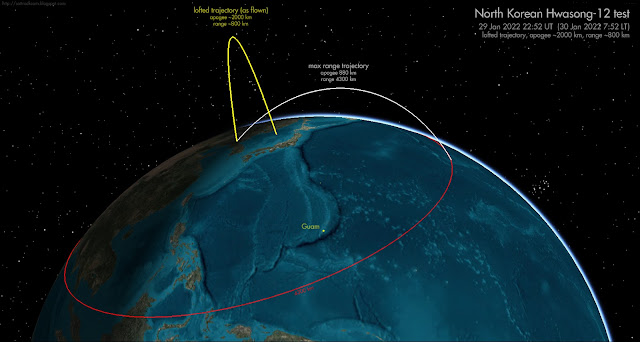
On 29 January 2022 at 22:52 UT (30 January 2022, 7:52 local time in North Korea), North Korea test-fired a Hwasong-12 IRBM. The missile impact point was in the Sea of Japan. According to western sources, it had as flight time of ~30 minutes with a range of ~800 km and an apogee of ~2000 km (the yellow trajectory in the reconstruction above). In other words, a highly lofted trajectory, such as we have seen earlier during various 2017 North Korean missile tests. 

Such a lofted trajectory can be chosen for two reasons: to avoid overflying other countries (Japan) and/or to be able to monitor most of the flight from North Korea itself.

Going from the reporteded apogee altitude and range (~2000 km and ~800 km), I find that this same missile would have an implicated maximum range of ~4300 km (white line in reconstruction above, and red circle) when launched on a more normal, more depressed ballistic trajectory. 

This fits with results for earlier Hwasong-12 lofted test flights, such as the 13 May 2017 test, and is slightly more than the more depressed Hwasong-12 test firings over Japan of 29 August 2017 (which as I have pointed out partly failed but was intended to fly ~3300 km) and 14 september 2017 (which flew ~3700 km).


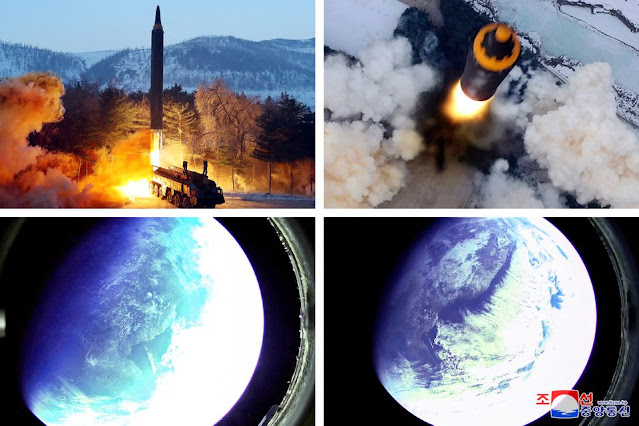
images: KCNA/Rodong Sinmun


Images of the launch published by the North Korean Government in Rodong Sinmun (above) include two images of the earth reportedly made from the missile, showing the Korean peninsula.

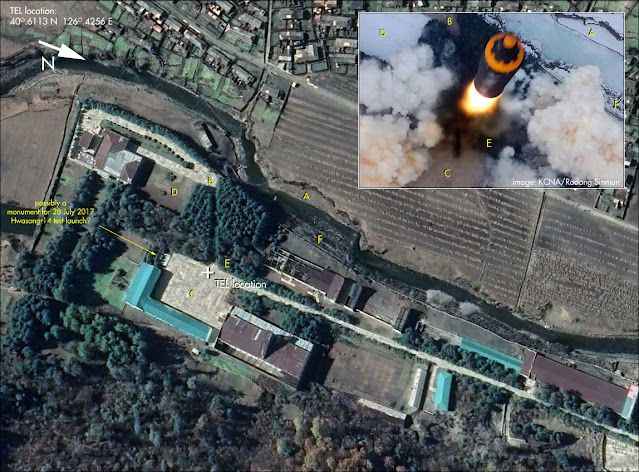
From the two published launch pictures, the launch location of the missile was geolocated by Joseph Dempsey to a spot near Mupyong-ri at 40.6112 N, 126.4257 E. In the image below I match particular terrain details in the drone launch image released by North Korea to a Google Earth image of that particular spot. Which is a familiar spot by the way: it is the same courtyard where on 28 July 2017 the first successful launch of a Hwasong-14 ICBM was carried out (at that time the courtyard was still grass covered: in the meantime it has been paved). On recent Google Earth imagery, what I think could very well be a monument built to commemorate the 2017 launch is visible near the southern courtyard perimeter (we know the North Korean's built commemorative monuments on other test launch sites). I have indicated it in the image below.


click to enlarge

The text of the post-launch North-Korean Government announcement in Rodong Sinmun of 31 January 2022 is interesting. It claims that the  "test-fire was aimed to selectively evaluate the missile being produced and deployed and to verify the overall accuracy of the weapon system". 

As Ankit Panda has pointed out, this probably indicates that this was not a test of a new improved Hwasong-12 variant: but rather a test launch to demonstrate the readiness of a deployed system of production grade missiles (similar to frequent test launches of Minuteman ICBM's and Trident-II SLBM's by the USA). We might therefore see more of such periodical launches in the future.

This was the 7th launch of a Hwasong-12, and the first launch of this type since 15 September 2017.

Sunday, 17 October 2021

A Chinese FOBS surprise (and other stuff of nightmares) [UPDATED]


[this post was updated on October 18 to reflect new information and a refutal of the claim by the Chinese Government. It was again updated on October 21 to reflect new information, including claims that it concerned *two* tests, on July 27 and August 13]


If you want to have nightmares for days, then listen to Jeffrey Lewis menacingly whispering "fòòòòòòòòòòbs..." in the first few seconds of this October 7 episode of the Arms Control Wonk Podcast...

I bet some people connected to US Missile Defense hear this whisper in their sleep currently, given news that broke yesterday about an alledged Chinese FOBS test in August.

FOBS (Fractional Orbital Bombardment System) has menacingly been lurking in the background for a while. In the earlier mentioned podcast it was brought up in the context of discussing new pictures from North Korea showing various missile systems: including a new one which looks like a hypersonic glide vehicle on top of an ICBM (which is not FOBS, but FOBS was brought up later in the podcasts as another potential future exotic goal for the North Korean missile test program).

image: Rodong Sinmun/KCNA

But the days of FOBS being something exclusively lurking as a menace in the overstressed minds of Arms Control Wonks like Jeffrey are over: the whole of Missile Twitter is currently abuzz about it.

The reason? Yesterday (16 Oct 2021) the Financial Times dropped a bombshell in an article, based on undisclosed intelligence sources, that claims China did a test in August with a system that, given the description, seems to combine FOBS with a hypersonic glide vehicle. [edit: but see update at end of this post]

That last element is still odd to me, and to be honest I wonder whether things have gotten mixed up here: e.g., a mix-up with a reported Chinese suborbital test flight of an experimental space plane from Jiuquan on 16 July this year. [edit: and this might be right, see update at the end of this post]

Anyhow: the FT claims that China:

"tested a nuclear-capable hypersonic missile in August that circled the globe before speeding towards its target".

"Circled the globe" before reaching it's target: that is FOBS.


FOBS

So, for those still in the dark: what is FOBS?

FOBS stands for Fractional Orbital Bombardment System. Unlike an ICBM, which is launched on a ballistic trajectory on the principle of "what goes up must come down", FOBS actually brings a nuclear payload in orbit around the earth, like a satellite.  

For example, a very Low Earth Orbit at an orbital altitude of 150 km, which is enough to last a few revolutions around the earth. At some point in this orbit, a retrorocket is fired that causes the warhead to deorbit, and hit a target on earth.

FOBS was developed as an alternative to ICBM's by the Soviet Union in the late 1960-ies, as a ways to evade the growing US Early Warning radar system over the Arctic. Soviet ICBM's would be fired over the Arctic and picked up by these radar systems (triggering countermeasures even before the warheads hit target). But FOBS allowed the Soviet Union to evade this by attacking from unforseen directions: for example by a trajectory over the Antarctic, which would mean approaching the US from the south, totally evading the Early Warning radars deployed in the Arctic region.

In addition, because FOBS flies a low orbital trajectory (say at 150 km altitude), whereas ICBM's fly a ballistic trajectory with a much higher apogee (typically 1200 km), even when a conventional trajectory over the North Pole would be used, the US radars would pick up the FOBS relatively late, drastically lowering warning times (the actual flight times of an ICBM and a FOBS over a northern Arctic trajectory are not much different: ~30 minutes. Over the Antarctic takes FOBS over an hour. But of relevance here is when the missiles would be picked up by US warning radars).

The Soviet Union fielded operational FOBS during the 1970-ies, but eventually abandoned them because new western Early Warning systems made them obsolete. This notably concerned the construction of an Early Warning system in space, consisting of satellites that continuously scan the globe for the heat signatures of missile launches. DSP (Defense Support Program) was the first of such systems: the current incarnation is a follow-up system called SBIRS (Space-Based Infra-Red System). This eliminated the surprise attack angle of FOBS, because their launches would instantly be detected..


Reenter FOBS

But now China has revived the idea, moreover with an alledged test of an actual new FOBS system (while Russia also has indicated they are looking into FOBS again). From the description in the Financial Times, which is based on undisclosed intelligence sources, the Chinese FOBS system moreover includes a hypersonic gliding phase. [edit: but see update at the end of this post]

Initially this surprised me: I was of the opinion (and quarrelled with Jeffrey Lewis about this, but am man enough to now admit I was wrong and he was right. Sorry Jeffrey, I bow in deep reverance...)  that FOBS in 2021 had very little over regular ICBM technology and was therefore a very unlikely strategy, feasible only as a desperate last defensive act of revenge before total annihilation in case of an attack by others. Because using FOBS in an offensive tactical role would guarantee you to lead to Mutually Assured Destruction.

I still stand behind that last part, but clearly, China thinks they nevertheless need FOBS. Why?

FOBS still has one advantage over regular ICBM's. That is, that a southern trajectory over Antarctica approaching the US mainland from the south, while not going undetected by SBIRS, still avoids warhead intercepts by the US anti-Ballistic Missile Defense (BMD) systems, that are currently geared to intercept a regular ICBM-attack over the Arctic or from the west (North Korea).

I should ad here: "for the time being".... The logical answer by the US (unless they chose to continue to ignore China with regard to BMD, as they did untill now) will now be to extend their BMD coverage to the south. For countering FOBS, they could use the same AEGIS SM-3 technology that they used to down the USA 193 satellite in 2008 (Operation Burnt Frost).

Here are two maps I made, one for a FOBS attack on Washington DC from China and one for a FOBS attack on Washington DC from North Korea. The red lines are ballistic ICBM trajectories (over the Arctic), and current BMD sites are meant to intercept these kind of trajectories. The yellow lines are FOBS trajectories over the Antarctic, showing how these attack the USA "in the back" of their missile defenses by coming from the south instead.

hypothetical FOBS attach from China. Click maps to enlarge

 
hypothetical FOBS attack from North Korea. Click map to enlarge

As the USA is currently putting much effort in Ballistic Missile Defense, developing a new FOBS capacity could be a way by which China is warning the USA that even with BMD, they are still vulnerable: i.e. that they shouldn't attempt a nuclear attack on China from a notion that their BMD systems make them invulnerable to a Chinese answer to such an attack. 

FOBS is hence a way of creating and utilizing weaknesses in the current BMD capacity of the USA, as a counter capacity.

It should be remarked here that the US BMD capacity is geared towards missiles fired by Russia or by  'Rogue Nations' like North Korea and Iran. The USA seems to have largely ignored China so far with regard to BMD. Meanwhile, China is concerned with the US BMD development, particularly deployment of BMD elements in their immediate region.

So this FOBS experiment could also be a way in which China tries to force the US to finally take the Chinese concerns about US BMD deployments and the inclusion of their region into such deployments, serious. 


Outer Space Treaty

China (like the US and Russia) is a signatory of the Outer Space Treaty (or, in full: the Treaty on Principles Governing the Activities of States in the Exploration and Use of Outer Space, including the Moon and Other Celestial Bodies). 

FOBS seems to be a violation of this treaty, as Article IV of the treaty clearly states that:

 "States Parties to the Treaty undertake not to place in orbit around the earth any objects carrying nuclear weapons or any other kinds of weapons of mass destruction"

This is exactly what FOBS does: it (temporarily) places a nuclear weapon in orbit around earth, so that they can later bring it down over a target.

The Soviet Union, when testing FOBS in the late '60-ies, tried to get out from under this by claiming that, as their FOBS did not complete a full orbit around the Earth, article IV of the treaty didn't apply. The US Government, surprisingly -and for opportunistic reasons- went along with this interpretation (see this article in The Space Review). Which is, pardon me the word, of course bullshit: in the sense of orbital mechanics (that is to say; physics), FOBS clearly does place an object in orbit, and it is very clear too by the fact that after launch it needs an actual, separate deorbit burn to get it down on the target.


North Korea and FOBS

How about North Korea? As I mentioned, FOBS has been repeatedly mentioned as a potential route North Korea might take with its nuclear missile program. Some fear that NK could be developing a FOBS capacity in order to have a means of final-revenge-from-over-the-grave from the Kim Jong Un regime in case of a 'decapitation' attempt (an attempt to end the Kim Jong Un regime by a targetted military strike on KJU and  his family members).

One reason behind this fear is that North Korean Kwangmyŏngsŏng (KMS) satellite launches were on a trajectory over Antarctica, bringing the payload over the US only half a revolution after the launch.

Compare this launch trajectory of KMS 3-2 in December 2012 for example (which comes from this 2012 blog post), to the hypothetical FOBS trajectory in the map below it: the similarities are obvious (if perhaps superficial).


KMS satellite launch trajectory (above) and hypothetical FOBS attack from North Korea (below). Click map to enlarge


It wouldn't surprise me if FOBS will quickly replace the EMP 'threath' that over the past decade has been hyped by certain hawkish circles in the US defense world, as the horror-scenario-en-vogue.


Something worse than FOBS? DSBS!

So, can we think of something even more sinister than FOBS? Yes, yes we can, even though so far it is completely fictional and a bit out there (pun intended).

Let us call this very hypothetical menace DSBS. It is truely something out of your nightmares.

DSBS is a name I coined myself for a so far nameless concept: it stands for Deep Space Bombardment System. DSBS at this point is purely fictional, with no evidence that any nation is actively working on it: but the concept nevertheless popped up, as a distant worry, in a recent small international meeting of which I was part (as the meeting was under Chatham House rules, I am not allowed to name participants). So I am not entirely making this up myself (I only made up the name to go with this so far unnamed concept).

The idea of DSBS is that you park and hide a nuclear payload in Deep Space, well beyond the Earth-Moon system: for example in one of the Earth's Lagrange points. There you let it lurk, unseen (because it is too far away for detection). When Geopolitical shit hits the fan, all is lost and the moment is there, you let your DSBS payload return to earth, and impact on its target.

With the current lack of any military Xspace (Deep Space) survey capacity,  such an attack could go largely undetected untill very shortly before impact. Your best hope would be that some Near Earth Asteroid survey picks it up, but even then, warning times will be short. Moreover, with the kind of impact velocities involved (12+ km/s), no existing Ballistic Missile Defense system likely is a match for these objects.

Far-fetched? Yes. But that is also something once said about FOBS...

(Note: I hereby claim all movie rights incorporating DSBS scenario's)

(added note: I only now realized, when answering a comment to this blogpost below, that, unlike FOBS or placing something in GEO, a DSBS parked in one of the Lagrange points would NOT violate Article IV of the Outer Space Treaty, because the device would NOT be in orbit around Earth (but co-orbital with Earth).


UPDATE 18 Oct 2021 10:45 UT and 20:10 UT: 

NOT FOBS?

China denies that they did a FOBS test: "this was a routine test of a space vehicle to verify technology of spacecraft's reusability", says a Chinese government spokesman. They reportedly also say the test happened in July, not August. That could mean that this earlier reported test flight of a prototype space plane on July 16 was concerned (a suspicion I already voiced earlier in this blogpost and at the Seesat-L list). 

Of course, as Jeffrey Lewis rightfully remarks, spaceplane technology shares a lot with FOBS technology. In Jeffrey's words:  "China just used a rocket to put a space plane in orbit and the space plane glided back to earth. Orbital bombardment is the same concept, except you put a nuclear weapon on the glider and don’t bother with a landing gear."

At the time, this space plane test was interpreted to have been suborbital, as the space plane reportedly landed in Alxa League, 800 km Badanjilin Airport, 220 km from the launch site, Jiuquan. I today however realised that this might have been a misinterpretation: it might actually have been an orbital, not suborbital, test fligth landing at the end of the first revolution. 

Indeed, I managed to create a hypothetical 41.2 degree inclined proxy orbit for a  launch from Jiuquan that brings it over Alxa League Badajilin Airport at the end of the first revolution.

Slightly more on this in this follow-up blogpost. which also points out that a Chinese source confusingly points to yet another airport as the landing site of the July 16 space plane test (if it was a space plane at all and not some upper atmospheric aircraft vehicle).

It could be that the Chinese Government is now seizing on the July 16 test to explain away a later FOBS test.

click map to enlarge

 UPDATE 21 October 2021 10:25 UT:

New information circulated by Demetri Sevastopulo, the FT journalist that broke the story, indicates that there were *two* tests, on July 27 and August 13. The first date tallies with rumours that reached me on July 29 about an 'unusual' Chinese test apparently having taken place (that I at the time erroneously though might refer to the July 16 'space plane' test).