Showing posts with label Starlink. Show all posts

Wednesday, 19 February 2025

The reentry of a Falcon 9 upper stage over NW Europe on 19 February [UPDATED]


In the early morning of February 19, 2025, near 3:45 UTC (4:45 CET) scores of people in the Netherlands, UK, Germany and Denmark saw a slow, fragmenting object move through the sky. The event garnered much attention. 

Above is a video of the event obtained by the camera of @dutchspace.bsky.social in the Netherlands.  Another stunning video, by the meteor camera of AndrĂ© Knoeffel in Brandenburg, Germany, is here. The video below is by Nick James from the UK, and shows the start of the reentry near 03:43 UTC and start of fragmentation.


The event was caused by the reentry of a SpaceX Falcon 9 upper stage, object 2025-022Y (cat nr 62878) . This upper stage, from the Starlink group 11-4 launch from Vandenberg, California, on 1 February 2025 23:02 UTC, 18 days prior to the reentry event, failed to deorbit in a controlled way after launch and payload insertion. It was supposed to do a deorbit burn after releasing the payloads, and deorbit over a specified area in the Pacific Ocean around 00:45 UTC on Feb 2, near the end of the first revolution (see map below). With the deorbit failed, it however stayed on orbit for almost 3 weeks, and then had an uncontrolled deorbit over NW Europe on February 19.


click map to enlarge

The general character of the Feb 19 event (slow, fragmenting) as well as time and location fit well with the Falcon 9 upper stage reentry. The CSpOC final TIP for this reentry (which we suspect is based on a satellite observation of the reentry fireball) is 19 February 3:43 UTC ± 1 min, near 52.8 N, 5.6 W. The reentry trajectory runs over the British Isles, the northern Netherlands, northern Germany and Poland.

Below is the ground-track for the last orbit up to reentry, and a detail of the approximate final reentry track over Europe, with the Netherlands indicated in red:

click map to enlarge

 
click map to enlarge

A possible piece of debris has been found at Komorniki near Poznan in Poland, media reports. The object on the photograph looks like a Composite Overwrap Pressure Vessel, a component of the Falcon 9 upper stage that has survived reentry before, e.g. in March 2021 when a Falcon 9 upper stage reentered over Washington. The location of the find matches well with the reentry trajectory, as can be seen in the map above. [update: reportedly another one of these composite-wrapped pressure tanks was subsequently found in Poland]

The event caused a lot of media attention: I did several media interviews on the reentry, amongst others with two Dutch national tv channels.


Wednesday, 9 February 2022

This week: rainshowers with a slight chance of falling satellites

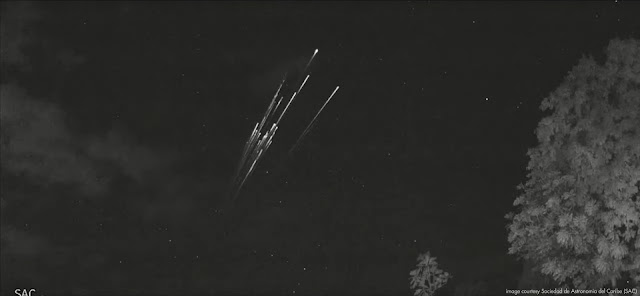
The spectacular image above is a frame from video footage obtained by cameras at Añasco, Puerto Rico, part of a cameranetwork from the Sociedad de Astronomia del Caribe (SAC). It was shot on 7 February 2022 near 6:40 UT (2:40 local time) and shows what clearly is a satellite reentry, the reentering satellite spectacularly breaking up into many fragments.

Below is the actual video. It shows two objects appearing about 1 minute apart, both reentering and fragmenting. Especially the second object is spectacular. The two objects could belong to one object that has broken up earlier; or be two separate objects close together in the same orbital plane.


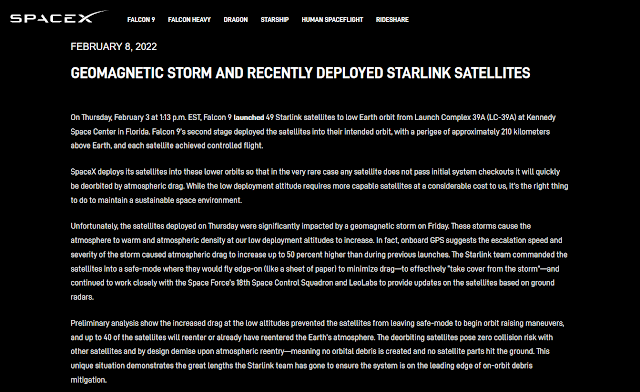
The reentering object(s) can be identified as belonging to a batch of 45 49 Starlink satellites launched on 3 February 2022, two-and a half days before the reentry sighting from Puerto Rico.

A day after the launch, when most of the deployed satellites yet had to raise their orbits, a Coronal Mass Ejection (CME) from the Sun arrived at earth, creating a geomagnetic storm

During a geomagnetic storm, the upper atmosphere warms up and expands somewhat, causing an increase in drag in low orbital altitudes. SpaceX therefore put their just launched satellites, still in a very low orbit, into safe mode and a least-drag attitude. 

This however prevented them from raising their orbits, and it did so long enough to make it impossible for some 40 of them to be rescued. Over the past days a number of them (at least three, possibly more, including the object over Puerto Rico, at time of writing (9 February 16:00 UT)) have already reentered and the other objects, some 40 in total according to SpaceX, will reenter over the coming week.

Fourty (40!) satellites reentering in only a week or so, is unique. The coming week, the chances of seeing a satellite reentry are therefore larger than usual for anyone between 53 N and 53 S. So keep an eye on the sky!

screenshot of Feb 8 announcement on the SpaceX website

Though it remains to be seen which of the 40 satellites it actually was, the Feb 7, 6:40 UT, Puerto Rico sighting can be possitively linked to this deluge of decaying Starlink satellites. 

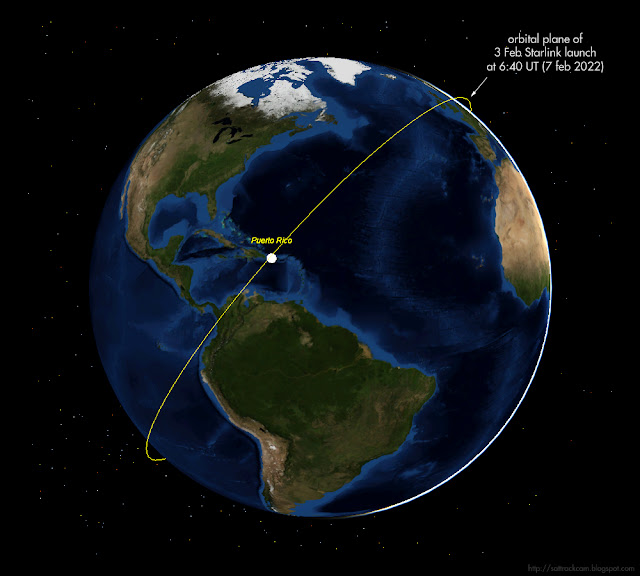
One clue is that the orbital plane of this launch was over Puerto Rico near the time of the event, and the direction of movement (SW-NE) matches it.


To get even more certainty, I did some astrometry on the footage and fitted a rough circular orbit to the measured positions.The rough orbital fit I get - I measured three fragments-  yield orbital inclinations in the range of 54-56 degrees: Starlink satellites are in 53.2 degree inclined orbits, so this is close enough (given the error margin) to conclude that the reentering object fits with the Starlink orbital plane. The RAAN values also match to a degree or so. So there is very little doubt that this was a Starlink satellite reentering.

One reason why I checked this, is that someone suggested another candidate, a Falcon 9 rocket stage from a 2017 launch (2017-014B), which was also expected to reenter around this date (in fact it had already reentered a day earlier) and had its orbital plane passing over Puerto Rico at the time of the event. This rocket stage however had an orbital inclination of 22 degrees, which is clearly much lower than what I get for the reentering object in the footage.

Starlink satellites are not very big and do not have big rocket engines, so there is very little chance that anything remains and reaches Earth surface from these reentries: it will all burn up in the atmosphere. 

Note: I thank Eddie Irizarry for alerting me to the Puerto Rico event


UPDATE 17:30 UT (9 Feb 2022):
For some 21 of the 45 49 Starlink satellites in question, orbital elements have now been released by CSpOC. A quick assessment with SatEvo suggests reentries happening over the coming week, up to mid-February.

Friday, 6 August 2021

A weird Navigational Warning for a mass deorbit on August 9-10? [updated]

click map to enlarge
 

A weird Navigational Warning (NAVAREA XII 384/21) for "Space Debris" has appeared defining nine areas, some of them overlapping, in the Pacific for August 9, 16:27 to 17:29 UT and August 10, 17:16 to 18:17 UT.

I have mapped them in the map above. Below is the text of the Navigational Warning:

060929Z AUG 21
NAVAREA XII 384/21(GEN).
EASTERN NORTH PACIFIC.
1. HAZARDOUS OPERATIONS, SPACE DEBRIS
   091627Z TO 091729Z AUG, ALTERNATE
   101716Z TO 101817Z AUG
   IN AREAS BOUND BY:
   A. 22-52-40N 137-34-57W, 20-12-47N 134-02-08W,
      04-25-05N 146-28-48W, 06-54-48N 149-55-52W.
   B. 51-11-05N 141-36-54W, 49-40-18N 142-13-53W,
      50-44-15N 170-19-30W, 52-17-11N 170-39-50W.
   C. 12-58-15N 130-00-21W, 10-52-28N 127-06-04W,
      05-17-31S 138-47-34W, 03-13-54S 141-40-25W.
   D. 48-12-47N 135-38-42W, 46-20-17N 136-55-43W,
      50-55-14N 165-28-28W, 52-59-09N 165-19-24W.
   E. 13-53-47N 126-52-33W, 11-46-05N 123-56-09W,
      04-19-41S 135-37-56W, 02-14-45S 138-32-32W.
   F. 49-27-33N 135-51-45W, 47-43-47N 136-53-00W,
      50-56-51N 168-09-57W, 52-48-04N 168-20-28W.
   G. 14-27-06N 127-19-28W, 12-18-52N 124-23-30W,
      03-36-29S 136-03-34W, 01-31-24S 138-57-30W.
   H. 49-46-04N 136-40-41W, 48-05-08N 137-37-30W,
      50-55-01N 168-54-51W, 52-42-19N 169-08-13W.
   I. 31-49-12N 124-20-42W, 30-20-18N 122-34-43W,
      22-47-14N 130-25-52W, 24-10-15N 132-10-44W.
2. CANCEL THIS MSG 101917Z AUG 21.

The nine areas A to I cluster in basically three regions (which I have colour-coded in the map above).

The directions of the areas point to a series of deorbits from a 51-53 degree inclined Low Earth orbit. As I have indicated in the map in top of this post, two of the three defined regions with warning boxes line up with the ISS groundtrack during the two time windows given, but I think this is coincidence (and the series of boxes south of Alaska do definitely not line up with the ISS during these two time windows. In fact, this points to deorbits from at least two different orbital planes).

Rather, my suspicion is a mass deorbit of Starlink satellites, who move in ~53 degree inclined orbits [but see update below].

UPDATE: 

After some discussion, Jan Hindrik Knot rightfully questioned whether Starlink satellites, with their ion thruster propulsion, are capable of a controlled deorbit in a designated area at all. That is a good point, which I overlooked initially.

So it appears we have no idea what will be deorbitted on August 9-10.

The combination of the areas in the mid-Pacific and those south or Alaska, to me point to deorbits from at least two different orbital planes (both inclined 51-53 degrees).

Note that, from the position of the areas, the fact that their shapes clearly point to deorbits from Low Earth Orbit, and that the NavWarning mentions time windows on two successive dates, it is clearly not related to this deorbit  (the Spectr-R rocket booster) from Deep Space either.

UPDATE 2:

The plot thickens: the on-line KML version of the Navigational Warning has appeared and mentions: 

"Authority: NASA 300917Z JUL 21"

(the versions sent to subscribers to the service doesn't mention the authorities issuing the warnings).

So it appears to be something NASA-related (HT to @john_moe on Twitter).

One possibility could be that these are emergency landing zones for Starliner (which was to be launched on July 30, the date mentioned in the "Authority:" line: but was scrubbed). Still open questions though: why August 9 and 10? Why where these same zones not published before the July 30 launch date? Questions, questions...

UPDATE 3:

I like the suggestion by Bob Christy that these are warnings for the reentry of the Starliner service module (that is jetissoned from the Starliner capsule before landing of the latter). That makes sense.

Thursday, 20 May 2021

The front group of Starlink V1.0 - L26

On May 15, yet another batch of SpaceX Starlink satellites was launched, and they are currently making evening and early night passes over Europe. Since launch, the resulting 'train' of satellites from the launch has split into two distinct groups passing a few minutes after each other.

The video above is from yesterday night (19 May 2021 ~23:17 UT) and shows the leading group, which is still quite tight. The trailing group (also captured but not shown in this video clip) is more dispersed. The video was shot with my DSLR: Canon EOS 80D + Samyang 1.4/85 mm lens.

A night earlier, I captured both the leading and trailing group with the WATEC 902H2 Supreme + FD 1.8/50 mm lens (see video below). They were naked eye during that pass.


Tuesday, 23 March 2021

[UPDATED] Reentry predictions for the Falcon 9 RB 2021-017BN

click diagram to enlarge

In my previous post, I discussed 2021-017BN, the Falcon 9 upper stage from the March 4 Starlink launch that should have been deorbitted after 1.5 revolutions on March 4th, but didn't.

It is still on orbit. At the moment of writing, 23 March 2021 at 11:00 UT, it is in a 217 x 200 km orbit according to the latest available elements from CSpOC, and it will stay on orbit for a couple of days to come. But the end is near: the orbital altitude of the rocket stage is quickly decaying, as can be seen in the diagram below:

click diagram to enlarge

My current reentry prediction (see diagram in top of post and table below) is that it will come down in the early hours of March 26 (2021). My prediction, based on modelling in GMAT R2020a using the MSISE90 model atmosphere, appears to be well in line with the TIP from CSpOC so far.

[UPDATE: my final post-cast predicted reentry at 26 Mar 04:34 UT, which is some 35 minutes too late. It is based on a 2/3rd maximum drag surface value. Interstingly, using the maximum drag surface leads to a reenrty at 3:56 Ut, within minutes f the actual time]

Revisit this post for prediction updates in the coming days.

orbit epoch     pred. date     reentry time (UT)
21081.600725    26 Mar 2021    02:33 +- 16.8 hr
21081.922054    26 mar 2021    03:36 +- 15.5 hr
21082.113317    26 Mar 2021    03:59 +- 14.7 hr
21082.216601    26 Mar 2021    03:40 +- 14.1 hr
21082.278149    26 Mar 2021    03:43 +- 13.8 hr
21082.462749    26 Mar 2021    05:29 +- 13.3 hr
21082.585776    26 Mar 2021    05:29 +- 12.7 hr
21082.708770    26 Mar 2021    05:37 +- 12.1 hr
21082.954651    26 Mar 2021    06:13 +- 11.1 hr
21083.138960    26 Mar 2021    05:03 +-  9.9 hr
21083.261785    26 Mar 2021    05:15 +-  9.4 hr
21083.296296    26 Mar 2021    05:20 +-  9.2 hr
21083.507296    26 Mar 2021    05:28 +-  8.3 hr
21083.875164    26 Mar 2021    05:26 +-  6.5 hr
21084.120127    26 Mar 2021    05:59 +-  5.4 hr
21084.181325    26 Mar 2021    05:20 +-  5.0 hr
21084.486963    26 Mar 2021    05:00 +-  3.5 hr
21084.548018    26 Mar 2021    03:19 +-  2.8 hr
21084.974688    26 Mar 2021    04:46 +-  1.1 hr * post-cast
21085.095602    26 Mar 2021    04:34 +-  0.5 hr * final post-cast


UPDATE  26 March 2021  12:30 UT:

The reentry happened last night, over North America, and was widely seen from the US States Washington and Oregon, near 4:00 UT (March 26 UT: that is 9 pm on March 25 local time for that area).

CSpOC's final TIP places the reentry at 03:58 +- 1 min UT. This time matches the reports from Washington and Oregon well, and based on the last orbit it would indeed place the rocket stage near the NW United States coast.

The listed geographic position in the TIP, 24.5 N, 151 W, does however not match well (it is further down the track, near Hawaii, corresponding to the Falcon 9 position about 6 minutes prior to the observed reentry). We have  noted such discrepancies more often in recent TIP messages. In this case, I half suspect the position was that given by their reentry model, and they forgot to update it when the SBIRS detection of the actual reentry fireball came in.

click map to enlarge

My own final "post-cast" places reentry some 35 minutes after the actual reentry.

Here are some of the reentry sightings as reported on Twitter:


UPDATE 2 April 2021 23:00 UT:

Debris has been recovered from this reentry. In Grant Country, Washington, a Composite Overwrapped Pressure Vessel (COPV) was found on farmland.


Friday, 12 March 2021

Apparent failed deorbit of the Starlink-18 Falcon 9 upper stage [UPDATED]

On 4 March 2021, after several delays, SpaceX launched the 18th Starlink batch (Starlink-18 or V1.0-17). While the launch and deployment profile appears to have been similar to other recent Starlink launches, it appears that something went wrong with the Falcon 9 upper stage near the end of its mission.

On March 8th, Polish observer Adam Hurcewicz reported a bright, fast object in the orbital plane of this launch, passing a few minutes before the main Starlink "train". It was seen on subsequent nights and by other observers as well: the video above is from the early morning of March 9. At it's brightest, this fast moving object reportedly reaches mag -3. It does not appear to match a known object from earlier launches. It also didn't match supplementary TLE's for the Starlink-18 payloads from Celestrak (which are based on State Vectors from SpaceX). The Polish observers therefore speculated it was the Falcon 9 upper stage from the launch. 

But that would be against expectations. The Falcon 9 upper stage normally does not stay in orbit: it is de-orbitted soon after payload release, usually about 1.5 revolutions (about 2.5 hours) after launch. So if this object is the Falcon 9 upper stage, this suggests  something went wrong and it failed to deorbit.

The speculation that this object is the Falcon 9 Upper Stage can now be bolstered by additional information. The first orbital element sets for this Starlink launch have appeared on the CSpOC portal  Space-Track late yesterday (11 March), with catalogue numbers ranging from 47722 to 47786. And they show an extra object!

With Starlink launches, 64 objects are usually catalogued: 60 payloads and four 'Falcon 9 debris' pieces. The latter 'debris' pieces are the payload stack retaining rods: four metal rods which keep the satellite stack together on top of the upper stage. They are jettisoned upon payload release.

An elset for the Falcon 9 upper stage is usually not released by CSpOC: as it normally stays on-orbit for barely more than 1 revolution, it is not catalogued.

But this time, not 64 but 65 objects have been catalogued. The extra 65th object must be the Falcon 9 upper stage, and it indicates it stayed on orbit for more than a few revolutions. Which lines up with the observations by the Polish (and later also other) observers.

Although the 65 objects, at the moment of writing, do not have been individually ID-ed by CSpOC yet (all have the temporary designation "TBA - TO BE ASSIGNED"), the 60 payloads, four retaining rods and the upper stage as such can be clearly identified among them. The objects separate in 3 groups in terms of orbital altitude. The 60 payloads all have (for orbits with epoch 12 March) a perigee above 280 km. The four retaining rods have clearly lower orbits: their perigee is near 243-246 km and apogee near 268-278 km.

The 65th object, which by inference must be the Falcon 9 upper stage, is in a still lower orbit . It has the smallest semi-major axis of all of them with perigee near 237 km and apogee near 270 km. The orbit for this object, catalogue nr 47782 (2021-071BN) also closely matches the observations by the Polish observers.

So why is the Falcon 9 upper stage still on-orbit? It suggests of course that the deorbit went not as planned, i.e. it failed for some reason (e.g. the rocket engine refusing to restart).

That the Falcon 9 upper stage should have deorbitted on March 4, after 1.5 revolutions, is clear from the Navigational Warnings that were issued in connection to this launch. Navigational Warning HYDROPAC 695/21 delineates the usual elongated deorbit zone in the Indian Ocean familiar from earlier Starlink launches:


021948Z MAR 21
HYDROPAC 695/21(GEN).
SOUTHERN INDIAN OCEAN.
1. HAZARDOUS OPERATIONS, SPACE DEBRIS
   041024Z TO 041326Z MAR,
   ALTERNATE 051004Z TO 051306Z MAR
   IN AREA BOUND BY
   29-43S 060-07E, 24-55S 064-27E,
   38-45S 084-30E, 45-12S 099-45E,
   49-46S 119-13E, 50-42S 138-19E,
   48-50S 156-44E, 51-46S 158-08E,
   54-42S 148-32E, 56-20S 131-03E,
   55-52S 107-50E, 49-11S 085-05E,
   34-32S 064-13E.
2. CANCEL HYDROPAC 685/21.
3. CANCEL THIS MSG 051406Z MAR 21.


I have plotted the zones from the Area Warnings connected to the launch in this map, along with the groundtrack for the first 1.5 orbital revolutions. The large elongated red zone in the southern Indian Ocean is the planned deorbit area from Navigational Warning HYDROPAC 695/21:

click map to enlarge

The position of the reentry hazard zone indicates a reentry was planned around 10:55 UT (March 4), 1.5 revolutions (2h 30m) after launch, following a deorbit burn some 30 minutes earlier.

But the deorbit evidently did not happen as it should have: the upper stage is still orbiting as we speak, a week after launch. The issued Navigational Warning for the deorbit hazard zone strongly suggests this is not intentional.

So how long will the upper stage stay in orbit? The current orbit is low (237 x 271 km), and the object is large (16 x 3.66 meter, with a mass of 4.5 tons) so eventually the rocket stage will have an uncontrolled reentry, somewhere between latitudes 53 deg N and 53 deg S. 

A first assessment using both SatEvo and a GMAT simulation suggests that the reentry will probably happen in the last few days of March or the first few days of April.


UPDATE 14 March 2021:
CSpOC has now added identifications to the objects, and indeed object 47782 is now listed as "Falcon 9 RB"

Monday, 4 May 2020

Guest Post: Modelling of Starlink trail brightness and comparison to observations

(The following post is a Guest Post written by Richard Cole)


Observers have been reporting ‘missing passes’ of Starlink trains since the Starlink L1.1 launch, the first of the operational spacecraft. A missing pass is where an examination of the NORAD or SpaceX orbital elements, or a prediction from one of the Starlink websites, would indicate that multiple spacecraft should be expected to be visible but none appear on time.

An observer in Argentina noted missing passes to their south in late February, local summer. Initially, I thought that perhaps the spacecraft had been temporarily placed into the operational low brightness mode (that brightness having been seen on the prototypes after deployment in mid-2019) but this did not match other observers seeing the same spacecraft at normal brightness at similar times. This phenomenon affected spacecraft in the holding orbit at 350-380km, not the operational spacecraft at 550km.

Recently, the images of the spacecraft on-orbit by Ralf Vandebergh and Szabolc Nagy showed its large solar panel of the solar array was facing the Earth when the spacecraft were overhead and explained the normally high brightness of the spacecraft as seen from the ground. The longer dimension of the panel was observed to be parallel to the velocity vector of the orbit, i.e. the orbit path.

SpaceX had referred in communications to a low-drag mode which was consistent with the observed appearance. This raised the question of how this mode of operation would deal with acquiring enough solar power. Would the panel always face upwards to the zenith, or would the spacecraft be rolled around the velocity vector to get more sunlight onto the panel?

During April 2020 more observers saw missing passes. I had personally tweeted a prediction for a late evening pass of the Starlink L1.5 train to the north of my site in southern UK on April 20th, but the spacecraft were only magnitude 6, needing binoculars to be seen at all. Observers in northern UK reported they had visually seen spacecraft on that pass. It was clear that the spacecraft were indeed being rolled around the velocity vector and by such an angle they were nearly directly facing the Sun, now towards the north in Spring, and observers to the south were just seeing the shadowed back of the panel.

Since it was clear that further analysis was needed to accurately predict visible passes, early on April 21st I created a simple model of the spacecraft panel pointing axis assuming the panel long axis was the velocity vector and the spacecraft was being rolled so that the Sun was in a plane normal to the panel and through the long axis (figure 1). Usually the panel cannot directly face the Sun, but is at some offset angle, in azimuth and elevation.

Figure 1: Spacecraft Roll-Angle concept.  Click diagram to enlarge

This concept allows calculation of the angle between the direction the panel is pointing and the observed Starlink direction for a particular observer on the ground, for the same time. This ‘panel view angle’ will be different for each possible observer of the same spacecraft at the same time, some will see a large part of the sunlit side of the panel, some will see only a little of the same side and some will see only the back of the panel away from Sun, which is dark.

The model gave panel view angles consistent with recorded occasions of observed train non-appearances.

Marco Langbroek’s excellent observation and images of the L1.5 train from Leiden on 2020 April 21 (the same day as the first version of the model was written, as it turned out) provided a useful test of the model. Further, more recent information from SpaceX has confirmed this behaviour and suggested that the actual roll-angle used on-board many not be exactly as calculated above.

In the image below (figure 2) I plot the calculated glancing angles to the sunlit side of the solar panel (so a glancing angle of zero means the view angle of the panel is to the edge of the panel, an angle of 90 would be face on). I have done this for two altitudes (elevations) in Marco's image, 50° and 70°. The roll-angle was as calculated above.

Figure 2: Marco Langbroek's image of Starlink 5 passes, with the calculated panel glancing angles overlaid. Click to enlarge

The trend of a reducing glancing angle with Starlink brightness is correct, so as the Starlinks passed further north (to the right of the image) of Marco at Leiden, less and less of the panel sunlit surface was visible until nothing could be seen. There was one predicted Starlink that passed on the right of the image (further north) but is only detectable by image analysis, it can’t be seen in the original camera image because very little of the sunlit side was facing the camera:

Figure 3: the extra and faint track of a predicted Starlink satellite in the image. Click to enlarge

I was observing the same pass from southern UK a few minutes earlier than Marco and saw the same behaviour of reducing Starlink brightness as each Starlink passed further to the north. I was very pleased to see he had recorded it in his image.

However, the fit is not perfect so I tried changing the roll-angle by a small amount from that calculated. The fit was best for a deviation of nine degrees from the model, that is the actual roll-angle was nine degrees less that the simple model predicts and the panel is pointing slightly higher in the sky. This gave a better fit:

Figure 4: the same image with the changed panel glancing angles overlaid, using an offset of nine degrees in the solar panel pointing direction. Click to enlarge

SpaceX is now promising to change the roll-angle model used on-board to minimise the Starlink brightness as seen from the ground. The panel will be rotated, at periods when the Starlink can be seen from the ground, so the sun falls on the edge of the panel, not on its face as in figure 1. This is a small portion of each orbit and as Starlinks at low altitude are not using their communication equipment, they will need less power to keep functioning.

Richard Cole
Twitter: @richard_e_cole

Friday, 24 April 2020

Starlink Galore! [UPDATED]

click to enlarge

Last week was dominated by impressive - if worrying - displays of SpaceX Starlink satellites. Over several nights, objects from the 18 March 2020 launch (Starlink 5) made impressive passes in the sky. And on April 22, there was a new launch, Starlink 6, that could be well observed in the evening of the 22nd and 23rd, causing an impressive satellite 'train' on April 23.

In this blogpost I provide photographs, video, and descriptions.

The new launch on April 22 (Starlink 6)


On 22 April 2020 at 19:30 UT, SpaceX launched the 7th Starlink batch of 60 satellites, Starlink 6, from SLC 39A on Cape Canaveral. Some 23 minutes later, the newly launched objects made a pass over the Netherlands, in a blue twilight sky, and were well visible.

Just some seven minutes prior to this pass, and 15 minutes after launch, the payloads had been deployed from the Falcon 9 Upper Stage while the latter was over the Northern Atlantic.

With the naked eye, the Falcon 9, the just released satellites and the associated debris objects all looked like one bright object (mag 0 to -1) crossing the sky. In binoculars, they could be separated into multiple objects.

The photograph below is a stack of 12 photographs, 2.5 seconds exposed each with a Canon EOS 80D and EF 2.0/35 mm lens at F2.2, 400 ISO, showing it pass over my house in Leiden.

click to enlarge

In 10 x 50 binoculars, the view was spectacular. It consisted of a bright object (the Falcon 9 upper stage), slightly separated from another, elongated bright object (the clump of released satellites), and four fainter flashing objects surrounding them in a paralellogram shape. These were the four tumbling retaining rods that had held the satellite stack together before deployment.

Some of this is visible in this video I shot with the WATEC 902H and FD 1.8/50 mm lens. Falcon 9 and payloads still appear merged as one object here, but the retention rods are visible as separate objects:


The provisional orbit that I had calculated prior to the launch turned out to be quite good: the objects were only 28 seconds early on predictions and less than 0.5 degrees off-track at culmination.

The next night, April 23, saw a twilight pass of the satellites again, that by now had developed into a clear 'train' of objects. They were not as bright as in May 2019 with Starlink 0.1, but in 10 x 50 binoculars the moving string of 60 lights, some 10-15 degrees long, was impressive. While low in the west, in Orion, they briefly became bright and clearly visible to the naked eye for a few seconds, then they grew fainter and I turned to my binoculars to observe them.

My WATEC 902H video camera, this time equipped with a Canon EF 2.0/35 mm lens, captured the train passing in Hydra. The video gives a good impression of the view as it was visible in binoculars:


The next day, April 24, I also filmed the 'train'. This was a low pass (21 degrees maximum elevation) in twilight, at rooftop level, shot from the loft window of my home. Video withe the WATEC 902H and a 1.8/50 mm lens:


Starlink 5 passes, April 19-21


Earlier that week, we were treated on some spectacular, if eerie and worrying, displays of Starlink satellites from the previous launch, the Starlink 5 launch on 18 March.

(worrying, because of the implied impact on the night sky)

A month after launch, the objects from this launch are dispersing as they one-by-one are lifted to a higher orbit, but mid-April there was still a recognizable main group that took about 20 minutes to pass. When passing south of the zenith they are bright (but faint when passing north of the zenith, due to satellite orientation and sun-satellite-observer angles), on the first few passes even very bright (up to magnitude +0.5 for almost a full pass).

At any given moment during the pass of this group, there were 5-8 bright satellites moving in the sky at the same time, following each other in file, typically some 20 degrees apart. It was a very eerie sight reminiscent of a Science Fiction Movie: almost like the Mothership had unloaded the invasion fleet into earth orbit! The long duration, 20 minutes that satelite after satellite after satellite appeared in file, made it very impressive.

Here is a single photographic image from 19 April, showing 4 Starlink satellites traversing the sky (the fainter one that is somewhat off-set is already rasing its orbit). It is a 5 second exposure with an EF 2.0/35 mm lens on a Canon EOS 80D:

click image to enlarge

Below is a stack of 202 images from 21 April, showing 39 Starlink satellites that appeared over a 20-minute period. Note how the trails become fainter when located more north (image is looking west, so north is at the righthand side of the image). Also note the two flaring satellites:

click image to enlarge

Here are single images showing the two flaring satellites, Starlink- 1274 and Starlink-1309, flaring close to Pollux:

click image to enlarge

click image to enlarge


I used the 202 photographs, shot over a 19-minute period,  to create this time-lapse movie showing the steady stream of satellites:


This is another time-lapse video, from images from the deep-twilight pass of the previous night, 20 April:


Below are three more stacks of photographic images from April 19 and April 20 (the gaps in the trails are the brief moments between two consecutive photographs, hence the dashed appearance of the trails):

click image to enlarge