Showing posts with label NROL. Show all posts

Wednesday, 27 March 2024

NROL-70, likely an ADVANCED ORION satellite

NROL-70 launch trajectory. Click map to enlarge


On 28 March 2024, if weather cooperates (see update at bottom of post), ULA will launch NROL-70 from SLC-37 at Cape Canaveral, carrying a classified payload for the National Reconnaissance Office (NRO). 

NROL-70 will be the last launch of ULA's iconic Delta IV Heavy rocket. Navigational Warnings for the launch (plotted on the map above) indicate a launch to Geosynchronous orbit. The launch window opens at 17:40 UTC and runs to 22:51 UTC. Back-up dates are March 29 to April 1. 

The classified payload is likely Mentor 10 (Orion 12), a Signals Intelligence (SIGINT) satellite in the ADVANCED ORION class.

The NRO launch patch for NROL-70 features a Snow Leopard:


NRO launch patch for NROL-70


ADVANCED ORION/MENTOR satellites are very large. At magnitude +8, they are the brightest geosynchronous satellites in the sky. In a 2010 speech a former Director of the NRO, Bruce Carlson, called one of these, the NROL-32 payload (Mentor 5), "the largest satellite in the world". 

The satellites feature a very large parabolic unfoldable mesh antenna, with estimates of the size of this antenna ranging from 20 to 100 (!) meter. An NSA internal newsletter from 2009 that was leaked as part of the Snowden files, contains an artist impression of the satellite which indeed features a large mesh dish antenna:


ADVANCED ORION artist impression from a 2009 leaked NSA newsletter


These ADVANCED ORION satellites (also known as 'Mission 7600') are huge listening 'ears' in the sky, monitoring large areas for radio emmissions, notably military COMINT (communications) and FISINT, as outlined in this leaked NSA document.

Here is an image of one of these ADVANCED ORION satellites, Mentor 4, imaged by me in January 2020. Note how much brighter it is, due to its size, than the nearby commercial geosynchronous satellite Thuraya 2 (that it is close to this commercial telecom satellite is no coincidence, see my 2016 article in The Space Review linked below):


click image to enlarge


From the Navigational Warnings for the launch and what we know of earlier ADVANCED ORION launches (see my 2016 Space Review paper), NROL-70 will first follow a low altitude (~200 km) coasting orbit. Near the descending node, some 25 minutes after launch, it will then boost into a Geosynchronous Transfer Orbit, which some 6 hours after launch will deliver the payload to a Geosynchronous orbit.


NROL-70 launch trajectory. Click map to enlarge


It initially will likely be placed near longitude 100 E, over Indonesia and within range of the Pine Gap facility in Australia, where it will undergo checkout. It will then be moved to its operational slot, which is unknown.

Initial control will be from the joint US/Australian Pine Gap facility in Australia. Depending on where its operational position will be, control at some point might be handed over to RAF Menwith Hill in the UK.

More backgrounds on the role of these kind of SIGINT satellites can be found in this 2016 article in The Intercept and in my 2016 article in The Space Review.

Here is the text of the relevant Navigational Warning (the three hazard areas A, B and C have been plotted by me as red boxes in the map above):


191855Z MAR 24
NAVAREA IV 333/24(GEN).
NORTH ATLANTIC.
FLORIDA.
1. HAZARDOUS OPERATIONS, ROCKET LAUNCHING
   281740Z TO 282251Z MAR, ALTERNATE
   291737Z TO 292251Z MAR AND 011725Z TO 012251Z
   APR IN AREAS BOUND BY:
   A. 28-34.73N 080-34.39W, 28-37.00N 080-20.00W,
      28-34.00N 079-44.00W, 28-30.00N 079-45.00W,
      28-28.00N 080-20.00W, 28-28.88N 080-32.26W,
      28-30.00N 080-32.80W, 28-33.65N 080-34.05W.
   B. 28-31.00N 073-23.00W, 28-22.00N 070-35.00W,
      27-51.00N 070-38.00W, 27-58.00N 073-22.00W.
   C. 22-05.00N 042-25.00W, 22-29.00N 042-17.00W,
      20-36.00N 036-57.00W, 20-22.00N 037-03.00W.
2. CANCEL THIS MSG 012351Z APR 24. 


Below are very approximate orbit estimates for the various phases of the launch. They are valid for launch on 28 March 2024, 17:40 UTC:


NROL-70 COASTING PHASE                        (valid 17:45-18:05 UTC)
1 70000U 24999A   24088.73611111  .00000000  00000-0  00000-0 0    06
2 70000 028.4000 281.1702 0007584 097.3393 339.7290 16.21678257    00

NROL-70 GTO PHASE                             (valid 18:05-23:30 UTC)
1 70001U 24999A   24088.75364583  .00000000  00000-0  00000-0 0    07
2 70001 028.4000 281.0464 7360043 179.7976 360.0000 02.21326367    09

MENTOR 10 initial placement guess              (valid from 23:30 UTC)
1 70002U 24999A   24088.98149645 0.00000000  00000-0  00000+0 0    02
2 70002   5.0000 278.2000 0001186 360.0000   2.0110  1.00277482    05

The last, Geosynchronous orbit assumes initial orbit placement at longitude 100 E at an initial orbital inclination of 5 degrees.

NRO Press kit for NROL-70
ULA Press kit for NROL-70


UPDATE 27 March 17:35 UTC:

Currently the weather forecast for 28 March does not look very positive, so launch might be postponed.

Wednesday, 20 April 2022

USA 327 / NROL-85


The video above which I shot yesterday evening (19 April 2022) shows USA 327, the NROL-85 payload, passing over my home in Leiden, slightly over two days after it was launched. The footage was shot with a WATEC 902H2 Supreme Low Light Level CCTV camera with a Canon FD 1.8/50 mm lens fitted.

NROL-85 (see two previous posts about this very recent classified launch here and here) has now been catalogued (with orbital elements witheld) by CSpOC as USA 327, catalogue nr 52259, COSPAR ID 2022-040A. Only one object was catalogued, there was no spoof second 'debris' object entered.

As already mentioned in a recent post, the fact that there is no second object is a big surprise. We expected NROL-85 to deliver two payloads, a pair of INTRUDER (also known as NOSS, which stands for Naval Ocean Surveillance System), SIGINT satellites used for geolocating shipping on the High Seas by means of time difference of arrival of their radar/radio emmisions.

Before 2001, NOSS systems existed of three co-orbiting satellites forming a thight triangular formation. From 2001 onwards (with the launch of NOSS 3-1, the first of the Block 3 NOSS-es) , this changed into two co-orbitting satellites.

(the video below, from 30 August 2018, shows a typical NOSS pair, in this case both briefly flaring due to a favourable sun-satellite-observer angle on some reflecting part of the satellites. While operational, NOSS pairs always move this close together. The NOSS pair in question is  NOSS 3-6, the same NOSS pair into which orbital plane the new USA 327 satellite was launched).


And now, we have only one, not two, satellite launched in a NOSS-like orbit. Analysts are scratching their heads over this.

Given the strong similarity in orbit, and the fact that it was launched into the orbital plane of an existing 10-year-old NOSS pair (see previous post), NOSS 3-6 (2012-048A & P), there is clearly some conceptual link of the new satellite to the NOSS program

But in what way exactly? There are a couple of options:

(1) This is a new generation of NOSS/INTRUDER, (i.e. NOSS block 4-1), that needs only one satellite;

(2) This is something else, something new, but related to NOSS/INTRUDER;

(3) This was meant to be NOSS 3-9, a regular NOSS pair, but something went wrong and the second satellite was not deployed;

(4) There is a second satellite but it is small (cubesat) and not yet detected;

(5) The second satellite still has to detach from the first


So let us briefly comment on these various options:

Option (1) apparently, is feasible, according to some. Apparently it is possible to do TDA using just one satellite

With regard to option (2), the most interesting one, one could think of for example an optical or radar counterpart to the existing NOSS 3-6 SIGINT pair: one that images the ships geolocated by NOSS 3-6. This makes sense (and it also makes sense that the new satellite orbits half an orbit apart from the NOSS pair).

While we cannot exclude option (3), I think it is not the most likely option. The same goes for option (5): with previous NOSS launches, two objects were detected right after launch. I have no opinion on option (4).

If we look at the current orbit of USA 327 and the orbit of the NOSS 3-6 pair, we note that: 

(a) they move in almost the same orbital plane; 

(b) they currently are almost exactly half an orbital revolution apart (see illustration below); 

(c) because of the latter difference in Mean Anomaly, their ground tracks are not the same but have some distance between them.


click map to enlarge

Observation (c) does not entirely make sense to me. Wouldn't you want your imaging satellite to follow the same ground track as the geolocating SIGINT satellites? On the other hand: true: the footprints are large enough to cover a large overlap in ocean space from both groundtracks. But still....

Another aspect of this that does not completely make sense to me is that, if USA 327 is a technology demonstrator for a new complementary IMINT mode to the NOSS SIGINT system, then why pick a 10-year-old, nearly retired pair of NOSS satellites to test it with? Why not pick a fresher pair, so you can happily experiment away for the time to come?

But maybe, those fresher pairs of NOSS satellites are deemed more suited for when, after this technology demonstration, the truely operational system is deployed. But then again, why bother with that, just replace the technology demonstrator with the operational version and deorbit the technology demonstrator.

Questions, so many questions, and my still post-COVID impaired brain cannot make much sense of it yet...

It will be interesting to see what USA 327 does (in terms of orbital manoeuvres etcetera) the coming months.

Meanwhile, Radio observer Scott Tilley in Canada has detected the first S-band radio signals from USA 327. He reports "huge fades in signal", which is odd. From Cees Bassa I understand that the frequency in question, 2277.5 MHz, is a know frequency used during the checkout-phase of NOSS 3-x pairs.

Monday, 18 April 2022

NROL-85 observed, but is it an INTRUDER/NOSS or something else? [UPDATED]

click image to enlarge


Yesterday 17 April 2022 at 13:13 UT, SpaceX launched the classified NROL-85 mission for the NRO. Before the launch we widely expected this to be NOSS 3-9, a new pair of INTRUDER/NOSS satellites (see previous post), based on clues as to the orbit it was launched into. 

The orbital inclination and orbital altitude suggested by OSINT infornation on the mission were typical for NOSS/INTRUDER, and the time of launch indicated a launch into the orbital plane of the 10-year-old NOSS duo NOSS 3-6. That is a pattern we have seen before with NOSS missions: a replacement launched into the same orbital plane after 10 years of operational service.

So we expected to observe two objects after launch. 

But NROL-85 had a surprise in store: so far, we detected only one object, not the expected two!

This leads to the question: is NROL-85 a new INTRUDER/NOSS, or not?

NROL-85 was first picked up by me, from Leiden, the Netherlands, some 7 hours after launch, in late evening twilight of 17 April around 19:59 UT (21:59 CEST). It was some 2.5 minutes early on my pre-launch estimated search elset. I subsequently also observed it on a second pass two hours later.

On the first pass, I captured it photographically (see image in top of this post, showing it above the roof of my house along with two old unrelated rocket stages), using a Canon EOS 80D with a Samyang 1.4/35 mm wide angle lens (the exposure is a 2-second exposure at ISO 800). The video system I had set up captured it too, but only very briefly in a corner of the field of view. Only one object was seen, nothwithstanding that I did a photographic plane scan during quite some time.

The second pass was in the northern sky with a less favourable phase angle (so the object was much fainter than during the first pass). I captured it with the video system, and after following it for a minute or so, left the camera stationary to look for a possible second object. None was detected, either before or after the detected object.

Likewise, fellow observers from the Seesat-L list including David Brierley and Eelke Visser, detected only one object too. And Scott Tilley reports that he did not detect radio signals at the frequencies usually used by NOSS.

The absence of a second object could mean that NROL-85 is not a new INTRUDER/NOSS mission after all, but something else, although the orbit is very NOSS-like.

Alternatively, perhaps it is an improved version of INTRUDER that now needs only one satellite, rather than two.

NOSS missions once consisted of three satellites orbiting close together in a triangular formation. In 2001 this changed to two satellites. Maybe now they found a way to do it with one satellite?

The object we detected is in a 1021 x 1191 km, 63.5 degree inclined orbit (update: with a longer observational arc constraining the eccentricity of the orbit better, the new value is ~ 1008  x 1207 km). This orbit is close to the specifications given in a launch contract tender for NROL-85. Below is a preliminary initial elset based on a 5.5 hour observational arc:

NROL-85 (USA 327)
1 70002U 22999A   22108.04497945 0.00000000  00000-0  00000+0 0    07
2 70002  63.5043 123.5866 0114230 185.9890 173.9785 13.40421486    07

rms 0.024 deg

Elset update (20 April 2022): Below is the latest elset based on 114 observations by Cees Bassa, Eelke Visser, David Brearley, Andriy Makeyev and me over a two-day observational arc:

USA 327 (NROL-85)                                      1008 x 1207 km
1 52259U 22040A   22109.98456423 0.00000000  00000-0  00000+0 0    08
2 52259  63.4462 118.5572 0132890 178.9713 181.1610 13.40467640    01

rms 0.011 deg    arc Apr 17.83 UT - Apr 20.01 UT


click to enlarge


As a final note: the post-deorbit-burn fuel vent by the Falcon 9 upper stage used for the launch of NROL-85, which was deorbitted over the Pacific Ocean at the end of the first revolution (see map in previous post), was seen and filmed from Hawaii, showing the characteristic spiral shape:


(a follow-up post is here)

Tuesday, 12 April 2022

NROL-85: probably NOSS 3-9, a new pair of INTRUDER Naval SIGINT satellites


image: Wikipedia

 EDIT (15 & 16 Apr):  the launch of NROL-85 has been postponed by at least two days, 'due to technical difficulties'

EDIT (17 Apr): new launch date is 17 April 2022 13:13 UT

On 15 April 2022, at 13:41 UT (or later) according to a tweet by the NRO, SpaceX will launch NROL-85 for the National Reconnaissance Office (NRO). The launch will be from SLC-4E at Vandenberg SFB. [edit 16 Apr: launch was postponed to 17 April 13:13 UT]

NROL-85 is almost certainly a pair of NOSS satellites. NOSS stands for Naval Ocean Surveillance System; they are also known under the code name INTRUDER. If correct, the duo would become NOSS 3-9 (the 9th mission of block III). It will probably enter with the designation USA 327 in the CSpOC catalogue (with orbital elements witheld).

NOSS satellites are SIGINT satellites operated by the US Navy. They geolocate shipping on the high seas, by detecting their radio/radar emissions. They always operate in close pairs. The secondary object is usually listed (with orbital elements witheld) as "debris" in the CSpOC catalogue, but this is a ruse that fools nobody: it is a payload too that manoeuvres and keeps a careful constant close distance to the primary satellite.

Information from the launch contract tender for this launch reveals that the mission aims for a semi-major axis of  7500.5 km, an orbital eccentricity of 0.0131, an orbital inclination of 63.535 degrees and an argument of perigee of 190 degrees (i.e. perigee almost on the equator). The listed semi-major axis and eccentricity translate to a 1024 x 1221 km orbit

The combination of the 63.5 degree orbital inclination and 1024 x 1221 km orbit strongly points to a NOSS/INTRUDER mission. These typically have an orbital inclination of 63.4 degrees and a semi-major axis of 7485 km, values close to those quoted for NROL-85. If launch is indeed at 13:13 UT on April 17, the resulting orbital plane will be very similar to that of the existing NOSS 3-6 duo (2012-048A and 2012-048P) which was launched in 2012, as can be seen in the figure below. That also lines up with a new NOSS-launch: NOSS-pairs are typically replaced after 10 years on-orbit.

The shift in launch time with date due to the two launch postponements agree with the estimated orbital altitude and orbital plane and matches the nodal precession of a typical NOSS orbital plane.


click image to enlarge


The Navigational Warnings for this launch (NAVAREA IV 336/22 NAVAREA XII 228/22 and HYDROPAC 987/22) define a launch direction towards the south-southeast, and agree with the 63.5 degree orbital inclination of the launch contract tender. 


[EDIT: The first NavWarning has been corrected: I initially copied the wrong NavWarning for this post.....]

100706Z APR 22
NAVAREA XII 228/22(18,21).
EASTERN NORTH PACIFIC.
CALIFORNIA.
1. HAZARDOUS OPERATIONS 1150Z TO 1514Z DAILY
   15 AND 16 APR IN AREAS BOUND BY:
   A. 34-41N 120-38W, 34-39N 120-40W,
      34-28N 120-38W, 34-04N 120-17W,
      34-04N 120-05W, 34-19N 120-14W,
      34-39N 120-19W.
   B. 32-03N 118-53W, 32-01N 118-49W,
      30-51N 117-56W, 30-21N 117-39W,
      30-08N 117-47W, 30-11N 118-01W,
      30-32N 118-18W, 31-54N 118-53W.
2. CANCEL THIS MSG 161614Z APR 22.


100644Z APR 22
HYDROPAC 987/22(22,83).
EASTERN SOUTH PACIFIC.
DNC 06.
1. HAZARDOUS OPERATIONS, SPACE DEBRIS
   1425Z TO 1649Z DAILY 15 AND 16 APR
   IN AREA BOUND BY
   20-12S 123-30W, 19-00S 119-00W,
   33-48S 109-30W, 36-00S 114-12W.
2. CANCEL THIS MSG 161749Z APR 22.


I have mapped the hazard areas from the Navigational Warnings and the resulting launch trajectory in the map below (the times listed along the trajectory are in UT and for the updated launch date with launch at 13:13 UT (17 April):
 

click map to enlarge


Based on the parameters from the launch contract tender, this is my orbital estimate, valid for launch at 13:41 UT on April 15 updated for launch at 17 April 13:13 UT:


NROL-85                         for launch on 17 Apr 2022 13:13:00 UT
1 70002U 22999A   22107.55069445 0.00000000  00000-0  00000+0 0    02
2 70002  63.5350 124.8521 0131000 190.0000 291.3542 13.36458926    04


There is an uncertainty of several minutes in pass time in this elset, progressively so after more than one revolution, and some cross-track error is possible. But the elset should be good enough for a plane scan, taking a wide time window around a predicted pass. Be carefull not to misidentify the NOSS 3-6 duo as NROL-85. An elset for NOSS 3-6 can be found here.

If the eventual launch time turns out to be later than 13:13 UT, the elset above can easily be adjusted to match the new launch time using my "TLE from Proxy" software downloadable here.

The Northern hemisphere will see good, fully illuminated evening passes on the day of launch and the days after it, so prospects are good for a quick on-orbit detection after launch.

The Falcon 9 upper stage deorbit is over the southern Pacific, just after the end of the first revolution. The deorbit-burn might be visible from south and/or central Asia.

The launch patch (see top of this post) features a cat, with a tiger as its reflection. The NRO itself explains some of the symbolism in the patch in this way:

"In the NROL-85 patch, the 3 stars represent guidance, protection, and allegiance. The cat represents loyalty and devotion shared among our nation and partners. The tiger in the cat’s reflection demonstrates that while space can be challenging, a determined attitude helps NRO succeed in going"


Given that this is going to be NOSS 3-9, the 9th instance of the Block III NOSS generation, I wonder if the cat was inspired by the proverbial 'nine lives' of cats.

It is possible that a number of other small satellites will be included in this launch as a rideshare.

The NRO press kit for NROL-85 is downloadable here.

FOLLOW-UP POST HERE reporting the first observations of NROL-85 from the evening of April 17. NROL-85 might not be an INTRUDER/NOSS after all!

A SECOND FOLLOW-UP POST HERE, going a bit deeper into various speculations about what the NROL-85 payload might be.


[a small update to this post was made 13 April 2022 09:00 UT, adding a bit more background information]

[an error where I had initially copied the wrong text of a NavWarning into this post was corrected at 13 Apr 20:30 UT - many thanks to the anonymous sharp-eyed reader who noted it!] 

[updated April 15 & 16 to reflect launch postponements] 

[updated 17 Apr 8:45 UT with updated launch trajectory map and orbital plane diagram]

Wednesday, 2 February 2022

The upcoming classified NROL-87 launch

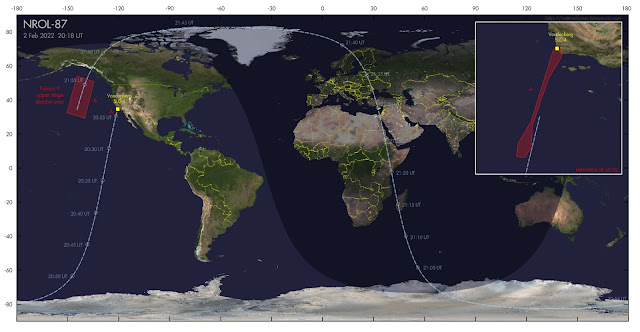
click map to enlarge


If weather cooperates, SpaceX will launch a classified payload for the National Reconnaissance Office (NRO) on 2 February 2022 at 20:18 UT [the launch eventually was at 21:27 UT]. This launch, from Vandenberg SLC-4 in California, is designated NROL-87.

Both (limited) specifications in a published contract for this launch (which states the intended orbital inclination and semi-major axis as respectively 97.4 degrees and 6890.7 km), as well as the position and orientation of hazard zones published in Navigational Warning NAVAREA XII 45/22 point to a launch into a 97.4 degree inclined, Sun-Synchronous Low Earth Orbit at about 512 km orbital altitude.

Analysts suspect the classified payload is one of a new generation of electro-optical IMINT satellites (either the first, or possibly the second, after USA 290/NROL-71, but in the latter case in a clearly different orbit) that is a follow-up to the KH-11 program. The sun-synchronous character of the intended orbit supports interpretation as an IMINT mission.

The image in top of this post gives the launch trajectory. The hazard areas I plotted in the map are from Navigational Warning NAVAREA XII 45/22 and they match a launch into an orbital plane with the quoted orbital inclination of 97.4 degrees:

280731Z JAN 22
NAVAREA XII 45/22(17,18,19).
EASTERN NORTH PACIFIC.
CALIFORNIA.
1. HAZARDOUS OPERATIONS:
   A. 1907Z TO 2138Z DAILY 02 AND 03 FEB
      IN AREA BOUND BY
      34-42N 120-41W, 34-41N 120-32W,
      34-31N 120-26W, 34-18N 120-30W,
      33-40N 120-53W, 32-10N 121-24W,
      31-25N 121-27W, 31-07N 121-40W,
      31-09N 121-55W, 31-35N 121-52W,
      32-17N 121-27W, 34-29N 120-46W.
   B. 2110Z TO 2249Z DAILY 02 AND 03 FEB
      IN AREAS BOUND BY
      54-00N 144-30W, 50-45N 134-30W,
      29-15N 140-00W, 32-30N 150-30W.
2. CANCEL THIS MSG 032349Z FEB 22.


The Falcon 9 upper stage from the launch makes a controlled reentry at the end of the first revolution, in the Northeast Pacific roughly between Alaska and Hawaii (the red box marked "B" in the map above). 

If launch is indeed near 20:18 UT (the launch window of the Navigational Warning runs from 19:07 to 21:38 UT), then the orbital plane launched into results in passes near noon and midnight local time and (if the semi-major axis is correct) a ~5-6 day repeating ground track. A pre-launch estimated elset is here.

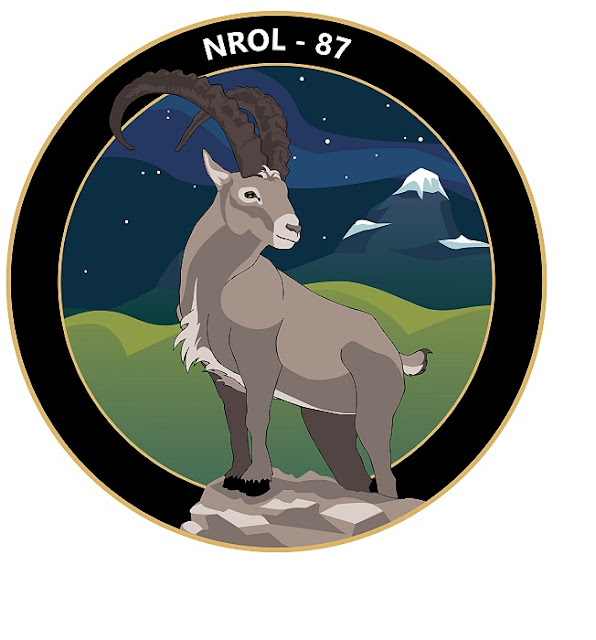
The Launch Patch for NROL-87 shows an Ibex keeping a watchfull eye over its territory:


image: NRO

Tuesday, 15 December 2020

NROL-108: another mystery launch perhaps similar to NROL-76 (USA 276)? [UPDATED]


UPDATE 17 December 2020 16:15 UT:

today's launch was scrubbed due to a pressure anomaly in the upper stage. A new launch attempt will be on December 18th 19th.

UPDATE 20 December 2020 12:20 UT:
NROL-108 launched succesfully on 19 december at 14:00 UT. A fuel dump was observed from New Zealand.


On 17 18 19 December 2020, SpaceX will launch a classified payload for the National Reconnaissance Office (NRO). The launch, from Cape Canaveral platform 39A in Florida, is designated NROL-108. The Navigational Warnings window opens at 13:55 UT and closes at 17:52 UT, pointing to launch somewhere between ~14:00-17:45 UT [edit: the scrub on December 17 suggests a window starting at 14:45 UT and ending at 17:00 UT] . The first stage will attempt to do a RTLS (return-to-launch-site).

NROL-108 is very odd as it was a surprise addition to the launch schedule in early October 2020, seemingly coming out of nowhere. It was originally slated for launch on October 25, but was postponed to December. The character of the mission is a mystery: this looks to be something new again.

The following Navigational Warnings have appeared for the launch hazard areas and the Falcon 9 upper stage deorbit area:

 NAVAREA IV 1201/20
 WESTERN NORTH ATLANTIC.
 FLORIDA.
 1. HAZARDOUS OPERATIONS, ROCKET LAUNCHING
    171355Z TO 171752Z DEC, ALTERNATE
    181355Z TO 181752Z DEC
 IN AREAS BOUND BY:
 A. 28-39-43N 080-38-12W, 29-02-00N 080-15-00W,
    28-57-00N 080-08-00W, 28-40-00N 080-11-00W,
    28-27-00N 080-24-00W, 28-26-52N 080-32-07W.
 B. 30-12-00N 079-06-00W, 30-28-00N 078-56-00W,
    30-54-00N 078-52-00W, 31-14-00N 078-13-00W,
    31-06-00N 077-36-00W, 30-47-00N 077-22-00W,
    30-27-00N 077-26-00W, 30-08-00N 078-20-00W,
    30-03-00N 078-58-00W.
 2. CANCEL THIS MSG 181852Z DEC 20.//


 HYDROPAC 3673/20
 EASTERN PACIFIC.
 DNC 06, DNC 13.
 1. HAZARDOUS OPERATIONS, SPACE DEBRIS
    171508Z TO 171841Z DEC, ALTERNATE
    181508Z TO 181841Z DEC
 IN AREA BOUND BY
    12-27S 135-24W, 11-03S 135-01W,
    04-31N 125-02W, 12-23N 118-23W,
    11-34N 117-22W, 01-11N 123-20W,
    11-32S 132-38W, 13-10S 134-27W.
 2. CANCEL THIS MSG 181941Z DEC 20.//


These hazard areas plotted on a map:

click map to enlarge


The time window for the upper stage deorbit and the fact that the first stage will attempt an RTLS point to a launch into Low Earth Orbit. The launch direction and the location of the Falcon 9 upper stage deorbit area point to a launch into an orbit with an orbital inclination near 52 degrees.

The location of the launch hazard areas is somewhat similar to the launch hazard area for the May 2017 mystery launch of USA 276 (NROL-76). In the map below, the two hazard areas for NROL-108 are in red, while the launch hazard area for NROL-76 (USA 276) from May 2017 is in blue:

click map to enlarge

USA 276/NROL-76 was a mystery NRO launch, like NROL-108 launched by SpaceX, in May 2017, that raised eyebrows because the payload made a series of very close flyby's of the International Space Station a month after launch (see my July 2017 article in The Space Review).

USA 276 went, as subsequent orbital observations of the payload by our amateur network showed, into a ~400 km altitude, 50-degree inclined orbit, so a 50-degree inclined orbit is perhaps also an option for NROL-108.

Such a 50-degrees inclined orbit does not match well with the position of the deorbit zone for the Falcon 9 upper stage. The latter will be deorbitted over the eastern Pacific near the end of the first revolution, the Navigational Warnings show. So for now, the 52-degree inclination (give or take a degree) looks a bit more likely. Still, I do not want to rule out a 50-degree inclined orbit altogether, as the Falcon 9 upper stage might end up in a somewhat different orbit than the payload

In May 2017, USA 276 was launched into an orbital plane very close to that of the ISS, which resulted in the close encounters a month later. 

The launch window for NROL-108 (~14:00-17:50 UT) rules out that NROL-108 will do something similar: the ISS orbital plane does not pass over or near the launch site during this time window. 

It is possible however that NROL-108 aims for an orbital plane near that of USA 276. The orbital plane of USA 276, which due to orbital precession over the past 3 years no longer is close to that of the ISS, passes over Cape Canaveral Launch Pad 39A near 17:02 UT, inside the NROL-108 launch window. This opens up the possibility that NROL-108 is perhaps a close approach target for USA 276, or USA 276 is a close approach target for NROL-108 (but that is pure and wild speculation: Caveat Emptor). [UPDATE: see the update at end of this post. It did not target the USA 276 orbital plane]

It will be interesting to see in which orbit NROL-108 will end up. As I have remarked with some launches earlier  this year, the latest NRO launches all seem to be  'new' kinds of payloads that are likely experimental/Mission demonstrators, and which go into 'new' kinds of orbits: lately we have frequently seen orbital inclinations near 50-degrees and odd orbital altitudes (either very low or very high). NROL-108 will certainly go into a Low Earth Orbit, and it will be interesting to see what the exact launch time will be, whether it will go into a 400 km orbit similar to the orbital altitude of USA 276, and what the eventual orbital inclination will be.


UPDATE 20 December 2020:

NROL-108 launched succesfully at 14:00 UT on December 19th. Slightly over an hour after launch, near 15:15 UT, a fuel dump (following a deorbit burn) from the Falcon 9 upper stage was observed from New Zealand. The facebook-post here shows the classic spiral shape of such a fuel dump. The Youtube video below shot from Pukehina Beach by Astrofarmer shows less detail but includes time details:


Assuming the included times in the video are correct, this allows me to make a new estimate of the orbital altitude in which the satellite was inserted, which is probably ~600 km rather than the ~400 km of my initial estimate, looking at the time the rocket stage passed south of New Zealand:


NROL-108
1 70000U 20999A   20354.58333333  .00000000  00000-0  00000-0 0    04
2 70000 051.9000 194.4979 0003581 047.9699 326.1978 14.88539141    08

The orbital inclination of the satellite is still a bit uncertain but likely ~52 degrees.

The launch time (14:00 UT) excludes that the orbital plane of USA 276 was targetted (the orbital plane of the latter passed over the launch site two hours after launch).


UPDATE 2 (20 Dec 2020):

Radio observers have now catalogued the payload in a 519 x 539 km, 51.35 degree inclined orbit.


Sunday, 1 November 2020

NROL-101: probably a HEO mission [or maybe not! See update at bottom]


click map to enlarge


EDIT 4 Nov 2020 22:30 UT: 

post UPDATED with new maps and new value for inclination parking orbit

EDIT 2, 22:50 UT (Nov 4): the launch has been SCRUBBED for at least 48 hours...

EDIT 3, 7 Nov 22: launch is now currently scheduled for 11 Nov, 22:22 UT 

EDIT 4, Nov 13:  NROL-101 cleared the tower at 22:32 UT (Nov 13)


If weather cooperates,ULA will launch NROL-101, a classified payload for the NRO, on November 11 (postponed from November 3 and 4). Based on Navigational Warnings, the launch window is from 22:00 UT (Nov 11) to 02:45UT (Nov 12), with ULA indicating a launch window start at 22:22 UT. 

[ EDIT: eventually, NROL-101 launched on 13 Nov 2020 at 22:32 UT

The launch is from platform 41 on Cape Canaveral, using an Atlas V rocket in 531 configuration (5-m fairing, 3 strap-on boosters, 1 single engine Centaur upper stage). It would have originally flown in 551 configuration but this was changed. It is the first Atlas V flight to feature the new GEM 63 solid fuel strap-on boosters.

This Navigational Warning has appeared in connection to this launch (updated):


062038Z NOV 20
NAVAREA IV 1074/20(GEN).
WESTERN NORTH ATLANTIC.
FLORIDA.
1. HAZARDOUS OPERATIONS, ROCKET LAUNCHING
   112200Z TO 120245Z NOV, ALTERNATE
   122200Z TO 130245Z AND 132200Z TO 140245Z
   IN AREAS BOUND BY:
   A. 28-38-50N 080-37-34W, 29-58-00N 079-28-00W,
      29-54-00N 079-21-00W, 29-34-00N 079-36-00W,
      29-15-00N 079-45-00W, 28-36-00N 080-23-00W,
      28-30-57N 080-33-15W.
   B. 30-01-00N 079-33-00W, 31-08-00N 078-36-00W,
      30-54-00N 078-14-00W, 29-47-00N 079-11-00W.
   C. 36-38-00N 073-35-00W, 39-03-00N 071-00-00W,
      38-30-00N 070-13-00W, 36-05-00N 072-46-00W.
   D. 51-37-00N 049-45-00W, 53-32-00N 044-58-00W,
      52-54-00N 044-15-00W, 51-03-00N 049-07-00W.
2. CANCEL THIS MSG 140345Z NOV 20.
 

The launch azimuth from the location of the hazard zones in this Navigational Warning and the initial launch azimuth depicted in a map tweeted by ULA point to an initial lauch into a [value updated] ~56-degree ~57.75 degree inclined orbit:


click map to enlarge

However: this is likely only a temporary parking orbit. The 531 rocket configuration has never been used for a launch into LEO so far, but always for launch into GEO. Given the launch azimuth, NROL-101 will certainly not be launched into GEO. 

So either the payload is destined for LEO but unusually heavy or (more likely) the final orbit aimed for is a HEO orbit (also known as a  Molniya orbit) with inclination ~63 degrees, perigee at ~2000 km over the southern hemisphere and apogee near 37 8000 km over the Arctic. [But: see major update at bottom! It might have been MEO rather than HEO, but this remains uncertain!]

A 63-degree inclined Molniya orbit cannot be reached directly from the Cape, because of overflight restrictions. Hence the initial launch azimuth corresponding to a ~58-degree inclined orbit. If NROL-101 goes into a Molniya orbit, it will do a dog-leg some time after launch, or (more likely) coast in a ~58-degree inclined parking orbit for perhaps several hours before being boosted into a Molniya orbit by the Centaur.

This appears to be underlined by the fact that to date (Sunday Nov 1) no Navigational Warnings have been issued for the reentry area of the Centaur upper stage. This could indicate that the upper stage will be left orbiting in a ~2000 x 37 8000 km transfer orbit, or is disposed into a Heliocentric orbit.

The NRO so far launched three kinds of  satellites into HEO orbits:

1) Data communication satellites (SDS);

2) SIGINT satellites (Trumpet FO);

3) combined SIGINT (Trumpet FO) and SBIRS Early warning satellites.

The last SIGINT/SBIRS combination launched into HEO was USA 278, launched in 2017. The last SDS launch into HEO was USA 198 in 2007 (there was also a launch in 2017 but this was into GEO, not HEO). As Ted Molczan pointed out in  a private com, SIGINT launches into HEO usually were done from Vandenberg, SDS launches from Cape Canaveral. So perhaps NROL-101 will carry a new SDS satellite, but this is far from certain. Radio observations after launch might shed some light on both orbit and payload character.

The initial trajectory will take it over NW Europe some 23 minutes after launch, but in Earth shadow, so the pass will not be visible:


click map to enlarge


UPDATE 15 Nov 2020 15:20 UT

Around 2:30 UT on Nov 14, four hours after launch, sightings of a fuel venting event were observed from the western USA.

This image tweeted by  Marc Leatham shows the V-shaped cloud in Saggitarius, imaged from Joshua Tree National Park:


There is also allsky imagery of the fuel cloud from Taos, New Mexico (look low at the horizon where the milky way touches the horizon(right side), for a 'moving' piece of Milky Way. This is the fuel cloud):


These sightings lead us to believe that the payload perhaps went into the lower part of MEO, not HEO. This is however (emphasis) not certain at this moment.

The launch sequence then could have been insertion into a LEO parking orbit; an apogee raising burn; a perigee raising/circularization burn bringing it into HEO; and fuel vent/orbit separation burn by the Centaur rocket. That latter event caused the observed fuel cloud, at about 8500 km altitude.

ULA reported 'mission successful' around 1:48 UT. For the launch provider, their mission is completed upon payload separation. 1.48 UT corresponds to a pass through the southern apex of the orbit, suggesting payload separation was at that point. This, in combinbation with the observed Centaur vent, would argue against insertion into HEO but does fit insertion into MEO.

If my guess is correct, then this should be the approximate orbit (orbital position is the approximate position for the time of the Joshus Tree fuel cloud sighting):


click to enlarge


Both the Centaur and payload have been catalogued (but without orbital elements) by CSpOC, as #46918 (2020-083A) USA 310 and #46919 (2020-083B) Atlas V Centaur R/B.

If USA 310 indeed went into HEO, then the identity/character of the payload remains a big guess.


Added note, 4 Nov 2020, 21:30 UT: the maps and inclination of the initial parking orbit have been updated based on a map showing the initial trajectory up to fairing jettison tweeted by ULA boss Tory Bruno.

This post benefitted from discussions with Cees Bassa, Scott Tilley, Ted Molczan and Bob Christy.

Wednesday, 10 January 2018

What is NROL-47 and in what orbit will it be launched? [updated twice]


UPDATE 10 Jan 17:25 UT: The launch has been scrubbed due to high altitude winds, and moved one day to Jan 11. New start of launch window is given as 1 pm PST = 20:00 21:00 UT. This means the launch window is shifting, indicating a prefered orbital plane and launch probably right at the start of the launch window.

Update 12 Jan: The launch was again scrubbed yesterday, and is now slated for January 12, 21:00 UT . My remark about a  shifting launch window above was in error, I missed that the Maritime Broadcast Warning window opens somewhat before the actual launch window opens.

Final Update , 12 Jan: NROL-47 successfully lifted off from Vandenberg SLC-6  at 22:11 UT!

Final Update 14 Jan 2018: Amateur observers using radio have located NROL-47 in orbit. It is transmitting in the TOPAZ frequency, 2241.52 MHz. The orbit is still very preliminary but appears to point to ~1100 km orbital altitude and an orbital inclination of ~105-106 degrees. This would identify NROL-47 as a new TOPAZ, but in an orbital plane that differs from the previous four TOPAZ satellites. Due to bad weather at the observing sites of several of our active observers (I was clouded out yesterday evening myself for example), optical observations have not yet been reported.


Hot after the excitement and drama of the Zuma launch (see my previous post), a new classified launch is upcoming on Wednesday January 10, when ULA will launch NROL-47, a classified payload for the National Reconnaissance Office (NRO), on a Delta IV from Vandenberg SLC-6 in California.

From Maritime Broadcast Warnings, the launch window opens at 20:30 UT and closes at 01:26 UT. [edit 1] After a one-day delay due to weather conditions, the launch is now slated to be on the 11th of January with the launch window opening 21:00 UT. The shifting launch window time indicates a launch into a preferred orbital plane, and it is likely that launch will be right at the opening of the launch window. [end of edit 1] [edit 2] This launch was scrubbed as well, and launch is now slated for 12 January 21:00 UT [end of edit 2]

The launch is in Westward direction, into retrograde orbit. This has led some space news websites to assume that the NROL-47 payload is the 5th TOPAZ (FIA Radar) satellite.

But is it? I have some doubts.

If it is TOPAZ 5, then it is clearly a deviation from the previous four launches. The launch hazard zones from published Maritime Broadcast Warnings show that the launch azimuth is different - previous TOPAZ missions all launched into azimuth 220 degrees, but NROL-47 launches into azimuth 200 degrees, a 20 degree difference.

NROL-47 Launch hazard areas (red) compared to the areas of four TOPAZ (FIA Radar) launches
click map to enlarge

This can be clearly seen on the map above, where the NROL-47 hazard zones are in red, and the hazard zones from the four TOPAZ in purple, green, light blue and dark blue. The azimuth and locations of the zones from the four TOPAZ launches are all quite similar, but those of NROL-47 stand out as different.

All the four TOPAZ satellites are in a 123.0 degree inclined retrograde orbit. The NROL-47 launch azimuth results in a retrograde orbit too, but with an orbital inclination of 108.6 degrees, not 123.0 degrees: a 14.4 degree difference.

The orbital altitude aimed for appears to be different too. The four TOPAZ satellites are in 1100 x 1110 km orbits. But the location of the Delta IV Upper Stage de-orbit zone (between South Africa and Antarctica), its shape and the opening time of the window (23:23 UT) points to the NROL-47 payload going into a 1500 km altitude orbit instead.[edit: from the first post-launch radio observations (see update in top of this post), the payload actually appears to be in a ~1100 km orbit, similar to previous TOPAZ: but indeed in a different orbital plane than the previous TOPAZ - end of edit]

estimated trajectory of NROL-47
click map to enlarge
So if this is the 5th TOPAZ launching as NROL-47 on Wednesday, then it is going into a quite different orbit compared to the previous four TOPAZ: different in orbital inclination as well as in orbital altitude.

In theory, the Delta IV rocket could do a "dogleg" and (when launching at 20:30 UT) deliver the NROL-47 payload into the 123.0 degree inclined orbit close to the orbital plane of TOPAZ 1 (FIA Radar 1). A second manoeuvre near the south polar pass could then align the RAAN and bring it exactly into the orbital plane of TOPAZ 1.

But why do that, if previous TOPAZ launches simply launched directly into the 123.0 degree inclination orbit?

So in my view, the jury is still out regarding the identity of NROL-47. It could be a 5th TOPAZ but in a quite different orbit compared to the previous four (in itself possible: the Lacrosses also occupied two different orbital inclinations). It could also be something new. If something new, it likely will be a radar satellite (like TOPAZ), given the retrograde character of the orbit. [edit - from radio observations, it appears to be a TOPAZ, but in a different orbital p;lane than the earlier TOPAZ -end of edit]


orbital constellation of TOPAZ 1, 2, 3 and 4 in 123.0 degree inclined orbits
The orbits are spaced 90 degrees in RAAN
click image to enlarge

The deliberate re-entry of the Upper Stage happens 1.5 revolutions (2h 55m) after launch.

Estimated search orbits, based on a 108.6 degree orbital inclination, are here. New elset estimates for the new launch date and time are here. South Africa will have two visible passes after launch.

An UPDATE on this post, with post-launch imagery of the payload in orbit, is here.

Thursday, 10 April 2014

Eagle Eyes

Recently I posted a topic on USA 184, one of the SBIRS-HEO satellites. That post was illustrated with amongst others this patch:

click image to enlarge

A sharp eyed reader, graphic designer and illustrator Olivier Rossel (PXP), noted something odd in the patch. More exactly, in the bothom "beard" of feathers of the Eagle's head.

I had not noted it until Olivier pointed it out (and it is so obvious now!), but letters are spelled out there:

(image courtesy of Olivier Rossel)

You can read the words "GEO", "DSP" and "HEO". These are all relevant to the US Infrared Early Warning system. SBIRS has satellites in two kind of orbits: GEO (geosynchronous) and HEO (Highly Elliptical Orbit - see my earlier post). DSP is the Defense Support Program, the predecessor of the newer SBIRS, consisting of a number of satellites in GEO.

Some Russian guy, Ivan Karavay, identified the words earlier in a post in this forum (in Russian) but I had never seen it until Olivier pointed it out to me.This while I knew words are sometimes hidden in NRO-related patches. Take these patches for example, from the NRO launches NROL-25, NROL-34, NROL-41 and NROL-49:


click images to enlarge

In the "vermicelli" that fills in the Earth in these patches, letters can be discerned that sometimes solve into acronyms: "4 SLS" (4th Space Launch Squadron),  NRO or NROL, and other letter combinations that are less easy to interpret.

Speaking of logo's and patches: I recently re-designed the logo of SatTrackCam. The new design is based on the older design but less cluttered:

click image to enlarge


Like in NRO patches, there is some coded information in this design: the Coat of Arms for example has a double meaning. The (pig-) Latin actually refers to a notorious NRO patch, as well as a famous internet meme.