Showing posts with label IMINT. Show all posts

Wednesday, 15 May 2024

A Russian Optical Reconnaissance satellite launch from Plesetsk upcoming [UPDATED TWICE]

click map to enlarge


(two updates at bottom of post)

Navigational Warnings have appeared that point to a Russian launch from Plesetsk between May 16-26. The direction of launch as indicated by the hazard zones from the Navigational Warnings (see maps above and below), points to launch into a ~97.75 degree inclined Sun-synchronous orbit. This, in turn, points to an IMINT mission, i.e. an optical reconnaissance satellite.

There are two options: another BARS M satellite (BARS M6), or something new. There are indications of the latter. Compared to previous BARS M launches, in addition to hazard zones near the Kola peninsula and Svalbard, there is an extra deorbit zone, in the NE Pacific some 1100 km out of the coast of California. As Bart Hendrickx pointed out, this might indicate the addition of a Fregat upper stage to a Soyuz 2 rocket, something not seen before for launches into SSO from Plesetsk.

Bart Hendrickx thinks it might perhaps concern a launch of three small Razbeg optical reconnaissance satellites.


click map to enlarge


Launch window as indicated by the Navigational Warnings is May 16-26, 20:00-23:00 UTC daily. These are the relevant Navigational Warnings (which are plotted in the maps above):


NAVAREA XX 062/24
BARENTS SEA.
CHART RUS 10100.
1. ROCKET LAUNCHING 2000 TO 2300 UTC
DAILY 16 TO 26 MAY NAVIGATION
PROHIBITED IN TERRITORIAL WATERS
DANGEROUS OUTSIDE IN AREA BOUNDED BY:
70-56-00N 032-04-58E, 70-10-00N 033-40-00E,
69-54-00N 032-40-00E, 70-08-00N 032-04-58E,
70-15-00N 031-50-00E, 70-30-07N 031-50-00E,
70-36-22N 031-43-18E.


111952Z MAY 24
HYDROARC 75/24(42,43).
BARENTS SEA.
SVALBARD.
DNC 22.
1. HAZARDOUS OPERATIONS, SPACE DEBRIS
   2000Z TO 2300Z DAILY 16 THRU 26 MAY
   IN AREA BOUND BY
   76-30.00N 022-00.00E, 75-20.00N 024-40.00E,
   74-50.00N 021-40.00E, 75-50.00N 018-40.00E.
2. CANCEL THIS MSG 270001Z MAY 24.


120900Z MAY 24
NAVAREA XII 330/24(18).
EASTERN NORTH PACIFIC.
1. HAZARDOUS OPERATIONS, SPACE DEBRIS
   2000Z TO 2300Z DAILY 16 THRU 26 MAY
   IN AREA BOUND BY
   29-21.00N 126-46.00W, 29-50.00N 128-52.00W,
   24-22.00N 130-24.00W, 23-53.00N 128-15.00W.
2. CANCEL THIS MSG 270001Z MAY 24.


Assuming an orbital altitude at ~500 km, this is an approximate orbit guess for launch at the start of the window (the orbital inclination could be off by a few tenths of a degree, and orbital altitude is a guess only):

Russian IMINT                  for launch on 16 May 2024 20:00:00 UTC
1 70000U 24999A   24137.83333333  .00000000  00000-0  00000-0 0    09
2 70000 097.7500 232.3966 0010908 075.7763 325.4205 15.22766913    04


UPDATE 1, 17 May 2024:

The launch was at 21:21 UTC (May 16). One single payload (59773, 2024-092A) has so far been catalogued, in a 97.25 degree inclined, 451 x 436 km sun-synchronous orbit. So my pre-launch orbit estimate above was off by 0.5 degrees in inclination and ~50 km in orbital altitude [but: see second update below].

The payload will likely get the designation Kosmos 2576. The orbital altitude is some 53.5 km lower than the typical orbit of a BARS M satellite, indeed suggesting this might be something new. The orbit also doesn't fit well into the existing BARS M constellation


KOSMOS 2576 (yellow) compared to BARS M constellation (white)

UPDATE 2, 19 May 2024:

8 additional objects have now been catalogued (59774 to 59781), making a total of 9. They fall in three/four groups:

GROUP     ORBIT       INC     PERIOD   OBJECTS
I         451 x 435   97.25   93.45    A
II        796 x 780   98.59   100.62   G,H,J
IIIa      552 x 532   97.59   95.52    D,E,F
IIIb      548 x 531   97.59   95.45    B,C

More in a follow-up post, as there might be something more to these orbits....

click to enlarge

Wednesday, 21 September 2022

NROL-91: a new (possibly electro-optical) sister ship of USA 290


click map to enlarge

On 24 September 2022 at 21:53 UT, an ULA Atlas Delta IV Heavy (the last to be launched from Vandenberg) will launch from Vandenberg SFB Launch Complex 6 as NROL-91, carrying a classified payload into Low Earth Orbit for the NRO.

The launch is in southernly direction. The locations of the four hazard areas from the published Navigational Warnings (see map above and text below) are consistent with launch into an orbital inclination of 73.6 degrees, which is similar to NROL-71 from January 2019 that launched USA 290 (2019-004A). 

So the NROL-91 payload likely is a sister ship to USA 290.

Below is Navigational Warning HYDROPAC 2592/22 for the launch (note that there appears to be a clerical error in the first coordinate of area C):

122224Z SEP 22
HYDROPAC 2592/22(GEN).
EASTERN PACIFIC.
CALIFORNIA.
1. HAZARDOUS OPERATIONS:
   A. 242020Z TO 242347Z SEP, ALTERNATE
      2020Z TO 2347Z DAILY 25 THRU 27 SEP
      IN AREA BOUND BY
      33-53.00N 120-23.00W, 34-28.00N 120-40.00W,
      34-39.00N 120-40.00W, 34-39.00N 120-35.00W,
      34-27.00N 120-25.00W, 33-55.00N 120-18.00W.
   B. 242020Z TO 242345Z SEP, ALTERNATE
      2020Z TO 2345Z DAILY 25 THRU 27 SEP
      IN AREA BOUND BY
      25-18.00N 117-07.00W, 25-12.00N 117-27.00W,
      26-35.00N 117-53.00W, 26-41.00N 117-33.00W.
   C. 242020Z TO 242345Z SEP, ALTERNATE
      2020Z TO 2345Z DAILY 25 THRU 27 SEP
      IN AREA BOUND BY
      00-17.00S 121-28.00W, 00-07.00S 110-21.00W,
      03-24.00S 109-33.00W, 03-24.00S 110-21.00W.
   D. 242242Z TO 250133Z SEP, ALTERNATE
      2242Z TO 0133Z DAILY 25 THRU 27 SEP
      IN AREA BOUND BY
      17-57.00N 140-23.00W, 06-13.00N 137-52.00W,
      06-30.00N 136-25.00W, 18-15.00N 138-53.00W.
2. CANCEL THIS MSG 280233Z SEP 22.// 

A second Navigational Warning for this launch, NAVAREA XII 695/22, is identical.

The locations of the first three hazard areas A to C from the Navigational Warning are indeed very similar to those for NROL-71 in 2019: compare for example to this map for NROL-71 from this december 2018 post:


NROL-71 from January 2019. click to enlarge


Area D, the upper stage deorbit area, is situated slightly more south and is a bit more elongated than it was for NROL-71, for unclear reasons. The upper stage deorbit happens at the end of the first revolution. The deorbit burn might be visible from central Asia around 23:10-23:20 UTC.

In 2019, NROL-71 was launched into a 395 x 420 km, 73.6 degree inclined non-sun-synchronous orbit and I expect the orbit of the NROL-91 payload to be very similar.

Here is my pre-launch orbital estimate for the NROL-91 payload based on this assumption:


NROL-91                      for launch on 24 Sep 2022 at 21:53:00 UT
1 70001U 22999A   22267.91180556  .00000000  00000-0  00000-0 0    06
2 70001 073.6000 044.7175 0018421 155.1634 324.7303 15.53162541    00


If NROL-91 indeed launches at 21:53 UT on the 24th, the orbital planes of the payload and USA 290 will end up at a 90-degree angle to each other, as can be seen in the polar view below:

polar view of the orbital plane relative to that of USA 290. Click to enlarge


If the launch is scrubbed on the 24th, and if indeed this specific orbital plane at 90-degree angle to that of USA 290 is aimed for, the launch time will shift ~13 minutes earlier each day.

USA 290 at the time was widely believed to be a new generation electro-optical reconnaissance (IMINT) satellite, a follow-on on the KH-11 ENHANCED CRYSTAL program. That it was launched, as NROL-91 will be, in a non-sun-synchronous orbit is odd though, for an optical reconnaissance satellite. 

One really wonders why the sun-synchronous polar orbit typical for such missions (and typical for earlier generation KH-11 EVOLVED ADVANCED CRYSTAL missions) was dropped in favour of this new 73.6 degree orbital plane. What is the advantage of this new orbital configuration? Or are USA 290 and NROL-91 perhaps not electro-optical systems, but something else?

Wednesday, 20 April 2022

USA 327 / NROL-85


The video above which I shot yesterday evening (19 April 2022) shows USA 327, the NROL-85 payload, passing over my home in Leiden, slightly over two days after it was launched. The footage was shot with a WATEC 902H2 Supreme Low Light Level CCTV camera with a Canon FD 1.8/50 mm lens fitted.

NROL-85 (see two previous posts about this very recent classified launch here and here) has now been catalogued (with orbital elements witheld) by CSpOC as USA 327, catalogue nr 52259, COSPAR ID 2022-040A. Only one object was catalogued, there was no spoof second 'debris' object entered.

As already mentioned in a recent post, the fact that there is no second object is a big surprise. We expected NROL-85 to deliver two payloads, a pair of INTRUDER (also known as NOSS, which stands for Naval Ocean Surveillance System), SIGINT satellites used for geolocating shipping on the High Seas by means of time difference of arrival of their radar/radio emmisions.

Before 2001, NOSS systems existed of three co-orbiting satellites forming a thight triangular formation. From 2001 onwards (with the launch of NOSS 3-1, the first of the Block 3 NOSS-es) , this changed into two co-orbitting satellites.

(the video below, from 30 August 2018, shows a typical NOSS pair, in this case both briefly flaring due to a favourable sun-satellite-observer angle on some reflecting part of the satellites. While operational, NOSS pairs always move this close together. The NOSS pair in question is  NOSS 3-6, the same NOSS pair into which orbital plane the new USA 327 satellite was launched).


And now, we have only one, not two, satellite launched in a NOSS-like orbit. Analysts are scratching their heads over this.

Given the strong similarity in orbit, and the fact that it was launched into the orbital plane of an existing 10-year-old NOSS pair (see previous post), NOSS 3-6 (2012-048A & P), there is clearly some conceptual link of the new satellite to the NOSS program

But in what way exactly? There are a couple of options:

(1) This is a new generation of NOSS/INTRUDER, (i.e. NOSS block 4-1), that needs only one satellite;

(2) This is something else, something new, but related to NOSS/INTRUDER;

(3) This was meant to be NOSS 3-9, a regular NOSS pair, but something went wrong and the second satellite was not deployed;

(4) There is a second satellite but it is small (cubesat) and not yet detected;

(5) The second satellite still has to detach from the first


So let us briefly comment on these various options:

Option (1) apparently, is feasible, according to some. Apparently it is possible to do TDA using just one satellite

With regard to option (2), the most interesting one, one could think of for example an optical or radar counterpart to the existing NOSS 3-6 SIGINT pair: one that images the ships geolocated by NOSS 3-6. This makes sense (and it also makes sense that the new satellite orbits half an orbit apart from the NOSS pair).

While we cannot exclude option (3), I think it is not the most likely option. The same goes for option (5): with previous NOSS launches, two objects were detected right after launch. I have no opinion on option (4).

If we look at the current orbit of USA 327 and the orbit of the NOSS 3-6 pair, we note that: 

(a) they move in almost the same orbital plane; 

(b) they currently are almost exactly half an orbital revolution apart (see illustration below); 

(c) because of the latter difference in Mean Anomaly, their ground tracks are not the same but have some distance between them.


click map to enlarge

Observation (c) does not entirely make sense to me. Wouldn't you want your imaging satellite to follow the same ground track as the geolocating SIGINT satellites? On the other hand: true: the footprints are large enough to cover a large overlap in ocean space from both groundtracks. But still....

Another aspect of this that does not completely make sense to me is that, if USA 327 is a technology demonstrator for a new complementary IMINT mode to the NOSS SIGINT system, then why pick a 10-year-old, nearly retired pair of NOSS satellites to test it with? Why not pick a fresher pair, so you can happily experiment away for the time to come?

But maybe, those fresher pairs of NOSS satellites are deemed more suited for when, after this technology demonstration, the truely operational system is deployed. But then again, why bother with that, just replace the technology demonstrator with the operational version and deorbit the technology demonstrator.

Questions, so many questions, and my still post-COVID impaired brain cannot make much sense of it yet...

It will be interesting to see what USA 327 does (in terms of orbital manoeuvres etcetera) the coming months.

Meanwhile, Radio observer Scott Tilley in Canada has detected the first S-band radio signals from USA 327. He reports "huge fades in signal", which is odd. From Cees Bassa I understand that the frequency in question, 2277.5 MHz, is a know frequency used during the checkout-phase of NOSS 3-x pairs.

Wednesday, 2 February 2022

The upcoming classified NROL-87 launch

click map to enlarge


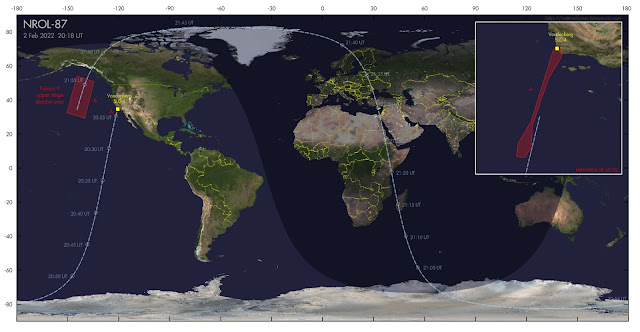
If weather cooperates, SpaceX will launch a classified payload for the National Reconnaissance Office (NRO) on 2 February 2022 at 20:18 UT [the launch eventually was at 21:27 UT]. This launch, from Vandenberg SLC-4 in California, is designated NROL-87.

Both (limited) specifications in a published contract for this launch (which states the intended orbital inclination and semi-major axis as respectively 97.4 degrees and 6890.7 km), as well as the position and orientation of hazard zones published in Navigational Warning NAVAREA XII 45/22 point to a launch into a 97.4 degree inclined, Sun-Synchronous Low Earth Orbit at about 512 km orbital altitude.

Analysts suspect the classified payload is one of a new generation of electro-optical IMINT satellites (either the first, or possibly the second, after USA 290/NROL-71, but in the latter case in a clearly different orbit) that is a follow-up to the KH-11 program. The sun-synchronous character of the intended orbit supports interpretation as an IMINT mission.

The image in top of this post gives the launch trajectory. The hazard areas I plotted in the map are from Navigational Warning NAVAREA XII 45/22 and they match a launch into an orbital plane with the quoted orbital inclination of 97.4 degrees:

280731Z JAN 22
NAVAREA XII 45/22(17,18,19).
EASTERN NORTH PACIFIC.
CALIFORNIA.
1. HAZARDOUS OPERATIONS:
   A. 1907Z TO 2138Z DAILY 02 AND 03 FEB
      IN AREA BOUND BY
      34-42N 120-41W, 34-41N 120-32W,
      34-31N 120-26W, 34-18N 120-30W,
      33-40N 120-53W, 32-10N 121-24W,
      31-25N 121-27W, 31-07N 121-40W,
      31-09N 121-55W, 31-35N 121-52W,
      32-17N 121-27W, 34-29N 120-46W.
   B. 2110Z TO 2249Z DAILY 02 AND 03 FEB
      IN AREAS BOUND BY
      54-00N 144-30W, 50-45N 134-30W,
      29-15N 140-00W, 32-30N 150-30W.
2. CANCEL THIS MSG 032349Z FEB 22.


The Falcon 9 upper stage from the launch makes a controlled reentry at the end of the first revolution, in the Northeast Pacific roughly between Alaska and Hawaii (the red box marked "B" in the map above). 

If launch is indeed near 20:18 UT (the launch window of the Navigational Warning runs from 19:07 to 21:38 UT), then the orbital plane launched into results in passes near noon and midnight local time and (if the semi-major axis is correct) a ~5-6 day repeating ground track. A pre-launch estimated elset is here.

The Launch Patch for NROL-87 shows an Ibex keeping a watchfull eye over its territory:


image: NRO

Tuesday, 26 January 2016

The Parliament Hearing

Last Friday was the MH17 hearing of the committee for Foreign Affairs of Dutch Parliament in the Dutch Parliament building in the Hague. I had been  invited as an external expert to this hearing (see a previous post), with the task to brief the parliament members on what military satellite systems from what countries might have observed the disaster, and could potentially provide useful information with a view on the criminal prosecution of the case.

An audio record of the block of the hearing that featured my presence can be downloaded here (it is in Dutch of course). Related to this, I also appeared on national television that evening (video here and below) in a long item in EénVandaag, a news background program broadcast nationwide at 6 pm. After the hearing, I also did a 20-minute live interview on national radio (audio here, below the video on that page).

It was quite an experience to be in this role, a role which I never had expected to have to play when I wrote my first blogpost on this all. I spent the better part of January doing research into even the most remotely possible questions I could imagine, digging up information, checking and re-checking facts, and writing the position paper.

The full hearing itself took 8 hours (I myself only attended some two hour of these though), and the block that included me took one hour (from 12:00 to 13:00 CET). I shared this block with Paul Riemens, who is the head of Dutch air traffic control; and prof. Piet van Genderen, who is a radar expert from Delft University.

Letter by the Minister

In the evening before the hearing, the Minister of Justice and Security, Van der Steur, had suddenly dispatched a letter to Parliament in answer to questions by Omtzigt , in which he stated that the prosecutor did receive radar and satellite data, and that in their perception there was "no need" for additional requests of those. He also mentioned that the prosecutor had insight in these data "through the MIVD"  (the Dutch Military Intelligence and Security Service) by means of "ambtsberichten" (i.e. brief statements on what the data show, not the data itself). The latter suggested to me, that the data are not declassified, and perhaps will not be declassified. Which is odd and unnecessary, as well as unwise, as I will discuss later in this blogpost.

The timing (combined with the fact that similar earlier questions by MP's Omtzigt and Sjoerdsma got unanswered) suggests that the Minister's letter to Parliament was a direct response to the position papers by Van Genderen and me, so it does seem our input into this discussion had some immediate effect.

Parliament members present

Parliament members attending the block of the hearing which I participated in, were Michiel Servaes (Labour party); Harry van Bommel (Socialist Party); Pieter Omtzigt (Christian Democrats); Louis Bontes (list Bontes/Van Klaveren, a right-wing splinter party split off from Wilders' Party for Freedom); Raymond de Roon (Party for Freedom); Sjoerd Sjoerdsma (Democrats '66); and Han ten Broeke (Party for Freedom and Liberty). Chairman of the hearing was MP Fred Teeven (Party for Freedom and Liberty: who incidentally was State Secretary at the Justice and Security department at the time of the MH17 tragedy), who is vice-chairman of the parliament committee in question.

some of the Parliament members during the hearing:
 f.l.t.r. Ten Broeke, Servaes, van Bommel and Omtzigt

Hearing proceedings and questions

Riemens, Van Genderen and me all three got a few minutes to present our information to the MP's. My main message to the committee was that there are a lot of military systems, from several countries including more than one ally of our country, that might provide useful information. I briefly outlined what kind of systems might provide what information, mentioning SBIRS, but also SIGINT and IMINT.

Next, the parliament members in the committee asked us further questions and clarifications. Servaes asked me which indications I had whether the Dutch prosecutor really needed more satellite data (harking back to the suggestions in the Minister's letter of the previous evening). Related to that, Van Bommel asked me whether my plea for an attempt to get these data and get them declassified was in the interest of transparency, or had some other additional goal. He also asked whether these data might help to further restrict the location from where the missile was fired or not. Ten Broeke asked me (and Van Genderen) for my opinion on the current government position in this.

answering questions

I amongst others answered that I was not a lawyer or attorney, but that it seemed to me that declassifying the evidence was crucial in order to be able to use them for a criminal prosecution, as well as indeed in the general interest of transparency and accountability. There are so many questions around this subject, and so many (conspiracy-) theories and different views (not to speak of desinformation floating around), that the final conclusions should be verifiable to all (after the hearing, I pointed out in the radio interview that it is also very important to the families of the victims to be able to judge these results, something also pointed out in the tv item by a father who lost his son in the tragedy).

In this context I also pointed to remarks made a year ago (17 Dec 2014) by Victoria Nuland, assistant secretary of  European and Eurasian affairs in the US government, and read these out loud to the Parliament members. During a Q & A session at the American Enterprise Institute, Nuland answered questions by a Russian reporter and said that the US government had already shared data with the Netherlands, but moreover that she expected that there:
"..will be, I believe, in the context of the Dutch case, when they roll it out – they are likely to ask us to declassify some of that, and I think we will be able to help in that regard"
In other words: she not only expects a request for declassification from the Dutch government: but she also expects that the US Government will answer positively to that request!

During the hearing, and partly in response to some of the questions,  I warned the parliament members that if these satellite data would not be pursued and a request to declassify them not be made, this could possibly stimulate a lingering feeling that the Dutch prosecution left data unchecked or unreveiled. I told them that if things transpired this way (the wording of the letter by the Minister was not so encouraging in this respect) I feared that this would potentially provide handles to those parties with an interest in denying the conclusions of the investigation, to question these results.

Omtzigt asked me if there were earlier precedents of these kinds of data being declassified. There are: in the hearing I provided the examples of infrared data on meteoric fireballs (which these satellites also register) being released to astronomers for analysis; the declassification of satellite imagery in order to argue the necessity of the invasion of Iraq at the start of the second Gulf War; and China providing satellite imagery of potential floating debris in the case of the search for the missing MH370 aircraft.

Sjoerdsma asked me whether, in case the data would be declassified and supplied, our country had the expertise to independently analyse them and verify the claims made from them. For the infrared data I answered that I am not sure, so could answer neither positively nor negatively. For IMINT and SIGINT, our country certainly has that expertise, both within our own military as well as on Dutch universities.

De Roon wanted me to clarify further which countries had what satellite systems. Bontes asked me whether the fact that we were now so reliant on foreign data from foreign systems, might be an argument to start to build, as a country, surveillance satellite capacity ourselves (I think I am really not the person to answer that question).

During my answering all these questions, van Bommel additionally asked me in what phase of the criminal investigation these data should be made public, and whether it was perhaps too early for that in the current phase.

To the latter I can agree, although (again) I am no lawyer or attorney. But I can understand that perhaps, in this phase of the inquiry, the prosecutors do not want to publicly show their hand of cards.

I do have some concern though, about whether at the end of the trajectory these data are going to be made public, in the interest of verifiability. In my opinion, they should. I find the wording of the letter by the Minister of 21 January 2016 however not very promising in that respect.

The  contributions by the other invited experts contained some significant points. Van Genderen for example made very clear that having the secondary radar data is not enough. He also made very clear that Ukrainian claims that all their radar systems were down for maintenance that day, are hard to believe, as that is against what is normal. Riemens made clear that normally, the air traffic controller on duty will be heard in the investigation (which has not happened in this case) and that radar data normally are available within an hour. Later during the hearing, well-known lawyer Knoops made very clear that without the original raw (radar, satellite) data being available, the prosecution would have no leg to stand on.

Wednesday, 20 January 2016

SIGINT, IMINT and MH17

(this post continues discussions in earlier posts on possible classified space-based observations of the shootdown of Malaysian Airlines flight MH17 over the Ukraine in 2014)

My position paper written for the Dutch Parliament Foreign Affairs committee hearing of Jan 22 (see my previous post) has a strong focus on infra-red detections of a missile by SBIRS. There are however a few other relevant aspects of Space Based observations in connection to the MH17 disaster that I could not cover in the space available to me for that paper.

In this post, I will provide some brief additional information about:

1) potential roles for IMINT satellites;
2) the positions of SIGINT satellites.


Optical and radar IMINT

1. optical IMINT

Both (unclassified) commercial and (classified) military satellite systems for high-resolution optical imagery (Image Intelligence, IMINT) exist, and both sources will be discussed below.

Optical and radar imagery obtained in the hours before, as well as during the event, might be used to look for missile systems, both on the Ukrainian as well as separatist sides of the front, in a wide circle around the site of the shootdown. It could also be used to verify the reconstruction of the purported movements of a Russian BUK system published by citizen journalist team Bellingcat, a study which is not uncontested. The Bellingcat team places the BUK in certain places at certain times, and if space-based imagery (either military or commercial) for those locations and times exist they could perhaps verify these claims.

The US military has one classified system of optical satellites with a (much-) better-than-1-meter capability: the KH-11 IMPROVED CRYSTAL/Evolved Enhanced CRYSTAL (aka 'Keyhole' or 'KENNAN') which reportedly (and theoretically, from known 2.4 meter mirror size specs) have a resolution in the order of  10-20 cm.

Mid-2014 this system consisted of four satellites: USA 161, USA 186, USA 224 and USA 245. All of these have been discussed on this blog before and are tracked by our amateur network.

We have accurate tracking data on three of these, USA 161, USA 224 and USA 245 for the days around 17 July 2014 and hence can pinpoint when these potentially had the crash area in their sight to better than a minute. For USA 186, which was actively manoeuvering around that time and for which we have a gap in our coverage form June to August 2014, pass times are a bit less certain and constrained to about 20-30 minutes accuracy.

First, we can positively affirm that one of the KH-11, USA 161 (2001-044A) actually had the Ukraine in its potential view during the incident at 13:20 UT:


click images to enlarge

Please note well: this does however NOT mean that USA 161 delivered imagery of the event. A number of factors should be taken into account:

1. the cloud cover at that moment, which might hinder imagery;
2. the crash site is located quite in the perifery of the satellites footprint area;
3. these satellites do likely not make images continuously, but only if commanded to do so, for specific areas of interest;
4. there is the question of whether USA 161 was still operational at that time. It was the oldest of the on-orbit KH-11, being launched 14 years earlier. Only a few months later it was de-orbitted, so it was clearly at the end of its lifetime.

In addition to their KH-11 system, the US military hires space on commercial high resolution optical IMINT satellites from the US commercial firm Digitalglobe (the same firm that supplies Google Earth with satellite imagery).  

Digitalglobe operates a number of satellites with a better-than-1-meter capability: Geoeye-1 (0.4 meter resolution), and Worldview 1, 2 and 3 (0.25-0.50 meter resolution). Most of the satellite imagery that the US Department of Defense supplies to the press (when briefing on the military situation in e.g. North Korea, Syria and Libya) comes from these commercial satellites.

Imagery from these same Digitalglobe satellites is also available commercially, to any interested party with money. And in addition to DigitalGlobe, the European company Airbus Defense and Space also offers commercial high-resolution optical imagery from its SPOT and Pléiades satellites. Pléiades 1A and 1B offer a 0.5 meter resolution. SPOT 5 and 6 offer a 2.5-1.5 meter resolution.

Accurate orbital data from non-classified sources are available for all the commercial imagers for 17 July 2014. The satellites in question made several daylight passes over the area in the morning of July 17, 2014, between 8:00 and 10:00 GMT, i.e. during the 3 to 5 hours before the shootdown, a period when the skies were still less clouded.

This does not mean that they necessarily made imagery of course. Yet any imagery these commercial Digitalglobe and Airbus satellites did make on July 16, 17 and 18 have the advantage that they are not "classified", unlike the US military data, meaning that they could be used and published without diplomatic problems by the Dutch government in the Dutch criminal investigation into the disaster.

I would therefore expect the Dutch OM to either buy or subpoena all potential Digitalglobe and Airbus imagery from these dates. They can be used to reconstruct missile system positions in the area (both on the Ukrainian, the separatist and Russian sides) within range of the shootdown location, and they can be used to hunt for missile transports (see my earlier remarks about the Bellingcat claims). The Dutch Air Force has an imagery analysis unit that is well suited to help with such an analysis. Including imagery from the days before and after the incident as well is useful to look for differences between imagery of these respective dates.


2. Radar IMINT

The US military has two systems for high resolution radar IMINT: the Lacrosse (ONYX) system of which currently only one satellite, Lacrosse 5 (2005-016A) is left on-orbit, and the radar component of the Future Imagery Architecture (known as TOPAZ), consisting of three satellites: FIA Radar 1, 2 and 3 (2010-046A, 2012-014A and 2013-072A). These systems should be capable of providing imagery with sub-meter resolutions, and like optical imagery, they can be used to look for the presence of missile systems in the area. They have the added bonus that they are not hampered by cloud cover, unlike optical imagery.

Apart from the USA, the German military also operates a radar satellite system, the SAR-Lupe satellites. The French military likewise operates its own radar satellite system, the Hélios system. Japan operates the IGS system (which includes both optical and radar satellite versions).

All of these satellites made passes over the Ukraine at one time or another on July 17 2014, so all of them might have provided useful imagery.  FIA Radar 3 made a pass right over the area in question near 11:43 UT for example, some 1.5 hours before the tragedy. FIA Radar 2 made a pass over the area at 18:00 UT, 4.5 hours after the shootdown. These are just a few examples.

Given what was happening in the area around this time, and the strong concern of NATO and the EU about this, it is almost certain that imagery of the area was collected by these US, German and French satellite systems.


SIGINT

My position paper briefly mentions that a number of countries have space-based SIGINT (Signals Intelligence) capacities. This does not only concern capacities for (for example) the NSA to tap into your cellphone and satellite telephone conversations: another important strategic aspect of space-based SIGINT is the capacity to detect radar and telemetry signals from enemy weapons systems. Such detections allow identification of the used weapons system (each system has its own 'signature'). They also allow, according to remarks by the then NRO director Bruce Carlson in a speech from September 2010 at the National Space Symposium, geolocation of the source of this radar signal (in the case of MH17: geolocation of the Target Acquisition Radar of the launch unit).

The US military has a number of SIGINT systems in several types of orbits: Low Earth Orbit (LEO) below 1500 km which allows coverage of a few minutes during a pass over a target; and Highly Elliptical Orbit (HEO) and geosynchronous orbit (GEO), which allow to monitor targets for many hours (HEO) to continuously (GEO) from distances of 36 000+ km.

France has a number of SIGINT satellites in LEO. China no doubt has SIGINT satellites too, as does Russia. For the moment I will focus on the US systems. I must ad that I did check the French systems as well but none of the French systems (ESSAIM and Elisa, both in LEO) had sight of the Ukraine at that time.

The US systems, under the catch-all codename ORION, include the TRUMPET-FO which move in HEO. One of them is USA 184, mentioned before in the discussion of SBIRS as it has a piggyback SBIRS capacity in addition to its main SIGINT role.

There are also the big MENTOR satellites in GEO, plus two MERCURY satellites also in GEO, and the older VORTEX system. Of these systems, TRUMPET-FO, MENTOR and MERCURY are certainly still active based on their orbital behaviour.

The map below shows the positions of those satellites in this series for which we have enough tracking data to allow a reconstruction of their positions and footprints on 17 July 2014, 13:20 UT and which had the MH17 crash area within potential view:


click map to enlarge

Again: this does NOT necessarily mean that all of these satellites were actively monitoring the Ukraine at that time. Quite a number of them will have been tasked on the Middle East.

Yet, given the strong NATO interest in events in the Ukraine at that time, notably the rising concern about advanced surface-to-air missile systems following the shootdown of a Ukrainian Antonov-26 a few days earlier, I would be surprised if none of them monitored the Ukraine at all.


A clarification note on the position of USA 184 (SIGINT/SBIRS)

In my position paper written for the Dutch Parliament Foreign Affairs committee meeting coming Friday, I included this map with the positions of three SBIRS satellites with view on the Ukraine at that time:


click map to enlarge

I should point out here that there is some leeway in the exact position of USA 184, depending on whether it made a corrective manoeuvre to maintain its Mean Motion of about 2.00615 revolutions/day or not since the day we last observed it.

If it did, its position would be slightly more westward compared to the position depicted above, i.e. in a position just north of Scotland rather than above the Norwegian coast:


Let me be clear: this does NOT influence the conclusions of my position paper: the MH17 crash site in both variants is well within the field of view as seen from USA 184, i.e. the satellite could potentially provide both Infra-red and SIGINT detections. In the interest of accuracy, I thought I should however mention it here.


Acknowledgement -  I thank Mike McCants (USA) and Ted Molczan (Canada) for discussions about satellite positions, notably concerning USA 184.