Showing posts with label Hwasong. Show all posts

Wednesday, 12 October 2022

The North Korean Medium Range Missile test of October 3rd

click to enlarge

On October 3rd (October 4th local time in Korea) at 22:22 UTC, North Korea launched an MRBM from Mupyong-ri. They fired it over Japan on a normal ballistic trajector, instead of on a highly lofted trajectory, causing consternation and air raid alarms to go off in northern Japan. 

Firing a missile over Japan had not happened since the two Hwasong-12 launches in August and September 2017 (see earlier blog posts here and here). 

Western military sources indicate a range of approximately 4600 km and an apogee at approximately 1000 km. This is at the upper theoretical  limit of the Hwasong-12 MRBM.

Photographs of the launch were released (along with images of several other launches of SRBM and SLBM from the past weeks) by the North Korean State Press Agency KCNA on October 10. The surprise aspect of the images was that it seems to show a missile that is somewhat different in outlook than the Hwasong-12 we know, i.e. something new.

October 3 MRBM launch (image KCNA)

October 3 MRBM in flight (image KCNA)


In the image below, I have put an image from the Hwasong-12 launch from earlier this year, January 29, launched from the same location (Mupyong-ri), next to the October 3 launch. Below it are the outlines of the two missiles as traced from the photographs.


There are subtle differences, as several people (a.o. Nathan Hunt, Ankit Panda and me) have noticed. The missile overall seems similar in length and diameter, but the nosecone with RV  looks different in shape, and the first/second stage might actually be slightly taller than that of a Hwasong-12. And while the Hwasong-12 we know has a flared base of the first stage, the new missile seems to have a beveled base. In-flight images suggest it has one single engine only, whereas the Hwasong-12 we know has four Vernier engines in addition to the main engine, as does the Hwasong-14.

So this looks to be a new missile (or a new version of the Hwasong-12 or Hwasong-14).

The trajectory it has flown is longer than that of the previous two Hwasong-12 launches over Japan in August and September 2017, as can be seen in the image below. This might also point to a new missile, or a clearly improved single-engine version of the Hwasong-12 or Hwasong-14.


click to enlarge


image KCNA


Among the images released by KCNA is one showing Kim Jung Un looking at a computer screen depicting a missile trajectory (see image above). I rectified the map shown on the screen and georeferenced it to an equal-area map (see below), yielding the trajectory below which matches well with a 4500 km trajectory (from the map I measure a range of ~4560 km, but given the error margins in processing this map, that basically is ~4600 km):

click to enlarge


The yellow dashed line (which was added by me as an overlay, as are the country outlines in black and yellow annotation) shows what a real ballistic trajectory would look like.

If the trajectory diagram is to scale hirozontally and vertically, then apogee should have been ~1300 km, slightly more than the ~1000 km quoted from western military sources.

The impact point of the missile is at 34.6 N, 178.3 E, close to the International Date Line. While passing over the Japanese islands, it was at an altitude of about 740-750 km, ascending towards its apogee.

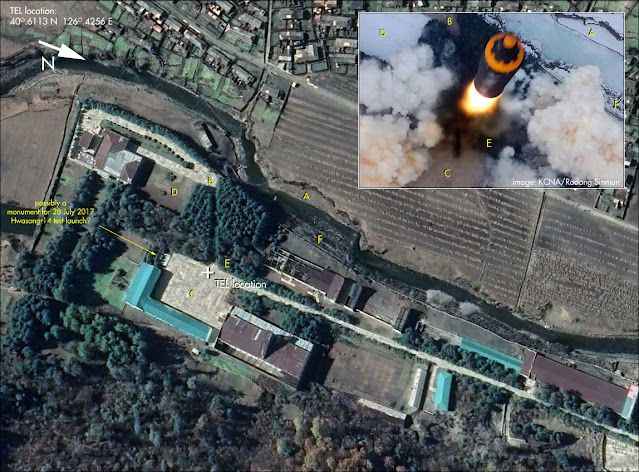
From the launch images, the launch site is the same as that of the January 29 Hwasong-12 launch earlier this year: the Mupyong-ri facility (see earlier blog post here) at 40.6112 N, 126.4257 E. The treeline and pavement, and small side road, is very recognizable. The same location also saw the first successful Hwasong-14 launch on 28 July 2017 (the Hwasong-14 is a two-stage version of the Hwasong-12). If the October 3rd launch indeed is a new missile, as it looks to be, then this facility has now seen launches of three different MRBM's: Hwasong-12, Hwasong-14 and this new missile.

Friday, 25 March 2022

North Korea's Hwasong-17 ICBM: capable of (briefly) bringing warheads into orbit?

image: KCNA/RodongSinmun

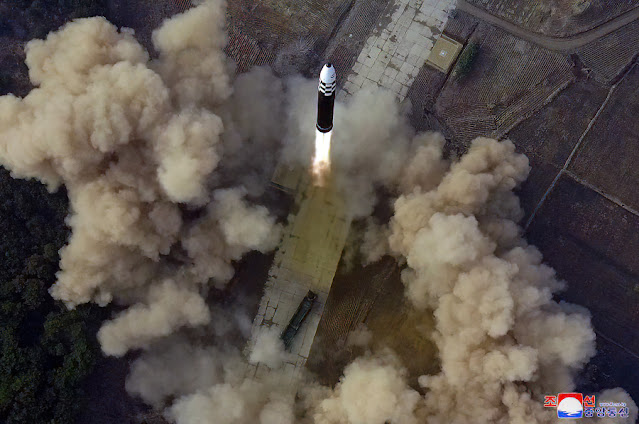
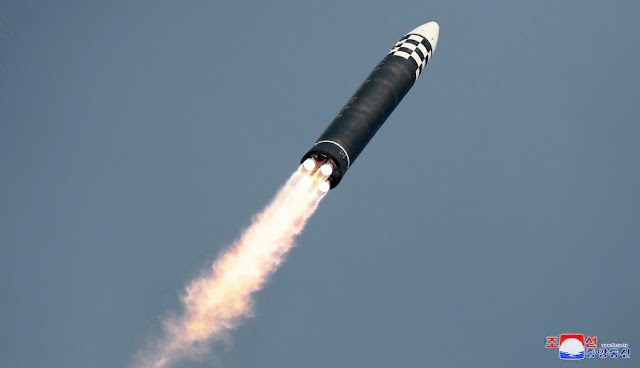
According to multiple western sources and North Korea, North Korea conducted a first full-power test-flight of its new Hwasong-17 ICBM on March 24, 2022, at 5:34 UT, from Sunan close to Pyongyang.

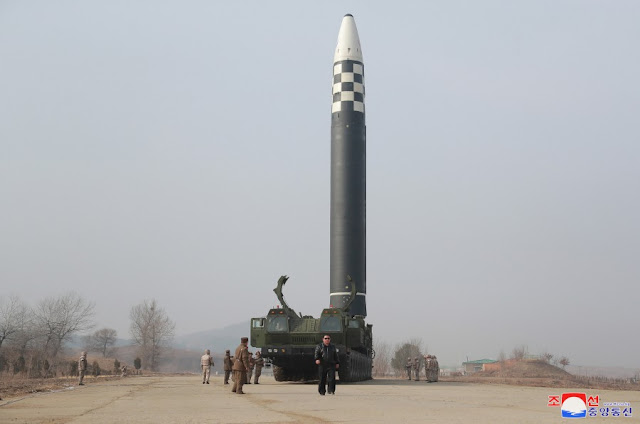
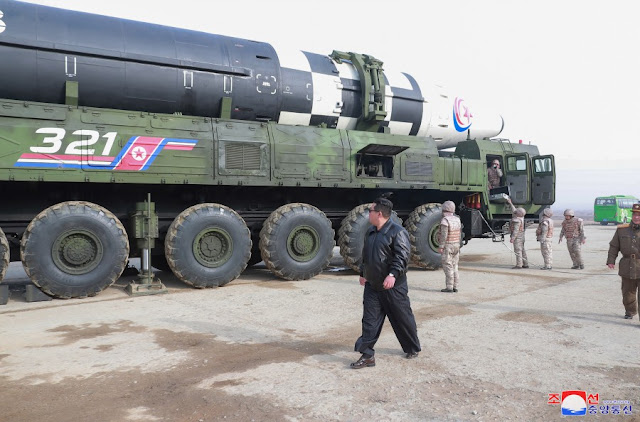
The Hwasong-17 is the Behemoth missile that was first revealed to the outside world one-and-a-half-years-ago during the 2020 October 10 parade in Pyongyang and surprised everyone by its massive size at the time. It is North-Korea's largest, heaviest missile so far and visually looks like a Hwasong-15 on steroids.

[NOTE: some sources are now casting some doubt on the missile identity, suggesting that footage from the failed March 16 launch (see below) was used. See comment at end of post]

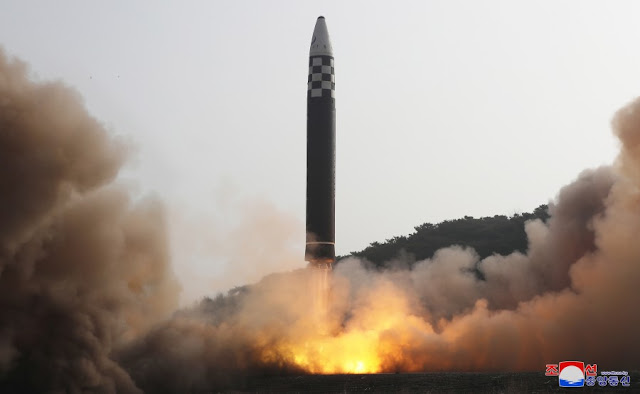
The test launch was confirmed by North Korean State sources which produced a written account on their KCNA and Rodong Sinmun websites, accompanied by photographs, while KCNA also broadcast a video of the test. The imagery underlines how impressive the size of the Hwasong-17 is: it is a Monster of a missile!
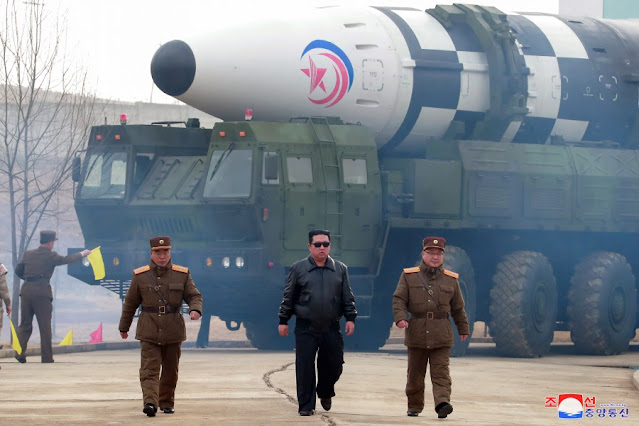
 

image KCNA/Rodong Sinmun

 
image KCNA/Rodong Sinmun


image KCNA/Rodong Sinmun

The video report on the test as broadcast by the North Korean State Agency KCNA is spectacular, with a glamour role for the sunglasses-clad North Korean leader Kim Jung Un (look at 3:55 to 4:05 in the video below!). It evokes shades of a Hollywood action movie trailer. 

(the actual footage of the test and test preparations starts at 3:25 in the video, after the usual bombastic introductions by news anchor Ri Chun-hee)


Earlier test flights of components of the same missile might have taken place in Februari and early March (but not on full power), according to western sources. North Korea claimed at the time that it was testing components for a reconnaisance satellite program. 

We also know that on March 16, another test flight from the same launch-site (near Sunan Airport), possibly also a Hwasong-17, failed shortly after launch at an altitude of less than 20 km.

But the March 24 test flight appears to have been successfull, as claimed by both North Korea and western sources. According to North Korean official State sources it reached an apogee at a whopping 6248.5 km altitude, with a ground range of 1090 km and a flight time of long duration (1h 7m 30s).

Western sources that independently tracked the launch mention similar ballpark values for this test: apogee "6200 km" and range "1080 km" according to the S-Korea Joint Chiefs of Staff; apogee "6000 km" and range "1100 km" according to the Japanese Government. The missile came down in front of the Japanese coast inside Japan's EEZ, at some 180 km from Cape Tappi. 

The apogee is at an extreme altitude, and this test was hence extremely lofted, as can be seen in this trajectory reconstruction I made:


click to enlarge

Looking into the necessary impulse in order to assess maximum range of the missile, I realized that the resulting nominal impulse of 7.85 km/s I reconstruct, actually means that the Hwasong-17 can achieve orbital speed. In other words: this means it is powerfull enough to, in principle, loft a payload to (low) earth orbit and get it (briefly) orbital!

Objects can complete at least one revolution around the earth if they have enough orbital velocity such that they can orbit at at least 100 km altitude (the exact value of the lower limit of orbital flight is debated: for circular orbits it might be possible at altitudes as low as 80-90 km, but it anyway strongly hinges on the drag characteristics of the object in question). The corresponding orbital speed at 100 km altitude is 7.84 km/s (for a circular orbit). The nominal impulse I get for the March 24 launch, at 7.85 km/s, matches that (in reality, it is more complex, as the missile will experience atmospheric drag during the initial phase of launch, which was not part of my reconstruction. And part of the initial impulse will be lost due to gravity pull before reaching 100 km altitude).

So in theory, this missile could briefly get an object (e.g. a warhead) in orbit around the earth, rather than on a suborbital ballistic trajectory. In case you wonder: it didn't on March 24, because it was not launched on an orbit insertion trajectory, but rather straight up.


image: KCNA/RodongSinmun

image: KCNA/Rodong Sinmun

image: KCNA/Rodong Sinmun


This was not something I had expected. But it gives a new meaning to North Korean claims from earlier this year that tests conducted then, possibly with Hwasong-17 components, where in connection to a space launch program.

They did fairly and squarely present the latest March 24 test as an ICBM  test flight though.

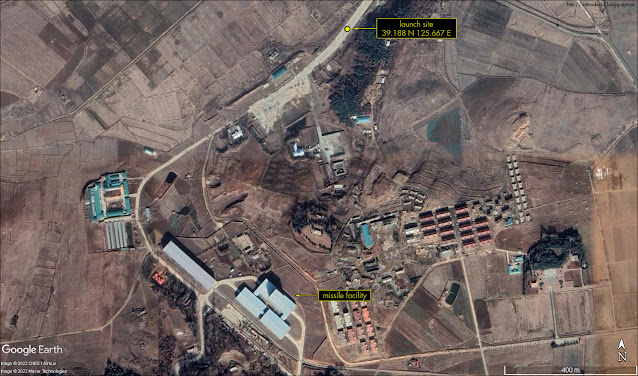
The launch location at 39.188 N, 125.667 E (as geolocated from the imagery by Joseph Dempsey) was on a concrete strip about 1.75 km from the main buildings of Pyongyang Sunan airport. That concrete strip is part of the Si-Li Ballistic Missile Support Facility which itself is some 2.5 km southwest of the airport:
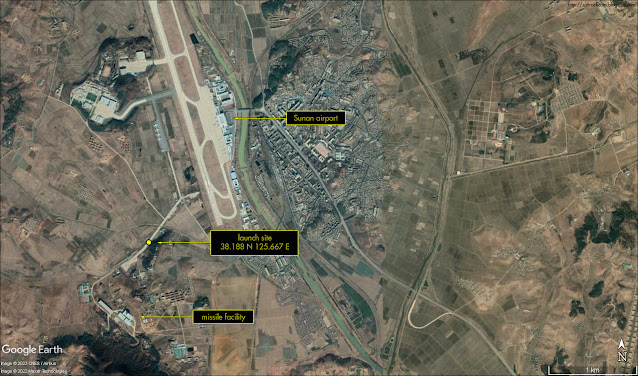
click map to enlarge

click map to enlarge

But let's get back to the realization that this missile can apparently reach orbital speeds. This means that it - or components of it - in theory can be used for road mobile satellite launches. But it can also mean that you can briefly bring a warhead in orbit, either for a full revolution or more, or - cough - for a "fractional" orbit....

Remember the discussion of the Chinese test of a FOBS ('Fractional Orbital Bombardment System') in July last year?! See this earlier post.

I have been doing some modelling. Based on specs of an early '60-era US warhead, the W56, I modelled whether a launch of a similar warhead into a very low 100 x 105 km, 98.0 degree inclined polar orbit from Sunan, could reach the USA. 

I used the General Mission Analysis Tool for this, with the MISE90 model atmosphere and F10.7 solar flux set at 100. I modelled for a 275 kg warhead with assumed Cd 1.0 and a drag surface of ~0.15 m2 (comments on how realistic those values are, are welcome) and under the assumption that the launch vehicle does achive sufficient orbital speed to insert it in such a 100 x 105 km orbit. The modelled launch was in southern direction, taking the long but undefended southern Polar route over Antarctica, approaching the USA from the south after finishing just over half an orbital revolution. [info added later: The model is strictly for the warhead assuming release from the missile upon orbit insertion: I did not model prolonged coasting as part of a post-boost vehicle of any kind].

With the mentioned specifications, I model it to nominally come down fairly and squarely in Ohio (or any other place within the continental USA if you adjust the orbital plane launched into somewhat), as the map below in which I have plotted the modelled trajectory for the warhead shows....

click map to enlarge
 

So: is the development of this missile perhaps a prelude to the development of a North Korean FOBS? With a suitable warhead, it appears they could do it with this missile.

Incidentally: the flight-time of the March 24 test was similar to the on-orbit flight time needed to get from Sunan to the United States via the southern polar route. But that is likely coincidence.

Leaving FOBS aside for the moment: at any rate a missile with this power launched on a more conventional ballistic trajectory can easily reach any location within the continental United States, as well as Europe and the Pacific (but would need a working reentry vehicle of course, which is another matter). In addition to that, it means that North Korea now in theory also has a potential road-mobile reconnaisance satellite launcher in their arsenal.
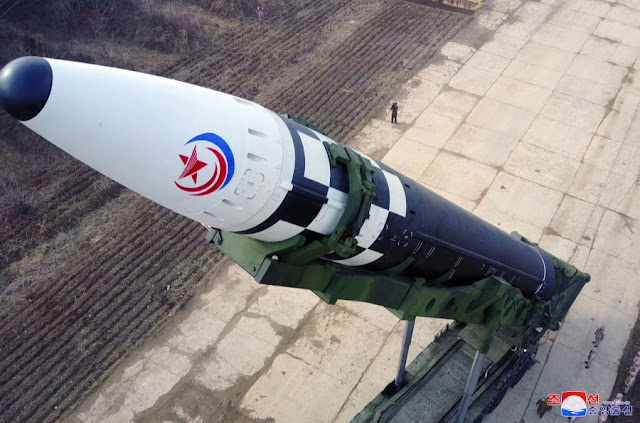
 

image: KCNA/Rodong Sinmun

image: KCNA/Rodong Sinmun

image: KCNA/Rodong Sinmun


image: KCNA/Rodong Sinmun


Added note: some sources are now casting some doubt on the missile identity, suggesting (with arguments from image analysis) that footage from the failed March 16 launch was perhaps presented by North Korea as being from the March 24 launch. The added suggestion is that the March 24 test missile might have been a Hwasong-15, not a Hwasong-17 as North Korea is claiming.

These objections are interesting, but multiple scenario's are possible. For example, they might have used footage from both test launches, certainly if iconic scripted propaganda scenes (e.g. KJU marching in front of the TEL leading his Rocket men) were shot during the preparations for the failed March 16 test. North Korea has been known to have doctored launch imagery for aesthetic/propaganda purposes before in the past, as I have shown for the historic first Hwasong-15 launch of 28 November 2017.

Whatever missile it really was: the missile performance shown by this test is remarkable and well beyond that of earlier North Korean ICBM launches. Western tracking of the missile test confirms the performance, so it is not just North Korean propaganda that can easily be waved away. This is a significant development, no matter how you look at it.

Wednesday, 2 February 2022

The North Korean Hwasong-12 test of 29 January 2022

click to enlarge
 

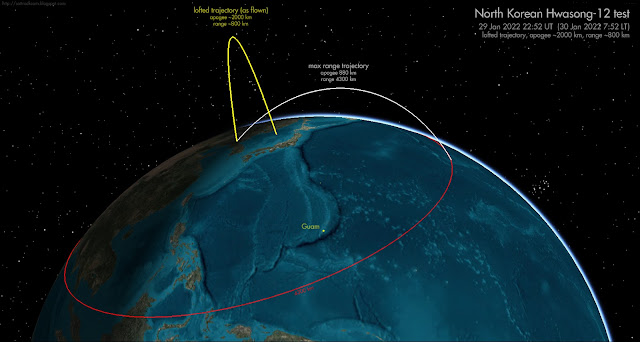
On 29 January 2022 at 22:52 UT (30 January 2022, 7:52 local time in North Korea), North Korea test-fired a Hwasong-12 IRBM. The missile impact point was in the Sea of Japan. According to western sources, it had as flight time of ~30 minutes with a range of ~800 km and an apogee of ~2000 km (the yellow trajectory in the reconstruction above). In other words, a highly lofted trajectory, such as we have seen earlier during various 2017 North Korean missile tests. 

Such a lofted trajectory can be chosen for two reasons: to avoid overflying other countries (Japan) and/or to be able to monitor most of the flight from North Korea itself.

Going from the reporteded apogee altitude and range (~2000 km and ~800 km), I find that this same missile would have an implicated maximum range of ~4300 km (white line in reconstruction above, and red circle) when launched on a more normal, more depressed ballistic trajectory. 

This fits with results for earlier Hwasong-12 lofted test flights, such as the 13 May 2017 test, and is slightly more than the more depressed Hwasong-12 test firings over Japan of 29 August 2017 (which as I have pointed out partly failed but was intended to fly ~3300 km) and 14 september 2017 (which flew ~3700 km).


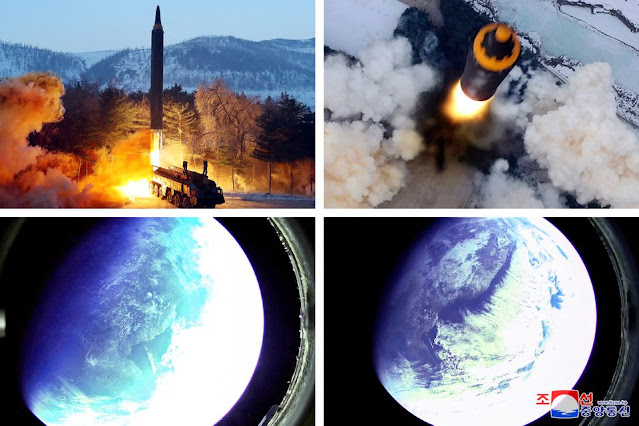
images: KCNA/Rodong Sinmun


Images of the launch published by the North Korean Government in Rodong Sinmun (above) include two images of the earth reportedly made from the missile, showing the Korean peninsula.

From the two published launch pictures, the launch location of the missile was geolocated by Joseph Dempsey to a spot near Mupyong-ri at 40.6112 N, 126.4257 E. In the image below I match particular terrain details in the drone launch image released by North Korea to a Google Earth image of that particular spot. Which is a familiar spot by the way: it is the same courtyard where on 28 July 2017 the first successful launch of a Hwasong-14 ICBM was carried out (at that time the courtyard was still grass covered: in the meantime it has been paved). On recent Google Earth imagery, what I think could very well be a monument built to commemorate the 2017 launch is visible near the southern courtyard perimeter (we know the North Korean's built commemorative monuments on other test launch sites). I have indicated it in the image below.


click to enlarge

The text of the post-launch North-Korean Government announcement in Rodong Sinmun of 31 January 2022 is interesting. It claims that the  "test-fire was aimed to selectively evaluate the missile being produced and deployed and to verify the overall accuracy of the weapon system". 

As Ankit Panda has pointed out, this probably indicates that this was not a test of a new improved Hwasong-12 variant: but rather a test launch to demonstrate the readiness of a deployed system of production grade missiles (similar to frequent test launches of Minuteman ICBM's and Trident-II SLBM's by the USA). We might therefore see more of such periodical launches in the future.

This was the 7th launch of a Hwasong-12, and the first launch of this type since 15 September 2017.

Monday, 12 October 2020

North Korea's October ICBM surprise

click to enlarge. Screenshot from KCTV broadcast

Saturday 10 October 2020 saw North Korea's big military parade in PyongYang, connected to the 75th anniversary of the founding of the Workers Party of Korea. A nighttime parade this time, unlike previous years.

Those who follow the North Korean rocket and missile program always eagerly await these parades, as sometimes new missiles are presented. They were not disappointed this year.

The most interesting new missiles presented were a new version of the Pukkuksong SLBM and, at the very end of the parade, a surprise appearance of four immense 11-axle TEL's, each carrying a very large missile that appears to be a new Hwasong ICBM variant (see images above and below).


click to enlarge. Screenshot from KCTV broadcast
 

This missile at first sight looks like a larger variant of the flight-proven Hwasong 15 from 2017 (several of which were also shown in the parade). Below is my attempt at getting dimensions for this potential new ICBM:


click to enlarge

First, some caveats with this dimensional analysis:

* I had to work from a limited resolution screenshot I took from the KCTV broadcast;

* The baseline used is based on a Google Earth measurement;

* The image is wide angle and has some barrel distortion. This means that the straight sightlines I have drawn, are an approximation.

All these points will cause uncertainties in the measurements, so don't take them too strictly. Behind the decimal, they are probably no more accurate than to 0.2 meter or perhaps even worse.

The dimensional baseline I used is the distance from the stair entrance at left to the center of the area between the grass borders. The platform with stairs is visible on a Google Earth image, and I measure a distance of ~26.25 meter to the square center line, which is used as the base referal length here (please note: I assumed the two patches of grass are at equal distance to this centerline. Similar for the area with the orchestra at the other side of the road).

In this way, I get the following approximate dimensions:

* 25.6 meter for the total missile length (not counting nozzle);

* 2.7 to 2.8 meter for the first stage diameter;

* 2.3 meter for the base diameter of the nose fairing/Post Boost Vehicle;

* 30.5 meter for the TEL, from front bumper to the feet of the firing table;

* 16.9 meter for the first stage length (assuming it ends at the chequer-pattern);

* 4.5 meter for the second stage length.

As Jeffrey Lewis noted, the second stage appears to be slightly tapered in shape.

By comparison: the Hwasong 15 (test flown in 2017) measures 21.5 meter in length (not counting the exhaust nozzle) and is about 2.4 meter in diameter. 

Hence, this new Hwasong variant appears to be a factor of 1.2 larger in both length and diameter compared to the Hwasong 15. Several commenters have pointed out that this makes it the largest road-mobile ICBM ever.

As is usual, discussion has emerged whether this is a real missile, or just a fancy mock-up. There is still too much of a tendency, especially among an American audience, to regard North Korean missiles as all 'smoke and mirrors'. Given North Korea's 2017 track record with succesful Hwasong 12 IRBM and Hwasong 15 ICBM test flights, I do not think that the default reaction should be that this new missile must be a deception. Of course, we will only know for sure when we see it launched.

It will be interesting to see if, and if so when, this large missile is test-flown.

Thursday, 1 March 2018

On PBS Newshour, about Open Source investigation of the North Korean missile program


In December of 2017, I was interviewed by Miles O'Brien for PBS Newshour, about Open Source investigation into the North Korean missile program.

The item aired on 28 February 2018. It is 9 minutes in duration and alternatingly features Jeffrey Lewis of the Middlebury Institute and me showing what we can learn from analysing DPRK propaganda photographs and video imagery.

(the video above starts at the start of the item).

Monday, 2 October 2017

The North Korean Hwasong-12 test of 14 September: georeferencing Kim Jong Un's map

(This post has been a while in the making. Due to various reasons, including the 21 Sept fireball, I did not come to write it up on this blog until now. The same analysis however was earlier presented as a Twitter-thread, on 23 September)

"I love the smell of UDMH in the morning..." (photo: KCNA)

Over the past months, I have spent a number of posts on North Korea's recent increasingly bold missile tests. The latest of these tests happened on September 14 (local September 15 in North Korea). At 21:57 UT that day, North Korea launched a Hwasong-12 IRBM from Pyongyang Sunan airfield towards the east-northeast. It crossed over Japan (causing air-raid alarms to go off) with, according to western military sources, a range of ~3700 km and apogee at 770 km, before impacting in the Pacific Ocean. The test was the second one to launch the Hwasong in a 'regular' rather than 'lofted' trajectory, over Japan.

I was abroad at the time of the test,  meaning it was several days before I could look at this test and start an analysis. Some results were earlier presented on 23 September as a Twitter-thread.

photo: KCNA

As part of the propaganda photographs published by KCNA following the test, there was (just like after the test of 29 August) a picture of Kim Jong Un sitting behind a desk, with a map in front of him. As was the case for August 29, the map shows a missile trajectory, presumably the trajectory aimed for in this test:

photo: KCNA

I obtained a high resolution version of this photograph for analysis with the much appreciated help of Ankit Panda. First, I roughly squared this image using the skew-tools in Photoshop:


Next, I georeferenced this image against an actual map using QGIS. The resulting map is the one below (the map projection I have used is a Lambert azimuthal equal area projection centered on Sunan. The grid is WGS84). :


click map to enlarge

The result of this georefencing is that the drawn trajectory starting at Sunan ends at approximately 39.60 N, 168.05 E. The range from Sunan to this impact location is 3615 km.

Note that I have added, in yellow, country outlines to the map to show the validity of the georeferencing. I also added a few annotations. I have added an STK-modelled ballistic trajectory to the map as a dashed red line: it is highly similar to the original trajectory line drawn on the map, as you can see, with apogee position corresponding to what appears to be a text in red on the map: what was depicted on Kim Jong Un's map hence appears to be a real ballistic trajectory.

The resulting range of 3615 km is close enough to the range reported by Western military sources (about 3700 km) to conclude that the 14 September test went much as intended.

This is a difference with the 29 August test. In that case, the map showed a ~3300 km range while western military sources said the actual range flown was ~2700 km: it also flew more north than the trajectory that was depicted on the 29 August map. See my earlier blog post here. The match for the 14 September test might indicate that the 29 August test perhaps did not go as intended.

The map below shows both trajectories: that of 29 August as depicted on Kim Jong Un's map (i.e. not the actually flown trajectory!), and that of 14 September as depicted on Kim Jong Un's map:

click map to enlarge (map by author)

It is interesting to look at the range distances for both tests. The range distances of 3316 km and 3615 km ring a bell. The distance from Pyongyang Sunan (the launch location) to Henderson AFB on Guam is ~3415 km. The August 29 map trajectory falls almost exactly 100 km short of that range, while the September 14 trajectory almost exactly 200 km overshoots this range.

I am going back-and-forth on whether this is significant or not. I tend to think that all these kind of map images released are intentional propaganda meant to convey a message: the map is meant to be analysed and "read" by the West.

As an illustration of how it potentially could be read: would we change the launch directions so that they would be towards Guam, then this (the two black crosses) would be the result in terms of the pattern of impact locations relative to Guam:

Remember that North Korea has "threathened" to conduct a quadruple demonstration with four missiles impacting in international waters in an 'envelope' around Guam, if the Trump administration does not stop B1 bomber demonstration flights from Guam. Do we see some kind of test mock enactment for this here? Is the message: "We are already practising for this, imperialist barking dottard dog!".

It would become very interesting if North Korea were to launche two other missiles the coming month, and the pattern where they (were implied to) land relative to the earlier two tests might be very interesting.

photo: KCNA
(I thank Ankit Panda for his help with obtaining a high resolution version of the photograph with Kim Jong Un and the map)

Friday, 1 September 2017

The other subliminal message in Kim Jong Un's missile test map

image: KCNA
The image above (from North Korea's KCNA) shows the North Korean leader Kim Jong Un and a map. It was likely taken on the day of the 29 August missile test that shot a Hwasong-12 MRBM over Japan, into the Pacific Ocean. I analyzed this map and what it shows in detail in my previous post, showing that the trajectory which seems to be sketched on the map deviates from the real missile flight path.

But there is more to this map, it turns out after further analysis. There are not one, but two subliminal messages contained in this map.

The first subliminal message, already discussed at the end of my previous post, is that it depicts a 3300 km trajectory (the real flight trajectory appears to have been shorter, 2700 km). This is the approximate distance to Guam.

But there is a second subliminal message. The map also contains a veiled threath to Hawaii.


click to enlarge

As can be seen in the annotated georeferenced version of the map image above (see also my previous post), the trajectory skeched on the map (white) is very close in direction to what a trajectory towards Hawaii would be.

In the map above, there are two lines representing such a trajectory targetting Hawaii:

- The green dashed line shows what a real, 7400 km range trajectory towards Pearl Harbour would be (this takes earth curvature and earth rotation into account);

- The yellow dashed line shows what the trajectory is if launched into the same azimuth as for  targetting Pearl Harbour, but with a shorter 3300 km range, as on the map in front of Kim Jong Un.

The latter yellow line obviously is very close to what is sketched on Kim Jong Un's map. In fact, I think that within the error margins of my georeferencing effort, they might well be the same.

The white line, my best effort to represent the trajectory sketched on the map, would be a missile launched into azimuth ~77.25 degrees. The dashed yellow and green lines, are both for missiles fired into azimuth ~76.9 degrees. 76.9 and 77.25 degrees are very close, a difference of only ~0.35 degrees.

To clarify further what the map depicts: the reason that, even though the launch azimuth is the same, the green and yellow lines do not overlap is because of earth rotation and earth curvature. Firing a missile into the same azimuth (~76.9 degrees) from Pyongyang Sunan, yields a slightly more southern trajectory if the range of the missile is ~3300 km (as on Kim Jong Un's map) instead of ~7400 km (the distance to Pearl Harbour). This is because a flight to Pearl Harbour takes longer in time, and the earth surface is meanwhile rotating under the flight path.

So the trajectory sketched on the map contains two subliminal messages: the length (~3300 km) is roughly the distance to Guam. The launch direction is the launch direction towards Pearl Harbour. Two veiled threaths in one. No wonder Kim Jong Un smiles so exuberantly: "Riddle this, you Imperialist agressor Puppets!".

I firmly believe that the North Korean propaganda machine deliberately includes these images into what it makes public. When they show a map or monitor with a trajectory, however oblique and vague, it is not unintentional but (I firmly believe) intentional.

(this post is a follow-on to my earlier analysis here)

Thursday, 31 August 2017

North Korea's 29 August Hwasong-12 test with Japan fly-over: did it go as planned?

image: KCNA
It are hectic times for those (like this author) interested in the North Korean rocketry program. The past months have seen a steady series of increasingly bold missile tests (along with a threath of test-firing missiles towards Guam), that have been the subject of three earlier posts on this blog the past months.

And now a new one has occurred, and it is perhaps the boldest of these test flights so far. Last Thursday, 29 August 2017, at 20:57 UT, North Korea launched a Hwasong-12 MRBM on a trajectory over Japan: a politically bold move that caused air-raid sirens to go off in Northern Japan.

images: KCNA

Western military sources say that the missile was fired from Pyongyang Sunan airfield. It reportedly travelled 2700 km, crossing over Hokkaido, coming down in the Pacific Ocean about 1180 km from Cape Erimo in southeast Hokkaido, Japan. Apogee of the trajectory is quoted as 550 km.

This allows us to produce the trajectory reconstruction below (with some leeway as the quoted ranges are probably balpark figures). It shows that the missile crossed Japan over the southern tip of Hokkaido, a trajectory that seems designed to minimize Japanese landmass overflown, mitigating risk levels. The two red circles on the second map are depicting a 2700 km range around Pyongyang Sunan and 1180 km range around Cape Erimo. Where they are closest, is the resulting impact point (near 41.92 N, 157.56 E). Using STK I get a flight-time of ~14 minutes.

click to enlarge

click to enlarge
That odd-looking second of the two maps above is based on an interesting photograph published by the North Korean State News Agency KCNA. It shows an exuberant Kim Jong Un sitting on a desk with a map in front of him:
image: KCNA

We have recently seen more of this kind of shots from KCNA published after previous tests, and they often yield interesting information. In this case, the interesting detail is that a trajectory appears to be depicted on the map, as a thin line (the arc above it ending at the same point likely is a 3D representation):


If the sketched line indeed is the intended trajectory, then the interesting point of it is that it does not match the observed trajectory according to Western military sources.

I used my GIS skills to georeference the map on the image (with QGIS). Like in the case of the 'Guam map', the low resolution of the image and very oblique angle of te map on it make this a challenge, and the georeferencing obviously is not perfect - but good enough for some conclusions. This is the result (look for the vague line that possibly represents a trajectory on the image):

click to enlarge
Here is the same map but with annotations added, and with the trajectory sketched on the map (white line) and the actual observed trajectory (black dashed line):

click to enlarge

It is immediately obvious that the two trajectories do not match well. The trajectory (if it is one) sketched on the Kim Jong Un map is located more to the south, and indicates a larger range, about 3300 km (interestingly, it does conform to a real ballistic trajectory with earth rotation and curvature taken into account, unlike the straight line drawn on the infamous "Guam map").

(the second map shows exactly the same map area, but with a DEM and country shapefile as background. It shows you how the topography matches that on the georectified map from the photograph)

The difference between the two trajectories amounts to a range difference of 600 km and a 45 km difference in apogee. It represents a difference in launch azimuth of 6 degrees and of 3.7 degrees in launch elevation. It points to an underperformance of around 0.4 km/s in the missile's burnout speed.

click to enlarge
It is interesting to note that while North Korea for some previous tests (and their proposed Guam shot) published very accurate figures for range, flight time and apogee, they did not do that this time. It is also interesting to note that some Western military sources report that the missile "broke into three pieces".

So there are multiple indications that the test did perhaps not go entirely as planned, with an underperformance of the rocket engine and an error in launch direction, and perhaps structural failure. This would imply that the targetting of the Hwasong-12 is not quite fail-safe yet, which has implications for Kim Jong Un's proposed Guam enveloping missile demonstration.

This was the first test of the Hwasong-12 on a "normal" trajectory and it shows why it is important for North Korea to test its missiles on such a normal operational, rather than a 'lofted' trajectory: it is a different regime of stress on the missile and has the engines perform under more realistic conditions than on a 'lofted' trajectory. Errors in targetting and missile performance become more apparent.

For North Korea to do such tests on a "normal" trajectory for its MRBM's and ICBM's, they have to fly it over Japan. We are going to see more of this kind of tests the coming months is my prediction.


Update 31 Aug 2017:

(1) The 38 North blog has an interesting post suggesting the possible failure of a post-boost vehicle.
(2) South Korean and US military analysts appear to come to the same analytical conclusions as I did, according to this Korean news bulletin
(3) As Ankit Panda rightfully remarked, the situation drawn on Kim Jong Un's map need not comply to reality. It could be merely meant as a propaganda message (3300 km is roughly the distance from the launch site to Guam).

Update 1 Sep 2017:

A further follow-on post is here, discussing how the map contains two veiled threaths, to Guam and to Pearl Harbour.