Showing posts with label Electro-Optical. Show all posts

Wednesday, 7 February 2024

An upcoming Russian SSO launch from Plesetsk

click map to enlarge

Navigational Warnings have appeared pointing to an upcoming Soyuz launch from Plesetsk between February 9 and 13.

The direction of the launch suggests a ~97.4-degree inclined Sun-Synchronous Polar Orbit. If I would guess at the payload, it likely is either a BARS-M or a EO-MKA optical reconnaissance satellite, based on the orbital inclination aimed for.

While I initially interpreted this launch as a possible BARS-M launch, the lack of a deorbit area for a 3rd stage might suggest an EO-MKA instead (the EO-MKA's are prototypes of a small optical imaging satellite). Or maybe it is something new altogether.

Here are the Navigational Warnings:

051945Z FEB 24
HYDROARC 10/24(42).
BARENTS SEA.
RUSSIA.
DNC 22.
1. HAZARDOUS OPERATIONS, ROCKET LAUNCHING
   0600Z TO 0800Z DAILY 09 THRU 13 FEB
   IN AREA BOUND BY
   70-13.00N 033-11.00E, 70-18.00N 033-49.00E,
   70-12.00N 034-11.00E, 69-54.00N 034-46.00E,
   69-33.00N 034-47.00E, 69-25.00N 034-15.00E,
   69-35.00N 033-37.00E, 69-53.00N 033-05.00E.
2. CANCEL THIS MSG 130900Z FEB 24.


052111Z FEB 24
HYDROARC 12/24(42,43).
BARENTS SEA.
SVALBARD.
DNC 22.
1. HAZARDOUS OPERATIONS, ROCKET LAUNCHING
   0600Z TO 0800Z DAILY 09 THRU 13 FEB
   IN AREA BOUND BY
   75-59.00N 021-26.00E, 75-50.00N 022-05.00E,
   75-35.00N 022-47.00E, 75-21.00N 022-52.00E,
   75-15.00N 022-13.00E, 75-24.00N 021-29.00E,
   75-36.00N 020-51.00E, 75-53.00N 020-43.00E.
2. CANCEL HYDROARC 11/24.
3. CANCEL THIS MSG 130900Z FEB 24.


The map in top of this post shows the two areas plotted: one is just north of Murmansk, the other close to Svalbard. I have not been able to find a matching area for the upper stage deorbit.

Wednesday, 21 September 2022

NROL-91: a new (possibly electro-optical) sister ship of USA 290


click map to enlarge

On 24 September 2022 at 21:53 UT, an ULA Atlas Delta IV Heavy (the last to be launched from Vandenberg) will launch from Vandenberg SFB Launch Complex 6 as NROL-91, carrying a classified payload into Low Earth Orbit for the NRO.

The launch is in southernly direction. The locations of the four hazard areas from the published Navigational Warnings (see map above and text below) are consistent with launch into an orbital inclination of 73.6 degrees, which is similar to NROL-71 from January 2019 that launched USA 290 (2019-004A). 

So the NROL-91 payload likely is a sister ship to USA 290.

Below is Navigational Warning HYDROPAC 2592/22 for the launch (note that there appears to be a clerical error in the first coordinate of area C):

122224Z SEP 22
HYDROPAC 2592/22(GEN).
EASTERN PACIFIC.
CALIFORNIA.
1. HAZARDOUS OPERATIONS:
   A. 242020Z TO 242347Z SEP, ALTERNATE
      2020Z TO 2347Z DAILY 25 THRU 27 SEP
      IN AREA BOUND BY
      33-53.00N 120-23.00W, 34-28.00N 120-40.00W,
      34-39.00N 120-40.00W, 34-39.00N 120-35.00W,
      34-27.00N 120-25.00W, 33-55.00N 120-18.00W.
   B. 242020Z TO 242345Z SEP, ALTERNATE
      2020Z TO 2345Z DAILY 25 THRU 27 SEP
      IN AREA BOUND BY
      25-18.00N 117-07.00W, 25-12.00N 117-27.00W,
      26-35.00N 117-53.00W, 26-41.00N 117-33.00W.
   C. 242020Z TO 242345Z SEP, ALTERNATE
      2020Z TO 2345Z DAILY 25 THRU 27 SEP
      IN AREA BOUND BY
      00-17.00S 121-28.00W, 00-07.00S 110-21.00W,
      03-24.00S 109-33.00W, 03-24.00S 110-21.00W.
   D. 242242Z TO 250133Z SEP, ALTERNATE
      2242Z TO 0133Z DAILY 25 THRU 27 SEP
      IN AREA BOUND BY
      17-57.00N 140-23.00W, 06-13.00N 137-52.00W,
      06-30.00N 136-25.00W, 18-15.00N 138-53.00W.
2. CANCEL THIS MSG 280233Z SEP 22.// 

A second Navigational Warning for this launch, NAVAREA XII 695/22, is identical.

The locations of the first three hazard areas A to C from the Navigational Warning are indeed very similar to those for NROL-71 in 2019: compare for example to this map for NROL-71 from this december 2018 post:


NROL-71 from January 2019. click to enlarge


Area D, the upper stage deorbit area, is situated slightly more south and is a bit more elongated than it was for NROL-71, for unclear reasons. The upper stage deorbit happens at the end of the first revolution. The deorbit burn might be visible from central Asia around 23:10-23:20 UTC.

In 2019, NROL-71 was launched into a 395 x 420 km, 73.6 degree inclined non-sun-synchronous orbit and I expect the orbit of the NROL-91 payload to be very similar.

Here is my pre-launch orbital estimate for the NROL-91 payload based on this assumption:


NROL-91                      for launch on 24 Sep 2022 at 21:53:00 UT
1 70001U 22999A   22267.91180556  .00000000  00000-0  00000-0 0    06
2 70001 073.6000 044.7175 0018421 155.1634 324.7303 15.53162541    00


If NROL-91 indeed launches at 21:53 UT on the 24th, the orbital planes of the payload and USA 290 will end up at a 90-degree angle to each other, as can be seen in the polar view below:

polar view of the orbital plane relative to that of USA 290. Click to enlarge


If the launch is scrubbed on the 24th, and if indeed this specific orbital plane at 90-degree angle to that of USA 290 is aimed for, the launch time will shift ~13 minutes earlier each day.

USA 290 at the time was widely believed to be a new generation electro-optical reconnaissance (IMINT) satellite, a follow-on on the KH-11 ENHANCED CRYSTAL program. That it was launched, as NROL-91 will be, in a non-sun-synchronous orbit is odd though, for an optical reconnaissance satellite. 

One really wonders why the sun-synchronous polar orbit typical for such missions (and typical for earlier generation KH-11 EVOLVED ADVANCED CRYSTAL missions) was dropped in favour of this new 73.6 degree orbital plane. What is the advantage of this new orbital configuration? Or are USA 290 and NROL-91 perhaps not electro-optical systems, but something else?

Wednesday, 2 February 2022

The upcoming classified NROL-87 launch

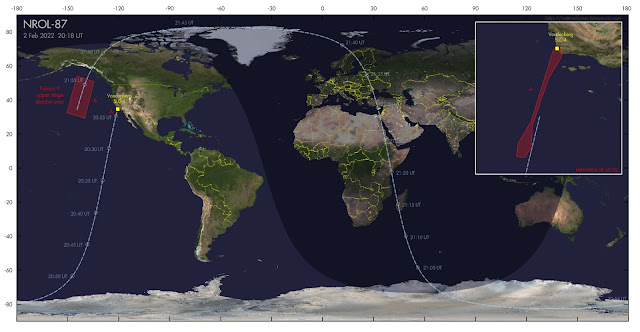
click map to enlarge


If weather cooperates, SpaceX will launch a classified payload for the National Reconnaissance Office (NRO) on 2 February 2022 at 20:18 UT [the launch eventually was at 21:27 UT]. This launch, from Vandenberg SLC-4 in California, is designated NROL-87.

Both (limited) specifications in a published contract for this launch (which states the intended orbital inclination and semi-major axis as respectively 97.4 degrees and 6890.7 km), as well as the position and orientation of hazard zones published in Navigational Warning NAVAREA XII 45/22 point to a launch into a 97.4 degree inclined, Sun-Synchronous Low Earth Orbit at about 512 km orbital altitude.

Analysts suspect the classified payload is one of a new generation of electro-optical IMINT satellites (either the first, or possibly the second, after USA 290/NROL-71, but in the latter case in a clearly different orbit) that is a follow-up to the KH-11 program. The sun-synchronous character of the intended orbit supports interpretation as an IMINT mission.

The image in top of this post gives the launch trajectory. The hazard areas I plotted in the map are from Navigational Warning NAVAREA XII 45/22 and they match a launch into an orbital plane with the quoted orbital inclination of 97.4 degrees:

280731Z JAN 22
NAVAREA XII 45/22(17,18,19).
EASTERN NORTH PACIFIC.
CALIFORNIA.
1. HAZARDOUS OPERATIONS:
   A. 1907Z TO 2138Z DAILY 02 AND 03 FEB
      IN AREA BOUND BY
      34-42N 120-41W, 34-41N 120-32W,
      34-31N 120-26W, 34-18N 120-30W,
      33-40N 120-53W, 32-10N 121-24W,
      31-25N 121-27W, 31-07N 121-40W,
      31-09N 121-55W, 31-35N 121-52W,
      32-17N 121-27W, 34-29N 120-46W.
   B. 2110Z TO 2249Z DAILY 02 AND 03 FEB
      IN AREAS BOUND BY
      54-00N 144-30W, 50-45N 134-30W,
      29-15N 140-00W, 32-30N 150-30W.
2. CANCEL THIS MSG 032349Z FEB 22.


The Falcon 9 upper stage from the launch makes a controlled reentry at the end of the first revolution, in the Northeast Pacific roughly between Alaska and Hawaii (the red box marked "B" in the map above). 

If launch is indeed near 20:18 UT (the launch window of the Navigational Warning runs from 19:07 to 21:38 UT), then the orbital plane launched into results in passes near noon and midnight local time and (if the semi-major axis is correct) a ~5-6 day repeating ground track. A pre-launch estimated elset is here.

The Launch Patch for NROL-87 shows an Ibex keeping a watchfull eye over its territory:


image: NRO

Thursday, 11 January 2018

[Updated] A potential use for satellites in Zuma-like 50-degree inclined orbits


SpaceX's launch of the Zuma satellite on 8 January was interesting, and not just because of the ongoing saga of whether it failed or not (see a previous post).  

The odd 50-degree orbital inclination is another element that made this launch interesting (see discussion in my pre-launch post here: sightings of the Falcon 9 Upper Stage over Sudan after launch later confirmed this orbital inclination).

New ideas started to form post-launch after the Falcon 9 sightings from Sudan made me realize that while it indeed was launched into a 50-degree inclined orbit, the orbital altitude (900-1000 km apogee) was higher than I initially expected, making a proposed link to USA 276 unlikely.

And then @Cosmic_Penguin posted this small message thread on Twitter, referencing this interesting publication. That struck a chord and reinforced an emerging idea about a potential role for satellites in such 50-degree inclined, ~1000 km altitude orbits.

As @Cosmic_Penguin notes, the publication specifically discusses ~50-60 degree inclined, ~1000 km altitude orbits. And it is all about Space-based Radar.


I had just been looking into the coverage of the Zuma orbit, and it lines up with content in that report.

The map below is a ground coverage map of Zuma, would it have been alive and well. One of the uses of a ~50 degree inclined ~1000 km altitude Space Based Radar satellite mentioned in the report, is for shipping surveillance.

Indeed, a satellite in a Zuma-like orbit would basically cover all Ocean surfaces, except for the high Arctic and Antarctic, which are not that interesting for the purpose discussed below (moreover, the Arctic is extensively covered by groundbased and airborne radar).


click map to enlarge

A (Radar) satellite in this kind of orbit therefore would be very useful to keep track of illicit shipping movements on the High Seas.

Think stuff like embargo-runners, e.g. embargo-breaking shipments of coal and oil to for example North Korea, illegal weapons exports from North Korea, oil exports from Syria, illicit weapons transports to the Middle East, and human trafficking as well as drugs shipments.

Ships engaged in such illegal activities sometimes turn off their transponder, making it harder to track their whereabouts once out of sight of landbased shipping radar (see also the story about one particular embargo-breaking ship here). The classified US NOSS duo ELINT satellites and similar Chinese Yaogan triplets are meant to track ships from passive radiosignal crosslocation, but when a ship displays strict radio silence, these systems will not detect them either. But Space-Based Radar will.

Embargoes have become an important geopolitical tool when outright war is deemed not an alternative. We currently see embargoes enforced with regard to for example Syria and North Korea. Means to enforce embargoes including detecting and stopping potential embargo violations therefore have become important. Human trafficking and drugs trafficking are growing geopolitical problems as well.

So was Zuma meant to be an (experimental, i.e. a technology demonstrator) version of such a Space Based Radar for Ocean shipping surveillance? It is an option.

What might argue against it is the extreme secrecy surrounding the launch. Very few details were made public about the Zuma payload, the Agency operating it was not disclosed, and the launch was announced very late.

For all of this, explanations can be sought, but that admittedly all is "special pleading". For example, maybe the secrecy is there because the mission involves cutting edge experimental Radar technology. Or the secrecy could simply be the result of the "secrecy cult" in some parts of the US Government going over the top. Or it could point to operation by an Agency that wants to keep this operation on the down low - e.g. the CIA. And I can think of a few more - much more outlandish, which is why I won't mention them here - potential reasons.

We have seen this kind of secrecy before with PAN (and its later sister ship CLIO), with Prowler, and more recently with USA 276. All of these were experimental satellites doing unusual things: PAN roved between, snug up to and eavesdropped on commercial geostationary satellite telephony satellites. Prowler was an experiment for covertly inspecting other geostationary satellites on-orbit. And USA 276 remains mysterious but a series of very close encounters to the International Space Station suggest it might be a technology demonstrator for observing rendez-vous manoeuvres in space.

Zuma (the more so now it might have failed) also strongly brings the infamous USA 193 satellite to mind, although there we do know that it was a satellite for the NRO, and likely an experimental radar satellite [edit: see added note 2 below].

Nevermind what Zuma really was meant to be, and who was to operate it: the message to take home is that High Seas shipping surveillance is a potential and viable role to keep in mind for any future satellite launched in a ~1000 km altitude, ~50 degree inclined orbit.


Added note 1: Cosmic Penguin pointed out to me that this was also earlier brought up in a forum post by Ed Kyle.

Added note 2, 12 January 2018:  This article suggests Zuma might be an electro-optical/SAR hybrid and a follow-on to the infamous USA 193:

"Second, the Northrop Grumman satellite may be a follow-on to another failed satellite US 193. [...] ...., a source with direct knowledge of the program told me it was a blend of radar and electro-optical and would not provide any more detail than that. A source with wide knowledge of classified space programs has told me that the Northrop Grumman-built Zuma may be the next iteration of this. Both were apparently experimental satellites, in that they were not part of a large constellation of similar satellites."

Such a spacecraft would be well suited for the purpose indicated in this blog post.

Also, Northrop-Grumman, the company that built Zuma, has actually worked on developing ideas for Space Based GMTI Radar, which again would suit well to the purpose I suggest in this blog post.


Acknowledgement: Hat Tip to @Cosmic_Penguin on Twitter for putting ideas into my brain.