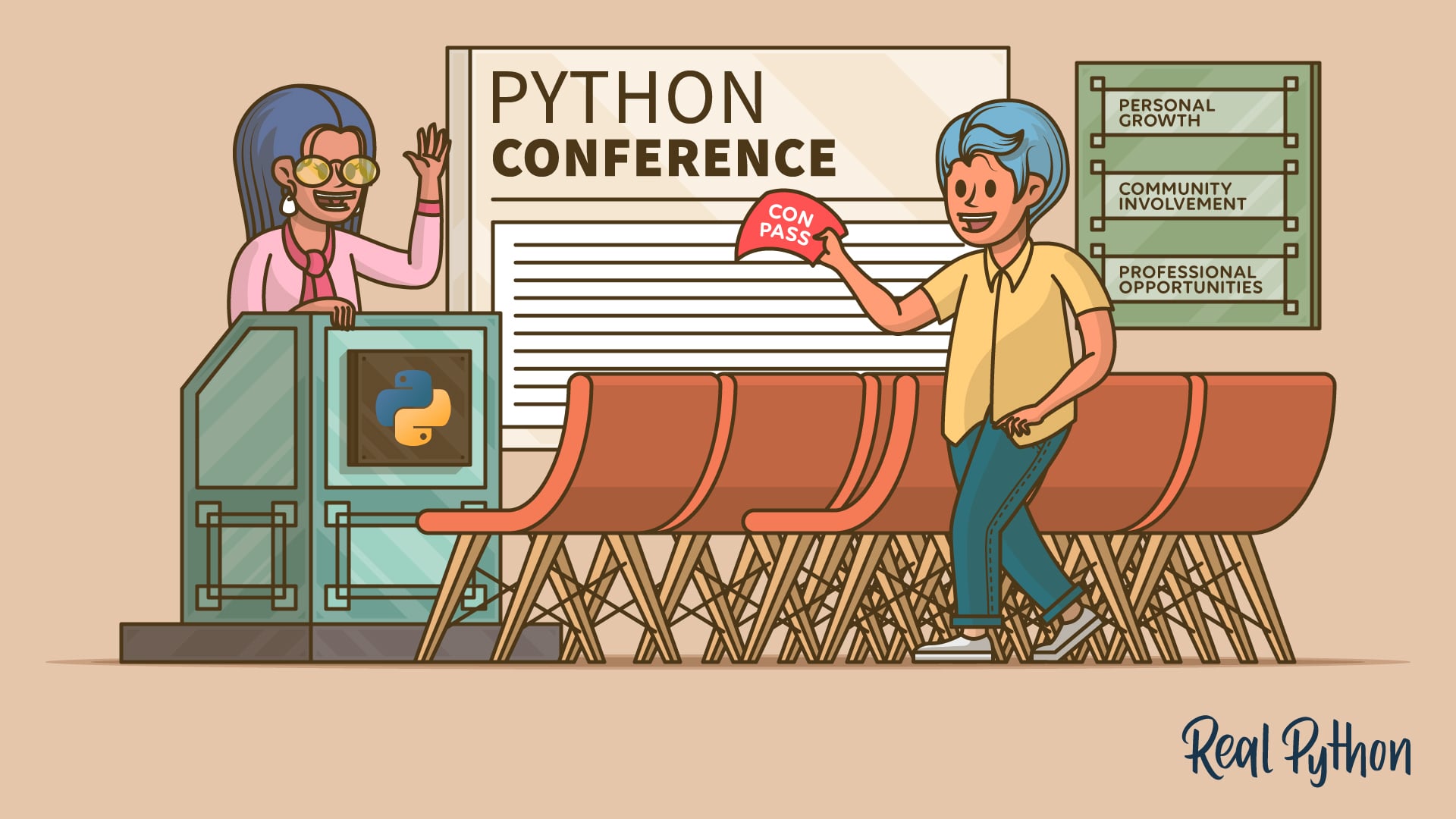
The idea of attending a Python conference can feel intimidating. You might wonder if you know enough, if you’ll fit in, or if it’s worth your time and money. In this guide, you’ll learn about the different types of Python conferences, what they actually offer, who they’re for, and how attending one can support your learning, confidence, and connection to the wider Python community.
Prerequisites
This guide is for all Python users who want to grow their Python knowledge, get involved with the Python community, or explore new professional opportunities. Your level of experience with Python doesn’t matter, and neither does whether you use Python professionally or as a hobbyist—regularly or only from time to time. If you use Python, you’re a Python developer, and Python conferences are for Python developers!
Brett Cannon, a CPython core developer, once said:
I came for the language, but I stayed for the community. (Source)
If you want to experience this feeling firsthand, then this guide is for you.
Get Your PDF: Click here to download a PDF with practical tips to help you feel prepared for your first Python conference.
Take the Quiz: Test your knowledge with our interactive “Python Skill Test” quiz. You’ll receive a score upon completion to help you track your learning progress:
Interactive Quiz
Python Skill TestTest your Python knowledge in a skills quiz with basic to advanced questions. Are you a Novice, Intermediate, Proficient, or Expert?
Understand What Python Conferences Actually Offer
Attending a Python conference offers several distinct benefits that generally fall into three categories:
-
Personal growth: Learn new concepts, tools, and best practices through talks, tutorials, and hands-on sessions that help you deepen your Python skills and build confidence.
-
Community involvement: Meet other Python users in person, connect with open-source contributors and maintainers, and experience the collaborative culture that defines the Python community.
-
Professional opportunities: Discover potential job openings, meet companies using Python across industries, and form professional connections that can lead to future projects or roles.
The following sections explore each category in more detail to help you recognize what matters most to you when choosing a Python conference.
Personal Growth
One of the biggest benefits of attending a Python conference is the opportunity for personal growth through active learning and engagement.
Python conferences are organized around a program of talks, tutorials, and collaborative sessions that expose you to new ideas, tools, and ways of thinking about Python. The number of program items can range from one at local meetups to over one hundred at larger conferences like PyCon US and EuroPython.
At larger events, you’re exposed to a wide breadth of topics to choose from, while at smaller events, you have fewer options but can usually attend all the sessions you’re interested in. Conference talks are an excellent opportunity to get exposed to new ideas, hear about new tools, or just listen to someone else talk about a topic you’re familiar with, which can be a very educational experience!
Most of these talks are later shared on YouTube, but attending in person allows you to participate in live Q&A sessions where speakers answer audience questions directly. You also have the chance to meet the speaker after the talk and ask follow-up questions that wouldn’t be possible when watching a recording.
Tutorials, on the other hand, are rarely recorded. They tend to be longer than talks and focus on hands-on coding, making them a brilliant way to gain practical, working knowledge of a Python feature or tool. Working through exercises with peers and asking questions in real time can help solidify your understanding of a topic.
Some conferences also include collaborative sprint events, where you get together with other attendees to contribute to open-source projects, typically with the guidance of the project maintainers themselves:

Participating in sprints under the mentorship of the project maintainers is a great way to boost your confidence in your skills and get some open-source contributions under your belt.
Community Involvement
Developers are used to collaborating on open-source projects with people around the world, but working together online isn’t the same as having a face-to-face conversation. Python conferences fill that gap by giving developers a dedicated space to meet and connect in person.
If you know who you’re looking for, it’s common to meet open-source contributors, library maintainers, and even CPython core developers at various Python conferences worldwide. This makes conferences a great way to finally connect with the maintainer of a Python library you keep coming back to, which can be tremendously useful for your work.
On top of being able to meet some notable folks—who you’ll quickly realize are always very down-to-Earth and friendly—you’ll also have the chance to meet dozens, if not hundreds, of other Python users. From professional Python users to hobbyist Python programmers, everyone will be happy to welcome you to the conference.
If you think about it, there are millions of Python users around the world. That’s more than the population of some countries. Attending a Python conference allows you to meet some of these users, making you feel like you’re part of a community instead of just another anonymous user of a programming language.
Professional Opportunities
Most Python conferences are organized and run by volunteers, which means sponsor companies play an important role in supporting the event.
At larger Python conferences, these sponsor companies often host booths. This gives you the opportunity to talk directly with people who work at those companies, learn about the tools they build, and find out whether they’re hiring, often while picking up some free swag along the way:

At local Python meetups, companies sometimes sponsor events by lending their office space. This smaller setting can make it easier to have informal conversations and learn more about what a company does and whether they’re hiring.
Beyond these types of interactions, simply chatting with other attendees is a form of networking. You never know where these serendipitous conversations might lead! As an example, I’ve personally found new professional projects through people I met at conferences while casually talking with them between sessions—connections that later turned into meaningful opportunities.
Last but not least, attending a Python conference is a lot of fun, so professional connections often form naturally because conferences are enjoyable social experiences. Different conferences offer different activities, but it’s commmon to find lightning talks, Python-related quizzes, social gatherings, and other informal events that make it easy to connect with others.
Find the Best Python Conference for You to Attend
Broadly speaking, Python conferences generally fall into four main categories, each offering a different experience depending on your goals and preferences:
- Local meetups: Smaller, shorter events that happen more often and provide an easy way to connect with the local Python community, with opportunities for deeper involvement.
- National PyCons: Large, multi-day events that serve as the flagship Python conferences for a country or region and attract hundreds of attendees.
- Topical Python conferences: Events similar in format and scale to national PyCons, but focused on a specific Python-related domain or tool.
- Online conferences: Fully remote events that are easy to attend and more accessible, but offer limited community interaction.
The upcoming sections explore each conference type in more detail to help you understand what to expect and decide which option best fits your goals.
Local Meetups
Local meetups are the smallest of the four events. They’re typically tied to a specific city or region, last only a couple of hours, and happen monthly or quarterly. Attendance is usually limited, with some meetups drawing as few as 10 to 20 participants.
Because local meetups are smaller and more informal, they’re a great starting point for first-time attendees to figure out what Python conferences are all about without feeling overwhelmed. The smaller size also makes it easier to have meaningful conversations with speakers and other attendees. If you become a recurring attendee at your local meetup, you’ll soon find yourself building relationships with your local Python community.
Another benefit of attending your local meetup is that it doesn’t require a major financial commitment, since you don’t have to pay for a ticket, travel, or accommodation. To find a local meetup near you, try searching online for “Python meetup” along with the name of your city or region.
National PyCons
National PyCons are the largest of the four event types. These annual conferences tend to have an international reach and are often branded as being the Python conference for a given country or region. For example, PyCon Portugal is the national Python conference held in Portugal.
PyCons can last a few days—typically anywhere from two to five days—with larger conferences like PyCon US and EuroPython lasting a week or more. Their schedules are usually organized into days dedicated to tutorials, talks, and sprints. Because they last multiple days, national PyCons provide plenty of opportunities to catch talks and tutorials about topics that interest you:

Attendance at PyCons varies widely. Smaller PyCons may host around 100 attendees, while larger ones attract 500 to 800 participants, with EuroPython drawing over 1,000 attendees and PyCon US exceeding 2,500 in some years. As the largest Python events, these conferences also attract many sponsors, creating plenty of opportunities for networking and professional conversations.
As mentioned earlier, another benefit of the larger conferences is that organizers arrange fun social activities like tours of the host city and dinners. At these events, it’s common to end the day sharing a meal with people you didn’t know at the start of the day. These interactions tend to happen organically—even if you consider yourself an introvert—and provide an easy way to make new connections.
The official Python website has an events section that lists many Python conferences around the world. If you don’t find one for your country, try searching online, as there are many Python conferences not listed on that page.
Topical Python Conferences
Local meetups and national PyCons tend to be “about Python” in the broadest sense, with talks covering a wide range of tools and topics. Some Python tools and use cases have a bigger user base than others, so the community started organizing conferences dedicated to specific Python-related topics.
The most well-known topical Python conferences are the DjangoCon US and DjangoCon EU conferences, which focus on Django, and the PyData conferences, dedicated to the world of data science and related fields. These conferences are usually held annually, last for a few days, and provide excellent opportunities if you work in or are particularly interested in the conference’s subject area.
The social and community benefits of attending a topical conference are very similar to those of national PyCons. The key difference lies in the program, as talks and tutorials at topical conferences are tightly focused on the subject matter of the event.
From a professional perspective, it’s also worth noting that a topical conference will attract sponsors that are specifically interested in meeting Python users of that domain. If you’re looking for professional opportunities related to a particular area of Python, then attending a topical conference may be your best bet.
Online Conferences
There are also some Python conferences that run 100% online, with one of the most well-known examples being PyLadiesCon, a global conference organized by the PyLadies mentorship group. Online conferences offer a different experience from in-person events, but because they’re easier to attend, they can be a great place to start.
Note: Some local meetups, national PyCons, and topical conferences also offer remote participation options, allowing attendees to join from home.
If you attend one of these events remotely, it’s worth keeping in mind that the experience may differ from attending in person, as some activities and interactions are limited to on-site participants.
An online conference can be a great first conference since tickets are typically more affordable and there’s no need to budget for travel or accommodation. At the same time, the online format reduces many of the social interactions that happen naturally at in-person events, which can make it harder to get involved with the community and form serendipitous connections with other attendees.
Python Conference Comparison
By now, you know how each type of Python conference offers a different experience, depending on what you’re hoping to get out of attending. The table below summarizes the main reasons you might choose one type of conference over another:
| Conference Type | Why You Might Attend | Learning Experience | Community Experience |
|---|---|---|---|
| Local Meetups | To meet local Python users and get involved gradually | Short talks and light learning | Strong, informal, and local |
| National PyCons | To explore Python broadly and build professional connections | Wide range of talks and tutorials | Large, diverse, and highly social |
| Topical Python Conferences | To go deep into a specific tool or domain | Focused, in-depth learning | Targeted and domain-specific |
| Online Conferences | To attend a conference with minimal cost or travel | Talk-centric and convenient | More limited than in-person events |
If you’re unsure which type of conference to attend, start by identifying the single most important outcome you’re looking for. Once you’ve clarified that goal, you can refer to this table to find the type of event that best aligns with it.
Take Your First Steps Toward Attending a Conference
By now, you should have an idea of the type of conference you’d like to attend, and hopefully, this will be the first of many. The steps below outline a simple, low-pressure way to get started.
Stay Updated
The very first thing you can do is make sure you stay on top of conference news. This is a low-effort way to engage with your conference of choice and helps ensure you’re aware of important dates and updates. For example, if you want to stay up to date with PyCon US, you could:
- Follow the conference on social media: For example, you can stay on top of updates about PyCon US on Mastodon.
- Subscribe to the conference newsletter: The PyCon US newsletter provides firsthand updates about when registration opens, when dates for the next event are announced, and other major milestones.
- Join the conference’s online community spaces: Many conferences offer Discord, Meetup, or Slack groups where you can start casually interacting with other attendees between events.
By doing these, you’re putting yourself in the loop, effectively kickstarting your conference involvement in a natural, low-pressure way.
Get More Involved
If you want to get more involved with the community, there are two additional options to consider. These are entirely optional, but they can significantly improve your overall conference experience:
- Volunteer at the conference: Most Python meetups and conferences are run by volunteers, and offering your help is a great way to support the event while meeting people along the way.
- Speak at the conference Speaking at a conference brings a lot of benefits in and of itself, so consider proposing a talk for the conference you’d like to attend. If it’s a local meetup, reaching out to the meetup organizers is often enough. If it’s a larger Python conference, you’ll need to go through the call for proposals (CfP). If a 20 to 30 minute talk feels intimidating, signing up for a 5-minute lightning talk can be a great first step.
Paradoxically, volunteering and speaking at a conference can be very helpful if you’re shy or new to the community. Volunteering helps you naturally connect with the organizers, other volunteers, and the attendees you end up helping. By speaking, you automatically have a built-in conversation starter, and you have the added benefit that people will often come to you to chat about your talk.
Set Expectations
If you’re thinking of going to a national PyCon or a topical conference, it’s helpful to set a few expectations ahead of time:
- You don’t need to attend every talk: The talk schedule is usually packed, often with multiple tracks running simultaneously. The “hallway track” refers to the informal conversations that happen outside the talk rooms, where many spontaneous and meaningful interactions take place.
- Be on the lookout for social events: These typically happen at the end of the day, and are an important part of the overall conference experience.
- Expect a welcoming environment: The Python community strives to make Python conferences as welcoming as possible for everyone. For example, many Python conferences observe the Pacman rule, which encourages people chatting in a circle to leave an open space so others can easily join in the conversation.
Setting a few expectations ahead of time can make the experience feel more manageable and enjoyable. It gives you permission to participate in ways that fit your energy, interests, and goals.
Address Common Concerns
Some attendees of national PyCons and topical conferences may have concerns. Common ones include the financial investment required and the potential overwhelm of entering a space where you don’t know anyone yet.
If you work with Python, consider asking your company to cover the cost of the conference ticket, travel, and accommodation. Frame attendance as an investment in your skills. If your company can’t support the cost and paying out of pocket isn’t feasible, look into financial aid options, as many larger conferences offer assistance programs.
To help make your case, it can be useful to know that many attendees continue to balance some work responsibilities while attending conferences. For example, it’s common for people to take important meetings during the event when necessary.
If you feel hesitant about meeting new people, remember that Python conferences are designed to be friendly and welcoming environments. Attending with a friend or colleague is always an option, and if large crowds become overwhelming, many conferences offer a quiet room where you can step away, rest, or work in silence whenever you need to.
Next Steps
You’ve explored why Python conferences are valuable and what different types of events have to offer. The steps below help you turn that understanding into a simple, actionable plan:
- Pick a conference you’d like to attend.
- Mark the conference date on your calendar.
- Stay up to date with the conference news.
- Read up on how to make the most of a larger conference.
Following these steps helps set you up for success at your first conference and turns it into an experience that supports your learning, builds confidence, and strengthens your connection to the Python community.
Get Your PDF: Click here to download a PDF with practical tips to help you feel prepared for your first Python conference.
Frequently Asked Questions
Now that you’re familiar with Python conferences, you can use the questions and answers below to check your understanding and recap what you’ve learned.
These FAQs are related to the most important concepts you’ve covered in this guide. Click the Show/Hide toggle beside each question to reveal the answer.
At meetups, expect to watch the one or two scheduled talks. At larger or online events, multiple tracks run at once, so you’re not expected to see everything. Use the hallway track when nothing grabs your interest.
Yes! Python conferences welcome everyone, regardless of skill level. Every expert started as a beginner.
Yes! These events are organized by and for the community, not just for full-time developers. If you use Python in any way, you belong.
Absolutely. Volunteers are always needed, and helping out is a great way to meet people and get the most from the event.
Take the Quiz: Test your knowledge with our interactive “Python Skill Test” quiz. You’ll receive a score upon completion to help you track your learning progress:
Interactive Quiz
Python Skill TestTest your Python knowledge in a skills quiz with basic to advanced questions. Are you a Novice, Intermediate, Proficient, or Expert?