Vetoed California Bills Would Have Improved Ray’s Car-Free Commute and Other Trips

Thanks to Kathy Fitzpatrick for helping me decide what to write about in this post. I have been enjoying my new 1.3-mile commute. Yes, I decided where to live based on having a short commute. Due to how many people cannot afford to live near where they work, I am fortunate to have this opportunity. Since I want to avoid sharing exactly where my home is due to this being a public blog, I will share a general overview of my commute.

California Does Not Have Stop As Yield for Cyclists Law

I avoid biking on McDowell Blvd because it is stressful. I wish the parking lane was a bike lane because I feel somewhat comfortable biking in the parking lane. Unfortunately, there are frequently vehicles parked in this lane so I have had to swerve into the travel lane. I doubt the residents would support converting the parking lane to a bike lane. While biking on Maria Dr is less stressful, the stop signs have been annoying.

Biking on N McDowell Blvd (left) is more stressful than biking on Maria Dr

As I wrote in this 2019 post, Oregon Senate Bill 998 allowed cyclists starting in 2020 to yield at stop signs under certain circumstances. Unfortunately, California does not have this law so I have been nervous about getting ticketed when not fully stopping at stop signs. Despite rarely seeing other people biking on the road (many people bike on the sidewalk) in Petaluma, most people do not fully stop at stop signs. I find it annoying to fully stop when I can see no cross traffic. While Governor Newsom had a chance last year to allow cyclists to yield at stop signs under certain circumstances, he vetoed Assembly Bill 122. He wrote the following in his veto message:

While I share the author’s intent to increase bicyclist safety, I am concerned this bill will have the opposite effect. The approach in AB 122 may be especially concerning for children, who may not know how to judge vehicle speeds or exercise the necessary caution to yield to traffic when appropriate.

California Governor Newsom
Source: https://www.calbike.org/bicycle-safety-stop-law/

Loma Vista Immersion Academy

I realize that I will not have children anytime soon. I am single and have not gone on a date recently. I can still dream about providing my future children with a great education. I bike past Loma Vista Immersion Academy, which is on Maria Dr, during my commute. Loma Vista’s Dual Immersion Program emphasizes a bilingual, biliterate and bicultural community with positive cross-cultural attitudes and skills resulting in an enriched experience for all learners as well as the community. Students begin school in transitional kindergarten classes, where they are taught using only Spanish. In kindergarten and first grade, students are taught 90 percent in Spanish and 10 percent in English. As they move through the grades, they are gradually taught more in English until, by the time they are in the fourth grade, they are taught half in English and half in Spanish.

Loma Vista’s Dual Immersion Program is awesome! I wish I had this during elementary school because learning a language is easier as a child. I am slowly using Duolingo to learn Spanish as an adult. While I knew being fluent in Spanish is a valuable skill to have in California, I got to see and hear firsthand how valuable this skill is when my coworkers and I were doing outreach at middle and high schools. The only coworker who is fluent in Spanish was the only person able to communicate with Spanish-speaking parents about their child’s transit needs. She also translated all of the online and paper marketing materials into Spanish. While I am excited that she got a new job in Colorado Springs, I will miss working with her. I am not sure how long it will take me to become fluent in Spanish, but I want to be able to help my team by providing us with a fluent Spanish person again. Being fluent in Spanish would also make it easier to date Spanish-speaking women.

California’s Freedom to Walk Act

Yes, I jaywalk where I feel safe doing so. As with not coming to a complete stop at stop signs, I also get nervous about possibly getting ticketed for jaywalking. In case you think that jaywalking laws exist in every country, my 2019 post explains how the Netherlands has no jaywalking laws. Pedestrians in the Netherlands can legally cross the street anywhere. I recommend this 2015 Vox article to learn the forgotten history of how US automakers invented the crime of “jaywalking” in the 1920s to sell automobiles. I am curious whether this history is truly forgotten. Every layperson (non-transportation planner or engineer) who I have discussed jaywalking with has told me they do not know the history of jaywalking. Did you know the history of jaywalking before I shared the Vox article?

Governor Newsom had a chance last year to end jaywalking tickets for safe mid-block crossings. Assembly Bill 1238 would have allowed police to still issue tickets for unsafe pedestrian behavior, but they could no longer use jaywalking as a pretext to stop people. Unfortunately, Governor Newsom vetoed this bill. Hopefully, he will sign Assembly Bill 2147 in the current session.

The governor’s veto rests on the belief that police enforcement or the threat of jaywalking tickets will somehow prevent pedestrian fatalities in the future when that has consistently failed in the past. Continuing to criminalize people’s rational, predictable responses to poor infrastructure is simply unjust.

Jared Sanchez, CalBike’s Senior Policy Advocate
Note that AB 1238 was in the last session. AB 2147 is in the current session. Source: https://www.calbike.org/freedom-to-walk-campaign/

Arrested Mobility

This post is getting long, so I am going to finish with what arrested mobility means and how it relates to jaywalking. In order to learn about and stay engaged with the national jaywalking movement, I recommend following Charles T. Brown. His Arrested Mobility podcast and Arrested Mobility Book Club have been helpful for me to learn more about and stay engaged in transportation justice issues. The book club sign-up link is from 2021, so I am not sure whether the link still works. While this Arrested Mobility Book Club Facebook group is private, which likely means you cannot access it, I wanted to reassure you that the book club still exists.

Source: https://arrestedmobility.com/

Future Blog Post

I am thankful to have a variety of ideas to write about. I could share another aspect of my commute by writing about how the Rainier Avenue Demonstration Project improved my bike commute. While I am not surprised by the many negative Nextdoor comments about this project from angry motorists, who do not like change in their neighborhood and believe no one bikes in Petaluma, I am concerned that the temporary project may not become permanent when Rainier Avenue is repaved and restriped in 2023. Since I am new to Petaluma and the Bay Area, I could also write about my car-free trips in Petaluma and the Bay Area. I am open to suggestions. What do you want to read?
Ray’s Crash Course in Respectability Politics

The power of social media, especially Facebook, helped me learn about respectability politics. I had never heard of respectability politics before today. As my below Facebook post shows, I thought I was helping to improve bike advocacy efforts by policing badly behaved cyclists.

For example, I saw a cyclist go through every stoplight on Fairfax Drive in Arlington, VA last Wednesday during afternoon rush hour. Since I’m tired of hearing well behaved cyclists and motorists tell me how badly behaved cyclists are ruining the image of all cyclists, I tried to chase down the badly behaved cyclist and tell him to stop breaking the law.

While I wasn’t able to catch up with the badly behaved cyclist, I’m thankful I posted this experience on social media. My friends were able to educate me about respectability politics and why it doesn’t work. Even though I was convinced I was doing the right thing by policing badly behaved cyclists, I’m thankful my friends stuck to their reasoning and waited patiently for me to show them that I understood their viewpoint. It took a few days for me to stop arguing my viewpoint and finally understand their viewpoint. Now I can share their reasoning with others that may not fully understand respectability politics.

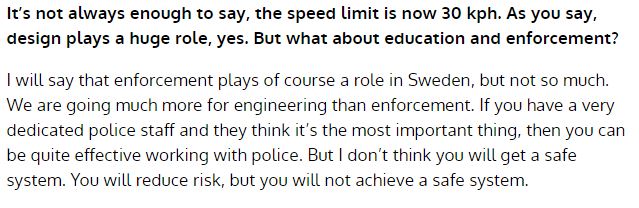
In case you haven’t heard of it before, respectability politics “refers to attempts by marginalized groups to police their own members and show their social values as being continuous, and compatible, with mainstream values rather than challenging the mainstream for what they see as its failure to accept difference.” Instead of policing cyclists, my friends suggested I encourage people to do the right thing. As Zvi Leve, who is an experienced cyclist living in Montreal, wrote, “I find that positive reinforcement is a far more effective strategy to encourage people to ‘do the right thing’.” Zvi also shared the following CityLab article, which discusses Sweden’s Vision Zero approach to education and enforcement.

Vision Zero Enforcement

Source: CityLab

Speaking of Vision Zero, I’m currently working with GGWash‘s staff to publish my next blog post about why Sustainable Safety, which is the Dutch alternative to Vision Zero, is more effective than Vision Zero.

Neighborhood Greenways Are Cool, But Oasis Greenways Are Awesome!

I submitted my contributor form to Greater Greater Washington (GGWash) today and GGWash’s staff gave me the green light, so my first blog post should be published on GGWash sometime next week. Since GGWash’s staff asked me to write differently than I write on my personal blog, I wanted to share the version I wrote before GGWash’s staff asked me to shorten my blog post and make it less technical. As I wrote in this post, I knew I would have less control over my writing when I started posting on other blogs. I’ll share my GGWash post after it is published, but as a teaser I’m sharing my longer and more technical version below.

Update: here is my first GGWash post!

A bike boulevard (DC region refers to neighborhood greenway as bike boulevard) is an outdated idea currently being used by many US cities to improve safety for all street users. An oasis greenway is a new approach that represents the future of safe street design. An oasis greenway is a long series of interconnected low-speed, low-volume, shared-space, vegetated linear parks created from an assembly of residential streets. As the below video shows, an oasis greenway is based on the Dutch woonerf.

According to Tom Bertulis’ 167-page thesis, Oasis Greenways: A New Model of Urban Park and Bikeway within Constrained Street Rights-of-Way, the nine elements that any given facility must include to be called an oasis greenway are the following:

  1. Extremely low traffic volumes, including traffic diversion as needed. While many cities in the US are focused on traffic diversion on a street by street basis, several cities in the Netherlands are focused on traffic diversion on a neighborhood or citywide basis. Houten, Netherlands, which is a suburb of Utrecht, has implemented a citywide traffic diversion plan.

    Houten Street Network

    Houten’s traffic diversion map. Source: ITDP

    As the below map shows, motorists are routed from their neighborhood road (green) onto a connector road (brown) that directs them to the outer ring road (yellow). Motorists must drive all the way around Houten until they reach another connector road that connects them to their destination. Since cyclists and pedestrians can travel through the traffic diverters, they can travel quicker than motorists through Houten.

    Houten Street Network zoomed in

    Neighborhood level of Houten’s traffic diversion map

    Watch this video to learn more about Houten.

    Since Houten was originally designed with traffic diversion, it is a unique city because it didn’t need to be retrofitted. Most, if not all, US cities will have to retrofitted with traffic diversion so here is a neighborhood retrofit example from Utrecht, Netherlands. US cities should be able to relate to this retrofit example much easier than the approach that Houten took with its citywide traffic diversion plan.

    While no US city has implemented a citywide nor neighborhood network of traffic diverters, Portland, OR has several traffic diverters. Here is a diagonal traffic diverter in northeast Portland.

    2015-07-26 16.21.38

    Diagonal traffic diverter at NE Tillamook St and 16th Ave. Photo: Ray Atkinson

    Diagonal traffic diverter at Tillamook and 16th

    Diagonal traffic diverter at NE Tillamook St and 16th Ave

  2. Extremely low traffic speeds, including traffic calming as needed. Below is a bayonet traffic calmer in Delftweg, Netherlands. While the street is two-way, the bayonet forces motorists to take turns going through the bayonet. Cyclists have a two-way trail so they can avoid the bayonet.

    DSCN0394

    Delftweg’s bayonet traffic calmer. Photo: Ray Atkinson

  3. Shared space, without sidewalks, with motorists sharing the space with pedestrians and cyclists, like a woonerf.

    Bell Street Seattle Before & After Shared Space

    Shared space on Bell Street in Seattle, WA

  4. Oasis greenways must be continuous for at least several blocks and have connectivity through busy intersections.

    Portland Neighborhood Greenway Crossing

    Portland neighborhood greenway crossing. Photo: Steven Vance

  5. Terminal vista. They must make use of the “terminal vista effect,” where the line of sight straight down the street is partially obscured, usually by trees or an on-street parking chicane. The below woonerf in Delft, Netherlands shows the terminal vista effect.

    Delft woonerf

    Woonerf in Delft, NL. Photo: Ray Atkinson

  6. Parklike, which refers to using grasscrete as the default in areas that aren’t travel-ways for cyclists and pedestrians. The below photo from Haarlem, Netherlands shows a grasscrete street.

    Grasscrete in Netherlands

    Grasscrete street in Haarlem, NL. Photo: Dan Burden

  7. Park and parking strip. They must have a wide area where on-street parking, parklets, trees, vegetation, and play areas are located.

    Oasis greenway park and parking area

    Rendering of park and parking strip. Rendering: Tom Bertulis’ thesis

  8. Minimal parking footprint. They must minimize the parking footprint based on a parking needs analysis. Use the below illustration to compare parking footprint of a traditional street with parking footprint of an oasis greenway.

    Oasis Greenway vs. Traditional Street

    Source: Tom Bertulis’ thesis

  9. Small and large play areas. They must have both small and large play areas, with the small play areas referring to the Park & Parking Strip and the large play areas referring to Oasis Greenway sections with “ultra-low volumes” where the play area temporarily becomes the entire cross-section of the street, not too different from when hockey is played in the street.

    Street Hockey

    Street hockey. Photo: Jonathan Tavares

While no street in the US has been designed with all nine elements of an oasis greenway, a few cities have experimented with several elements of an oasis greenway so please don’t think that an oasis greenway can only be designed by the Dutch or Europeans. Would you like to see an oasis greenway constructed in your neighborhood? If yes, where? If no, why not?

Shifting from Bicycle Boulevards to Neighborhood Greenways

While the following topic directly relates to my job because I consult for Arlington County, I’m hopeful I have some freedom to be an advocate during my free time. I love being an advocate but also want to keep my job so I’m feeling handcuffed. Even though I’m critiquing my client’s bicycle and pedestrian planning efforts, I’m not critiquing Capital Bikeshare so I assume the following topic is safe to write about.

With my background thoughts out of the way, what do you think of when you read “bicycle boulevard”? Did you only think of cyclists and wonder why I’m asking? Even though you may think only having cyclists prioritized on a slow speed neighborhood street is okay, I’m bothered by this. While Arlington has included several pedestrian projects in its bike boulevard plans, the public likely doesn’t realize that pedestrian projects have been included on a bike-specific project. This concerns me and should concern you!

While I’m not sure what percent of bike and ped projects are included in the overall bike boulevard plan, I assume that bike projects represent the majority of the projects because the title of the plan is bike boulevards. Even though I’m advocating for a shift from bike boulevards to neighborhood greenways, I have no idea whether this change will actually result in more focus discussions about ped projects. Since changing policy could result in focusing more on ped projects, I recommend Arlington adopt the green transportation hierarchy. According to the green transportation hierarchy, pedestrians should be prioritized over cyclists.

green-transportation-triangle

Source: BikePortland

While I’m not trying to insinuate that Arlington isn’t prioritizing pedestrians, I am stating that Arlington should use better language if it wants to prioritize pedestrians and attract pedestrian advocates to join the conversation. As the below video shows, Portland has been shifting from bicycle boulevards to neighborhood greenways. I believe one of the reasons why Portland chose to make this shift is because bicycle boulevards are seen as only for cyclists while neighborhood greenways are seen as multimodal. I hope Arlington will follow Portland’s lead and shift from bicycle boulevards to neighborhood greenways so pedestrians can be prioritized more.

Future Blog Post: Tactical Urbanism in Portland vs. DC

Since Catherine, who I have been dating for almost two months, thinks tactical urbanism events are awesome, I’m trying to find upcoming tactical urbanism events in the DC region. Even though I showed Catherine photos of tactical urbanism events, I feel you have to experience the event in person to fully understand and enjoy it. I’m hoping to take Catherine to a tactical urbanism event on a future date. While Open Streets DC has a website, I’m disappointed to read “One day a year, let’s open up those streets.” Only one day a year! Plus, I couldn’t find any upcoming open street events on the Open Streets DC website so I’m disappointed. I guess Portland spoiled me with five Sunday Parkways (open street events) each year!