There are several chart types allowing to visualize the distribution of a combination of 2 numeric variables. They always have a variable represented on the X axis, the other on the Y axis, like for a scatterplot (left).
Then the number of observations within a particular area of the 2D space is counted and represented with a color gradient. The shape can vary: hexagones result in a hexbin chart, squares in a 2d histogram. A kernel density estimate can be used to get a 2d density plots or a contour plots
Confusing? Visit data-to-viz to clarify..
SeabornThe contour plot can be easily built thanks to the kdeplot() function of the Seaborn library.
MatplotlibBuild a 2d histogram thanks to the hist2d() function of the Matplotlib library. Do not forget to play with the bins argument to find the value representing the best your data.
MatplotlibSplit the graph area in hexagones and you get a hexbin density chart. This time, it is matplotlib that gets you covered thanks to its hexbin() function.
Matplotlib2D densities are computed thanks to the gaussian_kde() function and plotted thanks with the pcolormesh() function of matplotlib().
2D densities often combined with marginal distributions. It helps to highlight the distribution of both variables individually. It is pretty straightforward to add thanks to the jointplot() function of the Seaborn library.
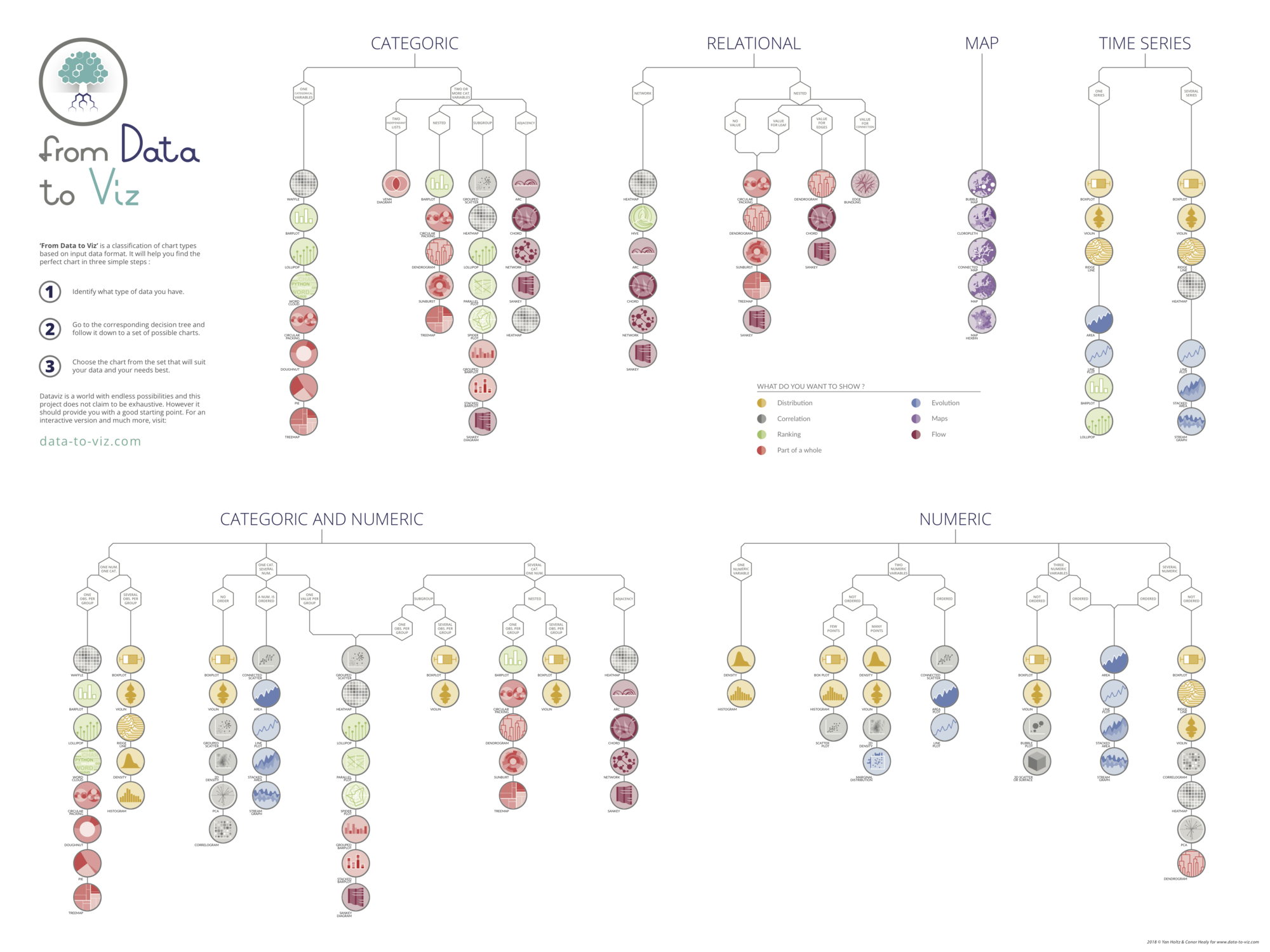
Do you know all the chart types? Do you know which one you should pick? I made a decision tree that answers those questions. You can download it for free!
