


A Systematic Review and Meta-analysis of Chemical Exposures and Attention-Deficit/Hyperactivity Disorder in Children
- PMID: 38108946
- PMCID: PMC11132938
- DOI: 10.1007/s11121-023-01601-6
A Systematic Review and Meta-analysis of Chemical Exposures and Attention-Deficit/Hyperactivity Disorder in Children
Abstract
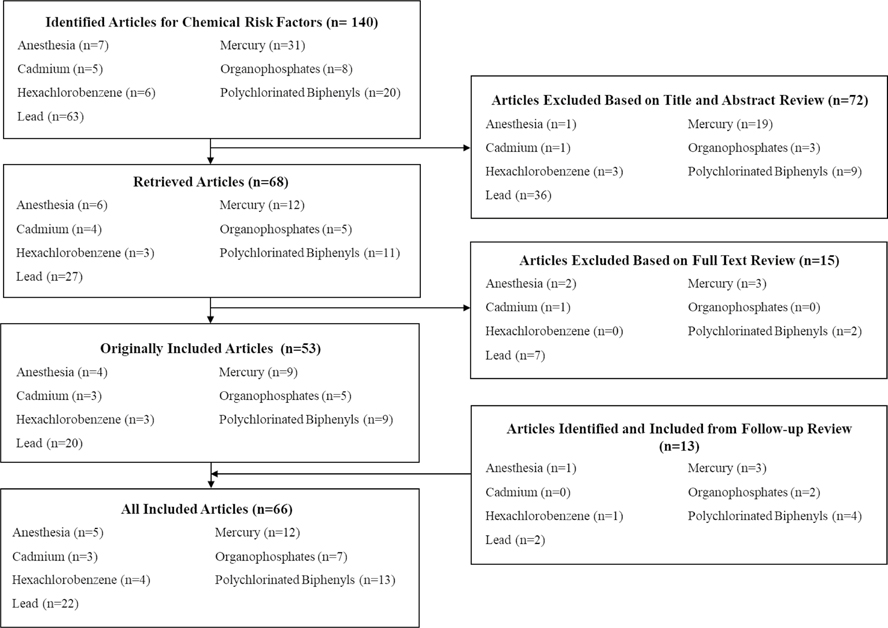
Exposure to certain chemicals prenatally and in childhood can impact development and may increase risk for attention-deficit/hyperactivity disorder (ADHD). Leveraging a larger set of literature searches conducted to synthesize results from longitudinal studies of potentially modifiable risk factors for childhood ADHD, we present meta-analytic results from 66 studies that examined the associations between early chemical exposures and later ADHD diagnosis or symptoms. Studies were eligible for inclusion if the chemical exposure occurred at least 6 months prior to measurement of ADHD diagnosis or symptomatology. Included papers were published between 1975 and 2019 on exposure to anesthetics (n = 5), cadmium (n = 3), hexachlorobenzene (n = 4), lead (n = 22), mercury (n = 12), organophosphates (n = 7), and polychlorinated biphenyls (n = 13). Analyses are presented for each chemical exposure by type of ADHD outcome reported (categorical vs. continuous), type of ADHD measurement (overall measures of ADHD, ADHD symptoms only, ADHD diagnosis only, inattention only, hyperactivity/impulsivity only), and timing of exposure (prenatal vs. childhood vs. cumulative), whenever at least 3 relevant effect sizes were available. Childhood lead exposure was positively associated with ADHD diagnosis and symptoms in all analyses except for the prenatal analyses (odds ratios (ORs) ranging from 1.60 to 2.62, correlation coefficients (CCs) ranging from 0.14 to 0.16). Other statistically significant associations were limited to organophosphates (CC = 0.11, 95% confidence interval (CI): 0.03-0.19 for continuous measures of ADHD outcomes overall), polychlorinated biphenyls (CC = 0.08, 95% CI: 0.02-0.14 for continuous measures of inattention as the outcome), and both prenatal and childhood mercury exposure (CC = 0.02, 95% CI: 0.00-0.04 for continuous measures of ADHD outcomes overall for either exposure window). Our findings provide further support for negative impacts of prenatal and/or childhood exposure to certain chemicals and raise the possibility that primary prevention and targeted screening could prevent or mitigate ADHD symptomatology. Furthermore, these findings support the need for regular review of regulations as our scientific understanding of the risks posed by these chemicals evolves.
Keywords: Anesthesia; Attention deficit/hyperactivity disorder; Cadmium; Chemicals; Childhood health; Hexachlorobenzene; Lead; Mercury; Meta-analysis; Organophosphate; Pediatrics; Polychlorinated biphenyls.
© 2023. This is a U.S. Government work and not under copyright protection in the US; foreign copyright protection may apply.
Conflict of interest statement
Figures
References
-
- Agency for Toxic Substances and Disease Registry. (2014). Who is at risk of exposure to PCBs? https://www.atsdr.cdc.gov/csem/polychlorinated-biphenyls/who_risk.html#:.... Accessed 02/09/22.
-
- Agency for Toxic Substances and Disease Registry. (2018). Choose safe places for early care and education. https://www.atsdr.cdc.gov/safeplacesforECE/cspece_guidance/former_use.html. Accessed 06/23/22.
-
- Alexander FW, & Delves HT (1972). Deaths from acute lead poisoning. Archives of Disease in Childhood, 47, 3. https://adc.bmj.com/content/archdischild/47/253/446.full.pdf - PMC - PubMed
-
- American Psychiatric Association. (2013). Diagnostic and statistical manual of mental disorders: DSM-5™ (5th ed.). American Psychiatric Publishing Inc.
Publication types
MeSH terms
Grants and funding
LinkOut - more resources
Full Text Sources
Medical
