


Circulating Bile Acids and Adenoma Recurrence in the Context of Adherence to a High-Fiber, High-Fruit and Vegetable, and Low-Fat Dietary Intervention
- PMID: 36113023
- PMCID: PMC9624497
- DOI: 10.14309/ctg.0000000000000533
Circulating Bile Acids and Adenoma Recurrence in the Context of Adherence to a High-Fiber, High-Fruit and Vegetable, and Low-Fat Dietary Intervention
Abstract
Introduction: Diet may affect bile acid (BA) metabolism and signaling. In turn, BA concentrations may be associated with cancer risk. We investigated (i) associations of BA concentrations with adenoma recurrence and (ii) the effect of a high-fiber, high-fruit and vegetable, and low-fat dietary intervention on serum BA concentrations.
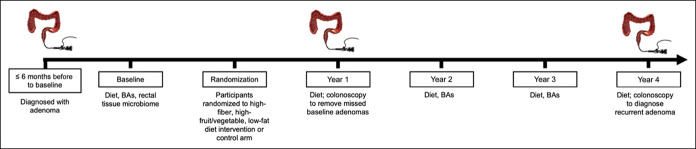
Methods: The Polyp Prevention Trial is a 4-year randomized, controlled trial that investigated the effect of a high-fiber, high-fruit and vegetable, and low-fat diet on colorectal adenoma recurrence. Among 170 participants who reported adhering to the intervention and 198 comparable control arm participants, we measured 15 BAs in baseline, year 2, and year 3 serum using targeted, quantitative liquid chromatography-tandem mass spectrometry. We estimated associations of BAs with adenoma recurrence using multivariable logistic regression and the effect of the dietary intervention on BA concentrations using repeated-measures linear mixed-effects models. In a subset (N = 65), we investigated associations of BAs with 16S rRNA gene sequenced rectal tissue microbiome characteristics.
Results: Baseline total BA concentrations were positively associated with adenoma recurrence (odds ratio Q3 vs Q1 = 2.17; 95% confidence interval = 1.19-4.04; Ptrend = 0.03). Although we found no effect of the dietary intervention on BA concentrations, pretrial dietary fiber intake was inversely associated with total baseline BAs (Spearman = -0.15; PFDR = 0.02). BA concentrations were associated with potential colorectal neoplasm-related microbiome features (lower alpha diversity and higher Bacteroides abundance).
Discussion: Baseline circulating BAs were positively associated with adenoma recurrence. Although the dietary intervention did not modify BA concentrations, long-term fiber intake may be associated with lower concentrations of BAs that are associated with higher risk of adenoma recurrence.
Copyright © 2022 Written work prepared by employees of the Federal Government as part of their official duties is, under the U.S. Copyright Act, a “work of the United States Government” for which copyright protection under Title 17 of the United States Code is not available. As such, copyright does not extend to the contributions of employees of the Federal Government.
Conflict of interest statement
Figures
References
Publication types
MeSH terms
Substances
Grants and funding
LinkOut - more resources
Full Text Sources
Medical
