


Modelling the impact of increased alcohol taxation on alcohol-attributable cancers in the WHO European Region
- PMID: 34918000
- PMCID: PMC8642705
- DOI: 10.1016/j.lanepe.2021.100225
Modelling the impact of increased alcohol taxation on alcohol-attributable cancers in the WHO European Region
Abstract
Background: Reducing the alcohol-attributable cancer burden in the WHO European Region is a public health priority. This study aims to estimate the number of potentially avoidable cancers in countries of the WHO European Region in 2019 for three scenarios in which current excise duties on alcoholic beverages were increased by 20%, 50%, or 100%.
Methods: Mean prices and excise duties for beer, wine, and spirits in the Member States of the WHO European Region in 2020 were used as the baseline scenario. We assumed that increases in excise duties (20%, 50%, and 100%) were fully incorporated into the consumer price. Beverage-specific price elasticities of demand, with lower elasticities for heavy drinkers, were obtained from a meta-analysis. Model estimates were applied to alcohol exposure data for 2009 and cancer incidence and mortality rates for 2019, assuming a 10-year lag time between alcohol intake and cancer development and mortality.
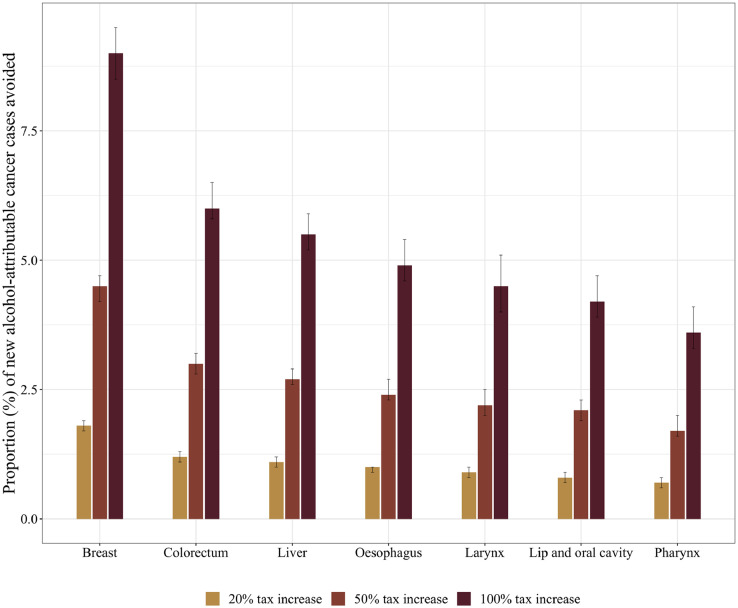
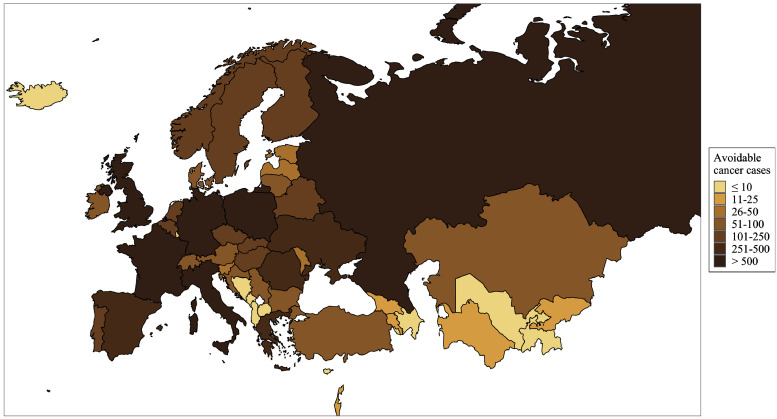
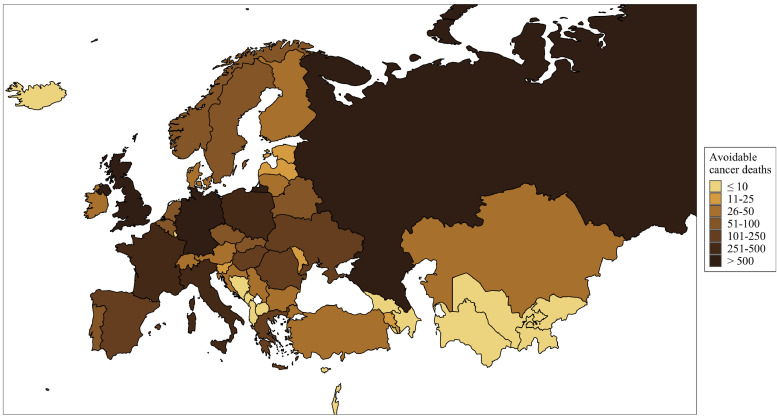
Findings: Of 180,887 (95% Confidence interval [CI]: 160,595-201,705) new alcohol-attributable cancer cases and 85,130 (95% CI: 74,920-95,523) deaths in the WHO European Region in 2019, 5·9% (95% CI: 5·6-6·4) and 5·7% (95% CI: 5·4-6·1), respectively, could have been avoided by increasing excise duties by 100%. According to our model, alcohol-attributable female breast cancer and colorectal cancer contributed most to the avoidable cases and deaths.
Interpretation: Doubling current alcohol excise duties could avoid just under 6% (or 10,700 cases and 4,850 deaths) of new alcohol-attributable cancers within the WHO European Region, particularly in Member States of the European Union where excise duties are in many cases very low.
Funding: None.
Keywords: Alcohol; WHO European Region; alcohol-attributable cancer; cancer; taxation.
© 2021 Published by Elsevier Ltd.
Conflict of interest statement
The authors have no conflicts of interest to declare. Carina Ferreira-Borges is a staff member of WHO, Maria Neufeld is a WHO consultant. Where authors are identified as personnel of the International Agency for Research on Cancer and WHO, the authors alone are responsible for the views expressed in this article and they do not necessarily represent the decisions, policy, or views of the International Agency for Research on Cancer and WHO.
Figures
References
-
- World Health Organization . WHO Regional Office for Europe; Copenhagen, Denmark: 2020. United action for better health in Europe. Draft European Programme of Work, 2020-2025.
-
- World Health Organization . WHO Regional Office for Europe; Copenhagen, Denmark: 2021. United Action Against Cancer, a pan-European movement from grassroots to government.https://www.euro.who.int/en/media-centre/events/events/2021/02/united-ac... Available from:
-
- World Cancer Research Fund International, American Institute for Cancer Research . American Institute for Cancer Research; Washington, DC: 2018. Diet, nutrition, physical activity and cancer: a global perspective: a summary of the Third Expert Report.
-
- IARC Working Group on the Evaluation of Carcinogenic Risks to Humans, World Health Organization, International Agency for Research on Cancer . International Agency for Research on Cancer; Distributed by WHO Press; Lyon, France: 2010. Alcohol consumption and ethyl carbamate. editors. (IARC monographs on the evaluation of carcinogenic risks to humans; vol. 96)
Grants and funding
LinkOut - more resources
Full Text Sources
