


Association of Dietary Vitamin D Intake, Serum 25(OH)D3, 25(OH)D2 with Cognitive Performance in the Elderly
- PMID: 34578965
- PMCID: PMC8467888
- DOI: 10.3390/nu13093089
Association of Dietary Vitamin D Intake, Serum 25(OH)D3, 25(OH)D2 with Cognitive Performance in the Elderly
Abstract
Background: As life expectancy increases, cognitive performance decline in the elderly has become one of the major global challenges. We aimed to evaluate the association of dietary vitamin D (VD), serum 25-hydroxyvitamin D3 (25(OH)D3), 25-hydroxyvitamin D2 (25(OH)D2), and total 25-hydroxyvitamin (25(OH)D) concentration with cognitive performance in older Americans.
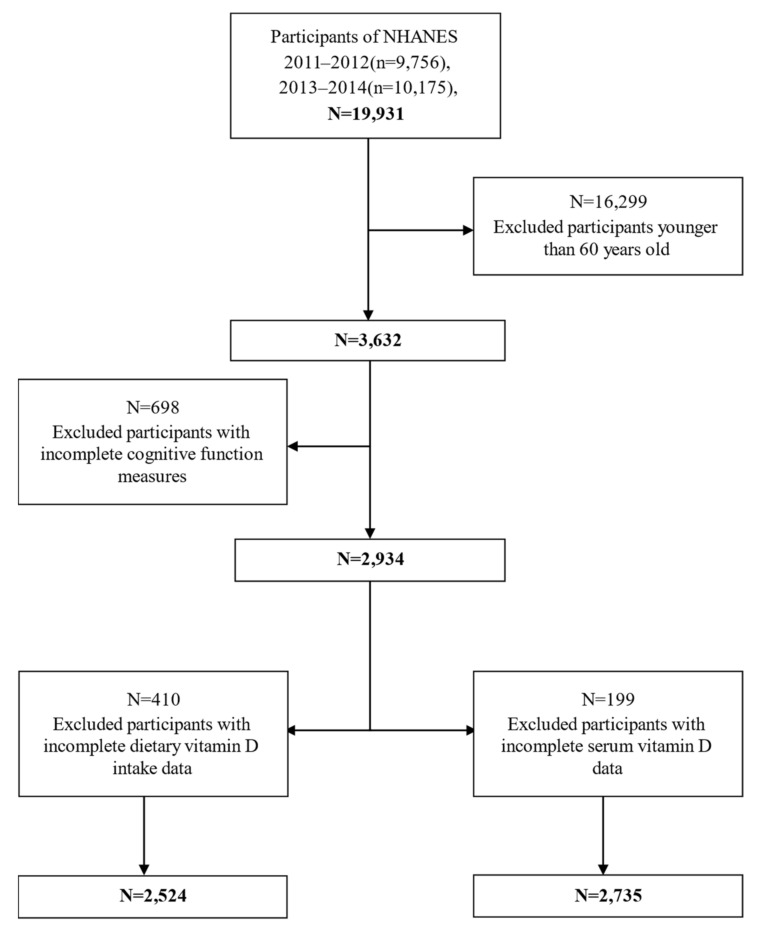
Methods: The data from the National Health and Nutrition Examination Survey (NHANES), 2011-2014 was used. The cognitive performance was assessed by the Consortium to Establish a Registry for Alzheimer's Disease (CERAD) Word Learning sub-test, Animal Fluency test, and Digit Symbol Substitution Test (DSST). A binary logistic regression model was applied to evaluate the association between VD and cognitive performance, and restricted cubic spline model was adopted to evaluate the dose-response relationship.
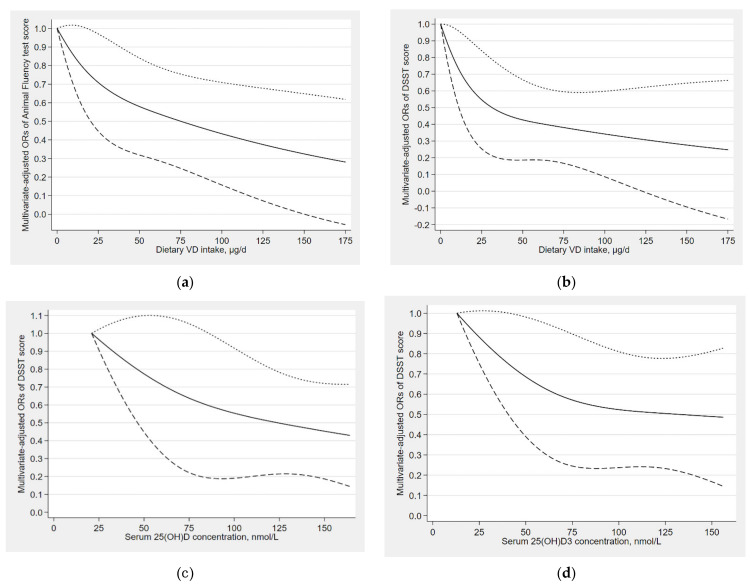
Results: While comparing to the lowest dietary VD intake group, the multivariate adjusted odds ratios (ORs) and 95% confidence intervals (CIs) of the highest dietary VD intake group were 0.51 (0.36-0.72) for the Animal Fluency test score and 0.45 (0.31-0.66) for DSST score, respectively; and those of serum total 25(OH)D and 25(OH)D3 concentration were 0.68 (0.47-0.97) and 0.62 (0.44-0.86) for DSST score. L-shaped relationships were identified for dietary VD intake, serum total 25(OH)D and 25(OH)D3 concentration with cognition performance. The associations between dietary VD intake, serum total 25(OH)D and cognitive performance were non-significant when stratified by gender.
Conclusions: The study indicates that dietary VD intake, serum total 25(OH)D and 25(OH)D3 concentration were positively associated with cognitive performance. Further studies are needed to clarify the possible effects of dietary VD intake and serum 25(OH)D2, 25(OH)D3 on cognitive performance.
Keywords: 25-hydroxyvitamin D2; 25-hydroxyvitamin D3; cognitive performance; dietary vitamin D; does–response.
Conflict of interest statement
The authors declare no conflict of interest.
Figures
References
MeSH terms
Substances
LinkOut - more resources
Full Text Sources
Medical
Research Materials
