


Trajectories of alcohol consumption during life and the risk of developing breast cancer
- PMID: 34483338
- PMCID: PMC8505448
- DOI: 10.1038/s41416-021-01492-w
Trajectories of alcohol consumption during life and the risk of developing breast cancer
Abstract
Background: Whether there are lifetime points of greater sensitivity to the deleterious effects of alcohol intake on the breasts remains inconclusive.
Objective: To compare the influence of distinctive trajectories of alcohol consumption throughout a woman's life on development of breast cancer (BC).
Methods: 1278 confirmed invasive BC cases and matched (by age and residence) controls from the Epi-GEICAM study (Spain) were used. The novel group-based trajectory modelling was used to identify different alcohol consumption trajectories throughout women's lifetime.
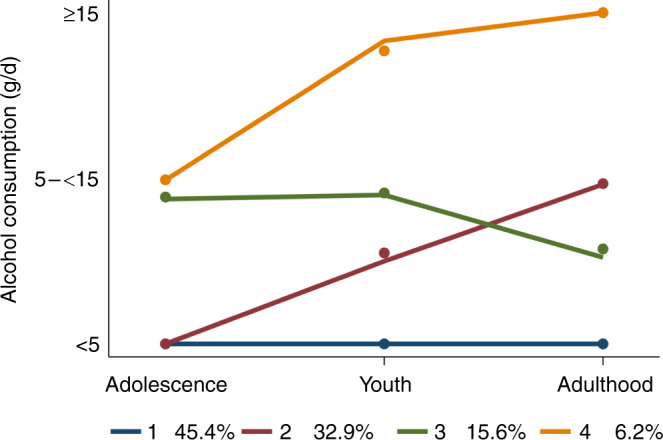
Results: Four alcohol trajectories were identified. The first comprised women (45%) with low alcohol consumption (<5 g/day) throughout their life. The second included those (33%) who gradually moved from a low alcohol consumption in adolescence to a moderate in adulthood (5 to <15 g/day), never having a high consumption; and oppositely, women in the third trajectory (16%) moved from moderate consumption in adolescence, to a lower consumption in adulthood. Women in the fourth (6%) moved from a moderate alcohol consumption in adolescence to the highest consumption in adulthood (≥15 g/day), never having a low alcohol consumption. Comparing with the first trajectory, the fourth doubled BC risk (OR 2.19; 95% CI 1.27, 3.77), followed by the third (OR 1.44; 0.96, 2.16) and ultimately by the second trajectory (OR 1.17; 0.86, 1.58). The magnitude of BC risk was greater in postmenopausal women, especially in those with underweight or normal weight. When alcohol consumption was independently examined at each life stage, ≥15 g/day of alcohol consumption in adolescence was strongly associated with BC risk followed by consumption in adulthood.
Conclusions: The greater the alcohol consumption accumulated throughout life, the greater the risk of BC, especially in postmenopausal women. Alcohol consumption during adolescence may particularly influence BC risk.
© 2021. The Author(s).
Conflict of interest statement
Ángel Guerrero-Zotano has received institutional grant from Pfizer; has participated in advisory board activities with Novartis, Palex, Pfizer and Astra Zeneca; has received travel grand from Roche, Pfizer and Novartis. Manuel Ramos has received honoraria from Novartis, Roche and Pfizer. Miguel Martín has received honoraria from Roche/Genentech, Lilly, Pfizer, Novartis and Pierre-Fabre; has participated in consulting or advisory board activities with Roche/Genentech, Novartis, Pfizer, Lilly, Astra Zeneca and Taiho Pharmaceutical; has received speakers’ bureau from Lilly/ImClone, Roche/Genentech and Pierre Fabre; has contracted research fees from Roche, Novartis, and PUMA. All remaining authors have declared no conflicts of interest.
Figures
References
-
- World Cancer Research Fund, American Institute for Cancer Research. Food, nutrition, physical activity, and the prevention of cancer: a global perspective. Amer Inst for Cancer Research; 2007.
-
- World Cancer Research Fund. Alcoholic drinks and the risk of cancer. 2018. https://www.wcrf.org/wp-content/uploads/2021/02/Alcoholic-Drinks.pdf.
