


Depression, Environmental Reward, Coping Motives and Alcohol Consumption During the COVID-19 Pandemic
- PMID: 33192708
- PMCID: PMC7661794
- DOI: 10.3389/fpsyt.2020.574676
Depression, Environmental Reward, Coping Motives and Alcohol Consumption During the COVID-19 Pandemic
Abstract
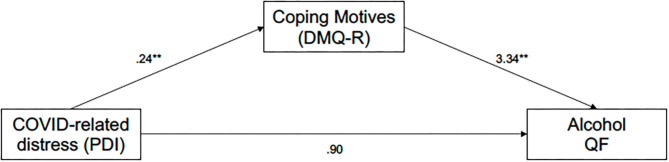
Background: Increases in the incidence of psychological distress and alcohol use during the COVID-19 pandemic have been predicted. Behavioral theories of depression and alcohol self-medication theories suggest that greater social/environmental constraints and increased psychological distress during COVID-19 could result in increases in depression and drinking to cope with negative affect. The current study had two goals: (1) to examine self-reported changes in alcohol use and related outcomes after the introduction of COVID-19 social distancing requirements, and; (2) to test hypothesized mediation models to explain individual differences in self-reported changes in depression and alcohol use during the early weeks of the COVID-19 pandemic. Methods: Participants (n = 833) were U.S. residents recruited for participation in a single online survey. The cross-sectional survey included questions assessing environmental reward, depression, COVID-19-related distress, drinking motives, and alcohol use outcomes. Outcomes were assessed via retrospective self-report for two timeframes in the single survey: the 30 days prior to state-mandated social distancing ("pre-social-distancing"), and the 30 days after the start of state-mandated social distancing ("post-social-distancing"). Results: Depression severity, coping motives, and some indices of alcohol consumption (e.g., frequency of binge drinking, and frequency of solitary drinking) were significantly greater post-social-distancing relative to pre-social-distancing. Conversely, environmental reward and other drinking motives (social, enhancement, and conformity) were significantly lower post-social distancing compared to pre-social-distancing. Behavioral economic indices (alcohol demand) were variable with regard to change. Mediation analyses suggested a significant indirect effect of reduced environmental reward with drinking quantity/frequency via increased depressive symptoms and coping motives, and a significant indirect effect of COVID-related distress with alcohol quantity/frequency via coping motives for drinking. Discussion: Results provide early cross-sectional evidence regarding the relation of environmental reward, depression, and COVID-19-related psychological distress with alcohol consumption and coping motives during the early weeks of the COVID-19 pandemic. Results are largely consistent with predictions from behavioral theories of depression and alcohol self-medication frameworks. Future research is needed to study prospective associations among these outcomes.
Keywords: COVID-19; SARS-CoV-2; alcohol; depression; mental health; social distancing; stress.
Copyright © 2020 McPhee, Keough, Rundle, Heath, Wardell and Hendershot.
Figures

References
LinkOut - more resources
Full Text Sources
Miscellaneous
