


Tapped out or barely tapped? Recommendations for how to harness the vast and largely unused potential of the Mechanical Turk participant pool
- PMID: 31841534
- PMCID: PMC6913990
- DOI: 10.1371/journal.pone.0226394
Tapped out or barely tapped? Recommendations for how to harness the vast and largely unused potential of the Mechanical Turk participant pool
Abstract
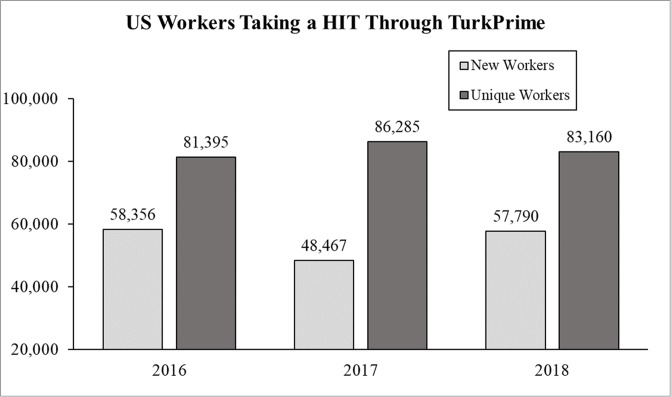
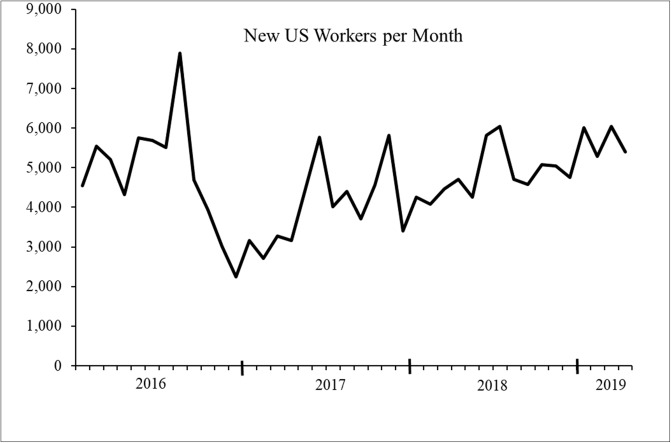
Mechanical Turk (MTurk) is a common source of research participants within the academic community. Despite MTurk's utility and benefits over traditional subject pools some researchers have questioned whether it is sustainable. Specifically, some have asked whether MTurk workers are too familiar with manipulations and measures common in the social sciences, the result of many researchers relying on the same small participant pool. Here, we show that concerns about non-naivete on MTurk are due less to the MTurk platform itself and more to the way researchers use the platform. Specifically, we find that there are at least 250,000 MTurk workers worldwide and that a large majority of US workers are new to the platform each year and therefore relatively inexperienced as research participants. We describe how inexperienced workers are excluded from studies, in part, because of the worker reputation qualifications researchers commonly use. Then, we propose and evaluate an alternative approach to sampling on MTurk that allows researchers to access inexperienced participants without sacrificing data quality. We recommend that in some cases researchers should limit the number of highly experienced workers allowed in their study by excluding these workers or by stratifying sample recruitment based on worker experience levels. We discuss the trade-offs of different sampling practices on MTurk and describe how the above sampling strategies can help researchers harness the vast and largely untapped potential of the Mechanical Turk participant pool.
Conflict of interest statement
We have read the journal’s policy and the authors of this manuscript have the following potential competing interests: All of the authors are employed at Prime Research Solutions. This is the company that owns TurkPrime, the platform whose TurkPrime ToolKit was used to source Mechanical Turk participants, and the database from which some data were queried. This does not alter our adherence to PLOS ONE policies on sharing data and materials.
Figures
References
-
- Bentley JW. Challenges with Amazon Mechanical Turk research in accounting. SSRN 2924876. 2018 Mar 30.
-
- Goodman JK, Paolacci G. Crowdsourcing consumer research. J Consum Res. 2017. February 22;44(1):196–210.
MeSH terms
LinkOut - more resources
Full Text Sources
