Review
. 2019 Sep 17;20(18):4584.
doi: 10.3390/ijms20184584.

Intestinal Microbiota: A Novel Target to Improve Anti-Tumor Treatment?

Affiliations
Review

Intestinal Microbiota: A Novel Target to Improve Anti-Tumor Treatment?

Romain Villéger et al. Int J Mol Sci. .

Abstract

Recently, preclinical and clinical studies targeting several types of cancer strongly supported the key role of the gut microbiota in the modulation of host response to anti-tumoral therapies such as chemotherapy, immunotherapy, radiotherapy and even surgery. Intestinal microbiome has been shown to participate in the resistance to a wide range of anticancer treatments by direct interaction with the treatment or by indirectly stimulating host response through immunomodulation. Interestingly, these effects were described on colorectal cancer but also in other types of malignancies. In addition to their role in therapy efficacy, gut microbiota could also impact side effects induced by anticancer treatments. In the first part of this review, we summarized the role of the gut microbiome on the efficacy and side effects of various anticancer treatments and underlying mechanisms. In the second part, we described the new microbiota-targeting strategies, such as probiotics and prebiotics, antibiotics, fecal microbiota transplantation and physical activity, which could be effective adjuvant therapies developed in order to improve anticancer therapeutic efficiency.

Keywords: adjuvant therapies; anticancer treatment; cancer; chemotherapy; intestinal microbiota; microbiome; probiotics; radiotherapy; surgery.


Conflict of interest statement

The authors declare no conflict of interest.

Figures

Figure 1
Figure 1
Impacts of intestinal microbiota on chemotherapy toxicity and efficacy. (a,b) Microbe-mediated xenometabolism could be linked to an increase of chemotherapy toxicity. (a) Bacteroides species would convert sorivudine into an intermediate component (BVU), which inhibits the degradation of 5-FU, leading to its toxic accumulation in the blood. (b) The β-glucuronidase-producing bacteria (β-gluc-PB) could induce an increase of the irinotecan active metabolite (SN-38) in the gut, which is associated with diarrhea. (c) Chemotherapy treatment could induce dysbiosis (microbial composition alteration), as has been noticed for doxorucibin, 5-FU, cyclophosphamide (CTX), and irinotecan. A dysbiosis could impact chemotherapy efficacy and/or side effects (diarrhea, mucositis, etc.). (d) Gut microbiota could impact chemotherapy efficacy by immune modulations or/and bacterial translocation to lymphoid organs. OXA chemoresistance has been described in antibiotics (ATB)-treated mice and correlated to a decrease of ROS-producing myeloid anti-tumor cells. The ATB-induced dysbiosis could also decrease the efficacy of CTX. Contrariwise, Enterococcus hirae, known to translocate from the gut to lymphoid organs following CTX-induced mucositis, could stimulate the anti-tumor activity of CTX by inducing Th1 and pTh17 responses and increasing the intratumoral cytotoxic T-cells (CTL)/ Tregs ratio. Barnesiella intestinihominis could improve systemic amount of Th1 and Tc1 and the intratumoral level of IFN-γ-producing γδ TILs (IFN-δ+ γδT cells), leading to an increase of CTX efficacy. (e) Intratumoral bacteria could modulate the treatment efficacy. Mycoplasma hyorhinis can directly degrade the pyrimidine nucleoside analogues (PNA) through its thymidine phosphorylase activity. Similarly, gemcitabine (GTB) and OXA inactivation could be due to cytidine deaminase-harboring bacteria. The activation of autophagy via the stimulation of the innate immune pathway TLR4/MyD88 by intratumoral bacterial, such as Fusobacterium nucleatum, could also be involved in the chemoresistance to 5-FU or OXA.
Figure 2
Figure 2
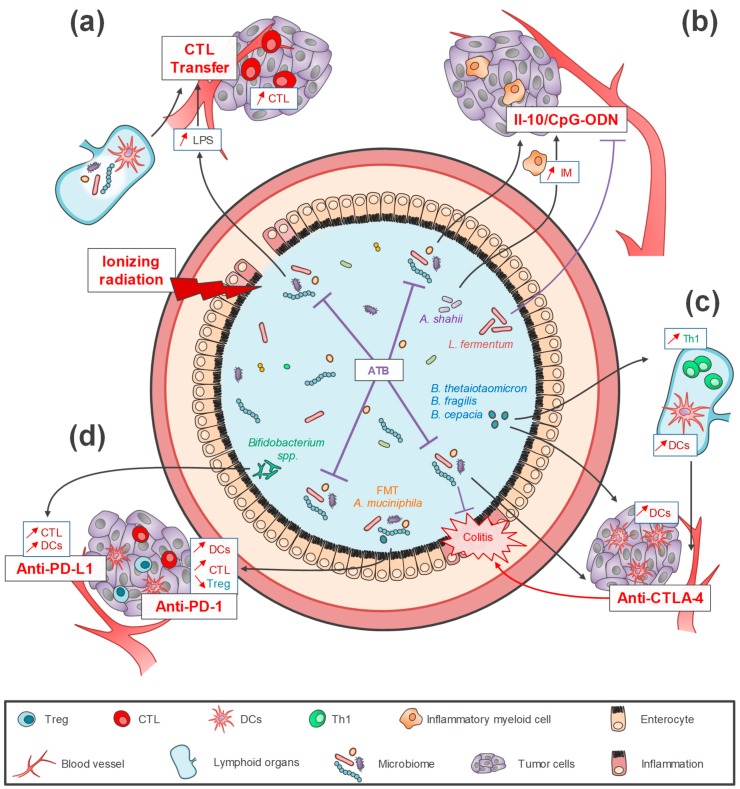
Impacts of intestinal microbiota on efficacy and toxicity of immunotherapy strategies. (a) Efficacy of anti-tumor CD8+ T cells (CTL) adoptive transfer (CTL transfer) has been stimulated by gut bacteria translocation into mesenteric lymph node and an increase of systemic LPS concentration induced by the total body irradiation in the murine model. This stimulation has been associated with an increase of CTL recruitment into a tumor microenvironment. (b) A decrease of gut bacterial load following antibiotics (ATB) therapy would impair the efficacy of anti-IL-10/CpG oligodeoxynucleotides (ODN) immunotherapy due to the decline of pro-inflammatory cytokine-producing myeloid cells (IM). In the same way, the negative role of Lactobacillus fermentum has been shown, meanwhile. A. shahii could increase the intratumoral IM and increase ODN efficacy (c,d) The impact of gut microbiota on ICI efficacy and toxicity via remoted lymphoid and myeloid cells modulation has been noticed. (c) Bacteroides thetaiotaomicron, Bacteroides fragilis and Burkholderia cepacia were associated with an increase of Th1 and dendritic cells (DCs) cells in lymphoid organs, leading to an increase in anti-CTLA-4 response. This microbiota-mediated immunotherapy response could be also supported by the recruitment of mature DCs in the tumor microenvironment. In addition, the presence of these specific bacteria could be associated with a decrease of anti-CTLA-4 side effects. (d) Bifidobacterium spp. was linked to effective anti-PD-L1 response due to the elevation of intratumoral CTL and DCs. The Fecal Microbiota Transplantation (FMT) from responder patients into GF mice could activate similar immune mechanism and improve the response to anti-PD-1 therapy in solid epithelial tumors. (a,b,c,d) ATB treatments have been reported to induce a decrease of anti-tumoral efficacy for all of these immunotherapies.

References

    1. Collins D., Hogan A.M., Winter D.C. Microbial and viral pathogens in colorectal cancer. Lancet Oncol. 2011;12:504–512. doi: 10.1016/S1470-2045(10)70186-8. - DOI - PubMed
    1. Zhang Y.-J., Li S., Gan R.-Y., Zhou T., Xu D.-P., Li H.-B. Impacts of Gut Bacteria on Human Health and Diseases. Int. J. Mol. Sci. 2015;16:7493–7519. doi: 10.3390/ijms16047493. - DOI - PMC - PubMed
    1. Lin L., Zhang J. Role of intestinal microbiota and metabolites on gut homeostasis and human diseases. BMC Immunol. 2017;18:2. doi: 10.1186/s12865-016-0187-3. - DOI - PMC - PubMed
    1. Schwabe R.F., Jobin C. The microbiome and cancer. Nat. Rev. Cancer. 2013;13:800–812. doi: 10.1038/nrc3610. - DOI - PMC - PubMed
    1. Elinav E., Garrett W.S., Trinchieri G., Wargo J. The cancer microbiome. Nat. Rev. Cancer. 2019;19:371–376. doi: 10.1038/s41568-019-0155-3. - DOI - PMC - PubMed

LinkOut - more resources