


Binge Drinking and Prescription Opioid Misuse in the U.S., 2012-2014
- PMID: 31200998
- PMCID: PMC6642832
- DOI: 10.1016/j.amepre.2019.02.025
Binge Drinking and Prescription Opioid Misuse in the U.S., 2012-2014
Abstract
Introduction: Prescription opioids were responsible for approximately 17,000 deaths in the U.S. in 2016. One in five prescription opioid deaths also involve alcohol. Drinkers who misuse prescription opioids (i.e., use without a prescription or use only for the experience or feeling it causes) are at a heightened risk of overdose. However, little is known about the relationship between drinking patterns and prescription opioid misuse.
Methods: Data were analyzed from 160,812 individuals (aged ≥12 years) who responded to questions about prescription opioid misuse and alcohol consumption in the 2012, 2013, or 2014 National Survey on Drug Use and Health (analyzed in 2017-2018). The prevalence of self-reported past-30-days prescription opioid misuse was assessed by sociodemographic characteristics, other substance use (i.e., cigarettes, marijuana), and drinking patterns. Multiple logistic regression analyses were used to calculate AORs.
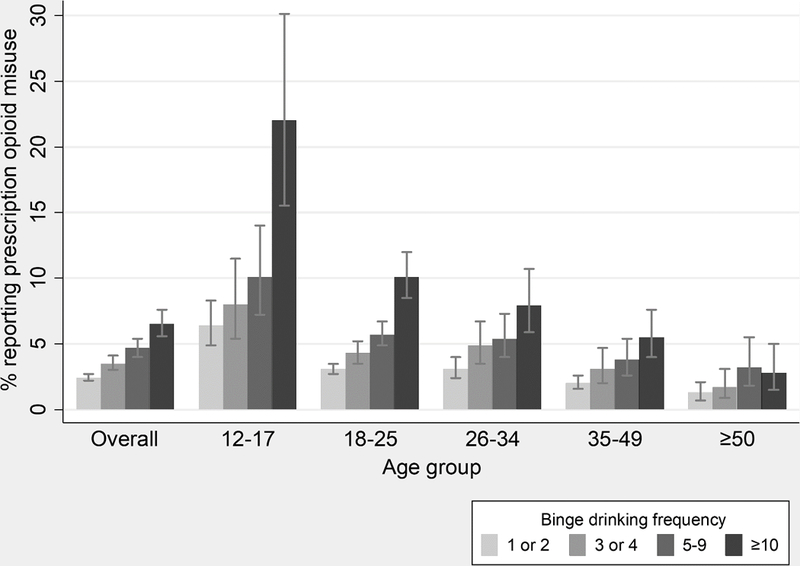
Results: From 2012 to 2014, 1.6% (95% CI=1.5, 1.7) of all individuals aged ≥12 years (estimated 4.2 million) and 3.5% (95% CI=3.3, 3.8) of binge drinkers (estimated 2.2 million) reported prescription opioid misuse. Prescription opioid misuse was more common among binge drinkers than among nondrinkers (AOR=1.7, 95% CI=1.5, 1.9). Overall, the prevalence of prescription opioid misuse increased significantly with binge drinking frequency (p-value<0.001).
Conclusions: More than half of the 4.2 million people who misused prescription opioids during 2012-2014 were binge drinkers, and binge drinkers had nearly twice the odds of misusing prescription opioids, compared with nondrinkers. Widespread use of evidence-based strategies for preventing binge drinking might reduce opioid misuse and overdoses involving alcohol.
Published by Elsevier Inc.
Figures
References
-
- CDC. Wide-ranging Online Data for Epidemiologic Research (WONDER). http://wonder.cdc.gov Published 2016. Accessed December 13, 2017.
-
- CDC. Annual surveillance report of drug-related risks and outcomes — United States, 2017. Surveillance Special Report 1. CDC, HHS; www.cdc.gov/drugoverdose/pdf/pubs/2017-cdc-drug-surveillance-report.pdf Published August 31, 2017. Accessed March 1, 2018.
MeSH terms
Substances
Grants and funding
LinkOut - more resources
Full Text Sources
Medical
Miscellaneous
