


Lessons learned from unsuccessful use of personal carbon monoxide monitors to remotely assess abstinence in a pragmatic trial of a smartphone stop smoking app - A secondary analysis
- PMID: 31193683
- PMCID: PMC6542188
- DOI: 10.1016/j.abrep.2018.07.003
Lessons learned from unsuccessful use of personal carbon monoxide monitors to remotely assess abstinence in a pragmatic trial of a smartphone stop smoking app - A secondary analysis
Erratum in
-
Erratum regarding missing Declaration of Competing Interest statements in previously published articles.Addict Behav Rep. 2021 Jan 21;13:100333. doi: 10.1016/j.abrep.2020.100333. eCollection 2021 Jun. Addict Behav Rep. 2021. PMID: 34095431 Free PMC article.
Abstract
Introduction: Verifying abstinence remotely in trials of digital cessation interventions remains a major challenge. This study reports on using personal carbon monoxide (CO) monitors to assess abstinence in a pragmatic trial of a standalone cessation app involving automated recruitment with no researcher contact.
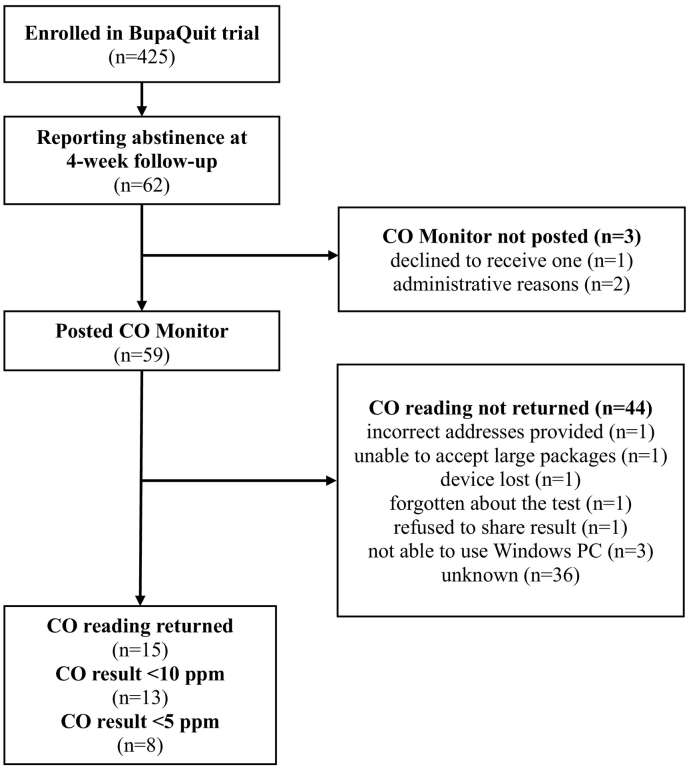
Methods: The study involved secondary data analysis of remote CO testing in a randomized trial (ISRCTN10548241) comparing two versions of a cessation app (BupaQuit). Trial participants were adult UK-based smokers interested in quitting, who were recruited online (02/2015-03/2016). Participants were followed-up through the app, email or phone at 4 weeks. Fifty-nine participants reporting not smoking were posted a personal CO monitor with instructions, and emailed two reminders. The monitors required installing software on a Windows PC. Participants were not reimbursed but retained the device. We recorded the proportion of CO tests returned, test results, self-reported ease of use, correct use, acceptability, and reasons for missing results.
Results: Fifteen (25.4%) CO results were returned, of which 86.6% were <10 ppm and 53.3% were <5 ppm, indicating abstinence (corresponding to 20.9% and 12.9% of all trial participants self-reporting abstinence, respectively). These 15 participants found the test easy, acceptable and believed they conducted it correctly. Eight (18.2%) of the missing results were accounted for, including no access to a Windows PC, barriers to receiving packages, and unwillingness to share results.
Conclusion: Remote validation using personal CO monitors may not yet be feasible in pragmatic studies of cessation apps in which participants are recruited with no reimbursement or direct contact with researchers.
Keywords: App; Biochemical verification; Carbon monoxide; Intervention; Pilot; Smartphone; Smoking cessation.
Figures
References
-
- Beard E., West R. Pilot study of the use of personal carbon monoxide monitoring to achieve radical smoking reduction. Journal of Smoking Cessation. 2012;7(01):12–17.
-
- Benowitz N., Jacob P., Ahijevych K.L., Jarvis M., Hall S., LeHouezec J.…Velicer W. Biochemical verification of tobacco use and cessation. Nicotine & Tobacco Research. 2002;4(2):149–159. - PubMed
-
- Brose L.S., Tombor I., Shahab L., West R. The effect of reducing the threshold for carbon monoxide validation of smoking abstinence—evidence from the English Stop Smoking Services. Addictive Behaviors. 2013;38(10):2529–2531. - PubMed
Grants and funding
LinkOut - more resources
Full Text Sources
