


Extending the Balloon Analogue Risk Task to Assess Naturalistic Risk Taking via a Mobile Platform
- PMID: 30505069
- PMCID: PMC6261382
- DOI: 10.1007/s10862-017-9628-4
Extending the Balloon Analogue Risk Task to Assess Naturalistic Risk Taking via a Mobile Platform
Abstract
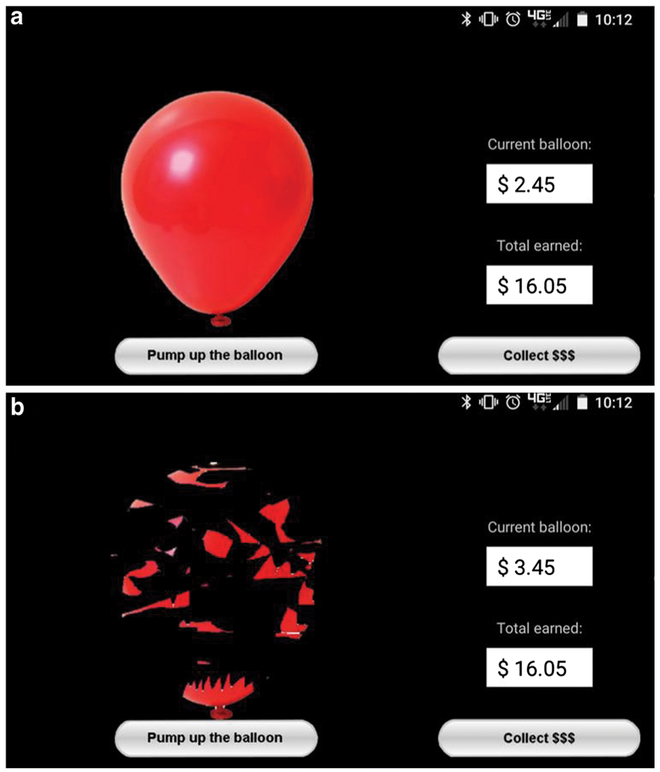
The Balloon Analogue Risk Task (BART) is a behavioral measure that is commonly used to assess risk taking propensity. The primary goal of the present study was to introduce a mobile version of the BART (mBART) that can be included within ambulatory assessment protocols to assess risk taking in daily life. Study 1 compared common BART indices (i.e., total money earned, adjusted average pumps, balloon explosions, and coefficient of variability [CV]) on a single administration of the laboratory BART on a computer and the mBART on a smartphone (n = 78). Results revealed generally consistent relationships between indices of risk taking propensity in both the laboratory BART and mBART. Study 2 administered the mBART as part of a 7-day ecological momentary assessment (EMA) protocol in a population of nondaily smokers (n = 51). Using multi-level models, results suggest that males have greater adjusted average pumps (p = .03), and that a participant's average CV is negatively related to trait sensation seeking (p = .03) and positively associated with trait positive urgency (p = .04). There were within-person effects of study day (p = .05) and environment (p = .02) with respect to adjusted average pumps such that individuals took greater risks as the study progressed and were riskier when alone compared to with others. Inclusion of the mBART in EMA did not appear to significantly increase participant burden and demonstrated acceptable levels of compliance. These results offer initial evidence supporting the feasibility and utility of the mBART for ambulatory research designs.
Keywords: Balloon analogue risk task (BART); Coefficient of variability; Ecological momentary assessment; Nondaily smoking; Young adults.
Conflict of interest statement
Conflict of Interest R. Ross MacLean, Aaron L. Pincus, Joshua M. Smyth, Charles F. Geier and Stephen J. Wilson declare that they have no conflict of interest.
Figures
References
-
- Acheson A, & de Wit H (2008). Bupropion improves attention but does not affect impulsive behavior in healthy young adults. Experimental and Clinical Psychopharmacology, 16(2), 113–123. https://doi.org/10.1037/1064-1297.16.2.113. - DOI - PMC - PubMed
-
- Aklin WM, Tull MT, Kahler CW, & Lejuez CW (2009). Risk-taking propensity changes throughout the course of residential substance abuse treatment. Personality and Individual Differences, 46(4), 454–459. https://doi.org/10.1016/j.paid.2008.11.018. - DOI - PMC - PubMed
-
- Ashenhurst JR, Jentsch JD, & Ray LA (2011). Risk-taking and alcohol use disorders symptomatology in a sample of problem drinkers. Experimental and Clinical Psychopharmacology, 19(5), 361–370. https://doi.org/10.1037/a0024412. - DOI - PMC - PubMed
-
- Ashenhurst JR, Bujarski S, Jentsch JD, & Ray LA (2014). Modeling behavioral reactivity to losses and rewards on the balloon analogue risk task (BART): moderation by alcohol problem severity. Experimental and Clinical Psychopharmacology, 22(4), 298–306. https://doi.org/10.1037/a0036837. - DOI - PubMed
-
- Blais AR, & Weber EU (2006). A domain-specific risk-taking (DOSPERT) scale for adult populations. Judgment and Decision making, 1(1), 33–47.
Grants and funding
LinkOut - more resources
Full Text Sources
Research Materials