


MMP14 is a novel target of PTH signaling in osteocytes that controls resorption by regulating soluble RANKL production
- PMID: 29401593
- PMCID: PMC5901377
- DOI: 10.1096/fj.201700919RRR
MMP14 is a novel target of PTH signaling in osteocytes that controls resorption by regulating soluble RANKL production
Abstract
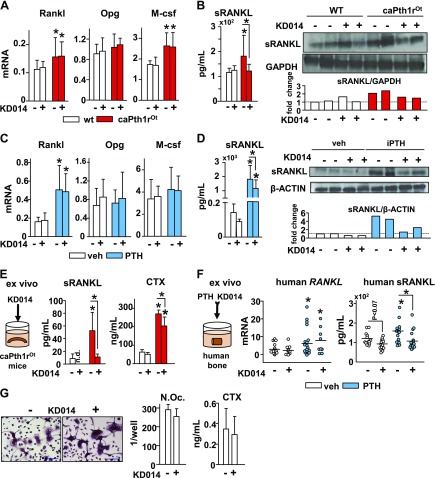
Parathyroid hormone (PTH) affects the skeleton by acting on osteocytes (Ots) in bone through yet unclear mechanisms. We report that matrix metalloproteinase 14 (MMP14) expression/activity are increased in bones from mice with genetic constitutive activation (ca) of the PTH receptor 1 (PTH1R) in Ots (caPTH1ROt) and in bones from mice exposed to elevated PTH levels but not in mice lacking [conditional knockout (cKO)] the PTH1R in Ots (cKOPTH1ROt). Furthermore, PTH upregulates MMP14 in human bone cultures and in Ot-enriched bones from floxed control mice but not from cKOPTH1ROt mice. MMP14 activity increases soluble receptor activator of NF-κΒ ligand production, which in turn, stimulates osteoclast differentiation and resorption. Pharmacologic inhibition of MMP14 activity reduced the high bone remodeling exhibited by caPTH1ROt mice or induced by chronic PTH elevation and decreased bone resorption but allowed full stimulation of bone formation induced by PTH injections, thereby potentiating bone gain. Thus, MMP14 is a new member of the intricate gene network activated in Ots by PTH1R signaling that can be targeted to adjust the skeletal responses to PTH in favor of bone preservation.-Delgado-Calle, J., Hancock, B., Likine, E. F., Sato, A. Y., McAndrews, K., Sanudo, C., Bruzzaniti, A., Riancho, J. A., Tonra, J. R., Bellido, T. MMP14 is a novel target of PTH signaling in osteocytes that controls resorption by regulating soluble RANKL production.
Keywords: antiresorptive; osteoblasts; osteoclasts; osteoporosis.
Conflict of interest statement
The authors thank Drs. Keith Condon, Gretel Pellegrini, and Sumana Posritong and Meloney Cregor (all from Indiana University School of Medicine) for their assistance in tissue and data collection. The authors also thank Drs. David Burr and Munro Peacock (both from the Indiana University School of Medicine) for critical reading of the manuscript. This research was supported by the U.S. Department of Veterans Affairs (1 I01 BX002104-01 to T.B.); the U.S. National Institutes of Health (NIH) National Institute of Arthritis and Musculoskeletal and Skin Diseases (Grant R01-AR059357 to T.B.; R01-AR060332 to A.B.); NIH National Heart, Lung, and Blood Institute (Grant T35 HL1 10854-01); a Scholar Award from the American Society of Hematology (to J.D-C.); and a grant from Instituto de Salud Carlos III (PI12/615), cofunded by the European Union through Fonds Européen de Développement Économique et Régional (FEDER) funds (to J.A.R.). The KD014 neutralizing antibody was obtained under a Materials Transfer Agreement with Kadmon Corp., LLC. J.R.T. was an employee of Kadmon Corp., LCC. The remaining authors declare no conflicts of interest.
Figures



References
-
- Ma Y. L., Cain R. L., Halladay D. L., Yang X., Zeng Q., Miles R. R., Chandrasekhar S., Martin T. J., Onyia J. E. (2001) Catabolic effects of continuous human PTH (1--38) in vivo is associated with sustained stimulation of RANKL and inhibition of osteoprotegerin and gene-associated bone formation. Endocrinology 142, 4047–4054 10.1210/endo.142.9.8356 - DOI - PubMed
Publication types
MeSH terms
Substances
Grants and funding
LinkOut - more resources
Full Text Sources
Other Literature Sources
Molecular Biology Databases
