


Improving quit rates of web-delivered interventions for smoking cessation: full-scale randomized trial of WebQuit.org versus Smokefree.gov
- PMID: 29235186
- PMCID: PMC5930021
- DOI: 10.1111/add.14127
Improving quit rates of web-delivered interventions for smoking cessation: full-scale randomized trial of WebQuit.org versus Smokefree.gov
Abstract
Background and aims: Millions of people world-wide use websites to help them quit smoking, but effectiveness trials have an average 34% follow-up data retention rate and an average 9% quit rate. We compared the quit rates of a website using a new behavioral approach called Acceptance and Commitment Therapy (ACT; WebQuit.org) with the current standard of the National Cancer Institute's (NCI) Smokefree.gov website.
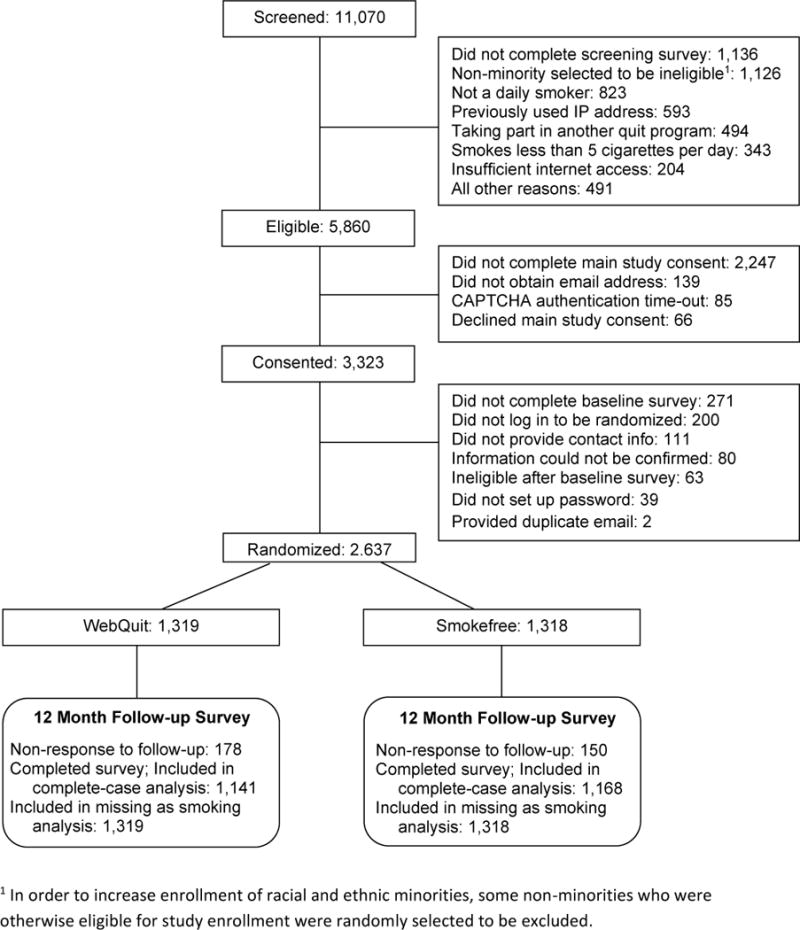
Design: A two-arm stratified double-blind individually randomized trial (n = 1319 for WebQuit; n = 1318 for Smokefree.gov) with 12-month follow-up.
Setting: United States.
Participants: Adults (n = 2637) who currently smoked at least five cigarettes per day were recruited from March 2014 to August 2015. At baseline, participants were mean [standard deviation (SD)] age 46.2 years (13.4), 79% women and 73% white.
Interventions: WebQuit.org website (experimental) provided ACT for smoking cessation; Smokefree.gov website (comparison) followed US Clinical Practice Guidelines for smoking cessation.
Measurements: The primary outcome was self-reported 30-day point prevalence abstinence at 12 months.
Findings: The 12-month follow-up data retention rate was 88% (2309 of 2637). The 30-day point prevalence abstinence rates at the 12-month follow-up were 24% (278 of 1141) for WebQuit.org and 26% (305 of 1168) for Smokefree.gov [odds ratio (OR) = 0.91; 95% confidence interval (CI) = 0.76, 1.10; P = 0.334] in the a priori complete case analysis. Abstinence rates were 21% (278 of 1319) for WebQuit.org and 23% (305 of 1318) for Smokefree.gov (OR = 0.89 (0.74, 1.07; P = 0.200) when missing cases were imputed as smokers. The Bayes factor comparing the primary abstinence outcome was 0.17, indicating 'substantial' evidence of no difference between groups.
Conclusions: WebQuit.org and Smokefree.gov had similar 30-day point prevalence abstinence rates at 12 months that were descriptively higher than those of prior published website-delivered interventions and telephone counselor-delivered interventions.
Keywords: Acceptance and commitment therapy; cigarettes; e-health; mindfulness; tobacco cessation; websites.
© 2017 Society for the Study of Addiction.
References
Publication types
MeSH terms
Grants and funding
LinkOut - more resources
Full Text Sources
Other Literature Sources
Medical
