Review
. 2017 Sep;57(5):142-149.
doi: 10.1111/cga.12232. Epub 2017 Jul 20.

Genetic polymorphisms and folate status

Affiliations
Review

Genetic polymorphisms and folate status

Mami Hiraoka et al. Congenit Anom (Kyoto). 2017 Sep.

Abstract

Moderate hyperhomocysteinemia-induced low folate status is an independent risk factor for cardiovascular disease, dementia, and depression. Folate is an essential cofactor in the one-carbon metabolism pathway and is necessary in amino acid metabolism, purine and thymidylate synthesis, and DNA methylation. In the folate cycle and homocysteine metabolism, folate, vitamin B12, vitamin B6, and vitamin B2 are important cofactors. Many enzymes are involved in folate transport and uptake, the folate pathway, and homocysteine (Hcy) metabolism, and various polymorphisms have been documented in these enzymes. Serum folate and total Hcy (tHcy) levels are influenced by folate intake and genetic polymorphisms in 5,10-methylenetertahydrofolate reductase (MTHFR) such as C677T. The prevalence of the MTHFR 677TT genotype varies across ethnic groups and regions, with a frequency of approximately 15% in Japanese populations. Individuals with the TT genotype have significantly higher tHcy levels and lower folate levels in serum than those with the CT and TT genotypes. However, administration of folic acid has been shown to eliminate these differences. Moreover, data have suggested that interventions based on genotype may be effective for motivating individuals to change their lifestyle and improve their nutrition status. Accordingly, in this review, we discuss the effects of MTHFR C677T polymorphisms on serum tHcy and folate levels with folic acid intervention and evaluate approaches for overcoming folic acid deficiency and related symptoms.

Keywords: folate; methylenetetrahydrofolate reductase; personalized nutrition; polymorphism.


Figures

Figure 1
Figure 1
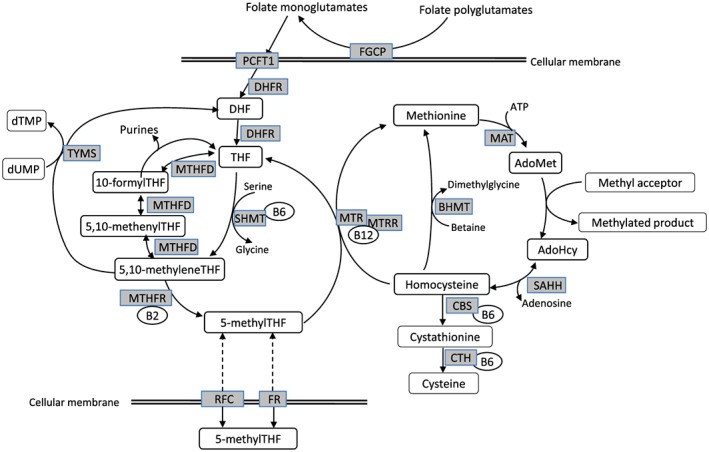
Simplified overview of the folate pathway and homocysteine metabolism. AdoHcy, S‐adenosylhomocysteine; AdoMet, S‐adenosylmethionine; BHMT, betaine‐homocysteine methyltransferase; CBS, cystathionine β‐synthase; CTH, γ‐cystathionase; DHF, dihydrofolate; FGCP, folyl poly‐γ‐glutamate carboxypeptidase; FR, folate receptor; MAT, methionine adenosyltransferase; MTHFD, methylenetetrahydrofolate dehydrogenase; MTHFR, methylenetetrahydrofolate reductase; MTR, methionine synthase; MTRR, methionine synthase reductase; PCFT1, proton‐coupled folate transporter; RFC, reduced folate carrier; SAHH, S‐adenosylhomocysteine hydrolase; SHMT, serine hydroxymethyltransferase; THF, tetrahydrofolate; B2, vitamin B2; B6, vitamin B6; B12, vitamin B12.
Figure 2
Figure 2
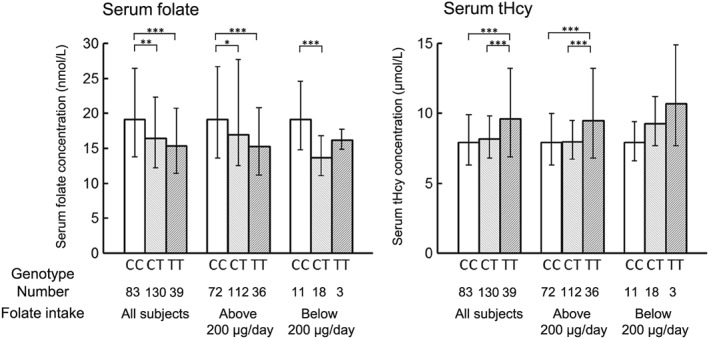
Distribution of serum folate and tHcy concentrations by folate intake according to MTHFR C677T genotype in young Japanese women (n = 252). The value of 200 μg/day represents the RDA of folate established according to the 6th edition of the RDA for Japanese to be used from April 2000 to March 2005. Values are the geometric mean and bars transformed from the logarithmic‐transformed values of the mean ± SD. Based on data from Hiraoka (2004). Significant difference between genotypes at P < 0.05 (*), P < 0.01 (**) and P < 0.001 (***) for Bonferroni post hoc test of analysis of variance.
Figure 3
Figure 3
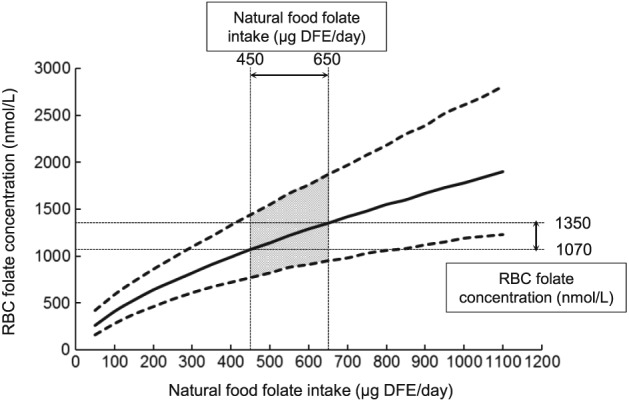
Natural food folate intake (μg/day of DFE) and associated RBC folate concentrations (nmol/L) based on Bayesian modeling of the association between natural food folate intake and RBC folate concentration as analyzed by microbiological assay. Solid line represents the median value under the assumed model. Dotted lines represent the 95% credible interval. The shaded area (natural food intakes between 450 μg DFE/day and 650 g DFE/day) refer to the range of intakes and RBC folate concentrations associated with the lowest population risk for a NTD according to Crider et al. (2014). Based on data from Marchetta et al. (2015). DFE, dietary folate equivalent.
Figure 4
Figure 4
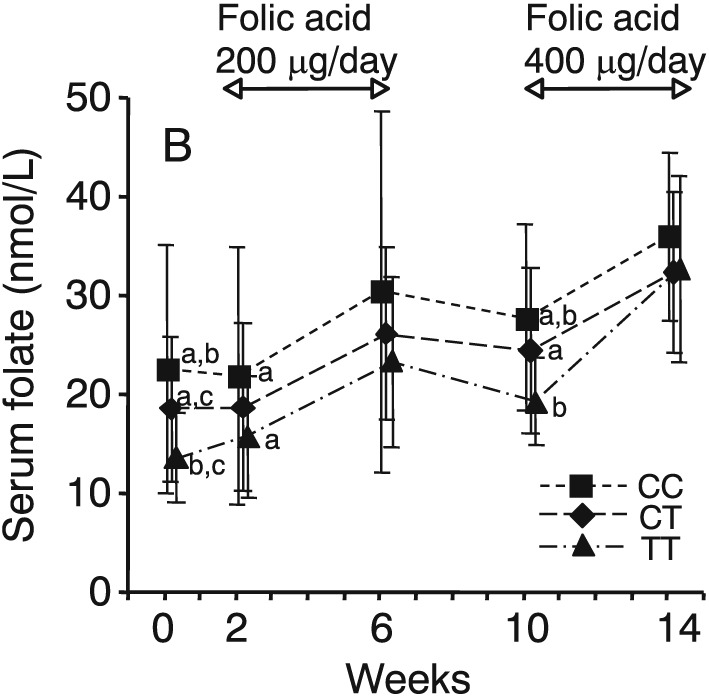
Serum folate concentrations in healthy young Japanese women with differing MTHFR C677T genotypes (CC, n = 36; CT, n = 47; TT, n = 17) at baseline and before and after supplementation with 200 and 400 μg/day folic acid. a, b, c MTHFR genotypes with the same superscripts differ significantly; P < 0.05. Reproduced from Hiraoka et al. (2004) with permission.

References

    1. Anderson CA, Beresford SA, McLerran D et al. 2013. Response of serum and red blood cell folate concentrations to folic acid supplementation depends on methylenetetrahydrofolate reductase C677T genotype: results from a crossover trial. Mol Nutr Food Res 57:637–644. - PMC - PubMed
    1. Bagley PJ, Selhub J. 1998. A common mutation in the methylenetetrahydrofolate reductase gene is associated with an accumulation of formylated tetrahydrofolates in red blood cells. Proc Natl Acad Sci U S A 95:13217–13220. - PMC - PubMed
    1. Berry RJ, Li Z, Erickson JD, Li S et al. 1999. Prevention of neural‐tube defects with folic acid in China. China‐U.S. Collaborative Project for Neural Tube Defect Prevention. N Engl J Med 341:1485–1490 Erratum in: N Engl J Med 1999;341:1864. - PubMed
    1. Binia A, Contreras AV, Canizales‐Quinteros S, Alonzo VA, Tejero ME, Silva‐Zolezzi I. 2014. Geographical and ethnic distribution of single nucleotide polymorphisms within genes of the folate/homocysteine pathway metabolism. Genes Nutr 9:421. - PMC - PubMed
    1. Bottiglieri T. 2005. Homocysteine and folate metabolism in depression. Prog Neuropsychopharmacol Biol Psychiatry 29:1103–1112. - PubMed

MeSH terms