


Sleeping with one eye open: loneliness and sleep quality in young adults
- PMID: 28511734
- PMCID: PMC5551384
- DOI: 10.1017/S0033291717000629
Sleeping with one eye open: loneliness and sleep quality in young adults
Abstract
Background: Feelings of loneliness are common among young adults, and are hypothesized to impair the quality of sleep. In the present study, we tested associations between loneliness and sleep quality in a nationally representative sample of young adults. Further, based on the hypothesis that sleep problems in lonely individuals are driven by increased vigilance for threat, we tested whether past exposure to violence exacerbated this association.
Method: Data were drawn from the Environmental Risk (E-Risk) Longitudinal Twin Study, a birth cohort of 2232 twins born in England and Wales in 1994 and 1995. We measured loneliness using items from the UCLA Loneliness Scale, and sleep quality using the Pittsburgh Sleep Quality Index. We controlled for covariates including social isolation, psychopathology, employment status and being a parent of an infant. We examined twin differences to control for unmeasured genetic and family environment factors.
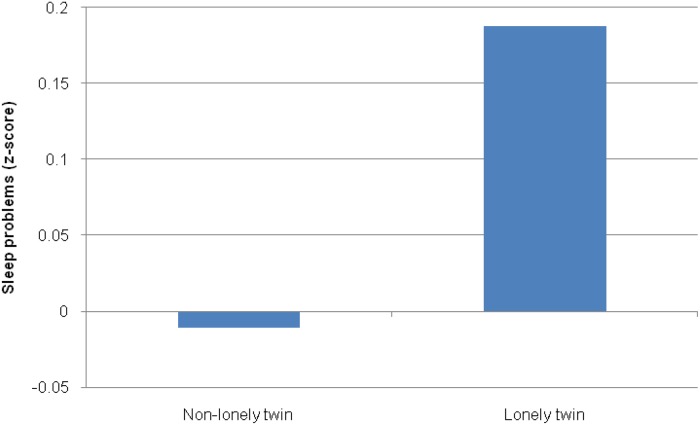
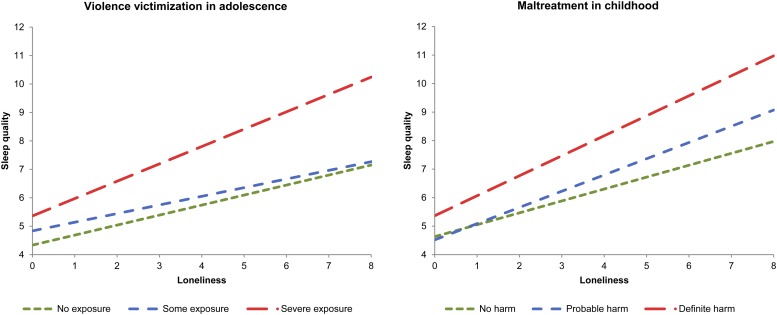
Results: Feelings of loneliness were associated with worse overall sleep quality. Loneliness was associated specifically with subjective sleep quality and daytime dysfunction. These associations were robust to controls for covariates. Among monozygotic twins, within-twin pair differences in loneliness were significantly associated with within-pair differences in sleep quality, indicating an association independent of unmeasured familial influences. The association between loneliness and sleep quality was exacerbated among individuals exposed to violence victimization in adolescence or maltreatment in childhood.
Conclusions: Loneliness is robustly associated with poorer sleep quality in young people, underscoring the importance of early interventions to mitigate the long-term outcomes of loneliness. Special care should be directed towards individuals who have experienced victimization.
Keywords: Loneliness; mental health; sleep quality; violence victimization; young adulthood.
Figures
References
-
- American Psychiatric Association (1994). Diagnostic and Statistical Manual of Mental Disorders, 4th edn American Psychiatric Association: Washington, DC.
-
- American Psychiatric Association (2013). Diagnostic and Statistical Manual of Mental Disorders, 5th edn American Psychiatric Association: Washington, DC.
-
- Backhaus J, Junghanns K, Broocks A, Riemann D, Hohagen F (2002). Test–retest reliability and validity of the Pittsburgh Sleep Quality Index in primary insomnia. Journal of Psychosomatic Research 53, 737–740. - PubMed
-
- Buysse DJ, Reynolds CF, Monk TH, Berman SR, Kupfer DJ (1989). The Pittsburgh Sleep Quality Index: a new instrument for psychiatric practice and research. Psychiatry Research 28, 193–213. - PubMed
Publication types
MeSH terms
Grants and funding
LinkOut - more resources
Full Text Sources
Other Literature Sources
Medical
Miscellaneous
