


Intestinal Microbiota-Generated Metabolite Trimethylamine-N-Oxide and 5-Year Mortality Risk in Stable Coronary Artery Disease: The Contributory Role of Intestinal Microbiota in a COURAGE-Like Patient Cohort
- PMID: 27287696
- PMCID: PMC4937244
- DOI: 10.1161/JAHA.115.002816
Intestinal Microbiota-Generated Metabolite Trimethylamine-N-Oxide and 5-Year Mortality Risk in Stable Coronary Artery Disease: The Contributory Role of Intestinal Microbiota in a COURAGE-Like Patient Cohort
Abstract
Background: Trimethylamine-N-oxide (TMAO), a metabolite derived from gut microbes and dietary phosphatidylcholine, is linked to both coronary artery disease pathogenesis and increased cardiovascular risks. The ability of plasma TMAO to predict 5-year mortality risk in patients with stable coronary artery disease has not been reported. This study examined the clinical prognostic value of TMAO in patients with stable coronary artery disease who met eligibility criteria for a patient cohort similar to that of the Clinical Outcomes Utilizing Revascularization and Aggressive Drug Evaluation (COURAGE) trial.
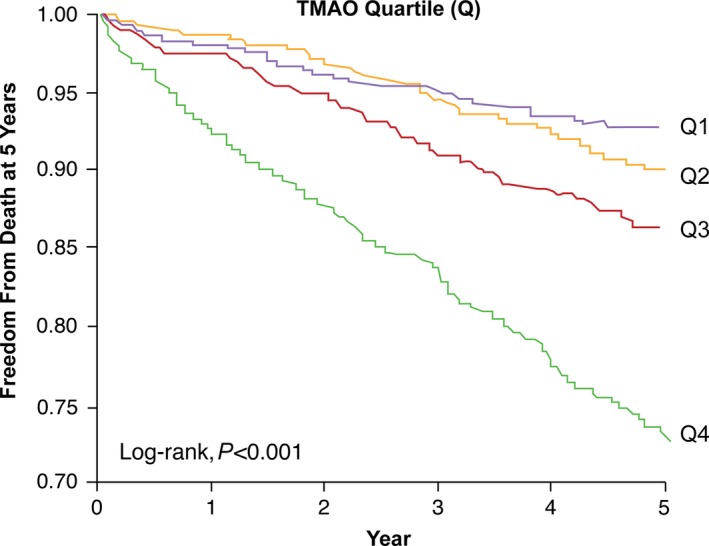
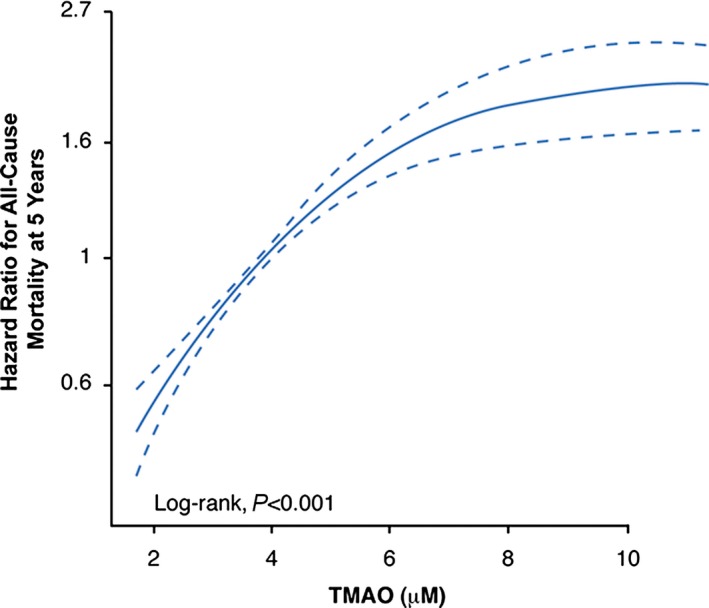
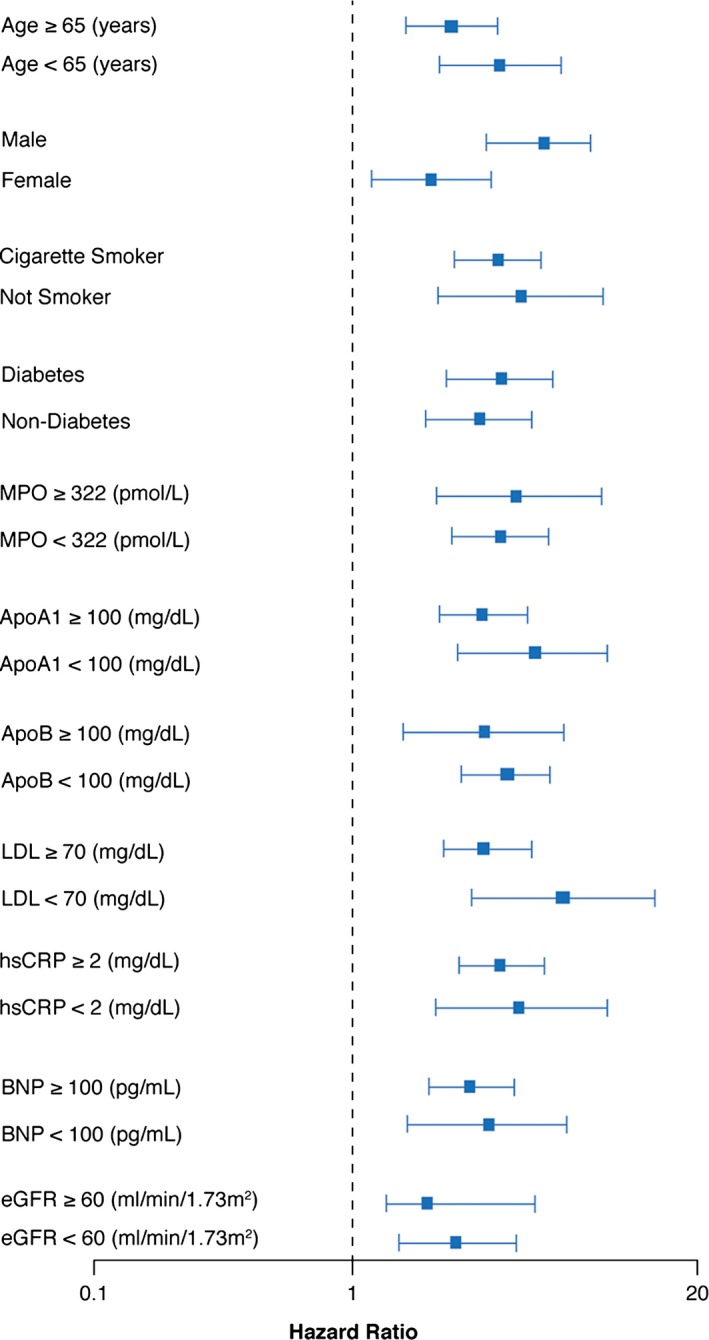
Methods and results: We examined the relationship between fasting plasma TMAO and all-cause mortality over 5-year follow-up in sequential patients with stable coronary artery disease (n=2235) who underwent elective coronary angiography. We identified the COURAGE-like patient cohort as patients who had evidence of significant coronary artery stenosis and who were managed with optimal medical treatment. Higher plasma TMAO levels were associated with a 4-fold increased mortality risk. Following adjustments for traditional risk factors, high-sensitivity C-reactive protein, and estimated glomerular filtration rate, elevated TMAO levels remained predictive of 5-year all-cause mortality risk (quartile 4 versus 1, adjusted hazard ratio 1.95, 95% CI 1.33-2.86; P=0.003). TMAO remained predictive of incident mortality risk following cardiorenal and inflammatory biomarker adjustments to the model (adjusted hazard ratio 1.71, 95% CI 1.11-2.61; P=0.0138) and provided significant incremental prognostic value for all-cause mortality (net reclassification index 42.37%, P<0.001; improvement in area under receiver operator characteristic curve 70.6-73.76%, P<0.001).
Conclusions: Elevated plasma TMAO levels portended higher long-term mortality risk among patients with stable coronary artery disease managed with optimal medical treatment.
Keywords: optimal medical treatment; prognosis; stable coronary artery disease; trimethylamine N‐oxide.
© 2016 The Authors. Published on behalf of the American Heart Association, Inc., by Wiley Blackwell.
Figures
References
-
- Mozaffarian D, Benjamin EJ, Go AS, Arnett DK, Blaha MJ, Cushman M, de Ferranti S, Despres JP, Fullerton HJ, Howard VJ, Huffman MD, Judd SE, Kissela BM, Lackland DT, Lichtman JH, Lisabeth LD, Liu S, Mackey RH, Matchar DB, McGuire DK, Mohler ER III, Moy CS, Muntner P, Mussolino ME, Nasir K, Neumar RW, Nichol G, Palaniappan L, Pandey DK, Reeves MJ, Rodriguez CJ, Sorlie PD, Stein J, Towfighi A, Turan TN, Virani SS, Willey JZ, Woo D, Yeh RW, Turner MB. Heart disease and stroke statistics—2015 update: a report from the American Heart Association. Circulation. 2015;131:e29–e322. - PubMed
-
- Fihn SD, Blankenship JC, Alexander KP, Bittl JA, Byrne JG, Fletcher BJ, Fonarow GC, Lange RA, Levine GN, Maddox TM, Naidu SS, Ohman EM, Smith PK. 2014 ACC/AHA/AATS/PCNA/SCAI/STS focused update of the guideline for the diagnosis and management of patients with stable ischemic heart disease: a report of the American College of Cardiology/American Heart Association Task Force on Practice Guidelines, and the American Association for Thoracic Surgery, Preventive Cardiovascular Nurses Association, Society for Cardiovascular Angiography and Interventions, and Society of Thoracic Surgeons. Circulation. 2014;130:1749–1767. - PubMed
-
- Ford ES, Ajani UA, Croft JB, Critchley JA, Labarthe DR, Kottke TE, Giles WH, Capewell S. Explaining the decrease in U.S. Deaths from coronary disease, 1980–2000. N Engl J Med. 2007;356:2388–2398. - PubMed
-
- Koeth RA, Wang Z, Levison BS, Buffa JA, Org E, Sheehy BT, Britt EB, Fu X, Wu Y, Li L, Smith JD, DiDonato JA, Chen J, Li H, Wu GD, Lewis JD, Warrier M, Brown JM, Krauss RM, Tang WH, Bushman FD, Lusis AJ, Hazen SL. Intestinal microbiota metabolism of L‐carnitine, a nutrient in red meat, promotes atherosclerosis. Nat Med. 2013;19:576–585. - PMC - PubMed
Publication types
MeSH terms
Substances
Grants and funding
LinkOut - more resources
Full Text Sources
Other Literature Sources
Medical
Research Materials
Miscellaneous
