Five year change in alcohol intake and risk of breast cancer and coronary heart disease among postmenopausal women: prospective cohort study
- PMID: 27169583
- PMCID: PMC5068920
- DOI: 10.1136/bmj.i2314
Five year change in alcohol intake and risk of breast cancer and coronary heart disease among postmenopausal women: prospective cohort study
Abstract
Objective: To test the hypothesis that postmenopausal women who increase their alcohol intake over a five year period have a higher risk of breast cancer and a lower risk of coronary heart disease compared with stable alcohol intake.
Design: Prospective cohort study.
Setting: Denmark, 1993-2012.
Participants: 21 523 postmenopausal women who participated in the Diet, Cancer, and Health Study in two consecutive examinations in 1993-98 and 1999-2003. Information on alcohol intake was obtained from questionnaires completed by participants.
Main outcome measures: Incidence of breast cancer, coronary heart disease, and all cause mortality during 11 years of follow-up. Information was obtained from the Danish Cancer Register, Danish Hospital Discharge Register, Danish Register of Causes of Death, and National Central Person Register. We estimated hazard ratios according to five year change in alcohol intake using Cox proportional hazards models.
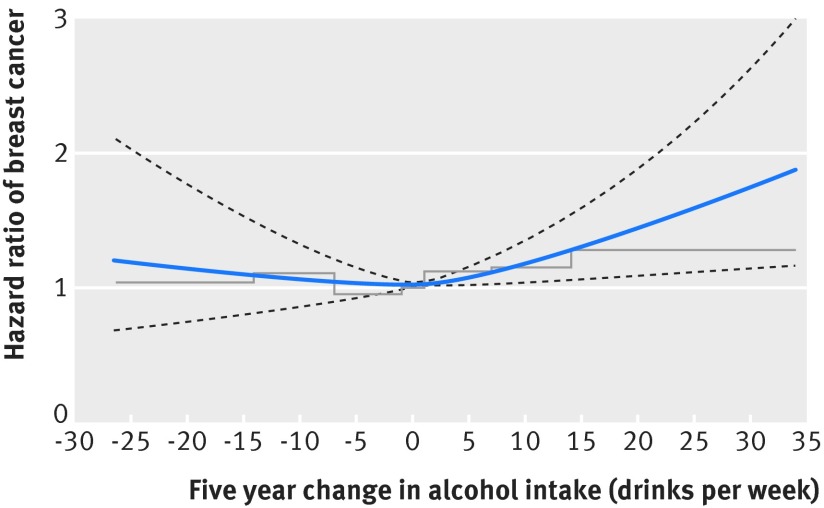
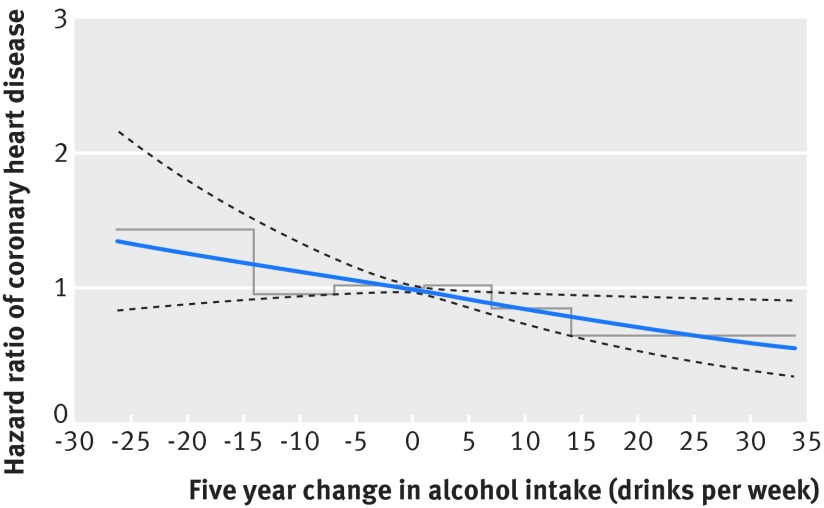
Results: During the study, 1054, 1750, and 2080 cases of breast cancer, coronary heart disease, and mortality occurred, respectively. Analyses modelling five year change in alcohol intake with cubic splines showed that women who increased their alcohol intake over the five year period had a higher risk of breast cancer and a lower risk of coronary heart disease than women with a stable alcohol intake. For instance, women who increased their alcohol intake by seven or 14 drinks per week (corresponding to one or two drinks more per day) had hazard ratios of breast cancer of 1.13 (95% confidence interval 1.03 to 1.23) and 1.29 (1.07 to 1.55), respectively, compared to women with stable intake, and adjusted for age, education, body mass index, smoking, Mediterranean diet score, parity, number of births, and hormone replacement therapy. For coronary heart disease, corresponding hazard ratios were 0.89 (0.81 to 0.97) and 0.78 (0.64 to 0.95), respectively, adjusted for age, education, body mass index, Mediterranean diet score, smoking, physical activity, hypertension, elevated cholesterol, and diabetes. Results among women who reduced their alcohol intake over the five year period were not significantly associated with risk of breast cancer or coronary heart disease. Analyses of all cause mortality showed that women who increased their alcohol intake from a high intake (≥14 drinks per week) to an even higher intake had a higher mortality risk that women with a stable high intake.
Conclusion: In this study of postmenopausal women over a five year period, results support the hypotheses that alcohol intake is associated with increased risk of breast cancer and decreased risk of coronary heart disease.
Published by the BMJ Publishing Group Limited. For permission to use (where not already granted under a licence) please go to http://group.bmj.com/group/rights-licensing/permissions.
Conflict of interest statement
All authors have completed the ICMJE uniform disclosure form at www.icmje.org/coi_disclosure.pdf and declare: no support from any organisation for the submitted work; no financial relationships with any organisations that might have an interest in the submitted work in the previous three years; no other relationships or activities that could appear to have influenced the submitted work.
Figures
Comment in
-
Alcohol, diet, and risk of breast cancer.BMJ. 2016 May 11;353:i2503. doi: 10.1136/bmj.i2503. BMJ. 2016. PMID: 27170004 No abstract available.
-
Late-life increases in alcohol consumption among postmenopausal women appear associated with greater breast cancer risk and less coronary heart disease risk.Evid Based Med. 2016 Oct;21(5):195. doi: 10.1136/ebmed-2016-110503. Epub 2016 Aug 23. Evid Based Med. 2016. PMID: 27555638 No abstract available.
Comment on
-
Change in alcohol consumption and risk of death from all causes and from ischaemic heart disease.BMJ. 1991 Sep 7;303(6802):553-6. doi: 10.1136/bmj.303.6802.553. BMJ. 1991. PMID: 1912885 Free PMC article.
-
Long-term change in alcohol-consumption status and variations in fibrinogen levels: the coronary artery risk development in young adults (CARDIA) study.BMJ Open. 2013 Jul 11;3(7):e002944. doi: 10.1136/bmjopen-2013-002944. Print 2013. BMJ Open. 2013. PMID: 23847267 Free PMC article.
References
-
- Anderson P. MLGG. Alcohol in the European Union—consumption, harm and policy approaches.World Health Organization, 2012.
-
- Seitz HK, Pelucchi C, Bagnardi V, La Vecchia C. Epidemiology and pathophysiology of alcohol and breast cancer: Update 2012. Alcohol Alcohol 2012;47:204-12. 10.1093/alcalc/ags011 pmid:22459019. - DOI - PubMed
-
- Scoccianti C, Lauby-Secretan B, Bello PY, Chajes V, Romieu I. Female breast cancer and alcohol consumption: a review of the literature. Am J Prev Med 2014;46(suppl 1):S16-25. 10.1016/j.amepre.2013.10.031 pmid:24512927. - DOI - PubMed
-
- Hamajima N, Hirose K, Tajima K, et al. Collaborative Group on Hormonal Factors in Breast Cancer. Alcohol, tobacco and breast cancer—collaborative reanalysis of individual data from 53 epidemiological studies, including 58,515 women with breast cancer and 95,067 women without the disease. Br J Cancer 2002;87:1234-45. 10.1038/sj.bjc.6600596 pmid:12439712. - DOI - PMC - PubMed
-
- Allen NE, Beral V, Casabonne D, et al. Million Women Study Collaborators. Moderate alcohol intake and cancer incidence in women. J Natl Cancer Inst 2009;101:296-305. 10.1093/jnci/djn514 pmid:19244173. - DOI - PubMed
Publication types
MeSH terms
Substances
LinkOut - more resources
Full Text Sources
Other Literature Sources
Medical