


Trends in Substance Use Among 6th- to 10th-Grade Students From 1998 to 2010: Findings From a National Probability Study
- PMID: 26949282
- PMCID: PMC4778563
- DOI: 10.1177/0272431613501409
Trends in Substance Use Among 6th- to 10th-Grade Students From 1998 to 2010: Findings From a National Probability Study
Abstract
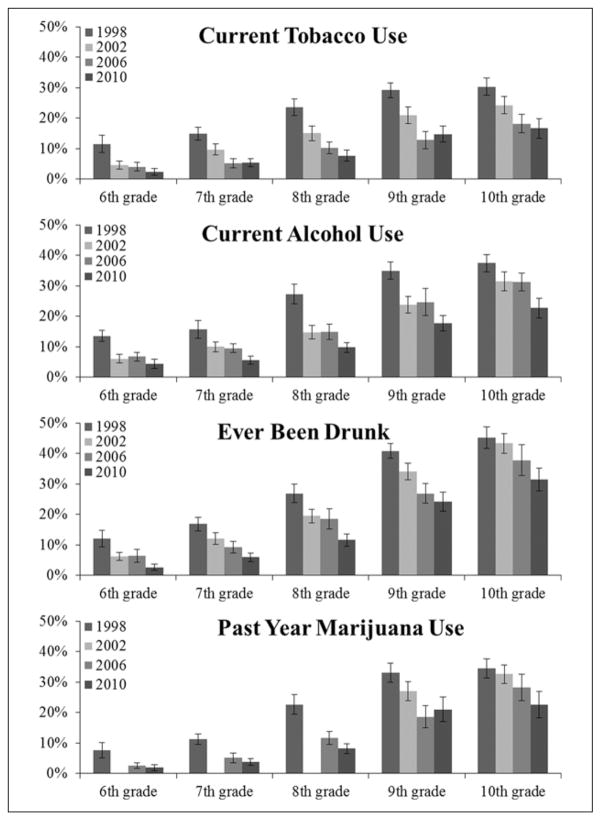
Of the handful of national studies tracking trends in adolescent substance use in the United States, only the Health Behavior in School-Aged Children (HBSC) study collects data from 6th through 10th graders. The purpose of this study was to examine trends from 1998 to 2010 (four time points) in the prevalence of tobacco, alcohol, and marijuana use among 6th through 10th graders. Differences in trends by grade, gender, and race/ethnicity were examined for each substance use behavior, with a primary focus on trends for sixth and seventh graders. Overall, there were significant declines in tobacco, alcohol, and marijuana use from 1998 to 2010. The declines were largest for the younger grades, which suggest promise for future declines among high school students as these cohorts age into high school.
Keywords: adolescent alcohol use; adolescent tobacco use; national prevalence of substance use; substance use trends.
Conflict of interest statement
The author(s) declared no potential conflicts of interest with respect to the research, authorship, and/or publication of this article.
Figures
References
-
- Anderson P, Baumberg B. Alcohol in Europe: A public health perspective. London, England: Institute of Alcohol Studies; 2006.
-
- Centers for Disease Control and Prevention. Youth risk behavior surveillance: United States. Atlanta, GA: Office of Surveillance, Epidemiology and Laboratory Services; 2011. Rep. No. 61 [No. 4]
-
- Centers for Disease Control and Prevention. Trends in the Prevalence of Alcohol Use, National YRBS: 1991–2011 [On-line] 2012a Retrieved August 23, 2013, from http://www.cdc.gov/healthyyouth/yrbs/pdf/us_alcohol_trend_yrbs.pdf.
-
- Centers for Disease Control and Prevention. Trends in the Prevalence of Marijuana, Cocaine, and Other Illegal Drug Use, National YRBS: 1991–2011 [On-line] 2012b Retrieved August 23, 2013, from http://www.cdc.gov/healthyyouth/yrbs/pdf/us_drug_trend_yrbs.pdf.
-
- Centers for Disease Control and Prevention. Trends in the Prevalence of Tobacco Use, National YRBS: 1991–2011 [On-line] 2012c Retrieved August 23, 2013, from http://www.cdc.gov/healthyyouth/yrbs/pdf/us_tobacco_trend_yrbs.pdf.
Grants and funding
LinkOut - more resources
Full Text Sources
Other Literature Sources